Posted in hand embroidery

Shadow and Texture

In this post I am following up on the next steps for Spring Green.

Here is how the foreground looked after I finished piecing it.

With textile paint, I created shadows and deepened existing shadows.

It’s finally time to begin sewing. To start with, I added a layer of batting. So that the batting doesn’t shift, I hand-basted the two layers together, adding a few safety pins for good measure. Next came the embroidery. Using cotton twist and cotton floss, I outlined the rims of the pots with couching.

The two groups of pots nearest to the viewer got two strands of gold cotton twist couched with four strands of embroidery floss in a cross-stitch pattern. I matched the floss color to the fabric color.
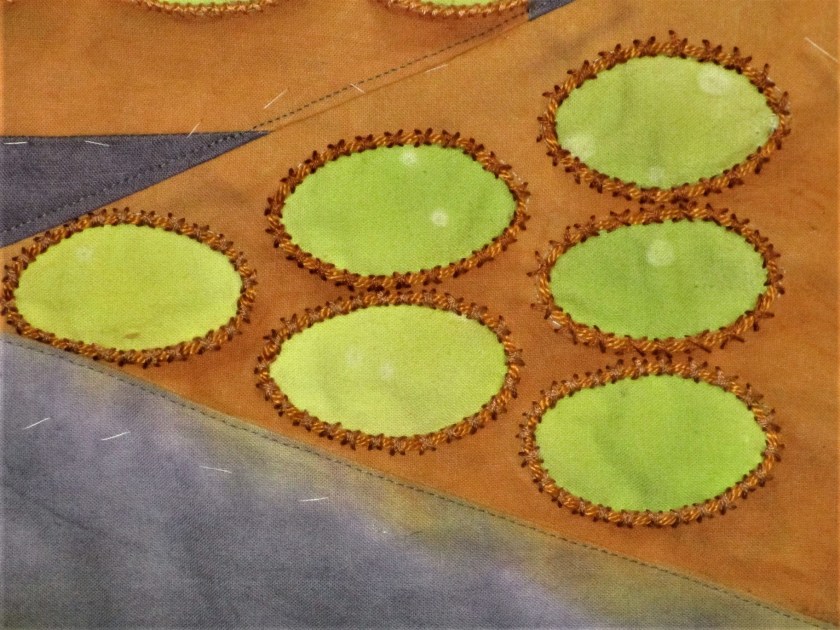
For the flat of pots further from the viewer, I couched only one strand of cord, using three strands of floss and the whip stitch. This will create a bit of perspective.
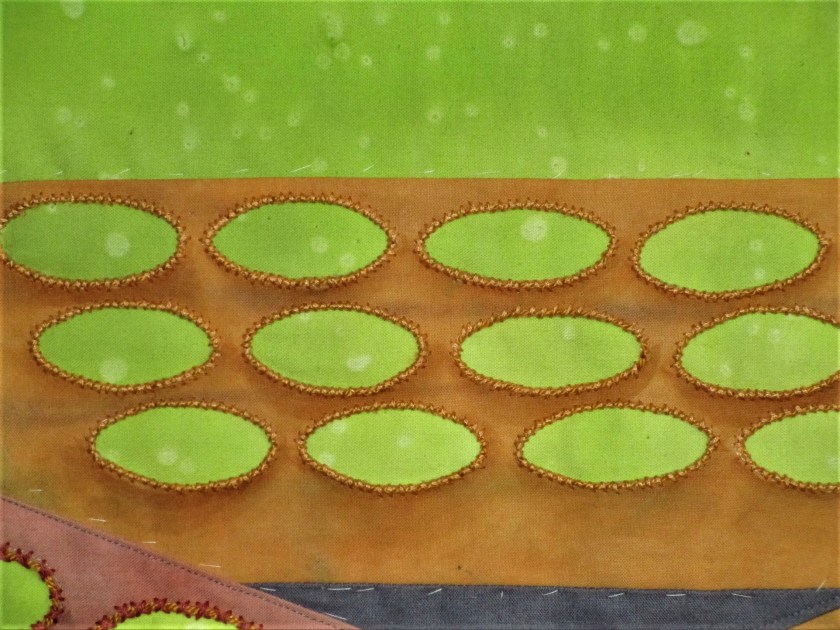
I’m loving the texture that the thick stitches create. Now that I have finished couching, I will add the backing.

After that, I will throw on a bit of machine quilting, just to anchor the edges and define further the parts of the image. It will give me more time to consider exactly what I will do next.

Posted in colorwork, painting, quilting

Painting Thread

So far I have found myself frequently frustrated while shopping in my local craft store for decorative topstitch thread. My local craft store, which is a Hobby Lobby ( I have a love-hate relationship with H-L,) has a limited selection of quilting threads, none of which are what I am wanting for my current project. And the threads that are available are not particularly affordable.

I have nothing to lose in experimenting with painting my own thread. (Not be confused with thread painting, a hand embroidery craft in which stitches are worked densely to create a painterly landscape of thread on fabric.) I have everything I need.

1. A 50 gram spool of 100% cotton DMC thread no. 10 in an off-white color. 2 Assorted jars of Jacquard Dye-Na-Flo fabric paint. 3. water proof freezer paper. 4. latex gloves.

After coiling several yards of thread and tying them together with string, I let the thread soak in the paint for about ten minutes. Wearing latex gloves I lifted the coil from the paint, squeezed out the excess and laid the threads on paper. Drying took several hours. The next day I pressed the dried thread with a hot iron, under a pressing cloth, for about 30 seconds. This was my attempt to fix the color. Because Jacquard Dye-Na-Flo is an acrylic paint, it is essentially color-fast from the moment it dries. But if you want to use the paint on an item that will be washed, I would recommend letting it cure for at least a week before washing.

Here are my hand-painted threads wound on spools.

I love that the paint gave the thread a variegated effect. I’m not sure if this happened because I mixed paint colors together or because I had a cord tied around the coil. It certainly makes for a splashy look.

Airplane is in natural thread. Moon is stitched with painted thread.

So far I haven’t noticed any color bleed on my sample fabric. Tomorrow I will start using it on my quilt. I’m excited to see how that goes.

Posted in quilting

Quilting Along

I hadn’t planning on ditch-stitching the Arches quilt. But I have been a bit stuck – uncertain about how to proceed and wary of my skills (or lack thereof) to quilt free motion. Hence, I partook of another tutorial. This one, taught by Susan Cleveland on blueprint.com, promised to teach me some alternatives to free motion quilting.

https://shop.mybluprint.com/quilting/classes/creative-quilting-alternatives-to-free-motion/60838

But first, here are a few views of the panel that I have already quilted.

This block pleases me. I was able to free motion quilt around the color waves in the background which imitate the sky and river. Using the walking foot I quilted the arch itself around the perimeter and also along the color breaks. I then stitched two lines up the side, which give a sense of the way the stainless steel panels are attached.

I quilted around the arch in the top two blocks the same way. In the background to the right of the arch, I chose to echo the arch shape. On the left side I stitched free motion in big swirls. These did not turn out well. I guess I will rip it out, but that kinda scares me.

Susan recommended that I stitch in the ditch between the squares. This is said to stabilize the piece. I am having a problem with fabric stretching out of shape. The ditch stitching and the basting of the panel edges should solve this issue. Once this step is done, decorative stitching can be applied. Some techniques I plan to try include top-stitching with big thread and hand embroidering areas of the quilt.

Now I need to decide which thread to use for the top-stitching and which designs to embroider. (sigh.) The completion date for this project is rather uncertain.