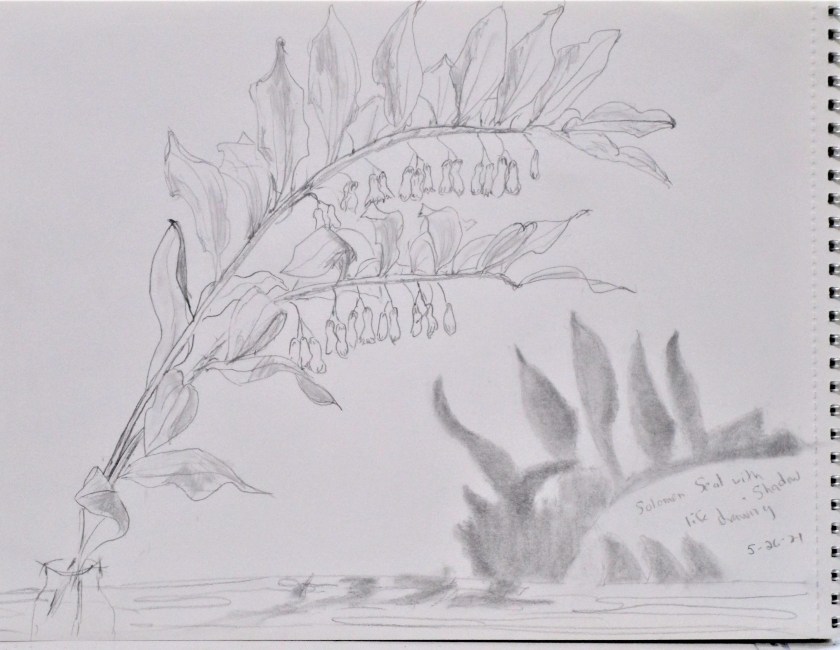
Rather then draw the plant from the photograph I cut some stems and brought them indoors to draw them from life. They were set in a jar and placed on my wood table in the studio.
This drawing focuses on the leaf shapes.
The shadow on the wall is not evenly toned, the way a real shadow is. But I wanted to do this sketch quickly (for me, anyway) and therefore left it as is.
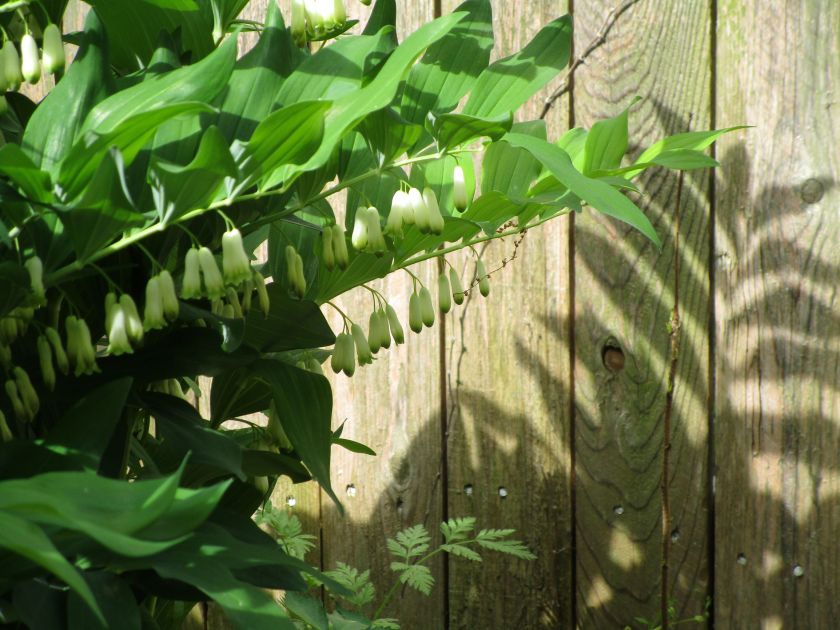
I have lots of this plant growing in shady areas of my yard. Last month it bloomed beautifully.
One sunny morning, I noticed that it had cast its shadow onto the weathered fence.
I have been wanting to sketch this view ever since. Well, truthfully I want to paint it. But I like to do a preliminary sketch before I paint. It helps me understand the details.
And boy, there are a lot of them.
I’m thinking that the scene needs some simplification to clarify its primary point. So I will work on that in another sketch. THEN I’ll pull out the paint.
I had an inspiration recently to try painting some converging curved lines that I saw in a photograph. While perusing my supplies, I came across some 8 by 10 boards with paper stretched on top, promoted as suitable for watercolor paints. So I thought I would test them with my current inspiration.
Boards with curved lines drawn in colored pencil
I plan to use staining pigments, starting with quinacridone rose and Thalo blue in the first two blocks. Why pink and blue? I think my brain was lingering on the yarns from my latest knitting project. Cast-on Monday – Summer Style
It took a little work to get the paper wet enough to lay on the wash. But eventually the paper was evenly wet and I laid down the paint using my biggest round brush.
So far so good. At this point, I was happy that the paper/board seemed to be performing well. After allowing the paint to dry overnight, I added two additional colors – gold and violet. This time, I let the colors bleed into the pink and blue, as a way to merge the two together. The work began to remind me of gender roles and society. Why? Again, the pink and blue, and the way the curves leveled out while flowing in a parallel fashion across the paper.
Here is the board immediately after laying down the two additional washes.
And 30 minutes later……
And here after completely dry.
Analysis: I’m not terribly sure what I am trying to say about gender and society. Something about shifting lines, blurring edges and the pressure to conform.
But the experiment on the watercolor board was successful enough to persuade me to try it again.
I’ve chosen the title to this blog because it’s the message I give students who are learning new skills in fiber arts (and other arts, in my case.) This blog is about my latest water color painting lesson and the resulting painting.
First, my inspiration. I have a lovely birdbath in my backyard. Everyday I watch the activity around the birdbath and think about painting it. So I chose it as my subject, for what I intend to be a series of paintings.
This is a morning shot. I am using this photo as a reference for my first painting of the backyard birdbath. In this first stage, I paint the subject.
I have sketched in a male cardinal to provide a focal point for the painting.
Next I used pale yellow and gold washes for the background underpainting. Let me say now that This was my Favorite Point in the process. Everything looks the way I want. The rocks, the pottery, even the background. From here on, it was a struggle.
Next came layer two. I added green to delineate the background and painted the cardinal with a wash of red. My instructor showed me how to paint a reflection in the birdbath and how to paint blades of grass in the middle ground.
Once everything dried, I added shadows to the birdbath, finished the bird, added the foreground, and dropped in a few spots of color to the middle ground. I also used a dark blue to under-paint the background. Here is the finished painting.
There’s a lot I like here, but there is plenty that I don’t.
I did Try Stuff. I Learned Lessons, and now I am ready for a Do-over.
You may recall that I was back to experimenting in water color paint earlier this week. Working with carbazole violet, I laid down a wash and then lifted the paint back in vertical lines. Because these looked like tree outlines to me, I added some pencil lines to accentuate the effect.
Yesterday I returned to this sketch. Deciding that I would continue with one color, I started to layer up violet washes between the white lines. This went pretty well, except for the fact that some of the white trunks and branches got covered up. In my mind the painting was ruined. Instead of giving up on it, I let the paint dry and then, following the lines of the trunks, lifted up the paint to find some branches. I stroked some paint horizontally in the foreground to suggest tracks in the snow. Finally I dabbed water and dots of paint in upper area of the paper, splashed on more water and let it dry again. Now I was willing to sign this one.
GHOSTLY TREES
It’s interesting how much I am learning by doing with these little pieces. I guess it’s the idea that there is no price to pay for failure.




 Daily Fiber