Posted in hand embroidery

Shadow and Texture

In this post I am following up on the next steps for Spring Green.

Here is how the foreground looked after I finished piecing it.

With textile paint, I created shadows and deepened existing shadows.

It’s finally time to begin sewing. To start with, I added a layer of batting. So that the batting doesn’t shift, I hand-basted the two layers together, adding a few safety pins for good measure. Next came the embroidery. Using cotton twist and cotton floss, I outlined the rims of the pots with couching.

The two groups of pots nearest to the viewer got two strands of gold cotton twist couched with four strands of embroidery floss in a cross-stitch pattern. I matched the floss color to the fabric color.
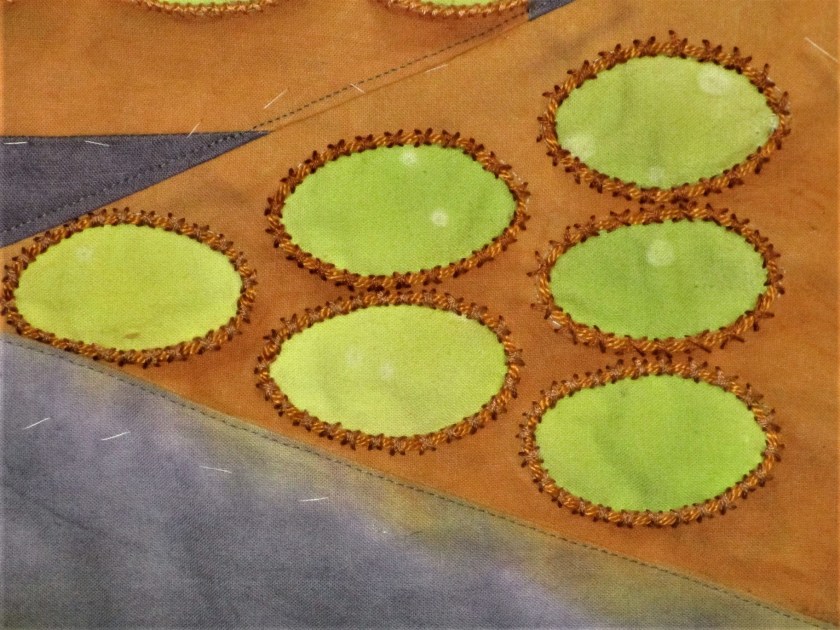
For the flat of pots further from the viewer, I couched only one strand of cord, using three strands of floss and the whip stitch. This will create a bit of perspective.
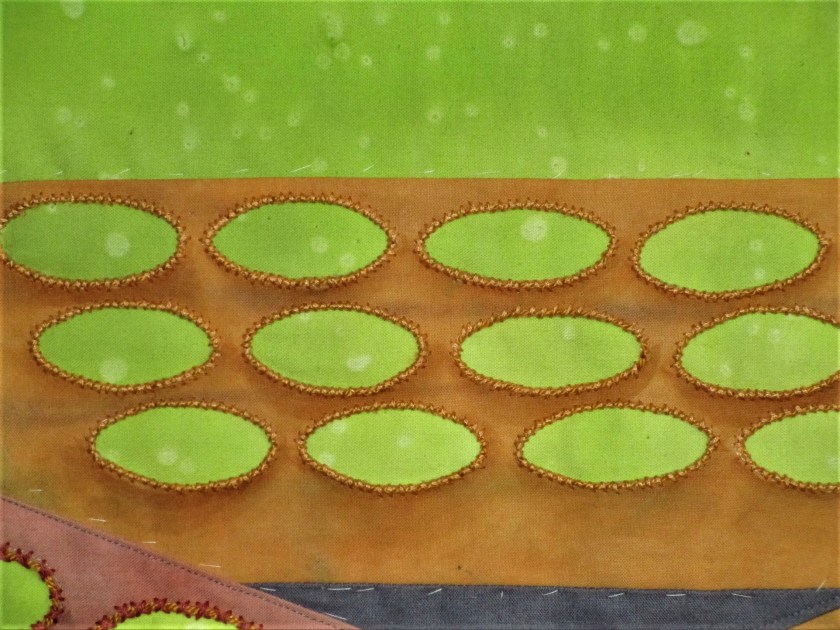
I’m loving the texture that the thick stitches create. Now that I have finished couching, I will add the backing.

After that, I will throw on a bit of machine quilting, just to anchor the edges and define further the parts of the image. It will give me more time to consider exactly what I will do next.

Posted in hand embroidery

Randomly Practicing Stitches

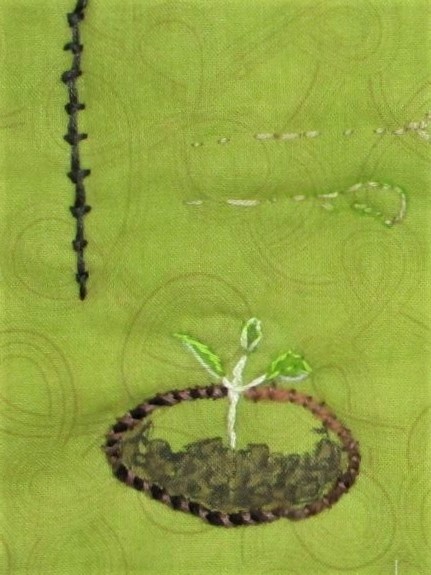
I am in the process of working out what stitches in which colors will be embroidered on to my Spring Green project. The wacky sampler you see above resulted from my random practice.

Just in case you are curious, here are the names of the stitches.

Clockwise from upper right:

Fly stitch worked in columns, Detached chain stitch, French knot on stalks (yellow flower.) I have no idea what the top left stitch is.

The goofy face on the left: running stitch (black) couch stitch (green yarn) woven back stitch (mouth)

The seedling: Stem is stem stitch, leaves are satin stitch tied with back stitch.

Black line is coral stitch. The seedling is growing from a pot outlined in couched yarn and cross stitched. The leaves are chain stitches and stem stitch. I used paint and fabric marker to add the color.

I think that’s enough for now. Time to get dinner.

Posted in sewing

Stitch Bible

No, friends, this is not a publication by a religious group. This is an exercise in making a reference guide for your own sewing machine.

Yesterday I took a few hours to document all the stitches that are programmed into my Bernina 1080 Special. I would have done this sooner but for my own impatience to get on with my making.

Basically, you just make a column of stitches, move to the next button and repeat until you have a sample of each stitch. In addition, I changed length and width as I stitched along, making notes in permanent marker along the way.

It wasn’t as boring as I had imagined, mostly because I listened to podcasts while I stitched.

Even though my Bernina only has 28 different stitches, I worked my way through several bobbins of thread. The payout of this exercise is getting to play with different combinations of the stitches that I discovered. My favorite setting is the mirror-image button. This allows me to highlight nice sections of my fiber objects with mirrored embroidery stitches.

I also learned how to couch cord, ribbons and yarn.

If you haven’t made a stitch bible for your sewing machine, I suggest that you give it a go. It may spark in you some creative ideas for future fiber play.