Posted in knitting

Orphan Skeins: A Plan

This year I am determined to shrink down my stash of yarn. While my stash isn’t as large as those of many of my peers (you know who you are!) there are far too many orphan skeins to suit me. So, I came up with a system.

I start with one orphan skein. Next, I pull any partial skeins with the same label. These yarns generally were used together in a previous project. The next step is to grab partial skeins that are the same fiber and weight (fingering, dk, worsted, etc.) and compatible colors. Once I am happy that the yarns can be combined, they get tossed into a project bag. As of today, I have four bags.

To find a suitable pattern, I start by adding up the total yardage in each bag (a digital scale helps with this step.) This number will tell me what kind of garment or accessory is possible. For example, a pair of socks requires about 400 yards, a shawl around 800 and a sweater 1200 or more.

Now the tricky part: finding a pattern. I am a big fan of Ravelry’s advanced search tool. Using the tool, I can build a search using the parameters of the yarns in the project bag. One additional parameter I choose is number of colors. I search for a project with two or more colors. No matter how many different colors of yarn I have, I can always alter the pattern to accommodate more colors.

As of today, I have four stash-busting projects, bagged up and in the queue.
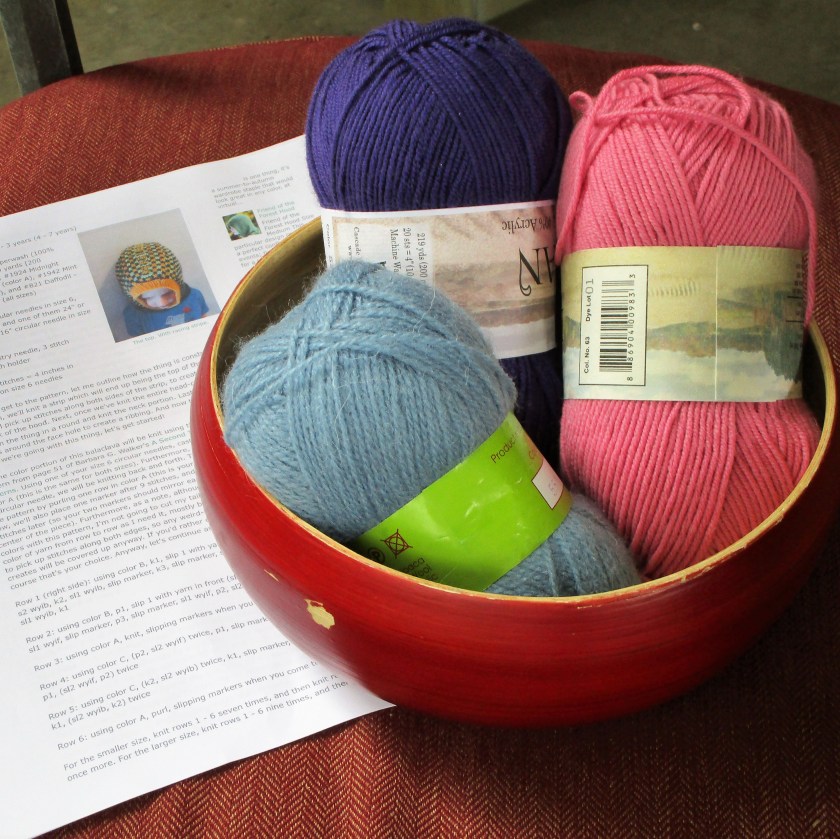
A hood for Laura Lu
A shawl for gifting to someone
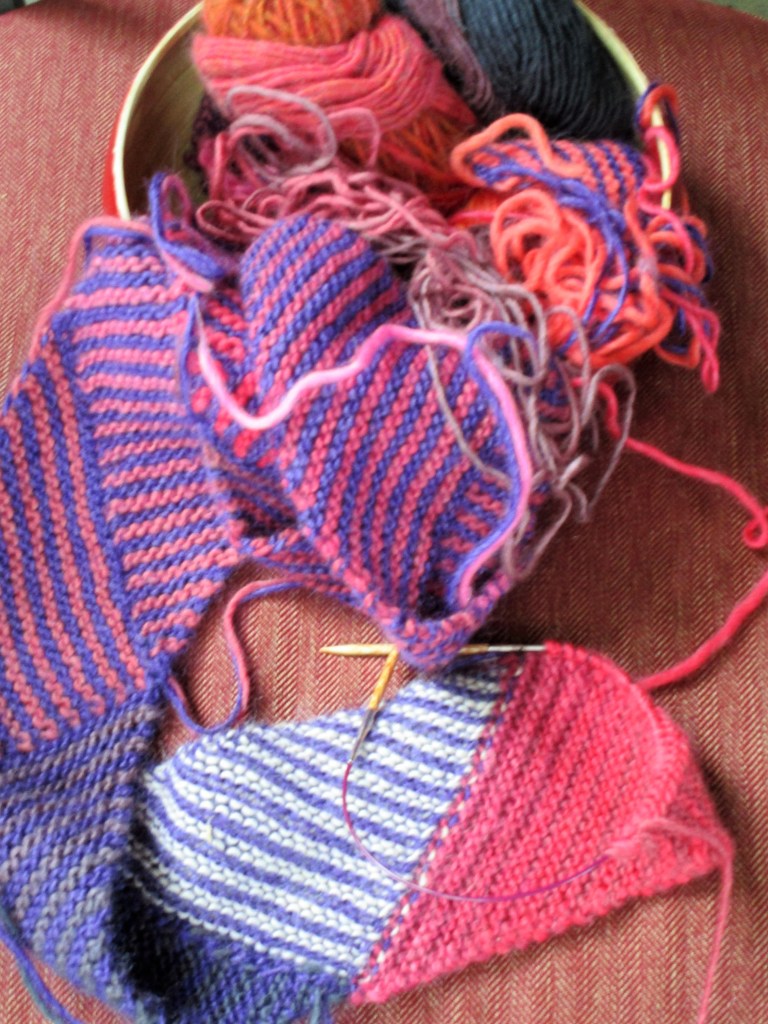
A scarf knit in garter ridge striped triangles.
A light-weight shrug in cotton yarn. (I’m always cold during the summer
in air-conditioned rooms.)

What’s in your yarn stash, and what can you make of it? I challenge you to come up with something unexpected.

Posted in knitting

Friday Finish

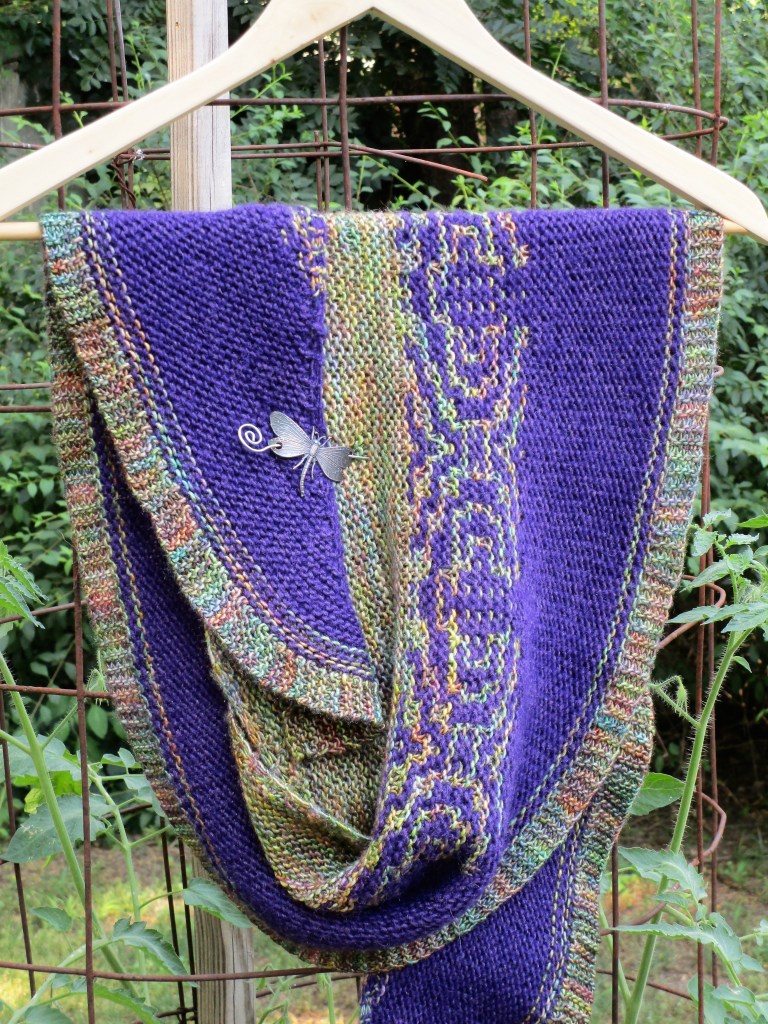
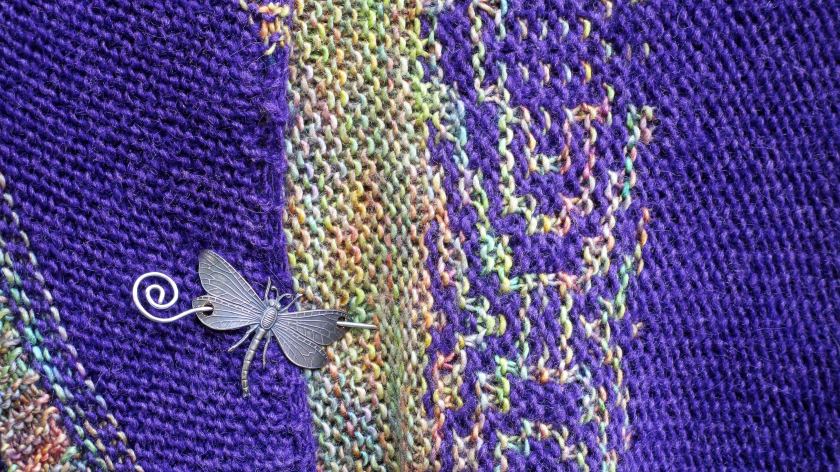
As promised, here is my purple shawl. The close-up photo shows all the sections: neck area, mosaic section, lower section and finishing band. I like the colors very much, especially the purple.

Stretched across a chair, the pattern looks just fine.

But once the shawl is wrapped around one’s neck, it become obvious that the neckline area is far stretchier than the mosaic, so it turns into a little collar.

The collar then covers over the patterned section. So, it ended up being a waste of time and energy to design and knit the mosaic pattern.

I’ll probably hang on to this shawl, at least until I get a chance to wear it a few times. It looks kinda pretty draped over my tomato cage.

Off I go to my yarn closet, for the next stash-busting project. In a future post, I’ll share my plan for how I am organizing projects from stash yarn.

Posted in knitting

Cast on Monday – Back to my studio

Since I returned from the cruise to Alaska, It’s been pretty hard for me to keep up my posts. First of all, we both came down with Covid. Recovery took 5 plus days. And then I found myself dissatisfied with my past work. It’s been a hard few weeks.

I thought an easy cast-on would help ease me back into things. So I chose a two-color cowl that will use up some stash yarn.

https://www.ravelry.com/patterns/library/spinal-twist

Spinal Twist, by Rebecca Marsh, starts with a crocheted provisional cast-on.

I have chosen some very soft single twist yarns. Labels have been lost, but it feels like there is some portion of alpaca.

Knit in the round, on large needles, with thick yarn. This could be finished in a week. By then, maybe my creativity will be unblocked and body fully healed.

Posted in knitting

WIP – Mosaic Stitch Swatches

For today’s post on work in progress, I’d like to share my adventure in choosing a mosaic stitch design for my crescent shawl.

To get started, I picked up Barbara Walker’s excellent Treasury of Knitting Patterns, published in 1968. Chapter Four (Color Changing Patterns) contains advice and 76 different examples of mosaic stitch. The first one I tried is called Rippled Chevron.

For the 1st pattern repeat, I used stockinette stitch. The second repeat was knitted in garter stitch. I liked this pattern, and it was quite easy. The garter stitch version would work better with my shawl design.

Continuing my swatch, I went for something more complicated: Dotted Diamond.

I love the look of this pattern. After knitting it I began to see how an exciting piece of knitting could be made by working a sequence of different mosaic stitches with different background yarns and one foreground yarn.

All of this swatching around is very fun and instructive. But I concluded that Mrs. Walker’s patterns were all very geometric looking. I craved a pattern that appeared more curvilinear – almost flower-like. So my next step was to use the advanced search option on Ravelry to find some flower-like mosaic patterns. This took a good hour. Eventually I discovered a pattern for socks that incorporated mosaic designs inspired by Native American symbols.

https://www.ravelry.com/patterns/library/burntwater-socks

This is getting closer to what I had in mind. After making a few final adjustments and switching to a bigger needle, I started knitting the resulting pattern into my shawl. By yesterday evening I was half-way finished with the 50-row pattern.

I love what’s happening here. My original swatch was too narrow to give me any idea of the secondary pattern in the design. When several pattern repeats are worked, the wing-like lines between the circles clearly stand out. This makes me happy.

Barbara’s treasury is truly a treasure. If you can get your hands on this book, you will find it immensely useful in expanding your knowledge and skills. Kudos also to Mary the Hobbit, who designed the Burntwater socks. This pattern could easily become my next sock project.

Posted in knitting

Cast-on Monday – Crescent Shawl

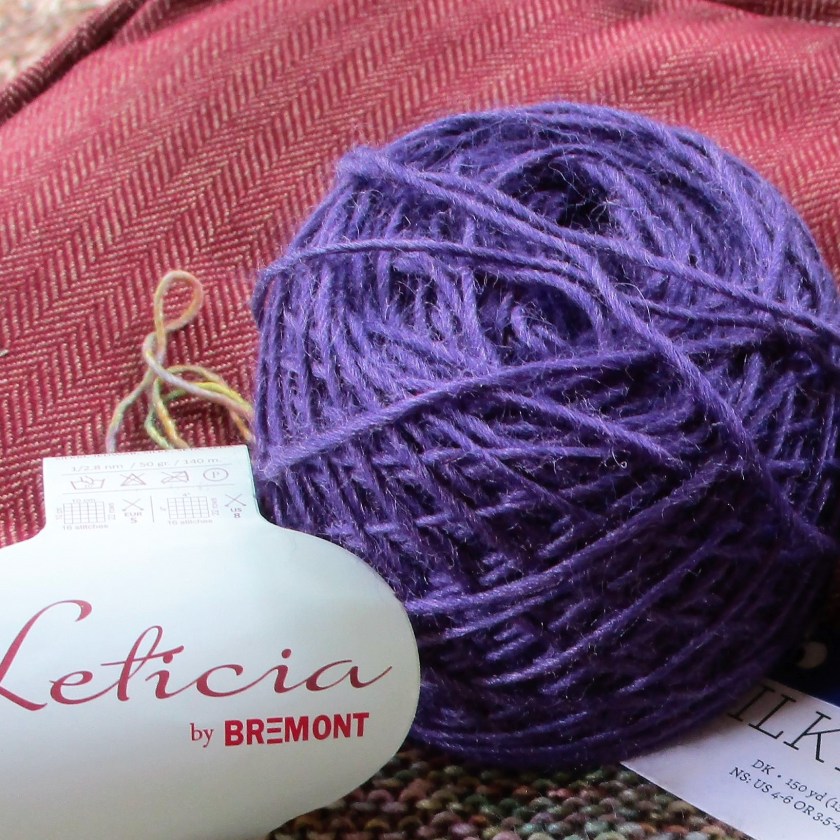
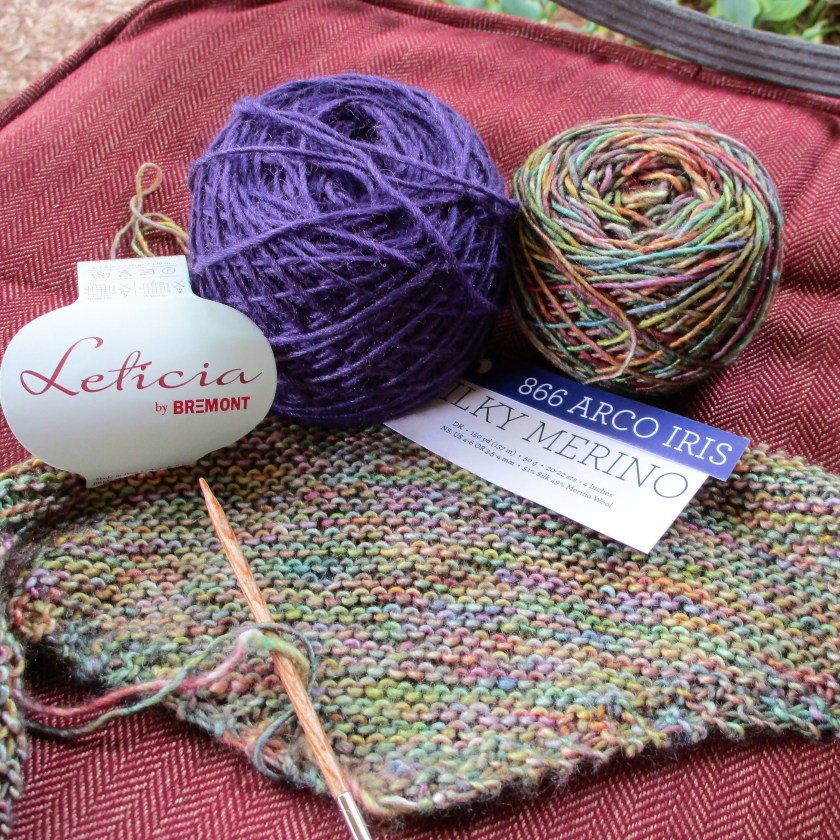
My new project is in keeping with my desire to work with my stash. I have been wanting to make a shawl with this purple yarn, called Leticia, by Bremont.

It is a singles yarn (for you non-knitters, that means it’s not plied.) Three fibers are blended together: wool, alpaca and silk. I own three skeins. Over the past few years, I have tried unsuccessfully to pair it with another yarn, so that I could make a two-color shawl.

Last week, while wasting a lot of time viewing yarns on the Jimmy Beans site (https://www.jimmybeanswool.com/ ) I discovered the perfect match from Malabrigo.

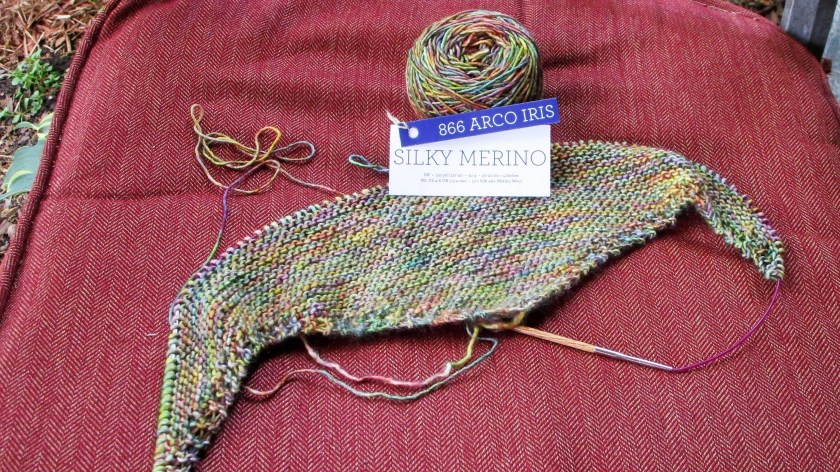
I ordered two skeins lickety-split and they arrived post-haste within three days. This yarn, also a singles, combines silk and merino wool about 50/50. It’s hard to describe the silky sheen of this yarn, (I was almost swooning while casting it on and knitting the first few rows.)

For my pattern, I re-visited a Craftsy tutorial by Laura Nelkin, in which she explains how to design 14 different shawl shapes. It’s fantastic, if you don’t mind doing a little math. I chose the crescent shape.

https://www.craftsy.com/class/knit-shawls-14-ways-exploring-shape-design/

My two-color shawl inspiration comes from Helen Kennedy’s Pale Moon pattern on Ravelry.

https://www.ravelry.com/patterns/library/pale-moon

I love the way the mosaic section bridges the two colors of yarn. But instead of making Pale Moon, I would prefer to use Laura Nelkins’ instructions for the shape and design a mosaic chart of my own.

My first attempt at designing a mosaic pattern, unfortunately, was a failure. Apparently, there are some hard and fast rules about sequencing slipped stitches between the two colors. So back I go to my graph paper for a re-do.