Posted in knitting

Works in Progress Wednesday

For the past several weeks I have had been knitting on two projects.

Let’s start with the Arrowhead Lace Interrupted cardigan.
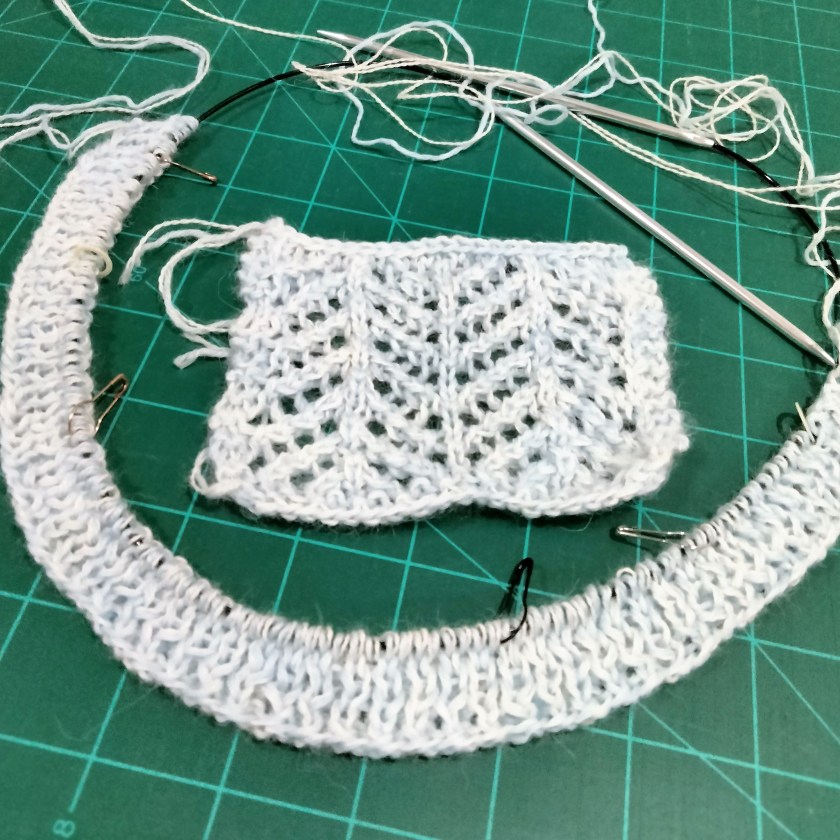
As of last week, this project has been sent to Time Out. Here is where I am so far.
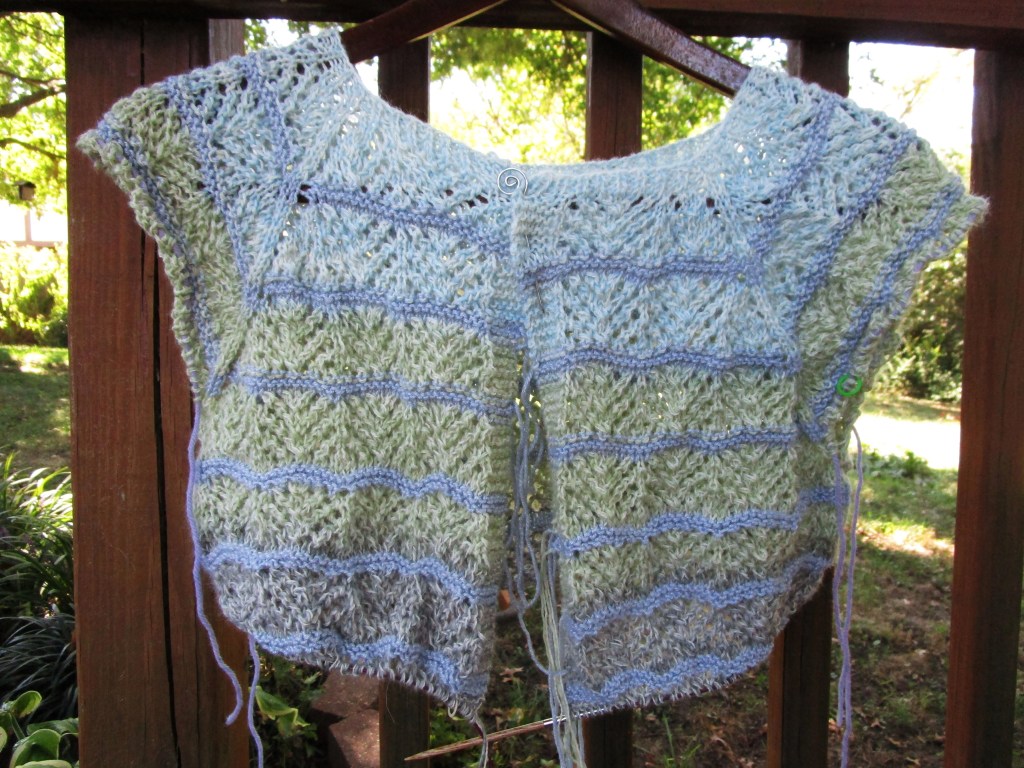
It’s looking pretty good. However, during the last repeat of the arrowhead lace sequence, I discovered pattern row 1 was short by two loops. And in my efforts to “fix” it, I lost three more loops!. Gah!

I’m having a much better time knitting the Biome hat. https://www.ravelry.com/patterns/library/biome-hat The biggest challenge for me has been reading a chart that has 120 stitches per row with no pattern repeats.

After struggling to keep track of where I was on the long row, I decided to stack the two sheets together, held on a clipboard with a purple strip of paper to mark the current row. This proved to be much more manageable.

When I reach the end of the first sheet, I simply insert the second under the purple place holder. Using this practice, I easily completed 20 rows of the 50-row chart.

Here’s a better look at the Biome, in sunlight.
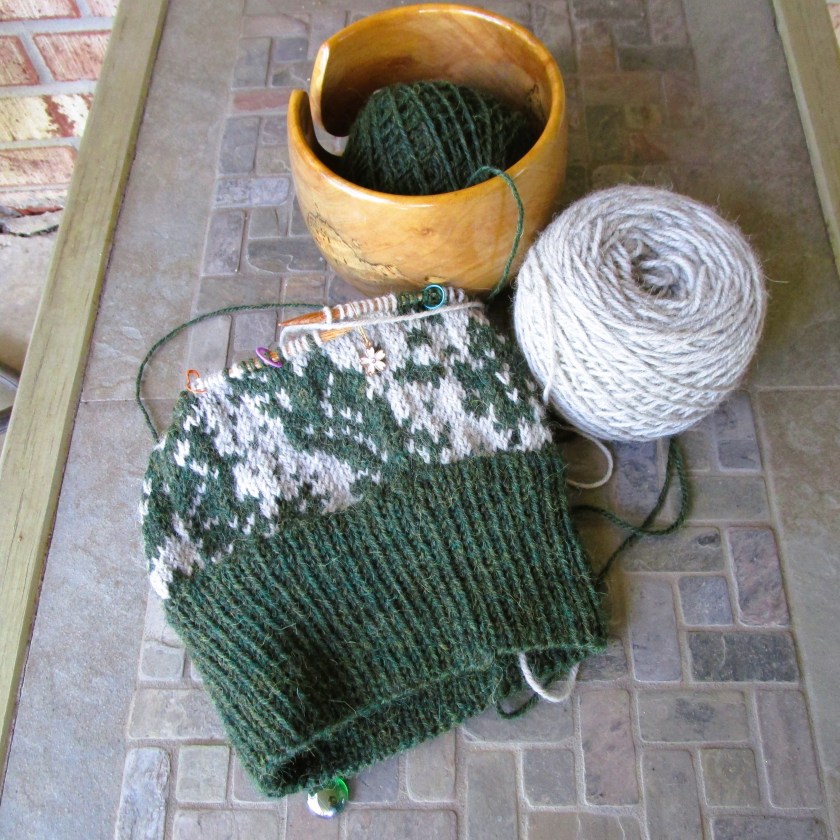
I’m calling the hat Summer Smoke, because the North Woods of Wisconsin was blanketed in smoke from Canada while I was visiting this summer. I purchased the yarn at North Wind Fiber and Book store, in Spooner, WI.

I think this hat looks pretty cool so far. It will go to Henry on his birthday in November. I expect there will be requests from other family members for Biome hats once they get a look at it.

Posted in knitting

Cast-on Monday: Now for something Completely Different

Honestly, the project itself is not completely different. It’s a hat. It’s a 2-color hat. It’s a 2-color hat knitted in fair-isle technique. The difference lies in the chart.

It was generated by computer using a program coded by designer Rianna Suen.

https://www.ravelry.com/patterns/library/biome-hat

@ Rianna Suen

In her words, “Simplex noise is a clustered randomness algorithm. When translated into knit stitches, it produces a colorwork pattern with an organic look.” The upshot of it is that no two patterns will be alike. Each time you click on the link, the algorithm runs and displays a new chart. If you don’t like what you see, move a variable and run it again. Save a few runs and use the pattern that you like the most.

My chart looks hand drawn, because it is. I was unable to get a workable print-out of the computer-generated image. So, I hand copied it, just like the monks did in an era prior to the invention of printing. Ha, take that! 21st century.

Here are my yarns.

Ultra Alpaca is an old friend. I used it and loved it many years ago in making a skirt with a colorwork band at the hem. The beige skein I selected is natural undyed fiber. The forest green was selected by Henry, who will receive the hat when completed.

I’ve got the band finished.

It’s now ready for me to start working from the chart. I’ll expect that the work will go slowly. There is no pattern repeat that can be memorized. Each row is unique and there are 50 of them.

If you like to experiment with your knitting, check out the Biome Hat on Ravelry.

Posted in knitting

Friday Finish: UFO Transitioned

A few months ago, I wrote about my plan to assign unused yarns in my stash to potential knitting projects. Among those plastic bags hanging in the yarn closet were some UFOs (unfinished objects) including this one.

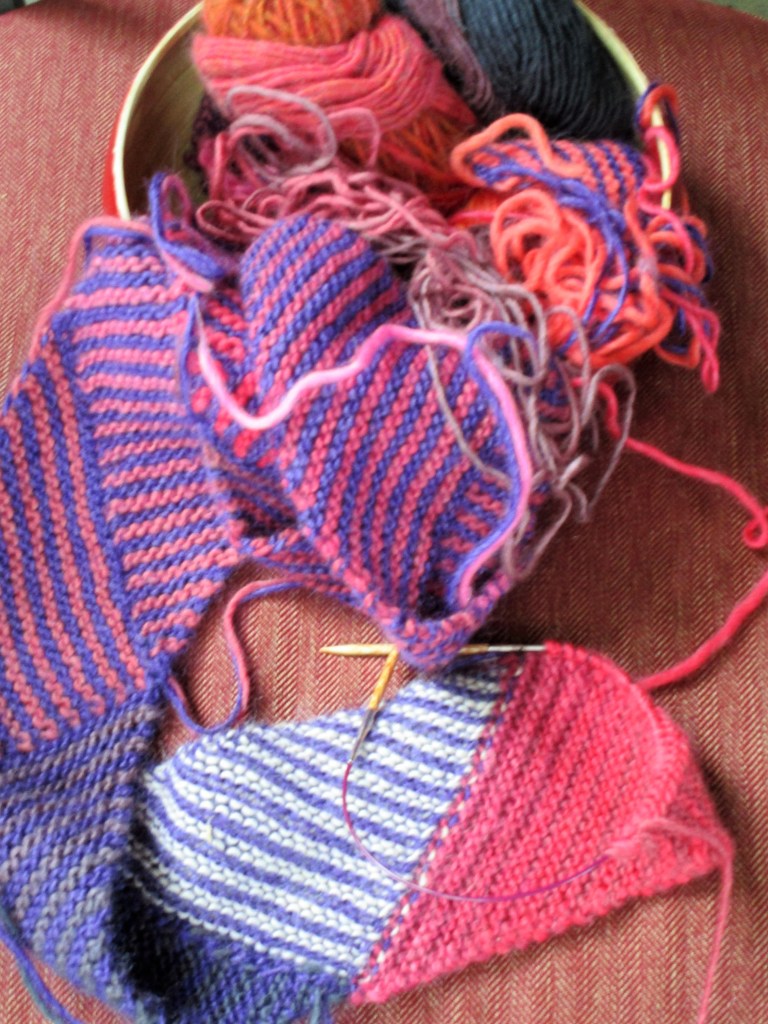
It had started life as a vest project, which involved knitting garter ridge triangles in strips, then sewing the strips together, adding shoulder seams, etc.

To make a long story short, I discarded that plan, partly because I really didn’t have enough yarn and didn’t want to buy more. Plan B involved making the strips longer and sewing them end-to-end to make a scarf.

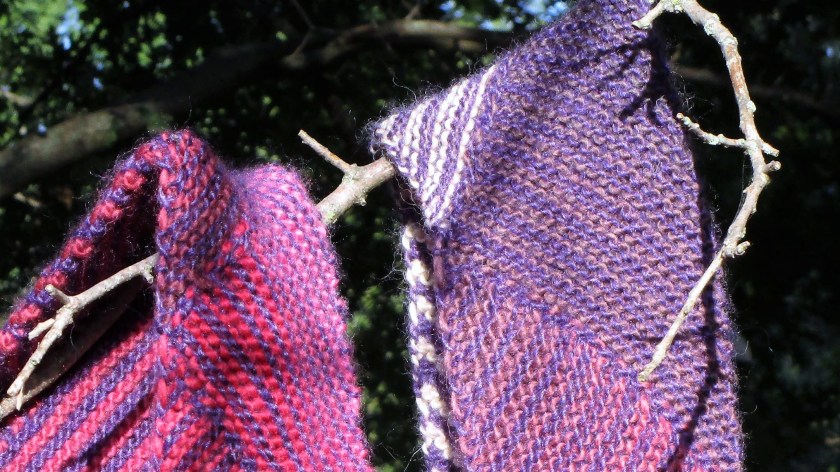
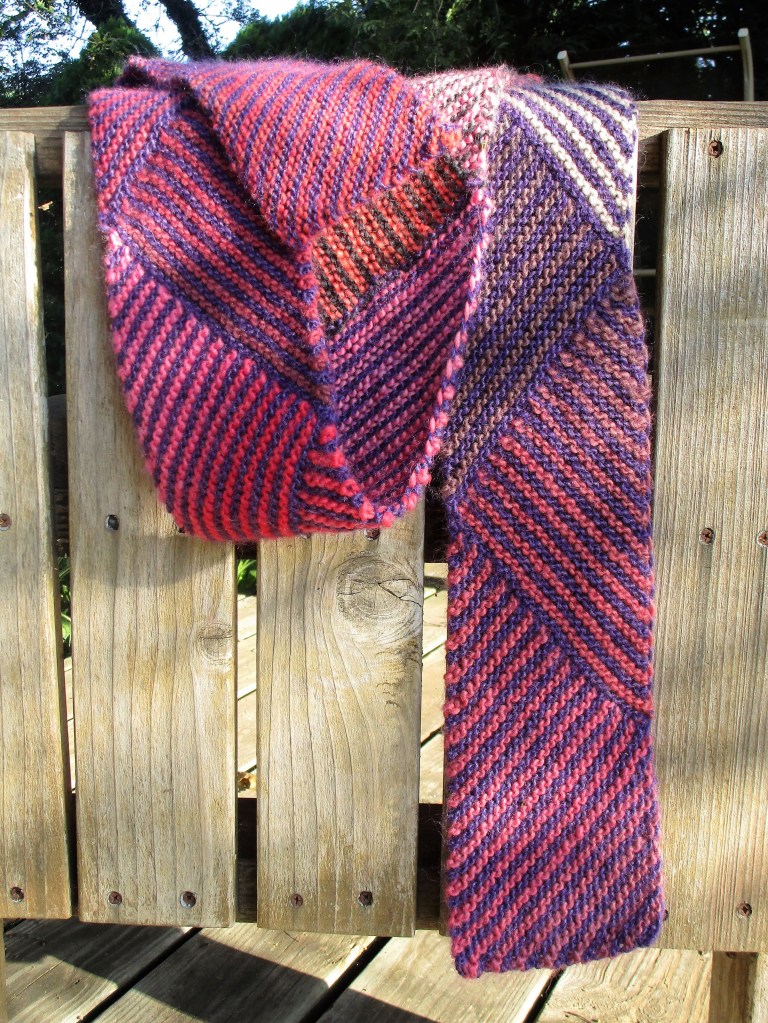
This scarf is today’s Friday Finish

I enjoyed working on this project. It was basic straight knitting and made a good mindless project. It’s easy to pick up stitches along the triangle’s edge – one stitch per garter ridge. And the color play is gratifying to watch.

The final project is about 54″ long and 5″ wide. There is almost no yarn leftover.

Presto! Another Stashbuster crosses the finish line!

Posted in knitting

Cast-on Monday: Back to my Stash

At one point, I was interested in working with yarn that has a very long color transition. One summer, when Knitpicks has its yarn on sale, I picked up this skein of Stroll. The colorway is called Beach House – hard to resist! But when I started to knit it, I noticed that it was very thin and quite light. I put it back in the yarn closet while I had a good think about what it could become.

Flash forward to this year and the Summer of the Stash Bust. Way in the back of the fingering weight yarn cubbyhole, I came across the skein on the left. It is 100% alpaca lace weight in a warm white color. It is languishing, because I found it impossible to work with yarns that light. As I made my loops, they had the predilection to float right off of my needles. I grabbed this featherweight and decided to knit the alpaca and the Beach House Stroll held together as one strand.

Finding a garment that I can make using only the 450 yards of fingering weight is tricky. It should become a shawl, but I have way too many of those. So I came up with a pattern for a tiny, short-sleeved lace cardigan by Susanne Sommer.

https://www.ravelry.com/patterns/library/arrowhead-lace-cardigan-3

Here is my swatch and my cast-on. The pattern is worked top down.

Based on the swatch, I am thinking that I will have to add a few additional repeats of the lace to get the cardigan to fit. SO, a game of yarn chicken is afoot. (sigh.)

Posted in knitting

Friday Finish: Child Balaclava

Gosh, this was a fun and easy project, once I got the hang of the 3-color slip stitch pattern. The yarns were great (Cascade Elysian) and blocked out beautifully. If only I had a five-year-old to test the fit and pose for the photo shoot.

A quick solution for a head mannequin: Grab an oatmeal box and draw a face on it. At least this solves for the photo shoot. Checking the fit will require plopping the piece on a real live child.

View from the side. I stuffed in a small ball of yarn to fill out the crown.

Looking at the back, you observe my slight alteration to the pattern: I noticed in the pattern’s photographs that the neck increases resulted in a slight flare.

To accentuate this feature, I switched from 1 by 1 ribbing to seed stitch just in this section. This will allow the back of the neck to fit easily over a collar.

Or, the flare could be tucked inside coat, to keep winter winds away from tender skin.

If you like the pattern, here is a link to Gretchen Tracey’s website.

https://www.ballstothewallsknits.com/2014/02/kids-dice-check-balaclava.html

She offers the balaclava in a baby size as well as dozens of other cute head coverings for kids. This pattern was free. I hope you’ll give her designs a try.