One of six children, I was raised by a busy mom, who instilled in me a love of fabric. Though I learned to sew and knit at a young age, it was the arrival of my first grandchild that pushed me into action. A long-time knitter, I am now ready to explore all things fiber.
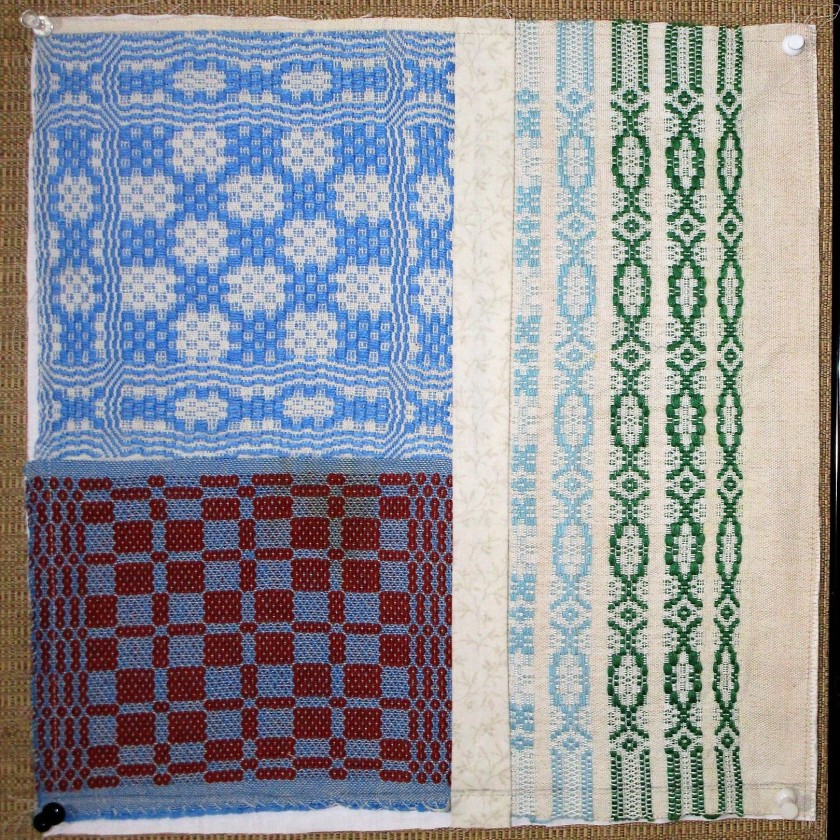
It’s been a while since I shared progress on the Howard Wabi-Sabi quilt. For this Work In Progress post, I’m showing how I hand-quilted a few of the vintage weaves that were used in this object.
After much consideration, I decided that it was OK to sew on (aka deface) someone else’s work. This change of heart came after I was in Madison recently, where I asked my daughter to show me more samples of Margaret Howard’s work.
Oh my. There was so much of it. Huge plastic bins filled to overflowing. Several samples were woven with the same motifs found in the pieces I was using in my quilt. Perhaps each piece was not that precious to the maker. They were woven, perhaps for practice, perhaps for auditioning alternative color choices.
When I picked up my quilt blocks again, it was clear to me that my stitching could accomplish its task of quilting down the batting and backing while also reinforcing the existing weave patterns. To my mind, this is enough to honor the maker.
Today I am showing two blocks with embroidery finished.
Center Block before:
Center Block after
Fire Block before:
Fire Block after:
I’m aware that the differences appear subtle in the photographs. But in person, the embroidery stitches bring some color variation and texture that was lacking.
Thanks to Amanda for adding her embroidery to the work, which jump-started my own efforts.
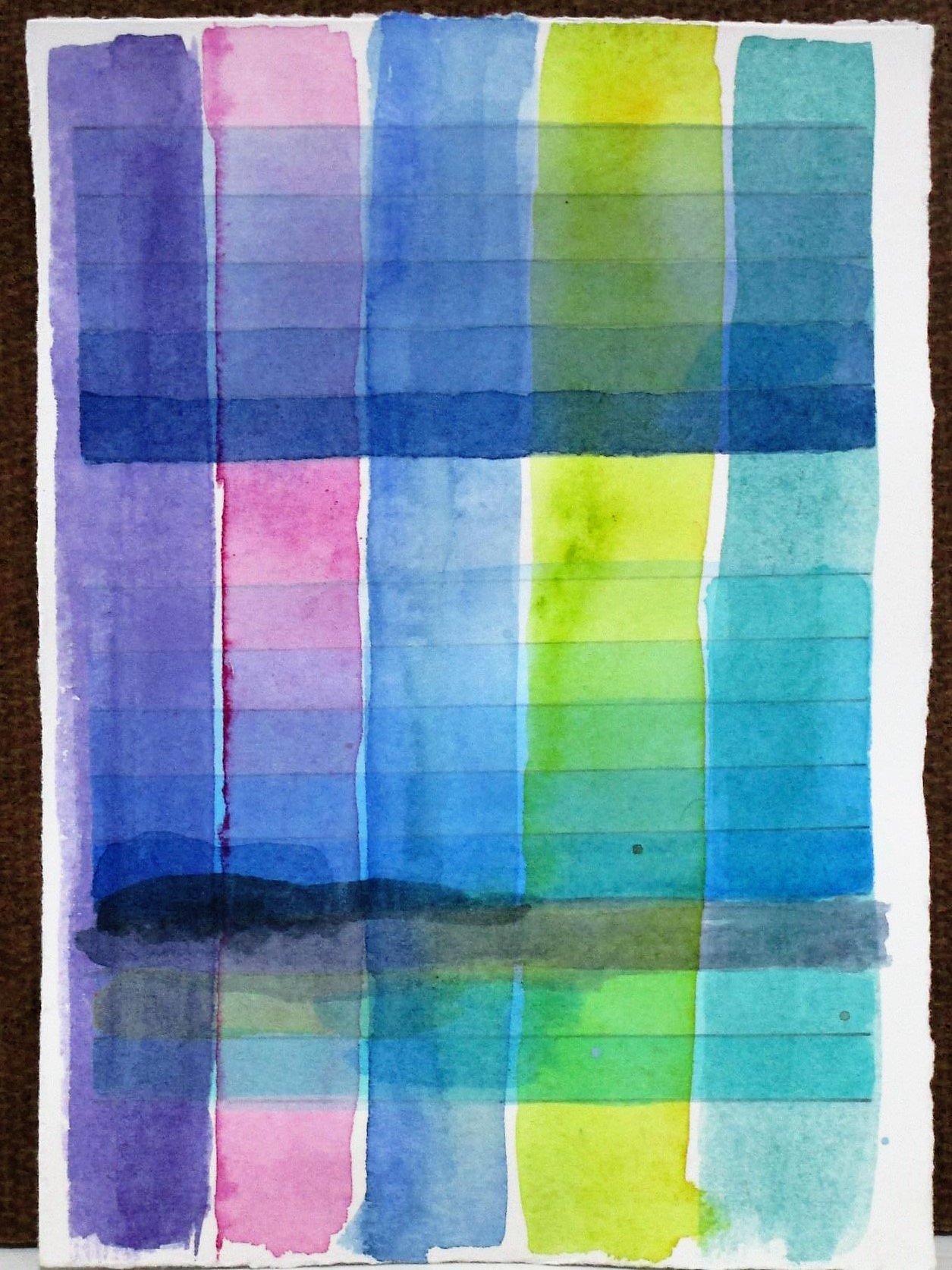
While tidying up my studio the other day, I came across several of my watercolor test swatches. I have three samples, each no bigger than 4 x 6 inches, that were made as I prepared to paint the geometric abstract of the Belize lagoon.
Looking at them with fresh eyes I got the idea of framing the paintings as a group. But first, I would want to work on them some more.
In the language of watercolor, a wash that is painted over existing washes is called a glaze. The term emphasizes the sheer characteristic of this medium. Today I got busy adding some glazes. When the paint had dried, I added a little line work.
Here is what I have so far.
I like the fresh and bright colors and the variety of shapes. But I am wondering if these tiny paintings are finished now. I’m toying with the idea of sewing on them with embroidery thread.
Rather than ending up Dazed and Confused, I believe that I will put this project aside and see how I feel about it tomorrow.
We’ve been enjoying lots of birds in our backyard. Because it has been such a dry and cold spring, the birds seem to be spending lots of time perched on the birdbath.
Male cardinal, photo taken last year
All the interest in the little blue birdbath reminded me that I had started a series of watercolor paintings of various creatures that stop here to drink or bath. In particular, I want to make a large-scale painting of an imaginary scene.
In my imagination, a bird and a squirrel are having an argument over which of them gets to drink first. I had done some small sketches and paintings of squirrels. Today I am sketching a blue jay perched here, right about where the cardinal is sitting.
To get started, I turned to David Sibley’s book, What it’s like to be a bird.
One of the things I love about this guide is the watercolor paintings, done to scale, of each bird featured. I knew Sibley was a great naturalist and now I know him as a fine illustrator. Turning to his image of blue jays, I traced the life-size head of the blue jay.
Eventually, I ended up scaling it down to about 90% of life size. I then transferred the tracing to my sketchbook. Then I looked at several photographs of the blue jay, some from the internet and some from Bill’s archives. Since I couldn’t find exactly the posture I want to represent, I just took bits and pieces of different images. This could have turned into a disastrous Frankenstein of a drawing, but it didn’t.
Love this guy’s attitude!
This took about an hour and a half, the but the time was well worth it. I learned a lot by studying each part of the bird as I worked on it.
In the future, I will do a few watercolor studies of the jay and also draw a squirrel to this same scale, before combining all the pieces together in one painting.
Last week I was recruited to teach a class at my local art association. I said yes, but I was at a loss on what to present. The introductory knitting classes which I taught last year were very lightly attended. I had to do some recruiting just to get a minimum number of students.
Thinking about possible roadblocks to knitting, I came face to face with certain inalienable facts about the craft:
The learning curve is steep.
Projects take a long time to finish.
What if I narrowed the number of skills required to a minimum, and what if I used these few techniques to make quick-to-complete projects? ……………..
The answer is I-Cord! This little add-on is used for strings for tying knitted hats and other decorative frou-frou. All it takes is a few yards, a cast-on, and repeated knit stitches over a very short row.
So today I am researching and stitching up all kinds of I-cord accessories. These projects will include jewelry so I will need a selection of beads.
The two strings in the left of the photo were purchased today. All the others I had acquired in the past 3 or 4 four years.
I also perused my stash for left-over fingering weight yarn. (No shortage here.)
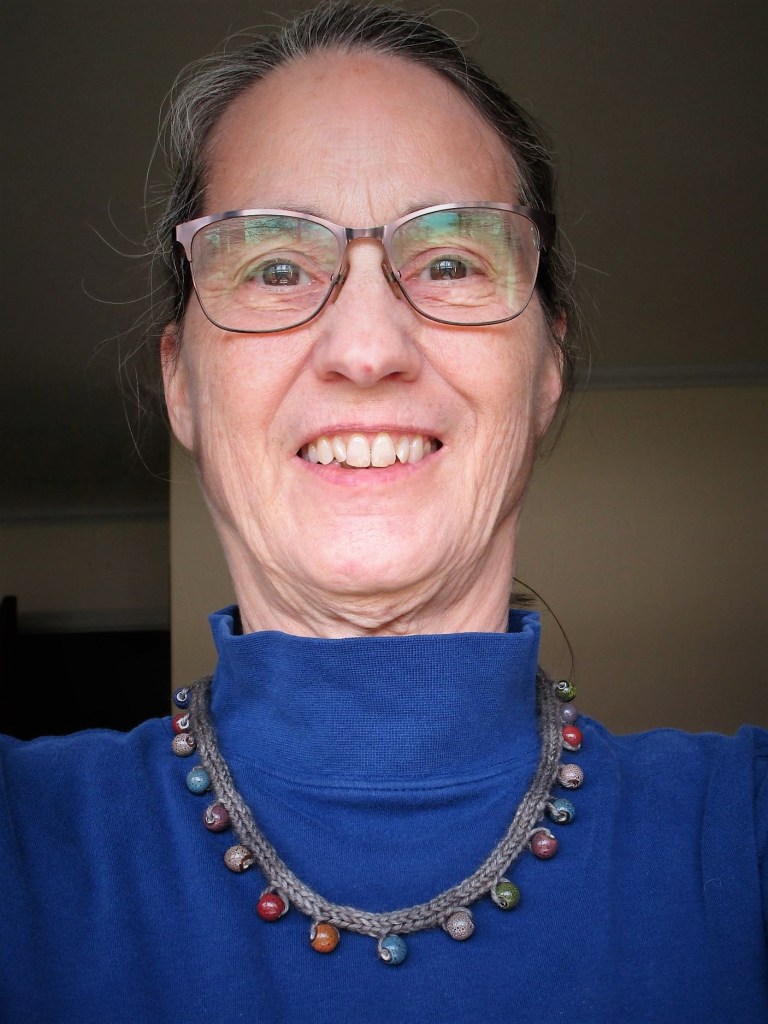
To kick things off I worked up this 18-necklace using tonally dyed merino wool and some porcelain beads.
My version is made with just one strand because I had only 24 beads. I love how each bead dangles below the cord. I am wearing it over a shirt, but this necklace would also be soft against bare skin.
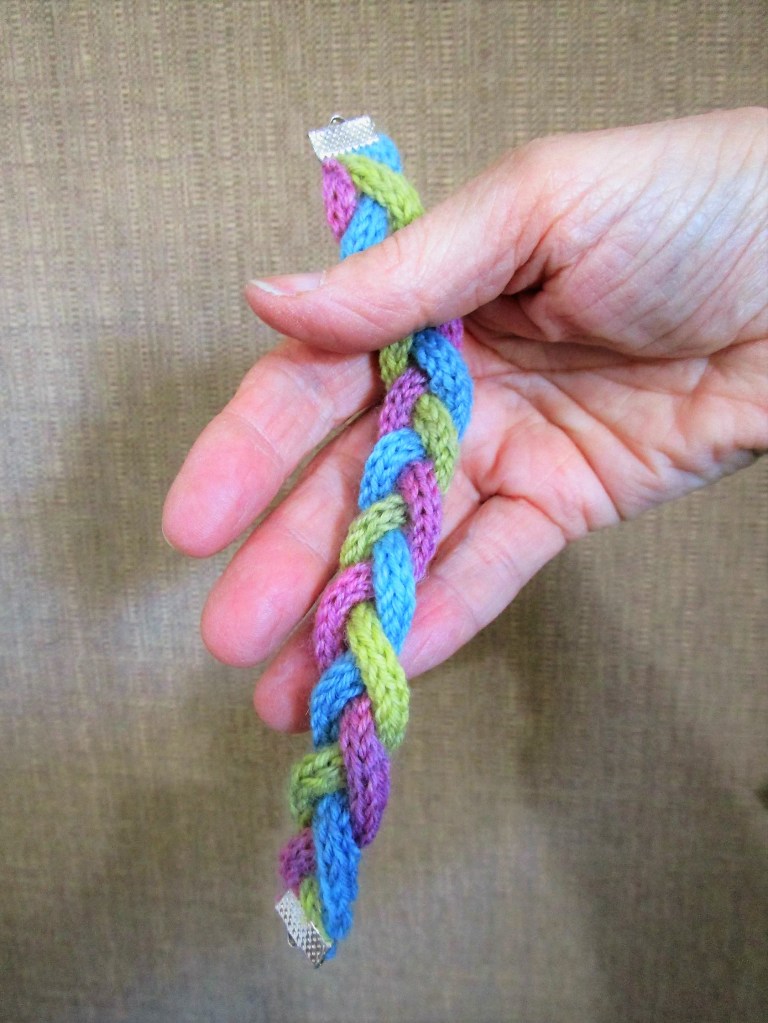
I sewed one end of the three strands together, braided them and then sewed the other end. The crimping finial is designed for holding ribbons so that they don’t fray.
For my third item, I switched to worsted weight yarn and move up to a size 5 needle. I was so happy to use up the left-overs of this lovely variegated Malibrigo merino.
This necklace doesn’t use a pattern. It will be made to my own specifications.
And here are my three I cord samples as of dinner time.
This should be enough material to work up a class proposal. I will also try making a headband and a multi-strand necklace.