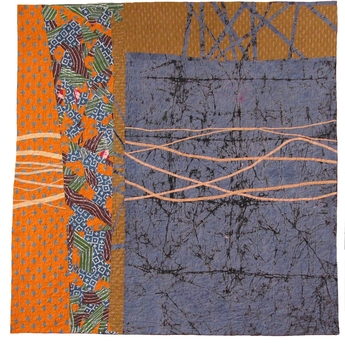
I came to learn quilting almost as an afterthought. As I started to get ideas for making fiber objects, I became aware that I lacked the skills I needed to realize them. Thus started my quilting education. There are some things about quilting I like – choosing fabrics, developing my design, adding surface details and actually doing the quilting. The things I dislike are cutting many identical pieces of fabric, squaring up blocks and especially matching corners.
So naturally I am drawn to improvisational piecing. Joe Cunningham (aka Joe the Quilter) and his process were a revelation to me. He offers the promise of freedom. Freedom from all the dull parts of quilting, which leaves more time for fun. The quilt featured at the top of my post is one of his. His website can be found here:
http://www.joethequilter.com/aboutjoe.html
Joe Cunningham has been a professional quilter since 1979. His philosophy is unique. He doesn’t use patterns. He designs out of his head, adjusting things as he goes along. He has no specific end in mind. He explains that as the quilt approaches the finish, he finds out what it will look like. He practices randomness, chance and serendipity. To this end, his method relies on chance from the first cut.
As an example, the class I took with Joe featured a quilt called “Rock the Block.” Here is how to make it:
Step 1: Choose three fabrics. Include one big print. The other two can be prints that don’t necessarily go with the big print. Also choose a solid color that you will cut into narrow strips, which Joe called “sticks.”
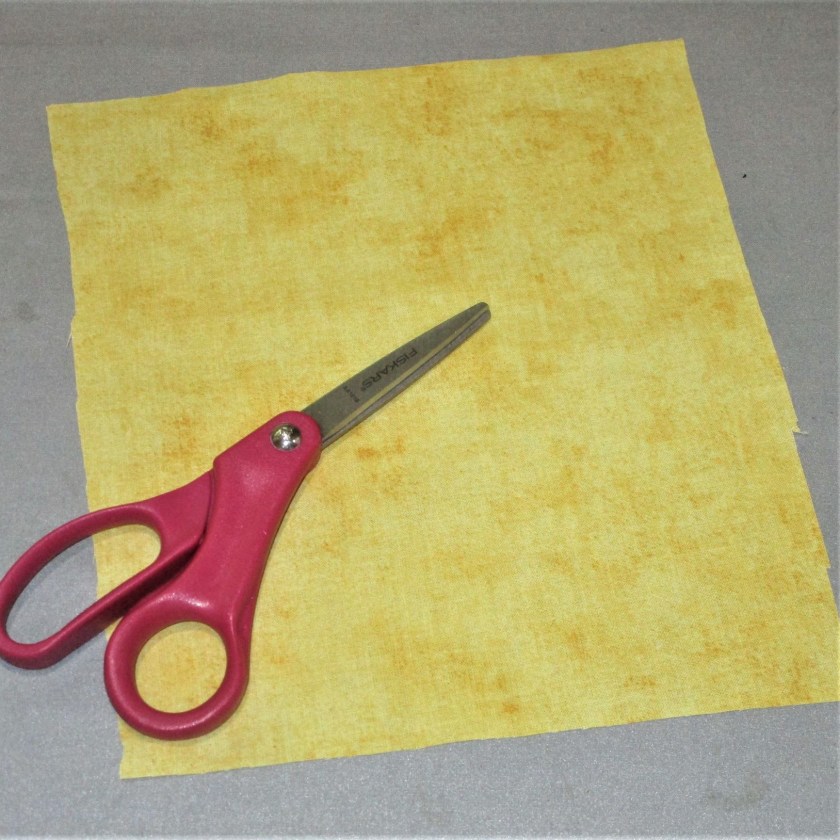
Step 2. Cut out a square. It doesn’t need to be perfect, but does need to be bigger than 7 inches.
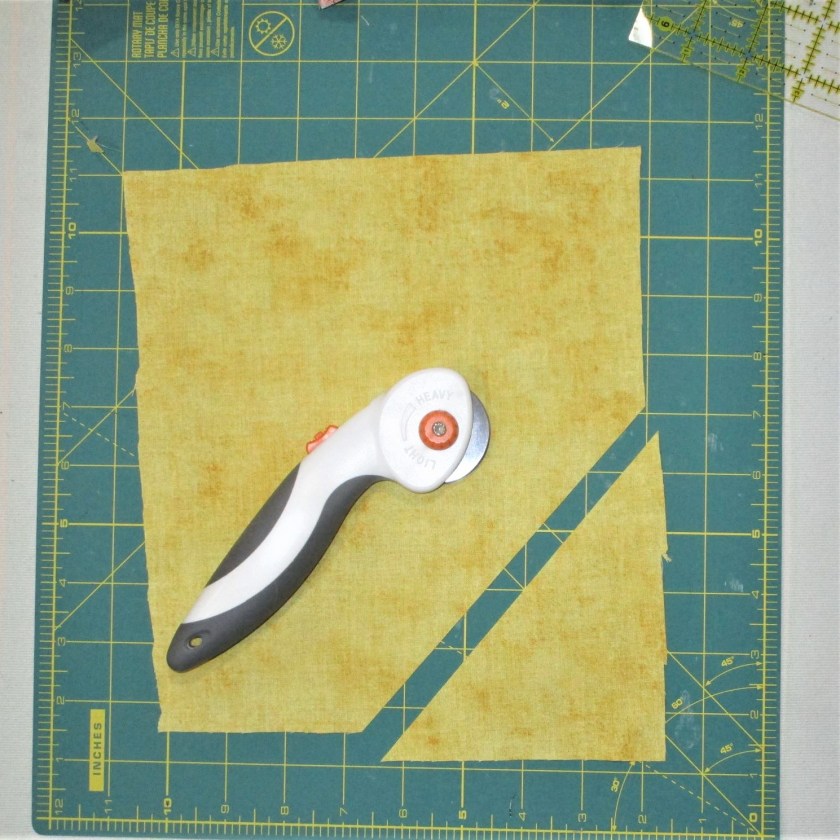
Step 3. Cut off a corner.
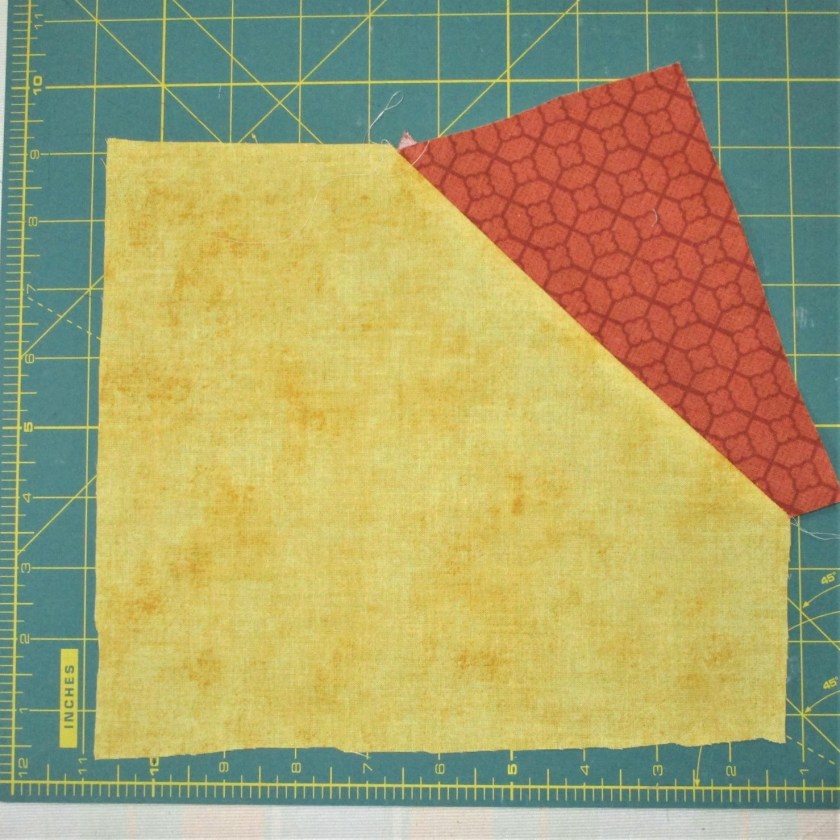
Step 4: Cut out a triangle from one of the other fabrics. Sew it to the square at the cut edge.

Step 5: Cut through the square, across both pieces of fabric.

Step 6: Sew in a stick.
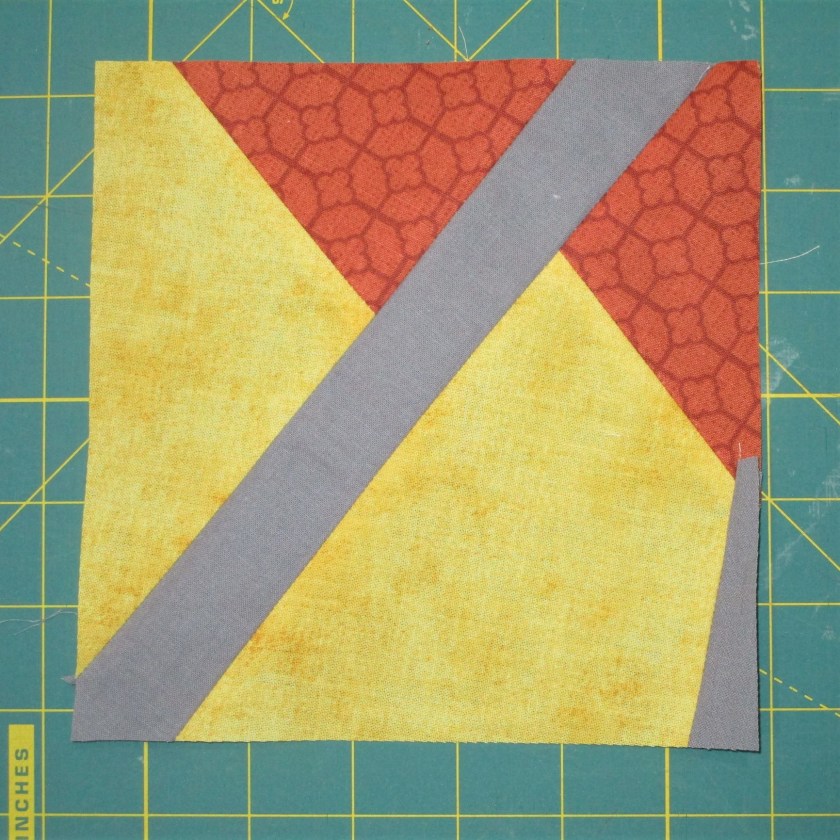
Step 7: Press seams open and trim the block with a 6 and 1/2 inch square ruler.
Repeat steps 2 through 7 until you have enough blocks for the size quilt you want to make. Use all the different combinations of your three fabrics. Your blocks might look like these.


Or they may look entirely un-like these!
Now the fun begins. Lay out your blocks in rows. Move them around, arranging the blocks until they look “pleasing to you.” Lacking a design wall, I laid mine on the floor.
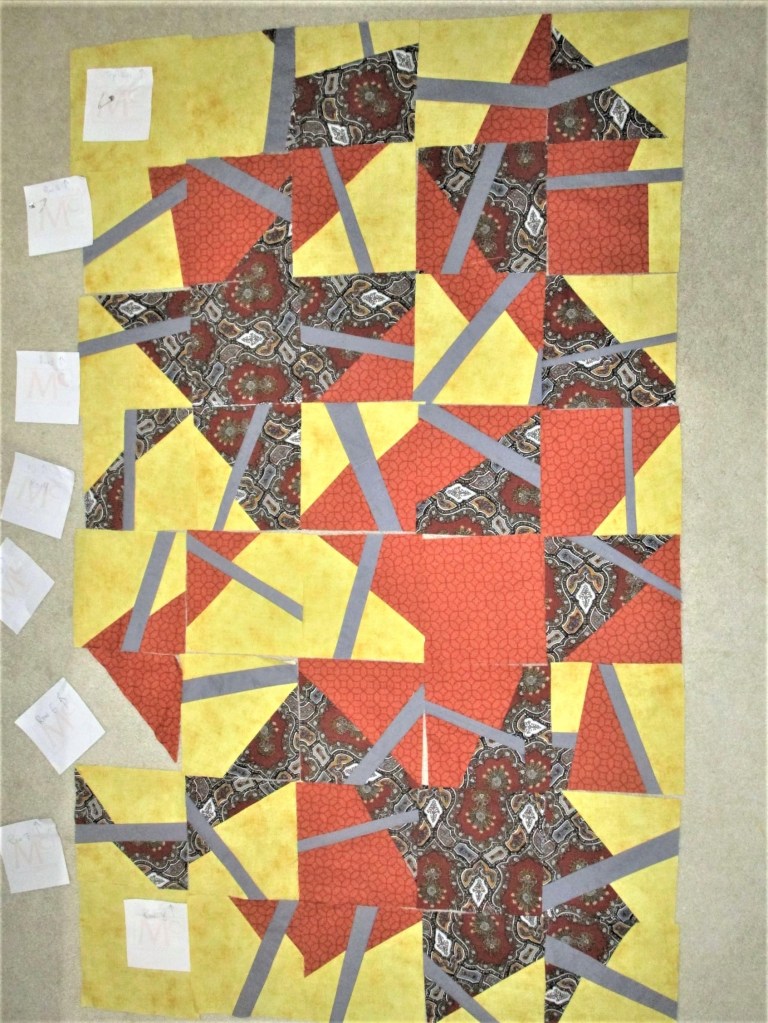
So far, this has been painless. Nay, it has been truly pleasurable. I plan to add more yellow blocks around all sides. Some of them will have patterned fabric crumbs and a few “sticks” sewn into them. Some may not.
While I acknowledge there will be corners to sew, I plan to adopt a laisser-faire attitude about the matching part. If this sort of design process is intriguing to you, I suggest you check out Joe the Quilter’s website to see more of his quilts.


 Daily Fiber
Looks magnificent!
LikeLiked by 1 person
I love this. The randomness is wonderful. I tried quilting and cannot make corners that match to save my life. I wish I could do this in knitting.
LikeLiked by 1 person
I like this idea. I went to his website — what unique work! I wonder if he’d be interested in a Gallery highlight?
LikeLiked by 1 person
Did you see on his site the video titled “bed?” It’s a send up of Rauschenberg. Very funny.
LikeLike
Wow! That looks great. It must be quite freeing to be able to mix the blocks up. Good blend of colours for it too. Looking forward to seeing it all finished.
LikeLiked by 1 person
It’s fun. Feels kinda like shuffling cards. I may feel differently when I start sewing together all those blocks. There’s no permanent escape from matching corners in the quilt world.
LikeLiked by 1 person
Laura, this method is a take off from crazy patch blocks which have existed since quilting began in the USA. The different part is using the sticks which I like. I am in the process of sewing crazy patches using the left over scraps from sewing almost 200 masks. I embroidered floral designs onto muslin and cut the fabric into 6 inch squares then cut off one corner giving me five sides which I then sew around until I have a nine inch block. I need 21 blocks and I have 19 finished. I had to quit because my sewing room got too hot.
LikeLiked by 1 person
That’s great. I love to hear about your process. It may interest you to hear that Joe started his career by studying old quilts. His process is always improvisational.
LikeLike
Hi Laura, I tried to open Joe Cunningham’s blog but could not get in. I am having trouble opening email address embedded into another email. I think my computer needs to go to Computer ER for a tuneup. Have fun with your piecing. Love MOM
I
LikeLiked by 1 person
This blog post is really informative Laura Kate, I have never attempted quilting but this more organic and random looking work appeals to me.
Thank you
LikeLiked by 1 person
Thank you for your interest.
LikeLike
This is very much like how I approach crochet. I have used patterns before, but I mostly design as I go. When I make dolls, I like to let them take me where they want to go.
LikeLiked by 1 person
That sounds like fun.
LikeLiked by 1 person
Great read, now following!
LikeLike