Since I returned from the cruise to Alaska, It’s been pretty hard for me to keep up my posts. First of all, we both came down with Covid. Recovery took 5 plus days. And then I found myself dissatisfied with my past work. It’s been a hard few weeks.
I thought an easy cast-on would help ease me back into things. So I chose a two-color cowl that will use up some stash yarn.
Spinal Twist, by Rebecca Marsh, starts with a crocheted provisional cast-on.
I have chosen some very soft single twist yarns. Labels have been lost, but it feels like there is some portion of alpaca.
Knit in the round, on large needles, with thick yarn. This could be finished in a week. By then, maybe my creativity will be unblocked and body fully healed.
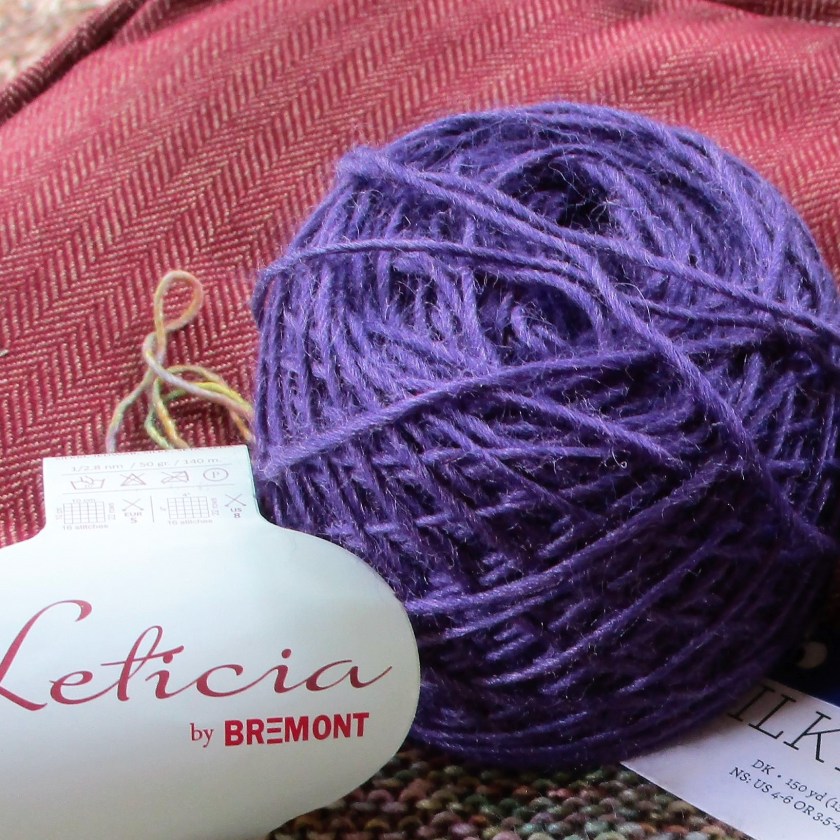
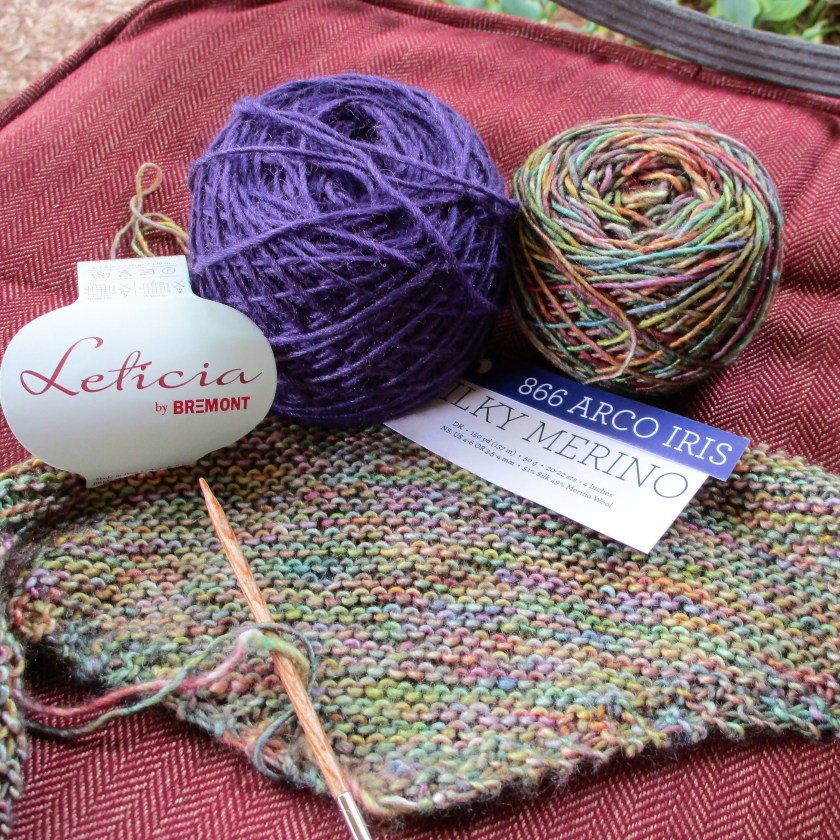
My new project is in keeping with my desire to work with my stash. I have been wanting to make a shawl with this purple yarn, called Leticia, by Bremont.
It is a singles yarn (for you non-knitters, that means it’s not plied.) Three fibers are blended together: wool, alpaca and silk. I own three skeins. Over the past few years, I have tried unsuccessfully to pair it with another yarn, so that I could make a two-color shawl.
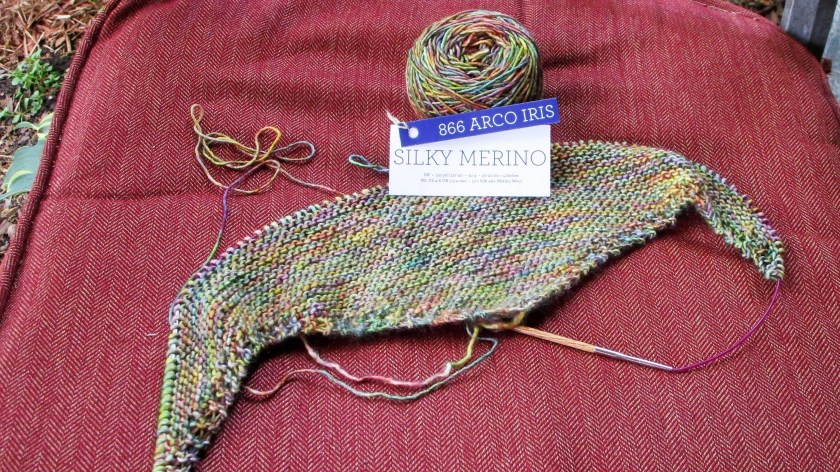
Last week, while wasting a lot of time viewing yarns on the Jimmy Beans site (https://www.jimmybeanswool.com/ ) I discovered the perfect match from Malabrigo.
I ordered two skeins lickety-split and they arrived post-haste within three days. This yarn, also a singles, combines silk and merino wool about 50/50. It’s hard to describe the silky sheen of this yarn, (I was almost swooning while casting it on and knitting the first few rows.)
For my pattern, I re-visited a Craftsy tutorial by Laura Nelkin, in which she explains how to design 14 different shawl shapes. It’s fantastic, if you don’t mind doing a little math. I chose the crescent shape.
I love the way the mosaic section bridges the two colors of yarn. But instead of making Pale Moon, I would prefer to use Laura Nelkins’ instructions for the shape and design a mosaic chart of my own.
My first attempt at designing a mosaic pattern, unfortunately, was a failure. Apparently, there are some hard and fast rules about sequencing slipped stitches between the two colors. So back I go to my graph paper for a re-do.
Spring is in the air and on the ground! Although we had frost on the roof this morning, it is warming rapidly. I was in St. Louis for the spring equinox. When I got home last Thursday, there were hundreds of grape hyacinths blooming in the yard and the flower bed.
While in St. Louis, we visited a LYS located in a suburb. We had promised Lu that she could pick out the yarn for her next sweater. Many thanks to the tolerant staff at Yarn Com while the little one whirled through the shop, looking at and picking up every skein that attracted her attention. She carried this on while talking softly to herself. Finally, she triumphently presented me with this hand-painted merino wool skein in her favorite shades of purple and pink.
Alas, the label was torn off and lost, so I don’t know the maker.
I paired it with some lavender Cascade 220 and a soft pink blended wool in Elysion by Cascade, quickly and quietly moving to the register before she added to the stack.
The washed swatch is very soft.
On Friday I searched Ravelry and chose a pattern that fit this yarn quite well.
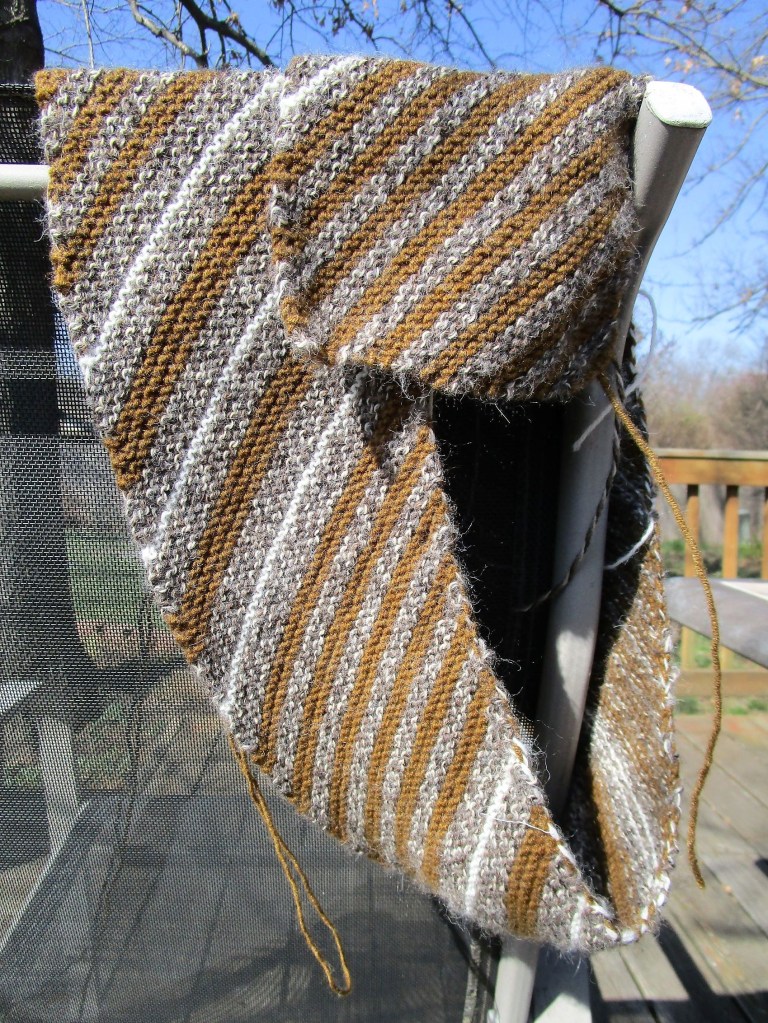
The other item I’m working is a scarf. It has many attributes, including travel knitting, mindless knitting, stashbuster and quick knit.
The brown yarn is a wool-acrylic blend leftover from Christmas sock making. The gray and white yarns are 100% alpaca. I was given the multi-hued natural colored skein from knitting buddy Kathy. The source of the white is forgotten and unknown.
To keep from being too bored I played around with different striping patterns. To achieve the diagonal stripe, you decrease at the end of the right-side rows and increase at the end of the wrong-side rows. I’ll knit until I run out of the shortest yarn. That could happen today.
Do you have a project in process that is inspired by Springtime?
This week’s prompt for the Stay At Home Round Robin quilt challenge comes from Home Sewn By Us and it is the spool block. This is one I haven’t tried yet, I believe it’s one of the easier blocks to make. And I have a good idea for using fabric from my orphaned quilt blocks for this challenge.
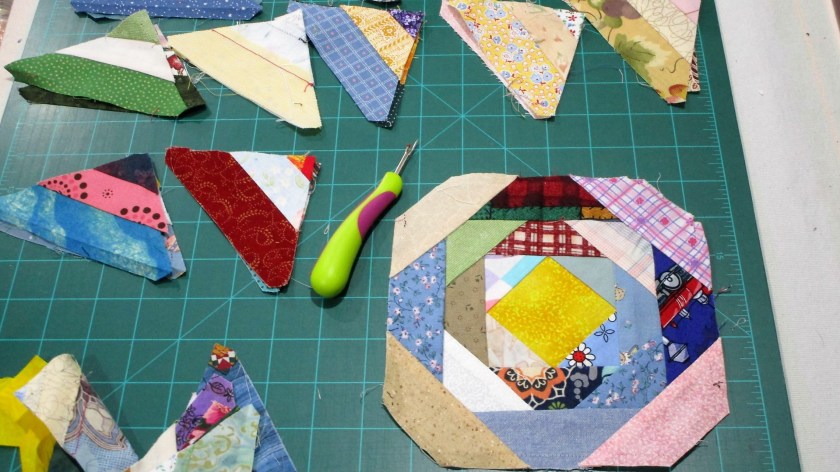
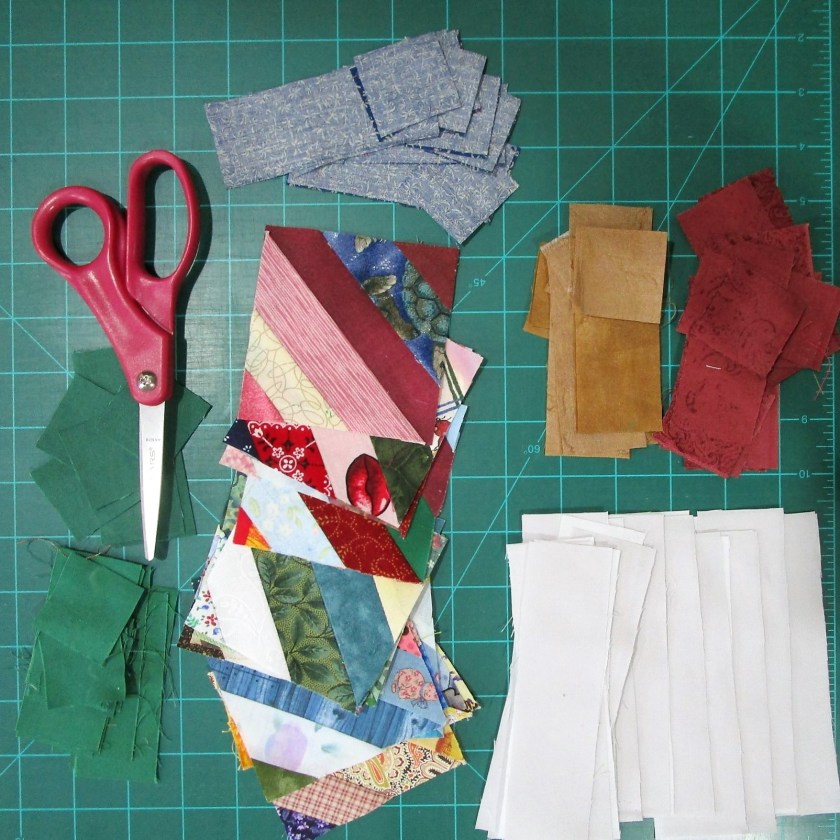
Using my seam ripper, I removed the corners from several of the blocks. (Can anyone tell me what this block is called? It’s a sort of square in a square with at least four iterations, but then stripped corner pieces were sewn on.) Anyway, I took these triangles and sewed two of them with long edges together. This gave me a square about 3 and 1/2 inches which formed the “thread” part of my spools.
To support the center pieces, I cut pieces from four dark colors and two shades of the background fabric. Three of the dark colors were left over from my Creation quilt. The brown fabric was used in my Badlands art quilt.
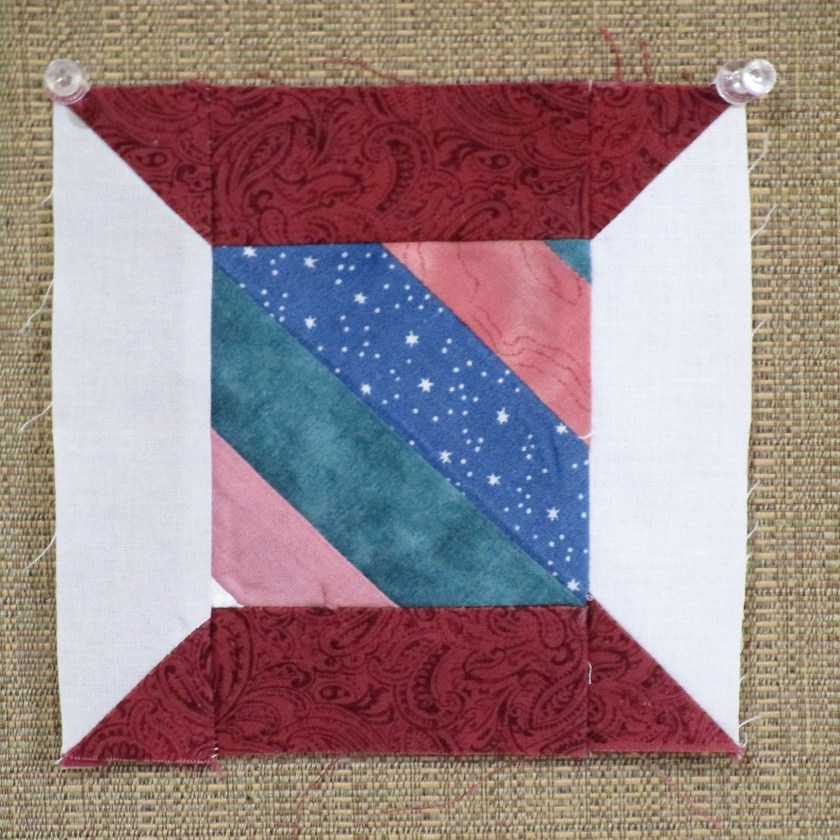
Here is my first block all sewn together.
I like the way the diagonal lines on the spool look like spiraling thread.
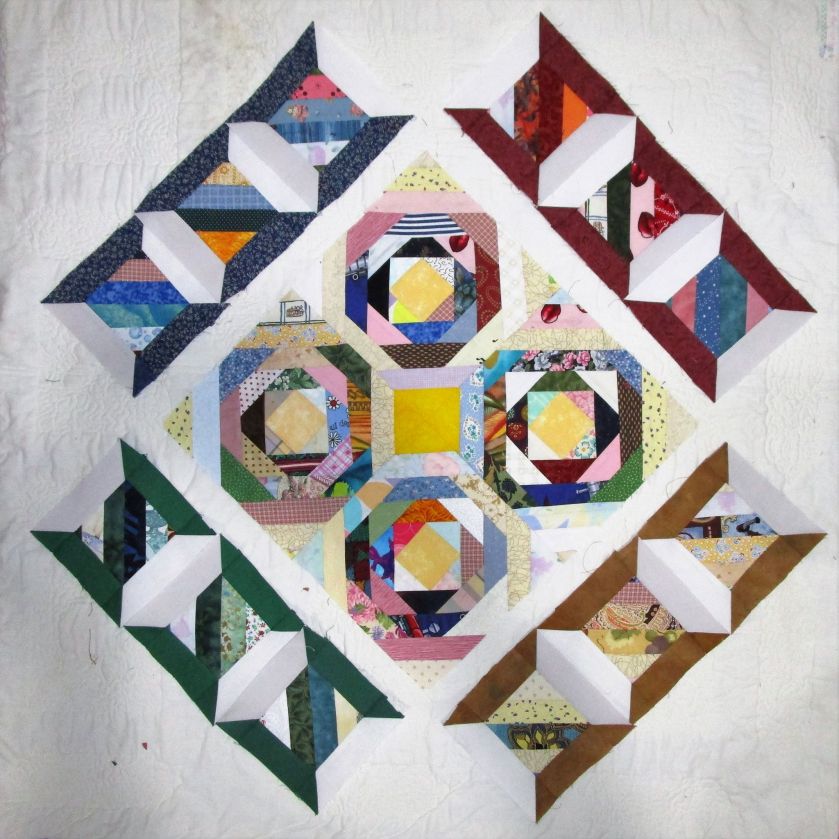
Eventually I made four 5-inch blocks in four different colors. My original design would have the spool blocks in a continuous border. When I started positioning the blocks, it became clear that there would be too much visual clutter. I settled on using three blocks on each side, leaving the corner areas available.
I will reserve the corners for the next round, or fashion corner posts using background fabrics.
To learn more about SAHRR 2023 and see what others are making, here is the link to this week’s round.
Today I have a progress report on my quilt inspired by a medieval manuscript.
Here is the center of the quilt. It is formed by the four corners of each four-by-four block. Upon first seeing that blank white diamond, I knew that it would work beautifully for a God’s Eye. After practicing on scrap fabric, I wove the centerpiece design into place. The four arms of the weaving are gold satin cording which I couched into place. The weft yarns are a combination of cotton embroidery twist and wool fingering weight yarn leftover from many a sock project.
I think it balances the four creation paintings beautifully.
Here are the quadrants of the piece at this point.
Now I can begin quilting. To start, I will stitch into the seamlines of all pieces. (AKA stich-in-the-ditch.) Next will come the free motion quilting. I have something special in mind for the light color patches which will involve more colorwork.







 Daily Fiber