Posted in quilting

Quilt Reveal 2025 SAHRR – Daily Fiber

These past few weeks have been tumbling like dominoes for me. It’s the last day for posting my finished round robin quilt, but it is not finished. Not yet.

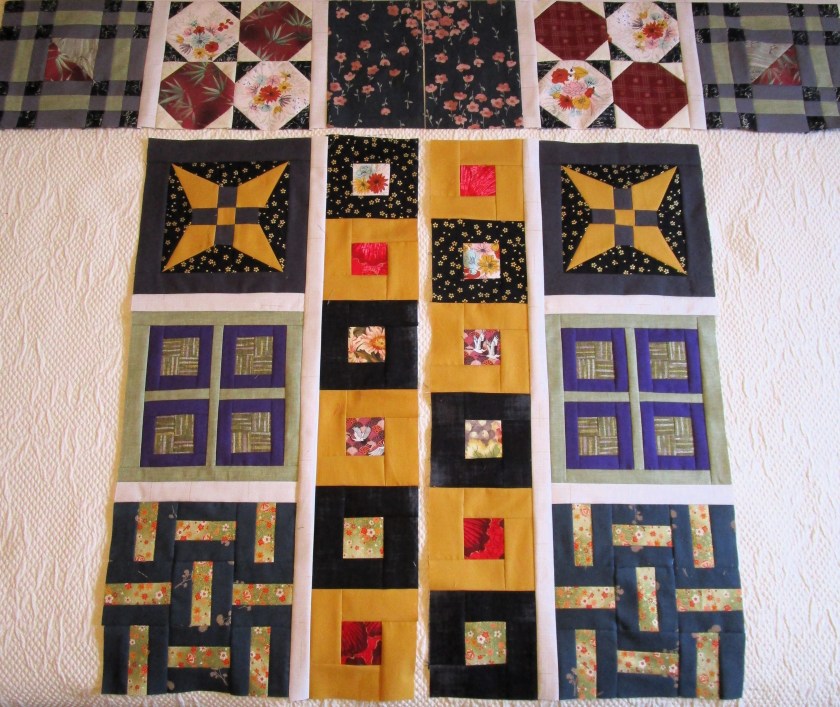
After Round Six, I still needed several more blocks for the front of my kimono/quilt. In the interest of speed and economy, I chose some of the simpler designs in the Japanese quilt block dictionary. Here they are arranged with the two kite blocks.

The quarter-sized blocks frame what will be the front opening.

My next step was to make the quilt sandwich. I chose to use cotton flannel as a thinner option for the bat. Then I started to search for a backing. Nothing I saw looked right for the job.

As I was beginning to pack my studio, in anticipation of moving house, I came across some red fabric – yards and yards of it, which I had purchased to make some drapes and totally forgot about it. It was polyester woven in the style of raw silk. An unusual choice for a quilt backing/kimono lining, but a beautiful match.

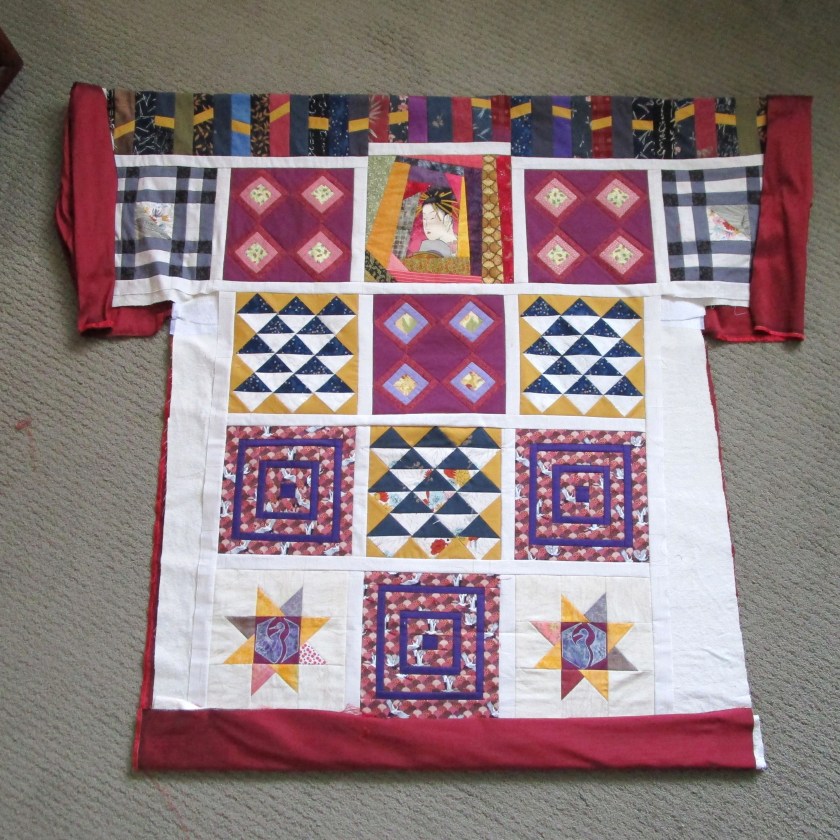
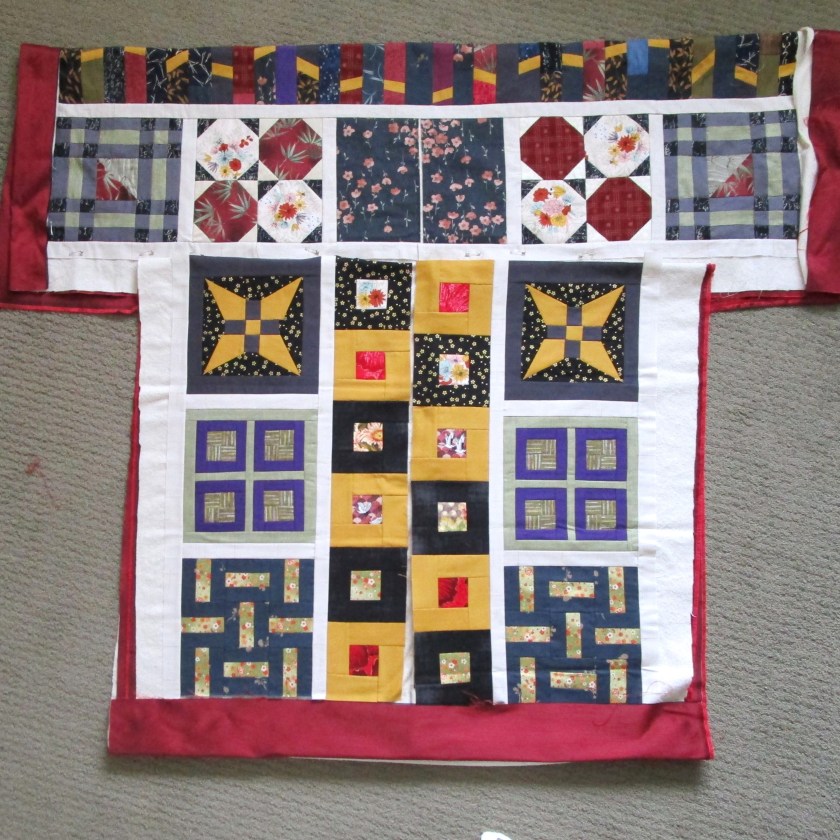
So I got busy cutting, pinning and quilting. By yesterday, I had quilted the shoulder/sleeve section using stitch in the ditch method. My choice allows the block piecing to show to the fullest. At the end of the day, I had sewn the back piece on, but not the front section. I laid it down on the carpet to get photos of front and back.

Quilt back, showing the red lining, which will be turned back to border the sleeves.

Quilt front, laid in position below the shoulder section.

There are some wonderful finished quilts at Quilting Gail’s In Linz party. I will be happy to add my almost-finished one to the parade. To see them all, click.

Here.

https://fresh.inlinkz.com/party/0e4465b5dfa6471681a87b0fd5c4fee5

Posted in quilting

SAHRR 2025 Border 1 Japanese style

I wanted to write a bit about the traits of Japanese style quilting compared to Western style quilting, but today’s schedule is a bit tight and the posting deadline is here. I’ll just show a few pictures. Or maybe I’ll use bullet points:

Types of fabric: plain cotton, woven patterns, large and small scale dyed patterns, stencil dyed cottons, silks and wool.

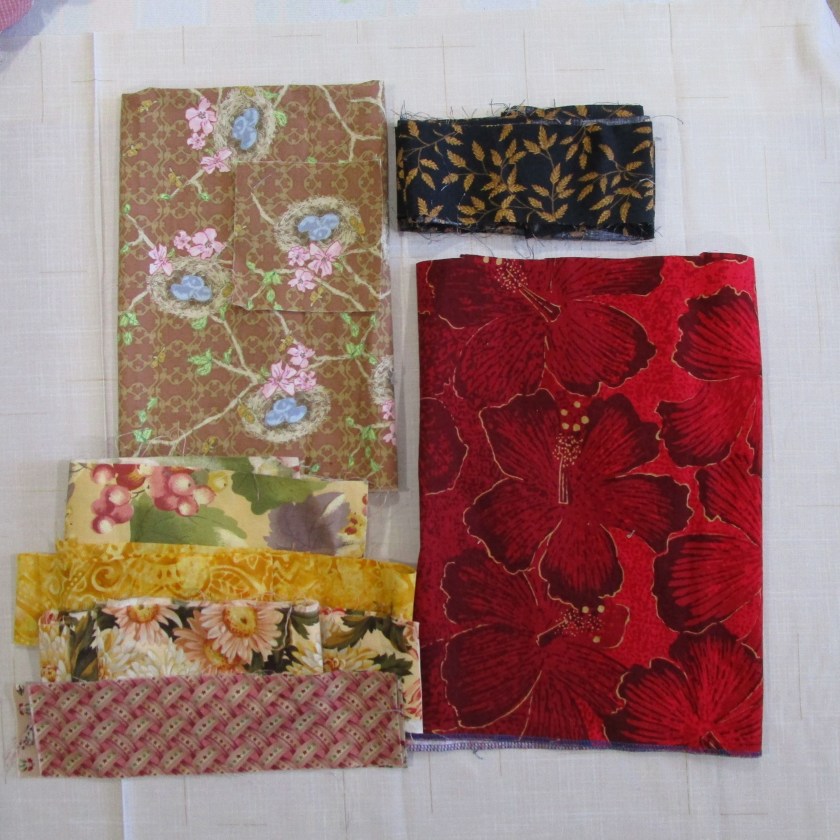
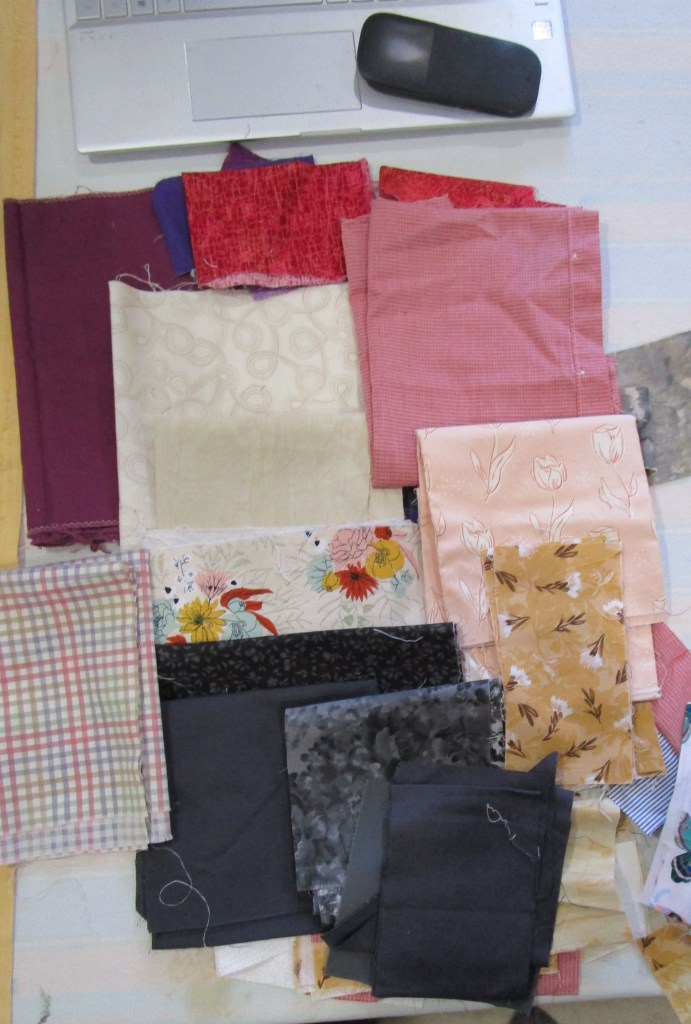
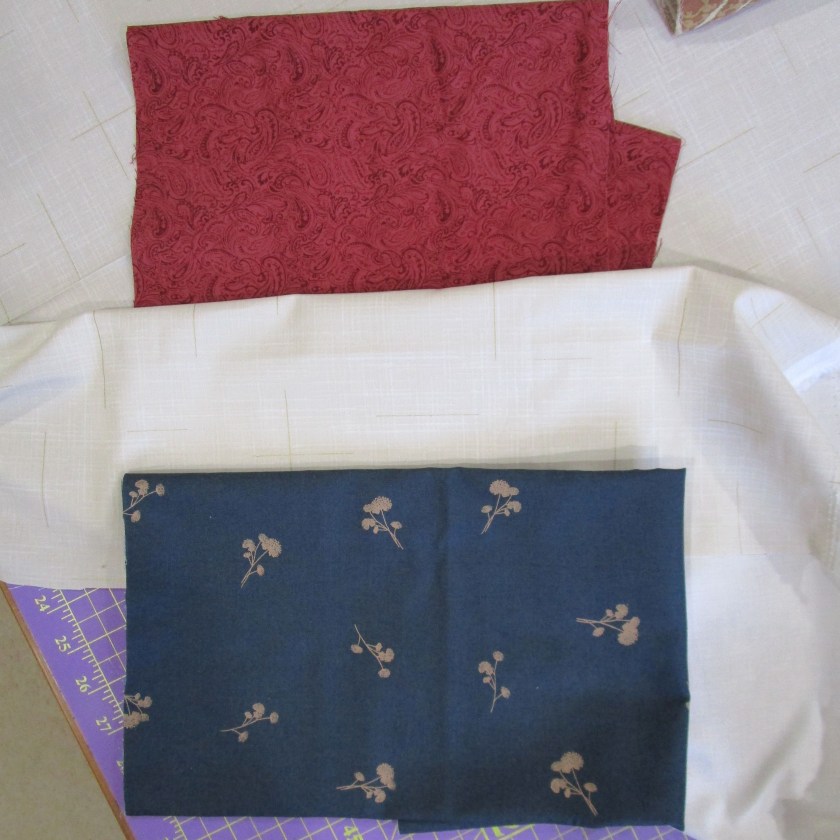
I tried to choose colors that were present in the center block.

From my mother’s stash
From my own stash
A few fabrics purchased from Hobby Lobby

Block categories: patchwork, Sashiko, Kamon (traditional family crests worked as applique or sashiko) and Takarazukushi (good fortune symbols worked in applique.)

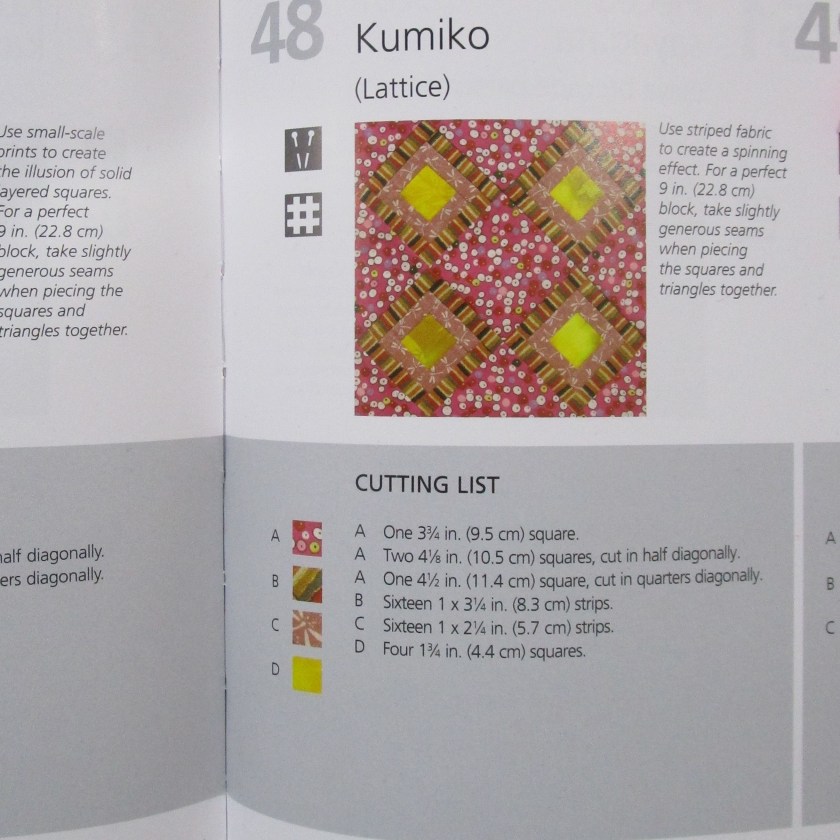
Now to the clue: Kathleen suggested King’s Crown pattern for this round, or choose a block that begins with a K, or that begins with the first letter of my name, L. I immediately thought of Log Cabin. But turning to my Japanese block design book, I saw no examples that looked like a log cabin. In studying the block names, I realized that the “L” sound is absent from the Japanese language! Lots of blocks start with a K. I settled on this pattern – Kumiko – which translates to Lattice.

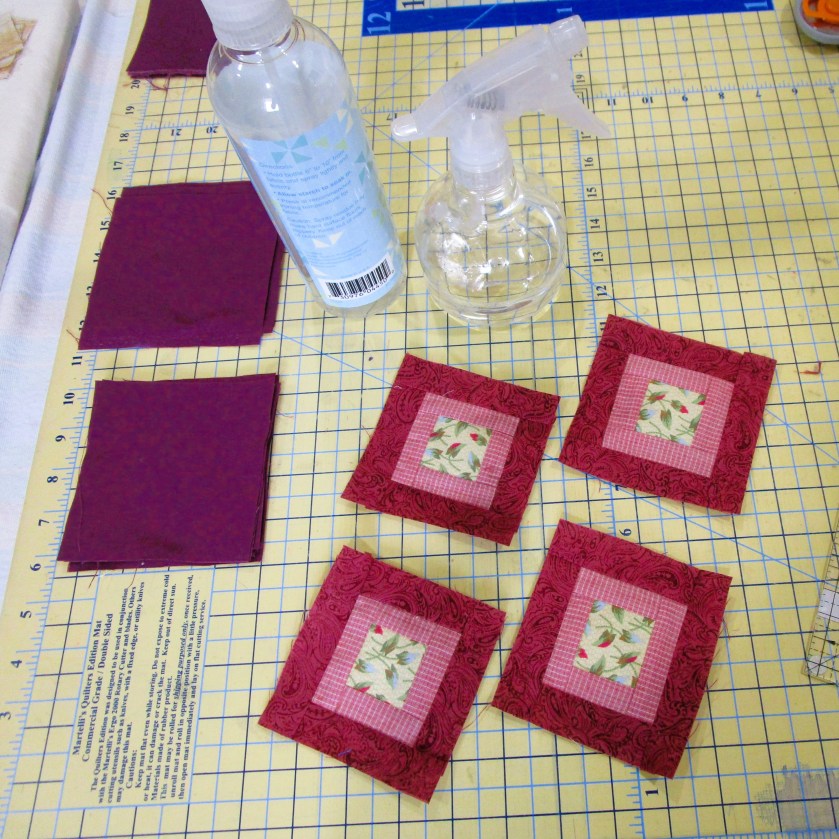
And its construction begins with making four strip-pieced squares built around a center square. Hm, that resembles the beginning of a log cabin.

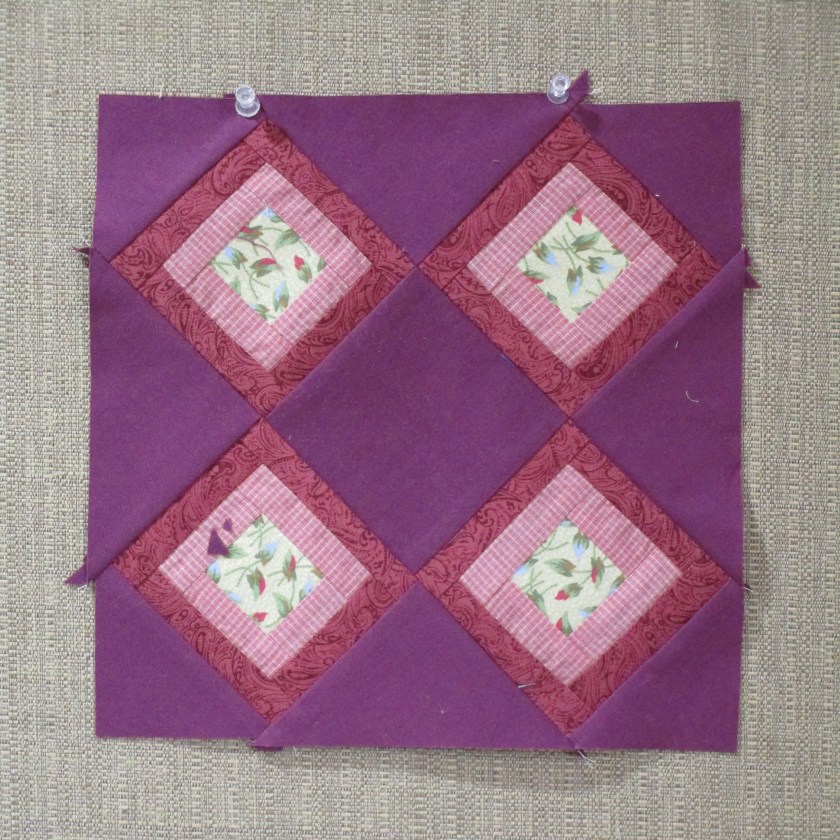
And here is my first block for Border One.

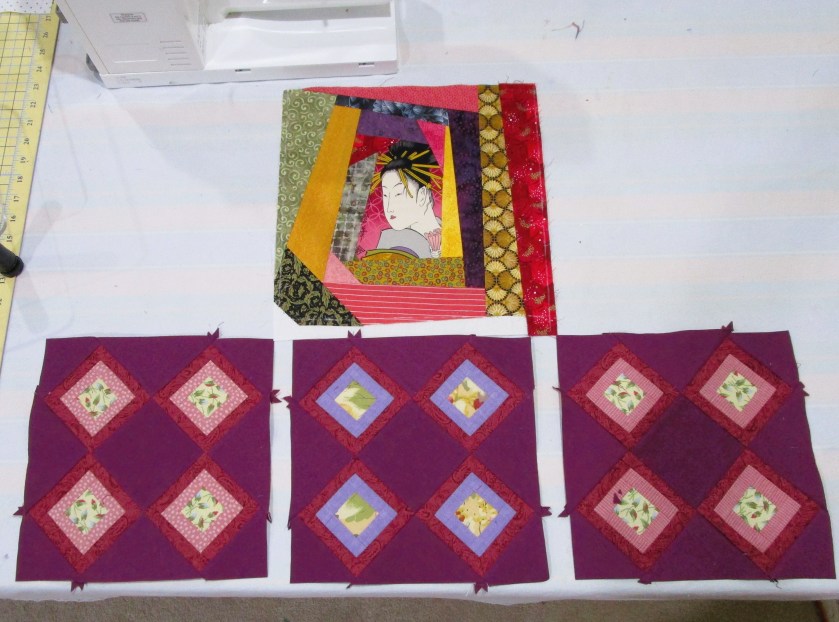
I ended up making three blocks, which I plan to place just below the center block row.

And so the first round is done, and my post written before the Linky party closes.

I see that my chosen path will hold much challenge if I stick to the plan.

If you want to follow along with Stay at Home Round Robin, here are the hosts and the weekly schedule. Check out their posts!

Posted in colorwork, knitting

Travel Project Frogged

In my last knitting post, I was starting a pair of socks worked with stash yarn.

https://dailyfiberfun.com/2024/06/25/casting-on-to-travel/

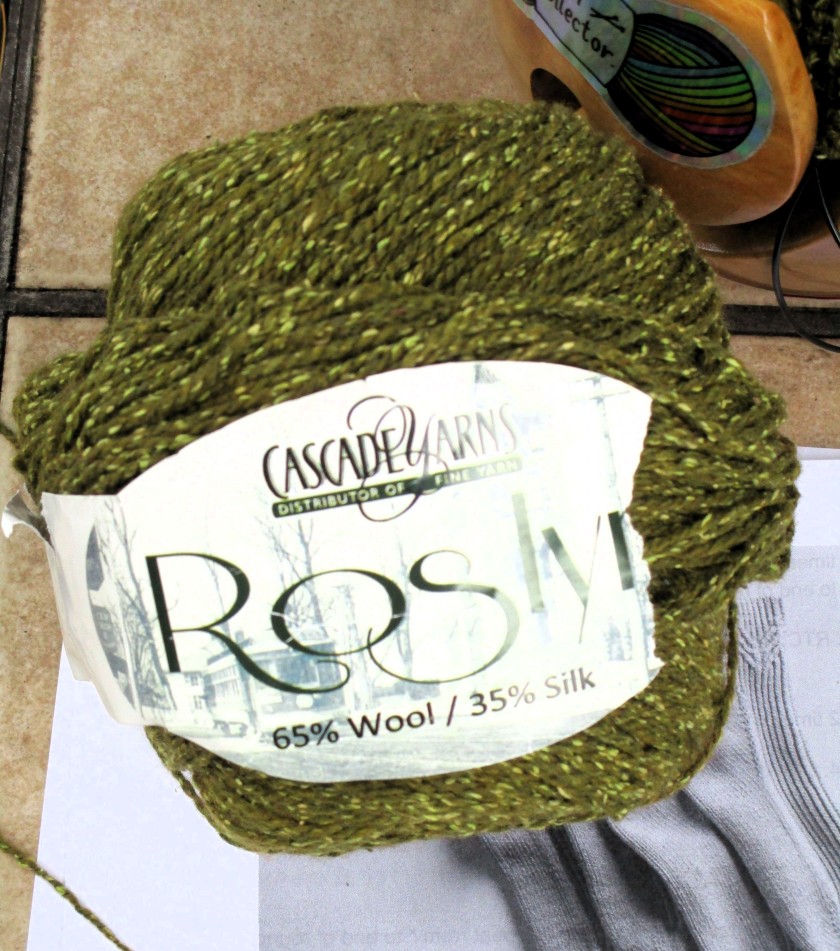
The yarn in question is Roslyn, by Cascade.

Well, the long and short of this story is that Roslyn is unsuited for socks. (Some of my readers tried to tell me that.) When I really paid attention to how the yarn behaved, it told me that it wanted to be a shawl. So, before we left for our trip, I ripped the sock off my needles and cast on a shawl.

I would really like to share the pattern I am using but alas, it eludes me. I remember printing it, using the printout to get started, memorizing the stitch pattern and then putting the paper pattern aside. It’s probably somewhere in Canada.

Photo taken in my Calgary hotel room.

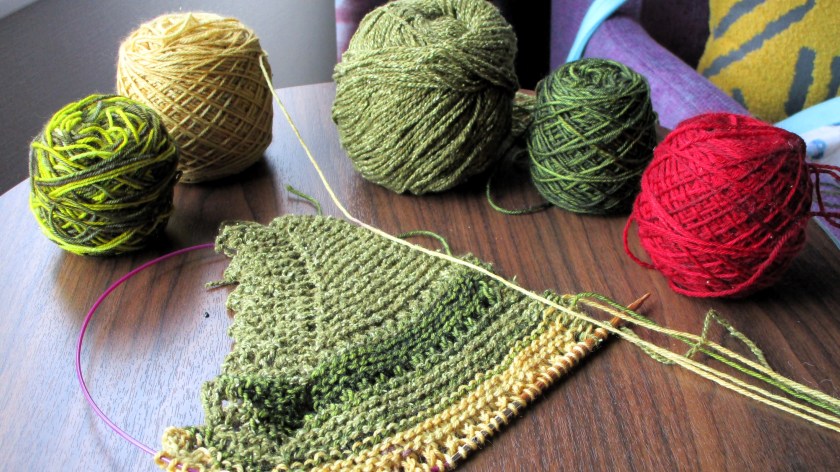
The good news is that my stash yielded four coordinating yarns in fingering weight to give color variation to this simple pattern for a point-to-point shawl with picot border. Since I was knitting on the fly, I decided to improvise the color changes.

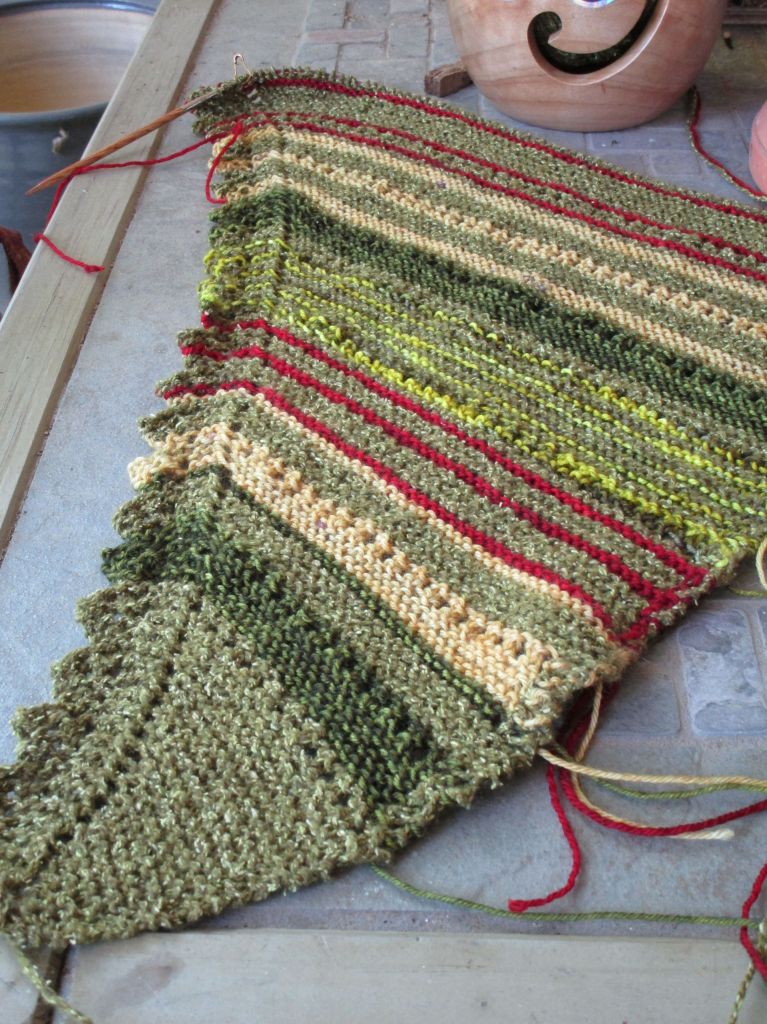
There is no pattern just some rules. The olive-colored Roslyn will be the background yarn, continued throughout the project. The four colors will rotate in and out at a fairly regular pace. Every so often, I will throw in a ridge of eyelet lace.

Oh, and the bright red yarn will appear only in single ridges, separated by the background yarn. It reminds me of pin striping.

This shawl could easily go on for weeks at this rate. It is a soothing knit.

I reserve the right to change a rule here or there, if it suits me.

Posted in quilting

Fabric Strips Saga: Chapter Three

My obsession with strips continues. First, let me share an image of the pieced abstract landscape that I have been working on most recently.

The work at this stage looks about as I expected, although I feel kind of let down by it. I’m also stumped as to how I will proceed with the surface embellishments and quilting. As I ponder, I have laid it aside.

Leftover strips are hanging out, and they keep drawing my attention. I started noodling around with them, cutting and sewing together. Since I had used the 1- and 1/4-inch-wide strips for the landscape art quilt, I wondered what else I could do with this size. Pulling out some 2 and 1/2 inch scraps, I start sewing strips together, again.

Well geez, first I need a little bit of structure to this game. How about a palette? I decide to try analogous colors. Pulling out my color wheel, I spun it around to show that teal blue color in the center, surrounded by its four closest relatives.

Now I am really in my comfort zone. My stash contains many scraps in this range, leftovers from some favorite projects.

If I sew two thin strips on either side of a 2 1/2 inch precut, then cut that piece down to four inches, I get a nice-looking square block. I decided to stick to monochromatic fabrics for each. Here are some examples.

Combining four of these gives me a seven and 1/2 inch square.

What if I sew four of these together?

Hm. To me it looks too busy while also looking kind of boring. I can do better.

How about inserting some sashing? I have a longing to try dark background fabric with this palette.

Now we’re talking. But to get more negative space into the picture, I could put the blocks on point and space them out with a background block.

Ah, the drama it beginning to happen. I sit down with graph paper and plot out a lap sized quilt using this on-point configuration.

This could be wonderful. Perhaps I can create focal points in the dark blocks by inserting some bits of hand-painted fabric. Something like this leaf, which is left over from my very first quilt.

Gosh I feel better. Going from a vague notion to a planned design is so satisfying. Even though I had no intention of sewing up another lap quilt, I’m ready to go. The trick will be to buy as little fabric as possible and still get the look I want. I’m up for that challenge as well.

Posted in quilting

In Progress: Pieced Landscape Art Quilt

Today I’m catching up on the abstract landscape quilt that I started in mid-May:

Obsessed by Strips

I would say nothing has changed, but I would be lying. During the planning phase, I started to think about Japanese quilts – most likely because I recently purchased two books on modern Japanese quilting by Susan Briscoe. She is a textile artist who worked in Japan for many years as an English teacher. In her book, Japanese Quilt Blocks to mix and match, she features 125 patchwork, applique and sashiko blocks in a modern style that is inspired by tradition. Textiles recycled from kimonos and other garments give the blocks an Asian look.

Consequently, I decided that my original plan was not abstract enough. I discarded the house block already constructed and made one using the Japanese block called Sunken Hearth.

In fact, I made two hearth blocks – one in bold colors for the middle ground and one in faded pastels for the background. This second block is located half-way up the mountain in the foggy part of the landscape.

I redrew the upper right corner of the design from clouds into a mountain. You could think of it as Mt. Fuji. The fabric is a white-on-white print of spirals, suggestive of clouds to me.

As of today, I am about 2 thirds finished with the piecing phase. I have completed four rows out of seven.

By the way, I have a new favorite tool:

This flexible flat-bottomed shape is a technical drawing tool that belongs to Bill. He got it back in his college days for a class. Using this tool, I can match up a long curve which crosses over two different blocks. I Love it.

One more Japanese touch will be added to the lower right corner. In the reference photograph, there is a group of red-twigged shrubs behind a stone wall. I plan to use the Pieced Ogi, aka Folding Fan, to abstract this feature.

Are you making something from your scraps? Do share.