Posted in colorwork, quilting

Thread Art Baby Portrait F.O.

This is a qualified finish. I still need to quilt the border and bind the edges. But the creative work is essentially done. I chose to use echo lines to quilt the background. The work went swiftly and smoothly.

The cotton damask fabric is a joy to work with. I had the benefit of a fresh needle in my machine, thanks to the delivery of my on-line order from Bluprint.com.

Following the example of Lola Jenkins, I used Prismacolor pencils to color the image. I had never tried this medium on fabric before. But by working slowly and carefully, I managed okay, rendering shadow and highlights modestly. Here she is as of today.

Here is a close-up of the subject.

I noticed that a damask vine landed smack in the middle of her onesie. I didn’t plan that placement, but serendipity happens. So I chose to leave it unpainted and embroidered a running stitch around it.

At 18 inches square, this piece is a good size for framing or mounting on artist canvas. Perhaps the arts supply store will open soon and I can buy what I need. In the meantime, she will be tacked up on one of my foamboard panels, allowing me to admire her on a regular basis.

Posted in colorwork, painting, quilting

Painting Thread

So far I have found myself frequently frustrated while shopping in my local craft store for decorative topstitch thread. My local craft store, which is a Hobby Lobby ( I have a love-hate relationship with H-L,) has a limited selection of quilting threads, none of which are what I am wanting for my current project. And the threads that are available are not particularly affordable.

I have nothing to lose in experimenting with painting my own thread. (Not be confused with thread painting, a hand embroidery craft in which stitches are worked densely to create a painterly landscape of thread on fabric.) I have everything I need.

1. A 50 gram spool of 100% cotton DMC thread no. 10 in an off-white color. 2 Assorted jars of Jacquard Dye-Na-Flo fabric paint. 3. water proof freezer paper. 4. latex gloves.

After coiling several yards of thread and tying them together with string, I let the thread soak in the paint for about ten minutes. Wearing latex gloves I lifted the coil from the paint, squeezed out the excess and laid the threads on paper. Drying took several hours. The next day I pressed the dried thread with a hot iron, under a pressing cloth, for about 30 seconds. This was my attempt to fix the color. Because Jacquard Dye-Na-Flo is an acrylic paint, it is essentially color-fast from the moment it dries. But if you want to use the paint on an item that will be washed, I would recommend letting it cure for at least a week before washing.

Here are my hand-painted threads wound on spools.

I love that the paint gave the thread a variegated effect. I’m not sure if this happened because I mixed paint colors together or because I had a cord tied around the coil. It certainly makes for a splashy look.

Airplane is in natural thread. Moon is stitched with painted thread.

So far I haven’t noticed any color bleed on my sample fabric. Tomorrow I will start using it on my quilt. I’m excited to see how that goes.

Posted in quilting

Back to the Scrap Heap

I’m taking a break from knitting and painting to do a little sewing.  Some may recall my brief panic the day I realized what happens to my studio as a consequence of quilting.

Crazy Out-of-Control Scrap Heap

After spending time perusing other quilt blogs to find out how other quilters deal with this situation, I found part of the solution in the form of quilted buckets.  This lesson comes to us from Christina Cameli and Bluprint.com.

https://shop.mybluprint.com/quilting/classes/free-motion-quilted-gifts/673670

So yesterday I started on my first of three fabric buckets that (I hope) will contain my fabric-waiting-to-be-used.  This project is also an opportunity for me to practice free motion quilting while adding color and style to my studio. Her are my fabric choices for the first bucket.

120619a
Pink for the outside and gray for the lining.

I’m quilting dimensional triangles for this bucket.  Here is the first step done.

120619b
I had to use a chalk pencil to keep my row straight.

The next few hours were spent happily quilting.  Eventually the first basket was finished.

120619c
Some inch-wide grosgrain ribbon I found became the basket handles.

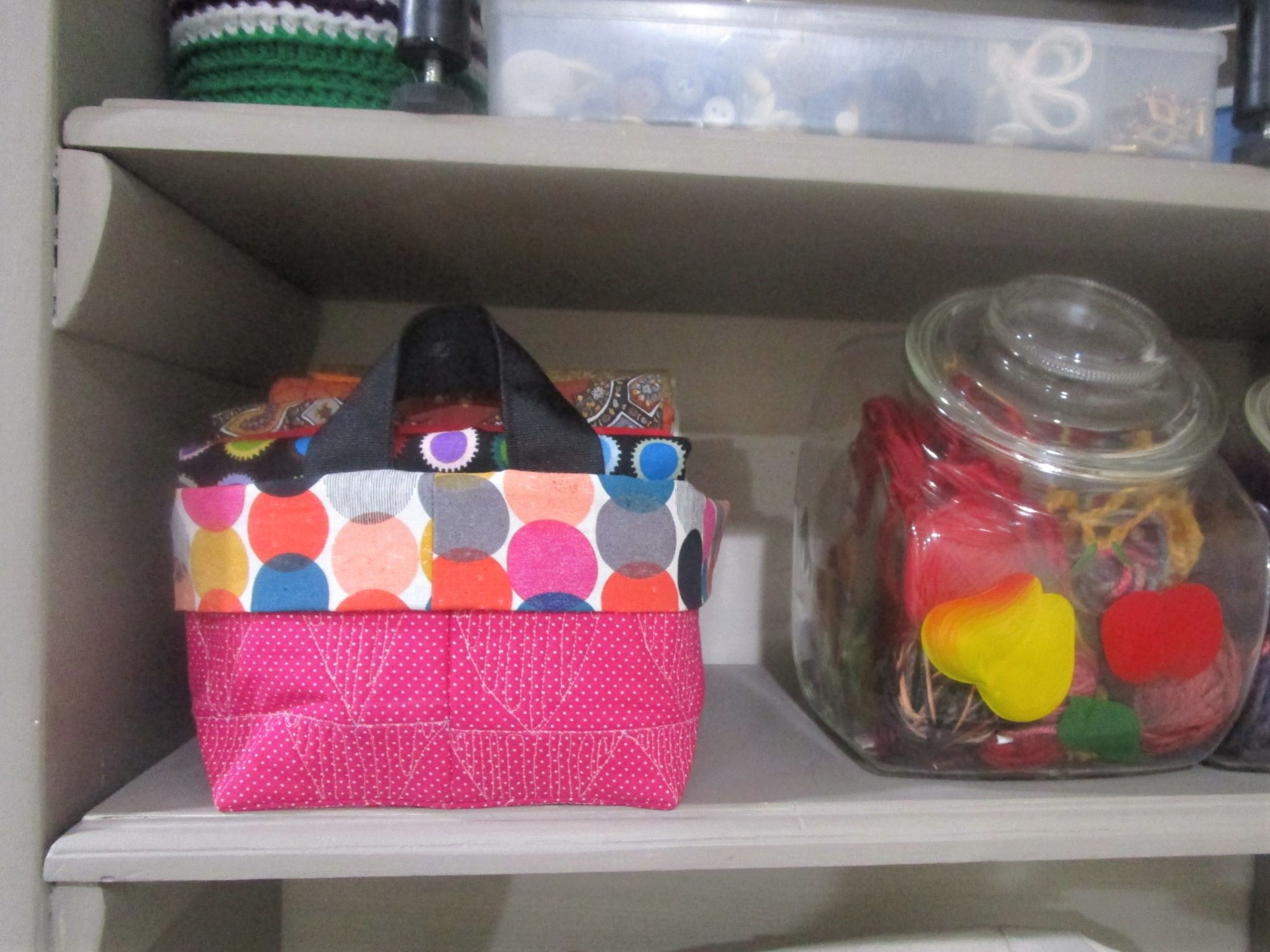
I have to admit that I sewed up the wrong sides of the baskets, so my basket is actually two inches longer than the one in the lesson. This turned out to be fortunate. The revised dimension held lots of fabric and fit nicely into the allotted space on my shelves.

120619d

I used the Kon-Marie method of folding the fabric and filled the bucket with the folded fabric pieces inserted on edge. It was amazing to see how much fabric this little bucket holds.  Each fabric piece remains clearly visible and easy to grab.

So my plan now is to make three more buckets to use in storing 1 yard and fat quarter size pieces, and to make some smaller baskets for the various colors of scraps.

I highly recommend Christina Cameli’s class. She is delightful instructor.  Each of her projects can be made in an afternoon and would make wonderful gifts.

Posted in quilting, recycling, sewing

Crazy Out-of-Control Scrap Heap

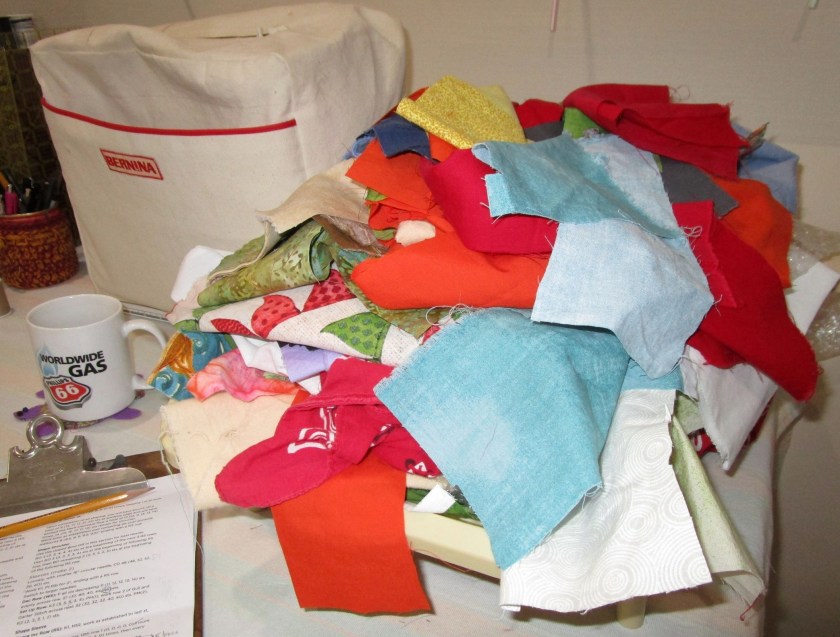
This past summer has been a wonderful time of learning for the fiber artist in me. I have viewed dozens of tutorials, focused primarily on quilting. “Don’t ever throw away your scraps,” is advice that I heard from an art quilter, early in my training. Well, I took her advice, and look where it has got me. I desperately need a system for managing these fabric pieces!

By nature I am not a messy person. I like to make my bed and wash the dishes. When I began my journey with fiber, I organized a space which I believed possessed ample work room and plenty of storage for tools and materials. It was great, as long as I stuck to yarn crafts. But once I ventured into fabric work, things went wonky. (FYI “wonky” is a technical term used by quilters.)

I share my closet with the family’s camping equipment. It also houses the ironing board, a small set of drawers and shelves for my yarn stash. The stash is relatively modest, but it now fills the shelves. My bookcases contain paint, books, tools, my fabric stash and sewing machine. But the scraps have proven recalcitrant. If left tossed in a basket, they are impossible to work with.

So this is my plea: Who of you has solved the Scraps Dilemma, and will you share your solution with me, a frustrated fiber artist?

Posted in knitting, recycling

A Little Remake

In March my daughter gave me three garments that were in need of a remake. I have already dealt with the silk blouse and the brown cardigan. The third was a blue wool baby sweater which got machine washed in hot water by mistake. The consequence was that it thoroughly felted and shrank down to the size of a doll’s coat.

I had been mulling over what I can make from a felted sweater. No ideas came forth. Then I shifted my thinking and considered what could be done with the felt itself? Remembering a conversation that I had with my grandson, about the poor performance of hand-knitted mittens in wet snow, I hit upon the idea of felt mittens. Melting snow will rarely, if ever, penetrate a heavy felt garment. Could I make mittens for the baby with this felt?

To start with, I cut off the sleeves. They looked vaguely mitten-like.

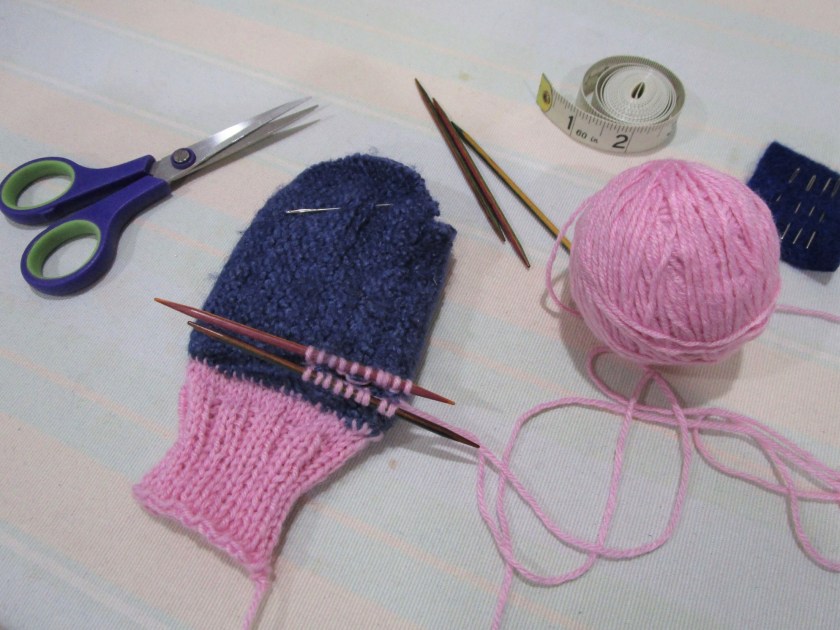
Using a crewel needle and sock yarn, I blanket-stitched around the lower edges of the sleeves. Then I picked up and knit into the blanket stitches and joined for knitting in the round. I knitted the cuff downward in rounds. After a few rounds, I started 2×2 ribbing for about an inch. Then I decreased, knitting another five rounds and bound off loosely.

Cuff finished. Beginning thumb for right hand mitten.

The process for the thumb was similar, except I had to slice a one-inch gash in the heavy felt. About eight rounds of knitting later, I decreased with k2tog, pulled the yarn through the remaining loops and fastened off.

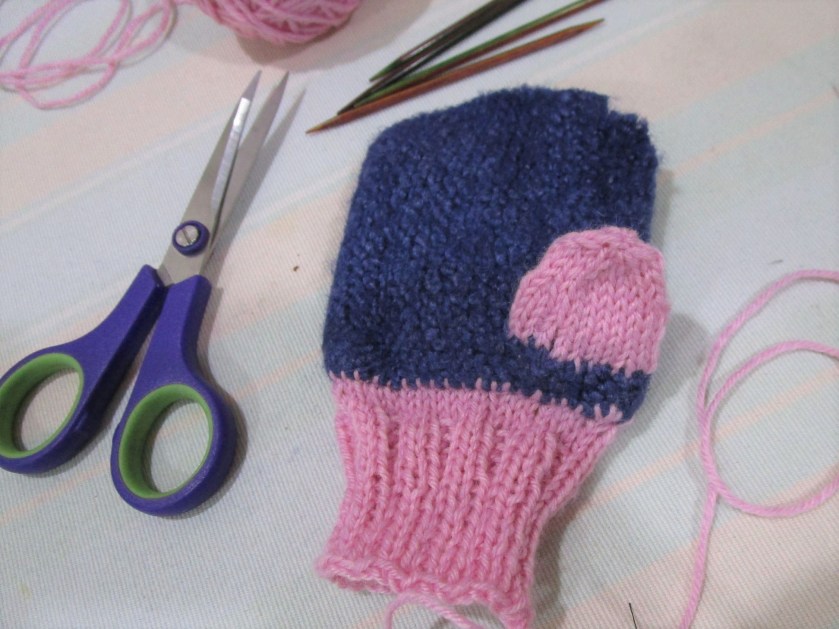
Here comes the fun part. I cut down the top edge, making the total length of the mitten 5 inches. The upper edge was closed with running stitch and then sewn with blanket stitch all around. Using pink and red yarn, I embroidered a heart on the back of the mitten.

The letter R is for Right Hand Mitten!

Right hand mitten is done. I do hope that this will be a workable mitten. Now to make the left hand mitten to match.

Rainbow Beanie Baby, holding the mitten for me while I make the second one.
Right-Hand Mitten’s buddy has arrived.