Posted in quilting

SAHRR Round #5: Moving forward with 4

Our quilting guru for this round is Quilting Gail. She has suggested that we make this border inspired by the number 4. That can cover a lot of turf. One could use blocks made of 4 patches, or 4 different colors in the block, or build the border to be 4 inches wide, or all of the above. Here are the fabrics I have selected for the bottom row of my SAHRR quilt.
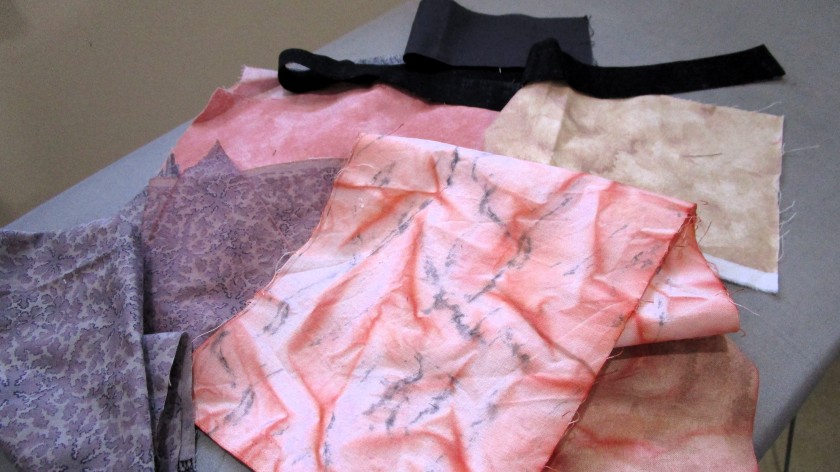
The warm and earthy palette of this round is informed by the colors of the American Southwest desert. My goal is to depict a (deadly) drought.

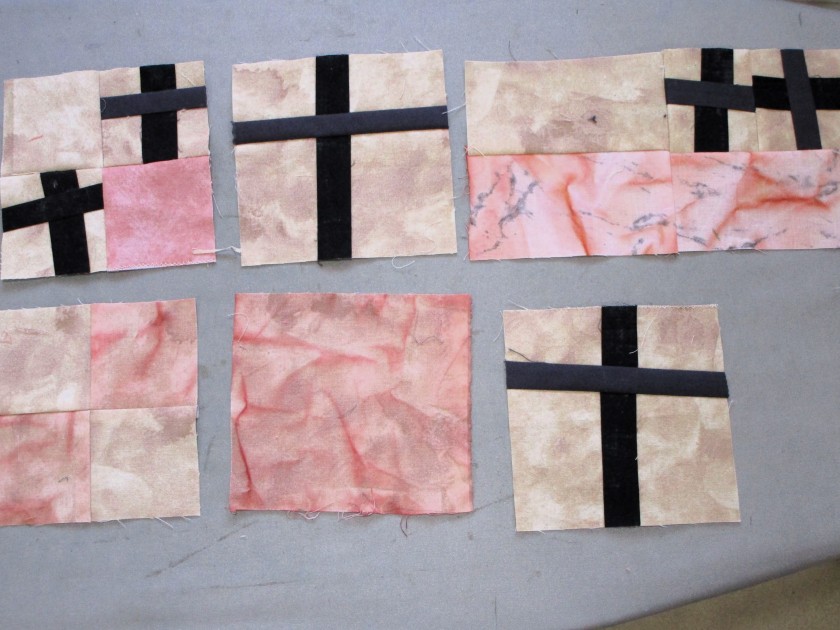
Here are the aspects of my border that accomodate the number four. I started with a piece of fabric about 5 inches square. I then transected it vertically, inserted a strip of black, cut across the block and inserted another strip. Four sections are divided by the sign of a cross. I proceeded to make four blocks containing crosses.

I also made a few four patch blocks, a few blocks sewn from 2 1/2 inch strips and a few one-piece blocks.

Here is my collection of blocks for the four-inch bottom border.
After this week, my quilt looks like this:

There is much left to do before I can proceed with round 6. I need to make the left and right borders of this round. I also need to finalize the top border, which now contains the fishy square in squares. While I will be seeking additional inspiration, I can reveal one thing: There will be more butterflies landing on these borders.

If you are curious to see how other Stay at Home Round Robin challenge participants have interpreted this week’s prompt, you can find the link to their posts here.

Posted in quilting

SAHRR 2024 Challenge 3: Brave World

Our host for the Stay at Home Round Robin challenge this week is The Darling Dogwood. She suggested that we use triangles. That should not be difficult to achieve. Many, many traditional blocks are made of triangular pieces. I decided to browse the very useful Quilter’s Recipe Book, by Celia Eddy to get some ideas that would work well with my design. In addition to using triangles, I needed a pattern that was not too difficult and would work well in a long row.

Here’s a four-square block called Brave World.

Each unit is composed of three triangles and a square and four units make up one block. I have specific plans for the square piece, so I say yes to Brave World. But to make it work for my border, I will only make 2 units. Here are two test blocks:

This photograph gives you a broad hint at the subject matter for this week. I have fabric with some animal silhouettes. These are the creatures of the forest and arctic ice that have been displaced by fire and melt. I also have some beehives. No bees though. They are out of the picture for now.

Bottom edge border

Right-side border

Lower right corner

And here is my quilt at the conclusion of the round.

I like the way that the triangles in round one are in conversation with the triangles in this round. You may notice the white sashing. I am using this design feature to outline the borders like a snail’s trail. My quilt is now 30 inches square.

Thanks for stopping by. If you want to see the work of other quilters who are taking the challenge, enter the linky party HERE.

Posted in sewing

Stash-Busting Border

I’m onto a new project that, I hope, will enhance my home while using up a ton of fabric scraps that are stacking up in my studio. It all started when I got tired of looking at the naked drapery rod over my bedroom window.

So I did what any practical woman would do. I browsed images in Pinterest to find out what is trending in home decor these days. Here’s what grabbed my attention:

QUILTED BORDER ON PLEATED DRAPES

I like the look, but wasn’t too keen to make this curvy pattern. Instead, I seek to emulate the look of slate mosaic, like the tile border in my shower.

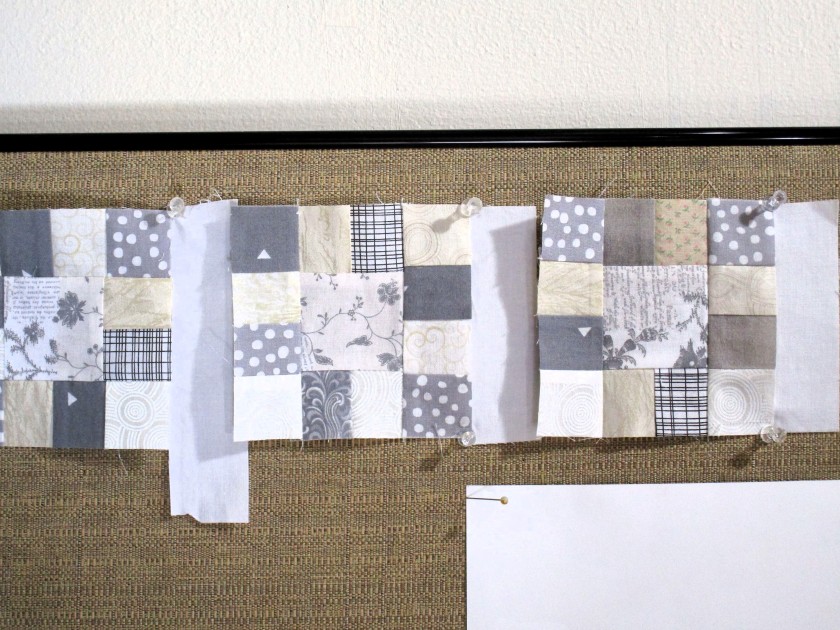
Settling on a pattern of 1-inch squares surrounding a 2-inch center, I pulled all the gray, beige and white fabric left over from my past quilt projects. Next,I sliced them into 1 and 1/2 inch strips, then sewed these together in twos, and fours.

The white strips will serve as sashing between blocks.

Strip sets on the work table.

Attaching the strips to the center, cutting back extra.

After three sessions, I have 25 blocks made with low volume, neutral colors. My estimate is that I will need about 30 for the two borders, depending on how long my draperies end up.

Time to lay out a few to see how the border might look.

Gosh this would be easier if I had a design wall (sigh.) Maybe I’ll have room for that in the next house.

Posted in quilting

SAHRR 2023 Round 6: So Close

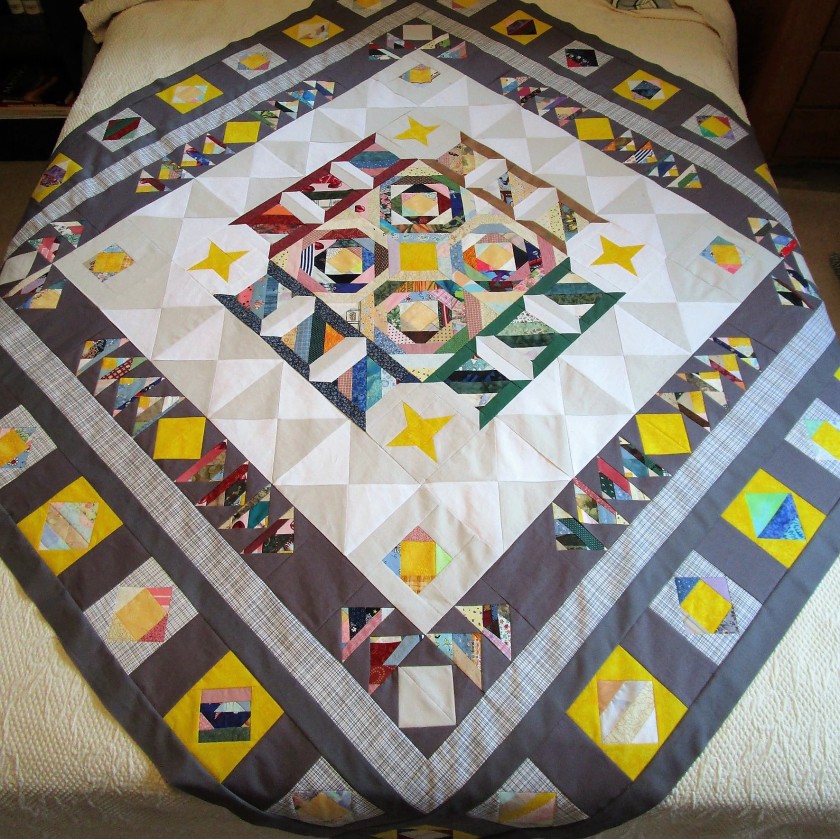
It’s the last round of the Stay At Home Round Robin quilt challenge and I’m feeling glum. By the time I finished sewing on the coping strip, row and setting triangles of round five, my scrappy quilt measured 90 inches tall by 68 inches wide.

It is large and full and colorful. Clearly it wants to be a queen-sized bed quilt. And it’s crying out for more areas of background fabric to give some calm in the storm.

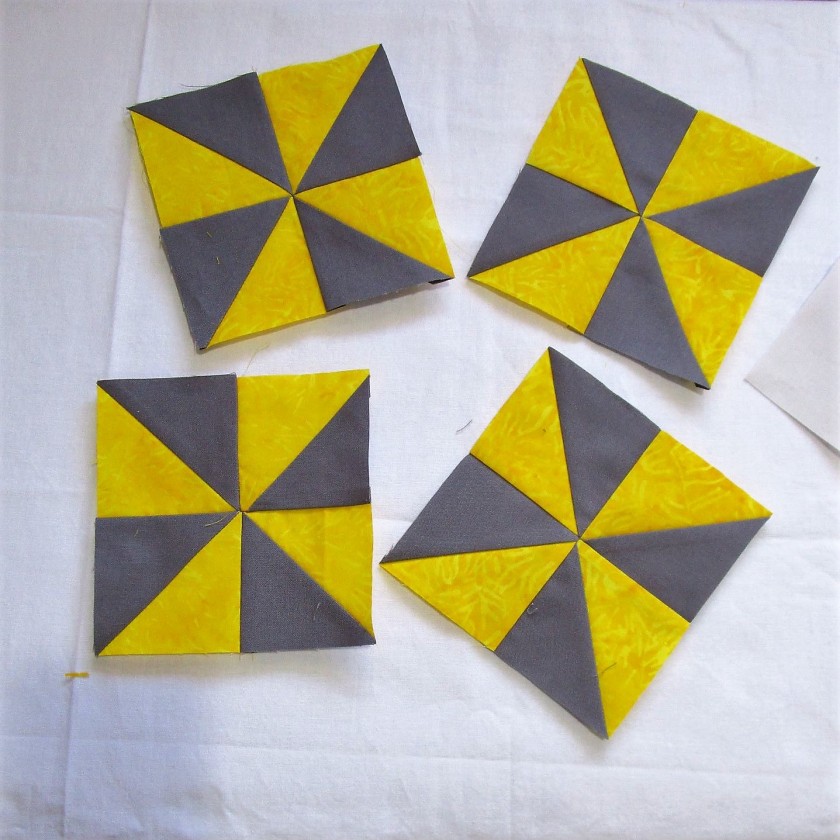
I am having trouble imagining how I could wedge in some pinwheel blocks as selected by Quilting Gail.

But I’m no quitter. I made four not-big pinwheels, trusting that they will fit in.

Somewhere.

One thought I have is to insert the pinwheels into square-in-square blocks of background fabric, then slip those blocks into the corners of the last rows.

Anyway, I’ll try to cheer up. After all, I have almost two weeks to finish the top before the quilt parade deadline.

Posted in quilting

2023 SAHRR Round 3 – Hourglass Block

This week Chris Knits and Sews is choosing the block and providing the linky party for quilting participants to post their work in the annual round robin challenge.

https://wordpress.com/read/feeds/32776/posts/4536905279

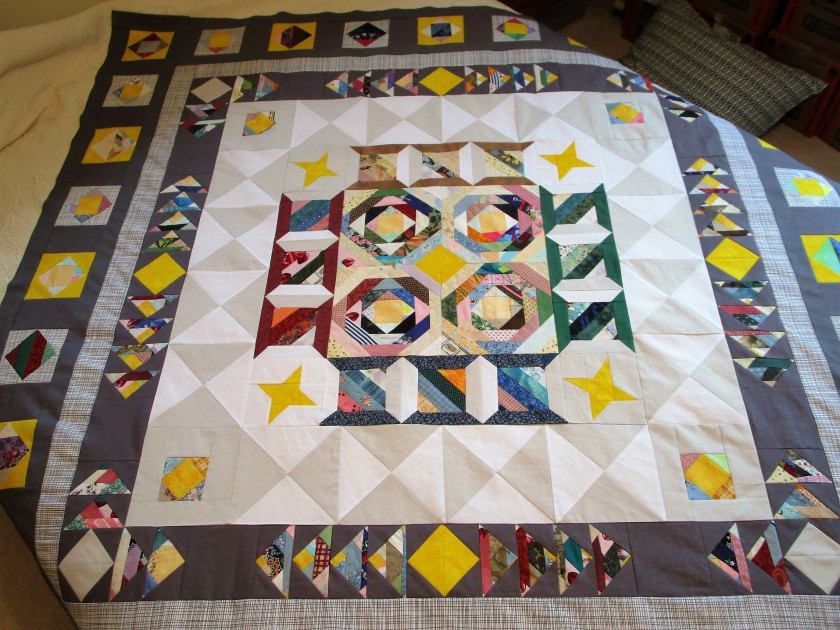
I approached this round with a plan to give some rest for the eye from the colorful center. Here is my quilt at the end of the last round.

I used two colors of background fabric to make the hourglass blocks. Here is one row attached to my quilt.

For the corner blocks, I cut the centers out of some pineapple blocks.

They are about 3 inches square. Next I sewed strips of light grey fabrics around all four sides to bring the corners up to the correct size.

I think they are pretty.

After attaching the corners to the last two strips of hourglass blocks I stitched them to the quilt.

What I learned from this round:

1 It pays to work slowly in sewing the blocks together to ensure a very accurate seam allowance. If one seams is too narrow or wide, it’s worth it to rip back and re-sew.

2. Sometimes it’s okay to press a seam open, particularly when sharp points are involved. It can help diminish lumps and bumps.

So far I’m having lots of fun making a stay-at-home round robin quilt. If you’d like to sew along, here is the list of the hosts and rounds.