Posted in painting

#WorldWatercolorMonth Two More Days

It’s been a quiet week-end here at the studio. I have definitely been absorbed by painting.

Today I have two images to share. The prompt for July 3rd was Playful. I chose to paint some dolphins in a pool with their toys.

This is technically a mixed-media painting. I started out by scribbling on the white paper with white crayon to create a wax resist. I also used a little white gel pen, to see if it would resist the paint. And finally, I brushed on the traditional drawing gum resist. The frothy effect is the crayon. The white ring in the lower right corner is the gel pen, and the white marks on the dolphins’ heads is the gum. After applying the paint, I came back with black micron pen to add detail to the dolphins.

This was a fun and fairly quick painting. I like that it looks like a storybook illustration.

The prompt for July 4th was the word Quiet. Immediately I thought about a sleeping baby. If the baby is sleeping, momma tells everyone to Be Quiet! But then, I thought about sleeping owls. They also nap during daylight hours.

I found a good photograph of two sleepy owls, and made this sketch of it:

I really liked the sketch and was excited to render the image in water color. This was to be a traditional painting, with nothing but watercolor paints on top of a few pencil marks.
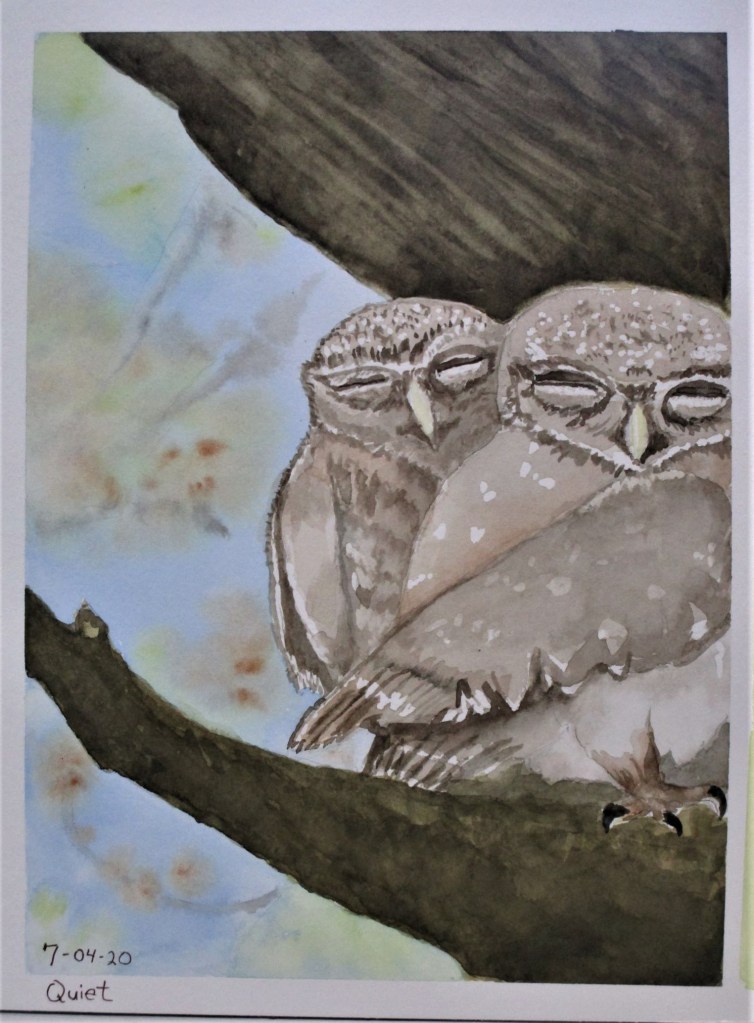
It took me all afternoon, because I had to wait for each wash to dry thoroughly before continuing. I reserved the white of the owls’ feathers with drawing gum resist. Completing the painting was satisfying, although some areas are not quite as I had intended them to be.

While the pose I rendered is exactly like the photograph, there is a some mystery about the image. Can you see the wing of the little owl on the left? It is tucked by its side. And yet, something that seems to be a wing is lying on top of the tucked-in wing. After thinking about this, there’s only one logical conclusion: The larger owl has its right wing wrapped around the smaller owl.

What do you think? Do owls give hugs? Or did the internet photographer doctor up the photo?

Posted in painting

Inspired by Nat GEO

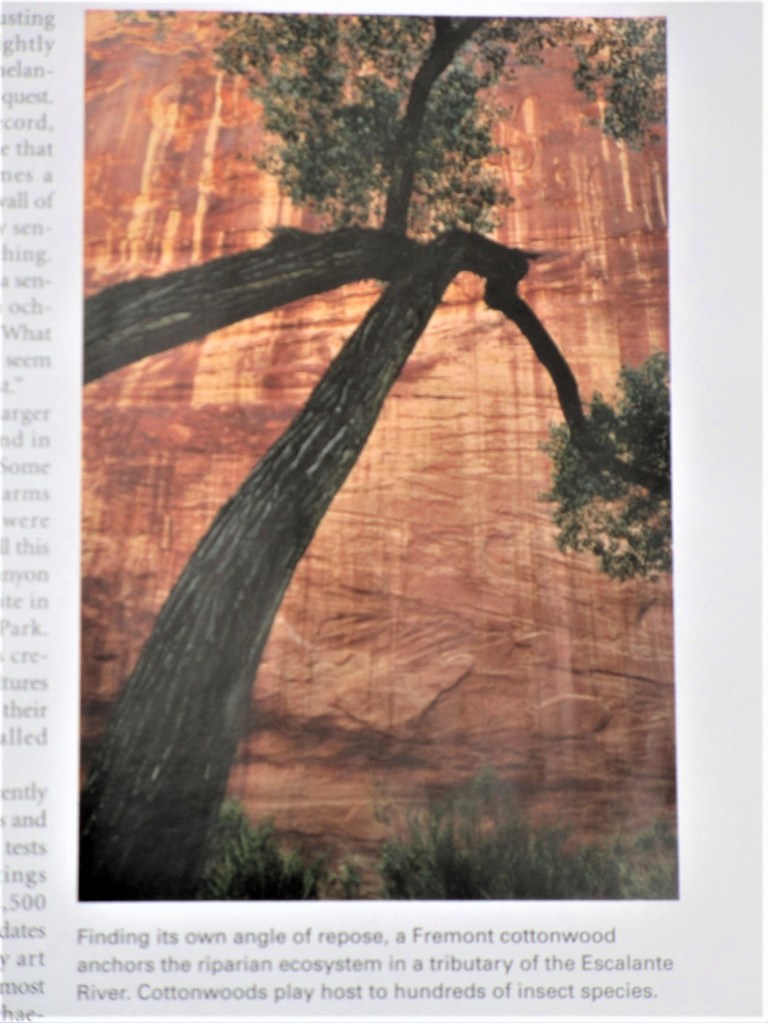
While organizing the reading material in my studio, I came across a National Geographic magazine from 2007 that I had saved for some reason. There were no bookmarks or post-it notes attached. So I asked myself: why did this issue end up here? The only thing to do is thumb through it and sees what jumps out. I stopped at page 147.

The photographer captured a tortured cottonwood on the Colorado Plateau, which is an area that sprawls across four states and contains a vast expanse of sedimentary rock. The plateau is carved by the Colorado and other rivers. This particular cottonwood is on the banks of the Escalante River in Utah. The dramatic sandstone cliff behind the tree forms a warm backdrop to the massive black branches. It’s as if the tree is embracing the cliff. I knew right away that I wanted to paint it.

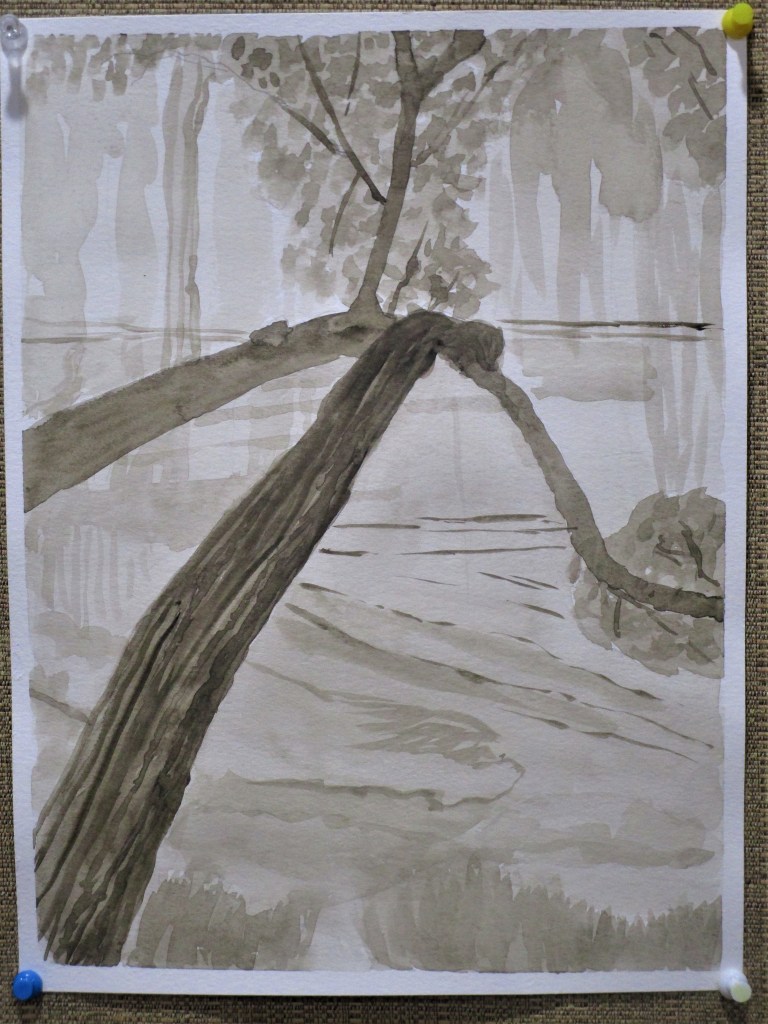
Instead of just jumping in and fooling around with paint and brushes, I studied the subject a little. Following the classic approach to painting, I first made a value study. This involves working out the light-to-dark areas of the image in a monotone. I had no gray paint, so I chose to paint the value study in sepia hues.

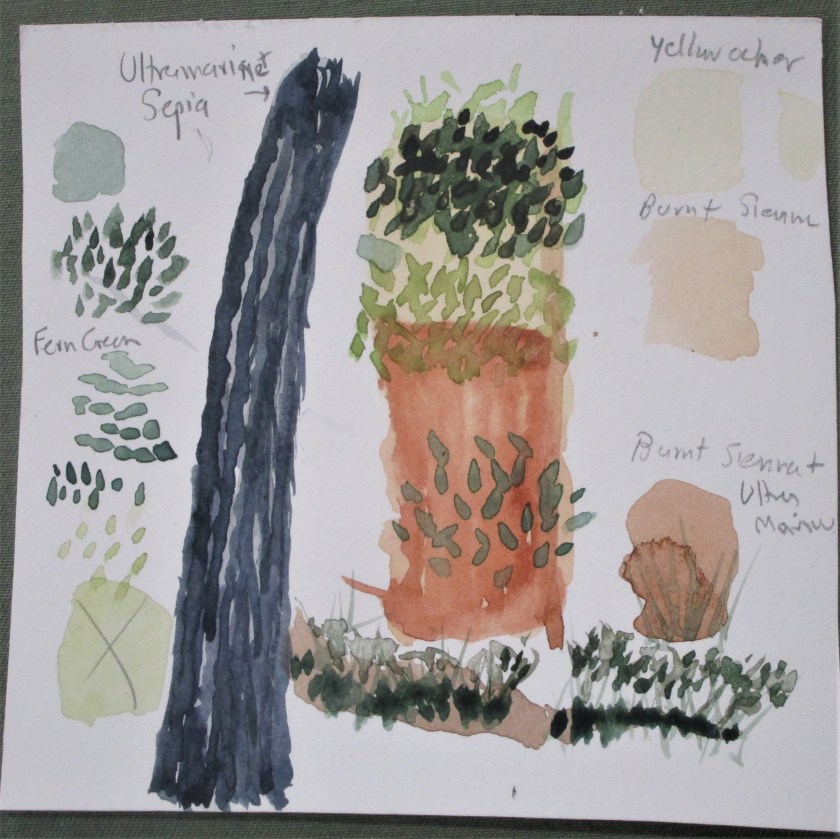
That seemed to go well. I was satisfied with this study. Next I worked out my palette. I had a little fun, making my paint swatches into parts and pieces of the image.

The palette will be yellow ocher, burnt sienna, sepia brown, ultramarine blue and fern green. My gestural study, using the selected palette, was next. I don’t have a photograph of this step. What I learned from that step was that the stone cliff is composed entirely of warm hues. So I chose to paint the tree in cool hues. As I worked through my studies, it became clear that this subject is all about the focal point. Having realized this, I knew it would be my task to eliminate any parts of the background that distracted.

After sketching in the outline of the tree branches, I applied an overall wash, and then laid down some burnt sienna on the cliff face.

The cottonwood looks ghostly. Focal point is where the branches intersect.

A landscape watercolor can take several steps to paint. I ended up painting four different layers, each of which needed drying time before I could proceed. Here is the painting after the second and third layers were complete.

I let it dry overnight. The next day I worked in the final details, adding another layer of darker leaves, some shading and shadows on the tree trunk, and some fine lines in burnt sienna on the cliff face. I tried to emphasize the detail lines that directed the eye to the focal point. After these parts dried, I glazed the whole background with a thin layer of yellow ocher and finally worked some textural lines onto the trunk.

Finished Painting. Cottonwood on the Escalante River

The finished painting is definitely better than I had expected it to be. The only fly in my ointment is that I didn’t use artists’ quality paper. So there is some buckling to deal with. Does anyone have recommendations on how to flatten the paper out?