Posted in painting

Watercolor Wednesday: Playtime

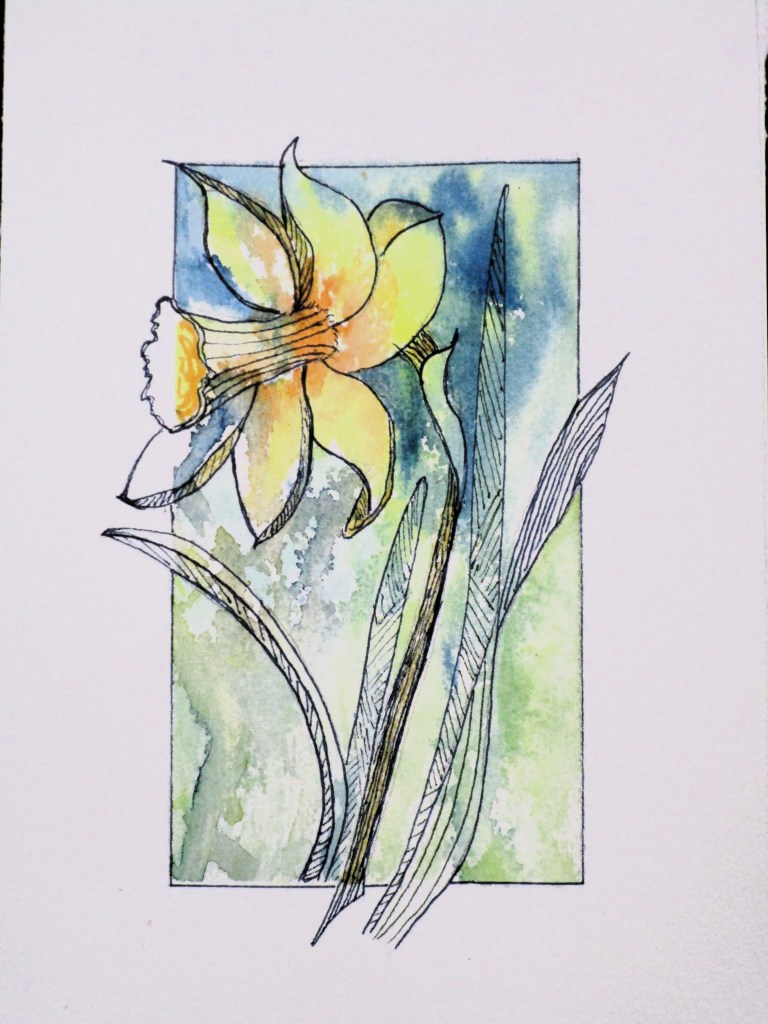
There was quite a crowd at today’s Open Studio. Cheryl Bryan decided that this session would be focused on playing with our paint. She brought examples of daffodils rendered in a stylized fashion using watercolor and pen.

Watercolor painted and photographed by Cheryl Bryan

I have been struggling with painting lately, so it was very therapeutic for me to let go and try stuff. Here is my 3 by 5 1/2 single daffodil based on the reference image.

After making the drawing with pencil, the panel was taped off and splashed with water Three colors were selected, dropped on the wet paper and encouraged to run. I used Winsor yellow, transparent orange and Prussian blue.

The paint was allowed to dry, then additional paint worked in, mostly around the edges and into the background. After drying thoroughly, the tape was removed and lines worked over the painting. I used a dark blue Micron pen. It was fun to let the elements of the image slip outside the border.

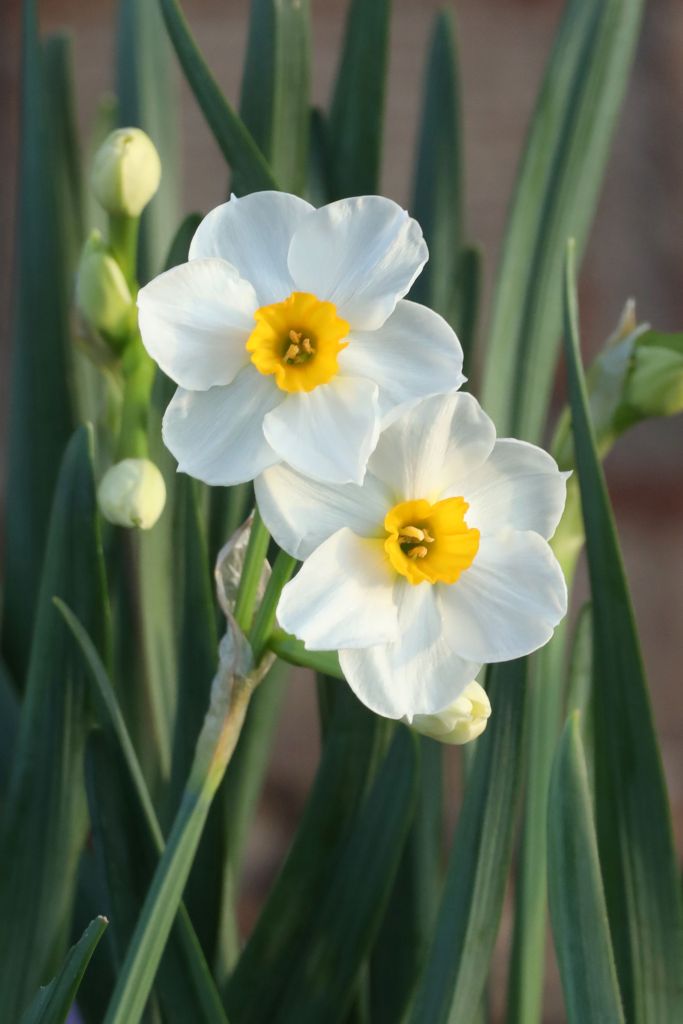
Next, I pulled out one of Bill’s photographs. He loves shooting images of the daffodils in our front yard. This variety is called geranium. They have tiny clusters of three or so flowers topping each plant.

copyright Bill Riley

Using the same technique, I worked these cuties in a cool palette of carbazole violet, quinacridone magenta and Prussian blue.

I intensified the color in the short trumpets with some watercolor pencil in gold and dark magenta.

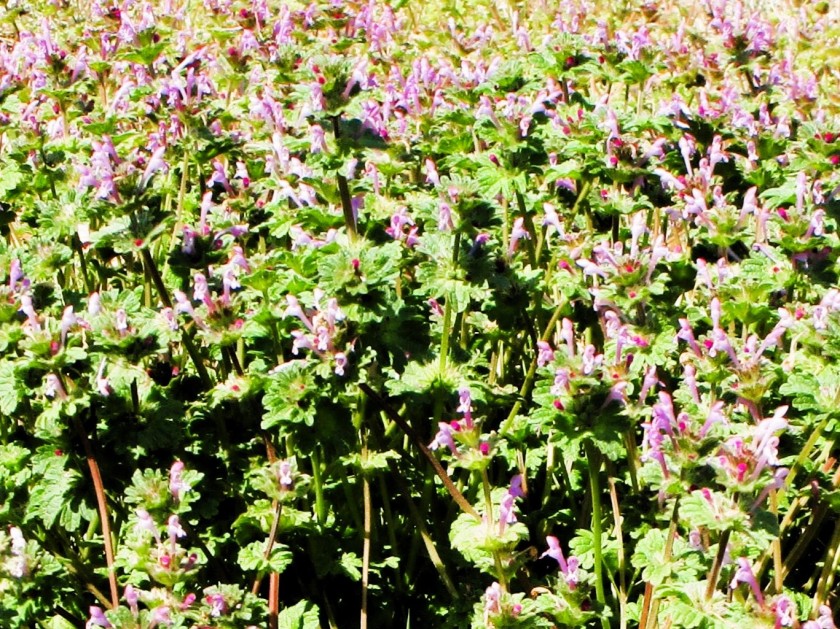
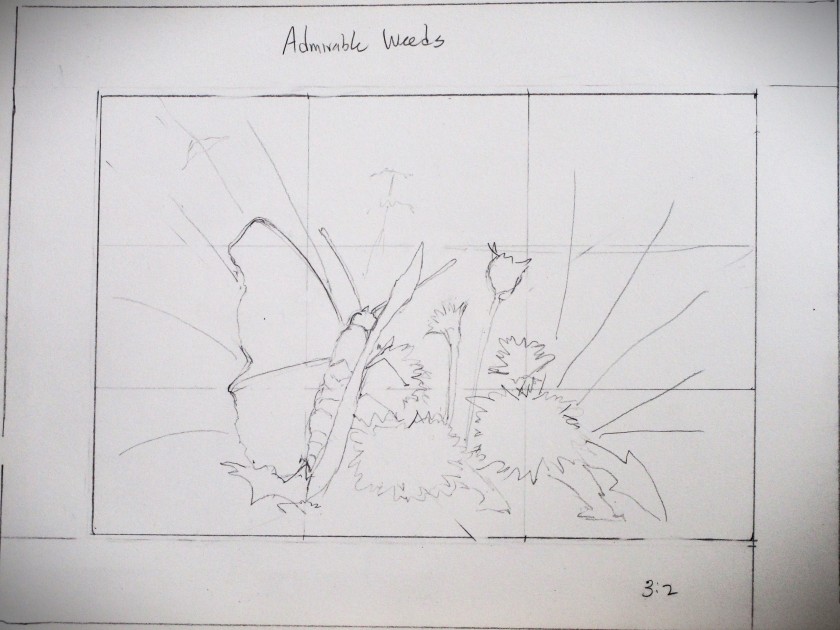
Despite the crowded room, I ended the session feeling relaxed and confident. Now I am ready to return to a slightly bigger painting that I have started, which features a butterfly and some spring weeds. Stay tuned.

To see some of Cheryl’s gorgeous watercolor paintings, you can visit her website:

https://cibstad07.wixsite.com/mysite-1/about

Posted in knitting, painting

Friday Finishes (Yes, two!)

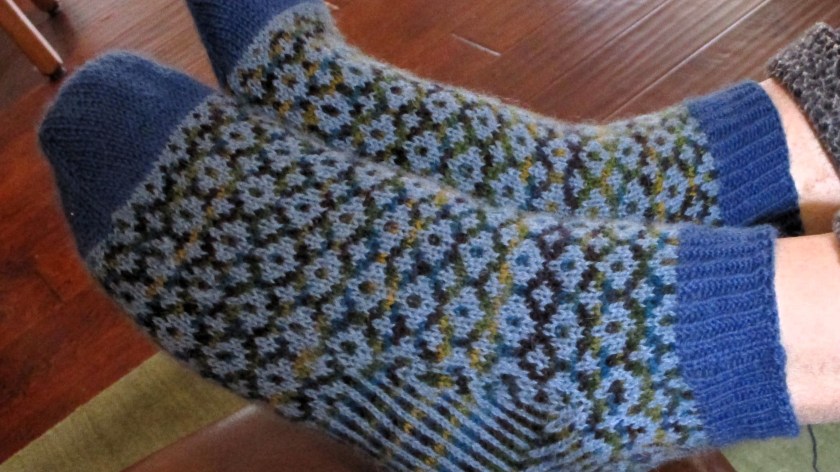
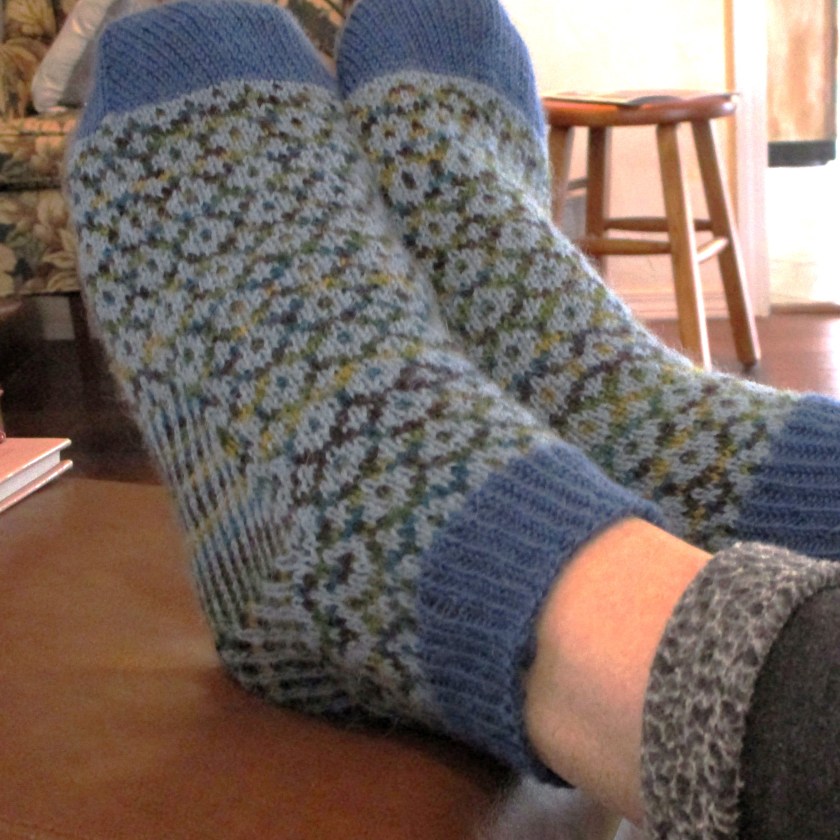
It’s been a pleasant and productive week for me. You see in the image that I have finished the second sock of the Mary Delany pattern.

This is the first time I have stranded two yarns across the heel. For the past few years I have been seeking construction techniques that reinforce the areas of the sock foot which always get holes. Logic tells me that two strands are stronger than one.

I used one blended yarn and one all-wool yarn. Fiber content includes acrylic, alpaca and sheep’s wool. Time will be the measure of success in this test of tensile strength!

The pattern is by Kate Davies, and I will again insert the link to it. I must confess to substituting another Fair Isle pattern for the pattern’s. Your results will vary.

https://www.ravelry.com/patterns/library/mary-delany

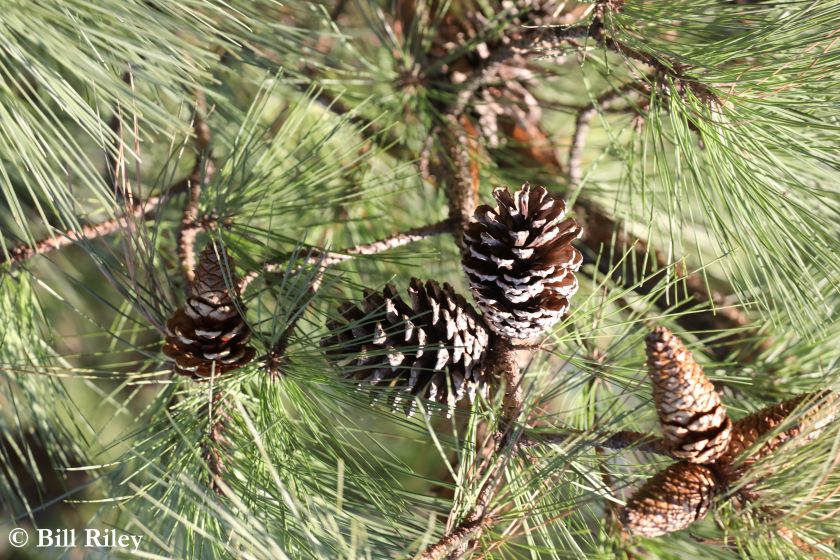
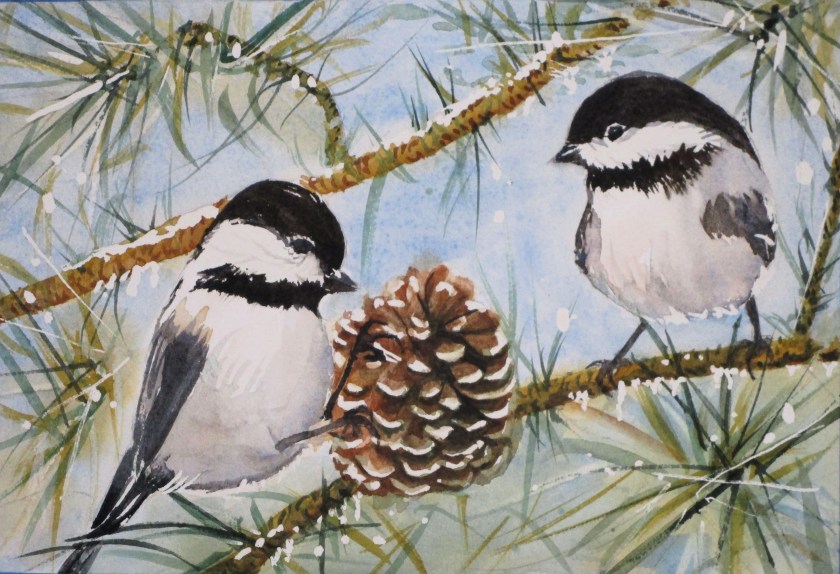
My second finish of the week is the Winter Birds watercolor painting based on Bill’s photographs. My composition is compiled from three of his photographs.

The two chickadees are cozied up to a pinecone, with the pine’s branches and needles as background. Working out the best layout was a wonderful challenge. My goal for the painting was to suggest bird camaraderie during the depths of winter.

WINTER CHICKS

This painting is about done. I still need to clean up some edges, tone some of the masked areas and add a highlight or two. All fun stuff. And it’s finished in time to slip it into a frame and hang it on the wall before Winter officially begins.

After laying in masking fluid, I used hansa yellow deep, transparent orange, pyrrol scarlet, burnt sienna, Winsor green blue shade, Cerulean blue and ultramarine blue. My new favorite black mix is ultramarine blue and transparent orange.

Posted in drawing

Sunday Sketches: Winter Birds

Today I am pondering a painting subject that illustrates wintertime. Pretty quickly I settled on the humble chickadee. It is an ever curious, constantly moving little bird. Today our backyard chickadees are flying back and forth from the tube feeder. Each bird selects and grabs one sunflower before darting up to a tree branch where it consumes its quarry.

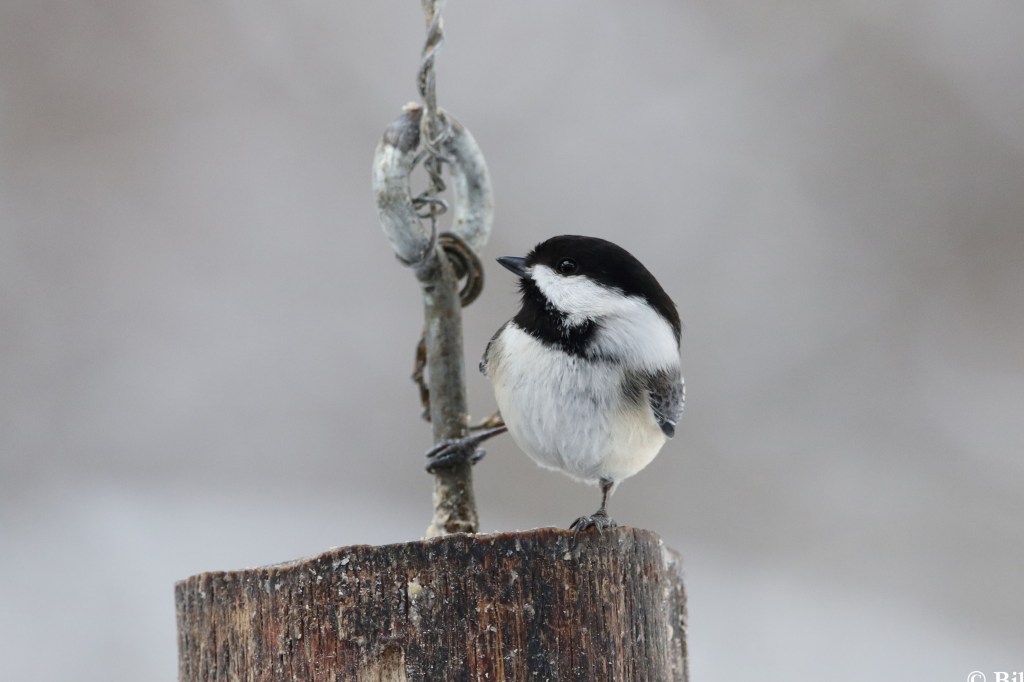
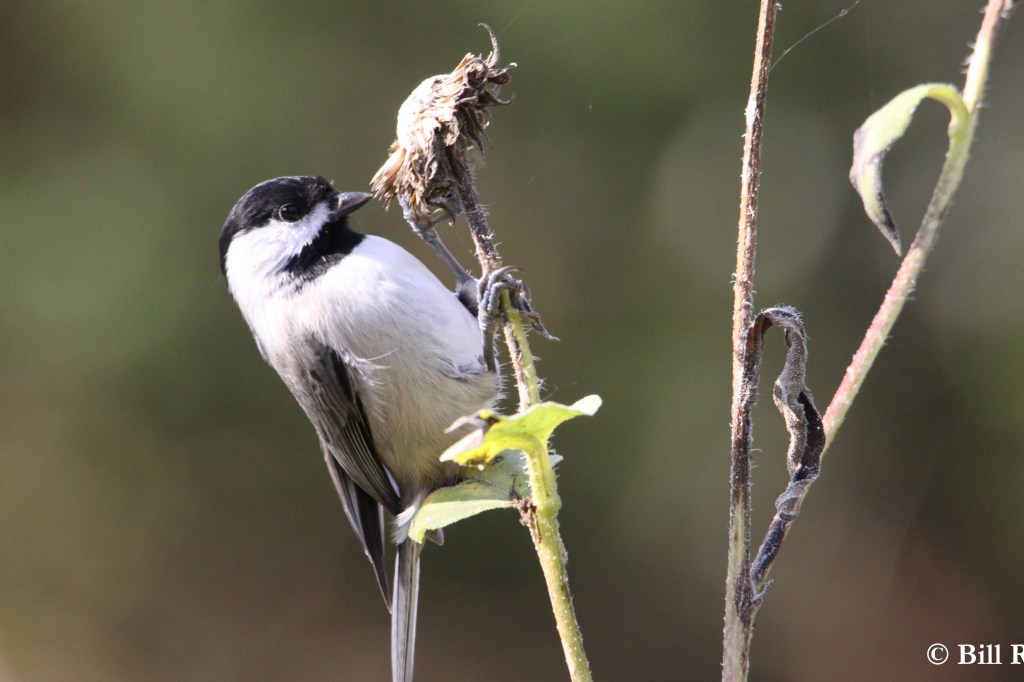
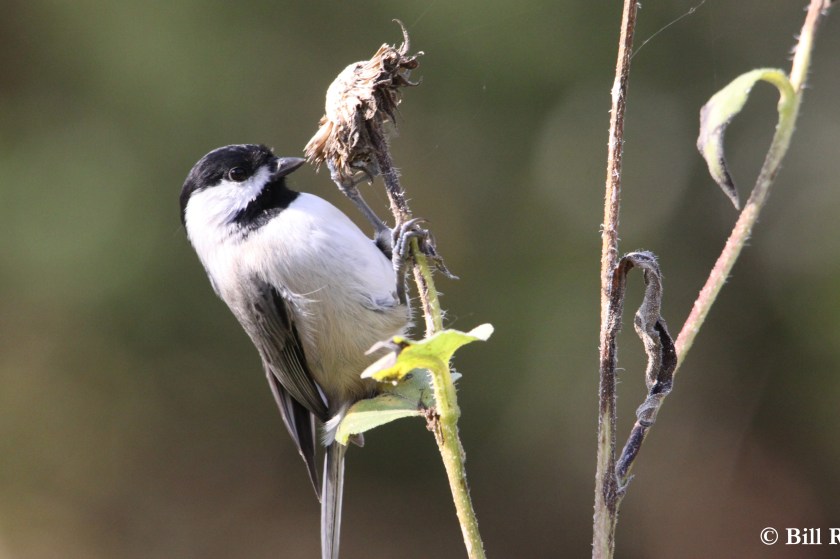
Fortunately for me, Bill has shared two photographs of chickadees suitable for my planned painting. But working out a composition that uses both birds is not coming easily to me.

Chickadee 1.

Chickadee 2.

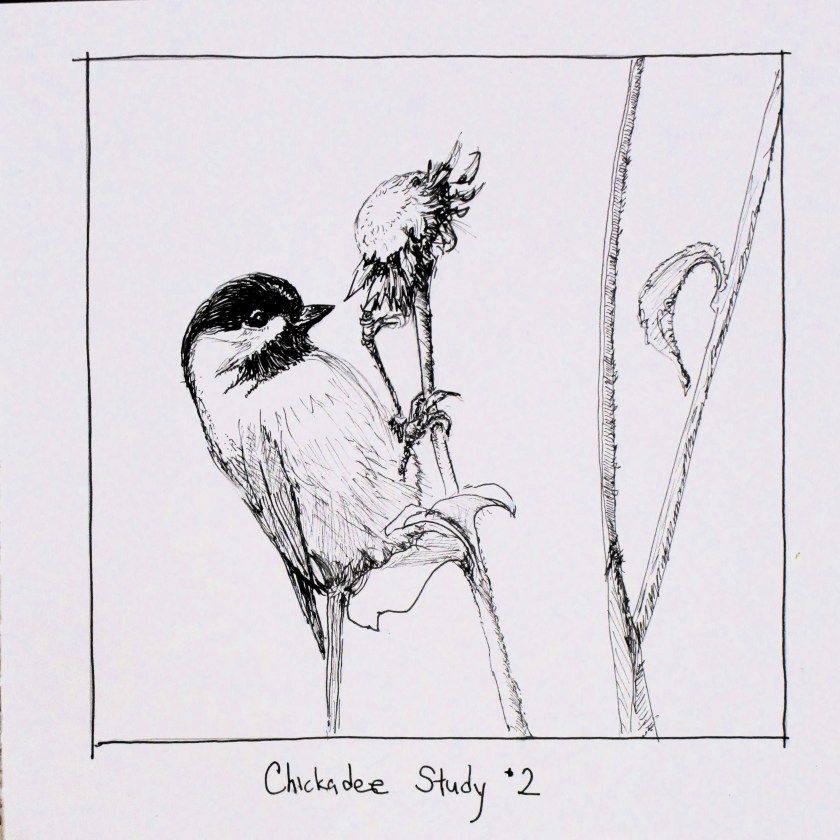
My first try at a composition is awkward and unsatisfactory to me, so it won’t even get shared. I decided to make ink sketches of these two photographs, which will get them familiar and warm me up to the task.

On an 8 by 8 inch piece of paper, the little chickadee, which measures barely 4 inches, can be drawn at its full size. First, I worked out the placement using pencil, then inked the contours lines, adding value with various types of marks. My sweet subjects, black and white IRL, were rendered with ease.

This one is very curious indeed.

This one is demonstrating his love of sunflower seeds.

My two chickadee drawings are numbers 42 and 43 in the 100day project.

Now I need to figure out a scene that will serve as a setting for the two birds.

Posted in drawing

Wednesday Sketching: Loon Study

Today’s sketch may also be categorized as the 100 Day Project. I am again working with photographs by husband Bill. Having recently enjoyed spending time with loons while on the lake in Wisconsin, I gained more appreciation for the beauty of these birds. This photograph is a classic loon pose: neck held in a graceful S-curve, head and bill slightly raised. But what I’m interested in for this exercise is the graphic quality of those black and white feathers. I zoomed in on Bill’s picture to examine the feathers more closely.

I started my sketch by drawing strong lines to separate what I see as four quadrants of an abstract view. Using a micron fine tip pen, I drew in the white markings, making shapes with a lot of variety – just like I see them. Then I used a Stabilo permanent marker to fill in around all of the white dots.

I originally wanted to do this art piece in black and white only. But the solid-looking color of the neck suggested an opportunity to try out a water soluable graphite pencil. So, I did and used it again on the lower body.

In the end, I felt compelled to add a little bit of color, in the form of red ink and blue watercolor paint for the water and sky.

I took some liberties with a few red dots. They create some focal points, and echo the bird’s red eye, which remains unseen in my sketch.

My abstract loon was drawn on smooth paper in a 9 x 9 sketchbook.

Posted in painting

WIP Wednesday: Dragonfly Art Quilt

I have been busy painting dragonflies on my hand-painted backgrounds. The process is really fun! I have also been researching dragonflies. They are amazing animals.

Did you know that some dragonflies can live for six years? That is pretty good for an insect. Granted, up to four years are spent as naiads, in water. They look kind of like shrimp. Adult dragonflies have six legs, yet they cannot walk. They use their legs to snatch prey in flight, which they then tear apart and eat while still flying. If you were the size of a fly, you would find dragonflies terrifying.

So far, five of my panels have dragonflies on them.

I cut a stencil to make these two panels

In addition to Jacquard textile paint, I am using watercolor pencils and Micron pens. The paint is thinned with FolkArt floating medium, which permits better blending and lengthens the drying time.

Here is a mock-up of the quilt layout I’m considering.

If I go with this layout, the finished piece will be 28 x 36 inches.

Two more panels need dragonflies, and then I will consider painting some details on some of the backgrounds.