Posted in quilting

Improvisational Quilting with Joe

I came to learn quilting almost as an afterthought. As I started to get ideas for making fiber objects, I became aware that I lacked the skills I needed to realize them. Thus started my quilting education. There are some things about quilting I like – choosing fabrics, developing my design, adding surface details and actually doing the quilting. The things I dislike are cutting many identical pieces of fabric, squaring up blocks and especially matching corners.

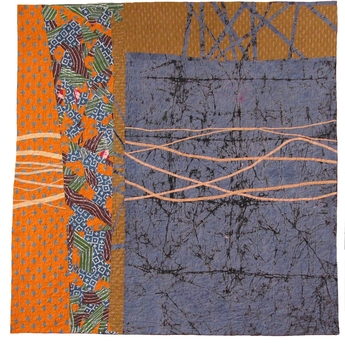
So naturally I am drawn to improvisational piecing. Joe Cunningham (aka Joe the Quilter) and his process were a revelation to me. He offers the promise of freedom. Freedom from all the dull parts of quilting, which leaves more time for fun. The quilt featured at the top of my post is one of his. His website can be found here:

http://www.joethequilter.com/aboutjoe.html

Joe Cunningham has been a professional quilter since 1979. His philosophy is unique. He doesn’t use patterns. He designs out of his head, adjusting things as he goes along. He has no specific end in mind. He explains that as the quilt approaches the finish, he finds out what it will look like. He practices randomness, chance and serendipity. To this end, his method relies on chance from the first cut.

As an example, the class I took with Joe featured a quilt called “Rock the Block.” Here is how to make it:

Step 1: Choose three fabrics. Include one big print. The other two can be prints that don’t necessarily go with the big print. Also choose a solid color that you will cut into narrow strips, which Joe called “sticks.”
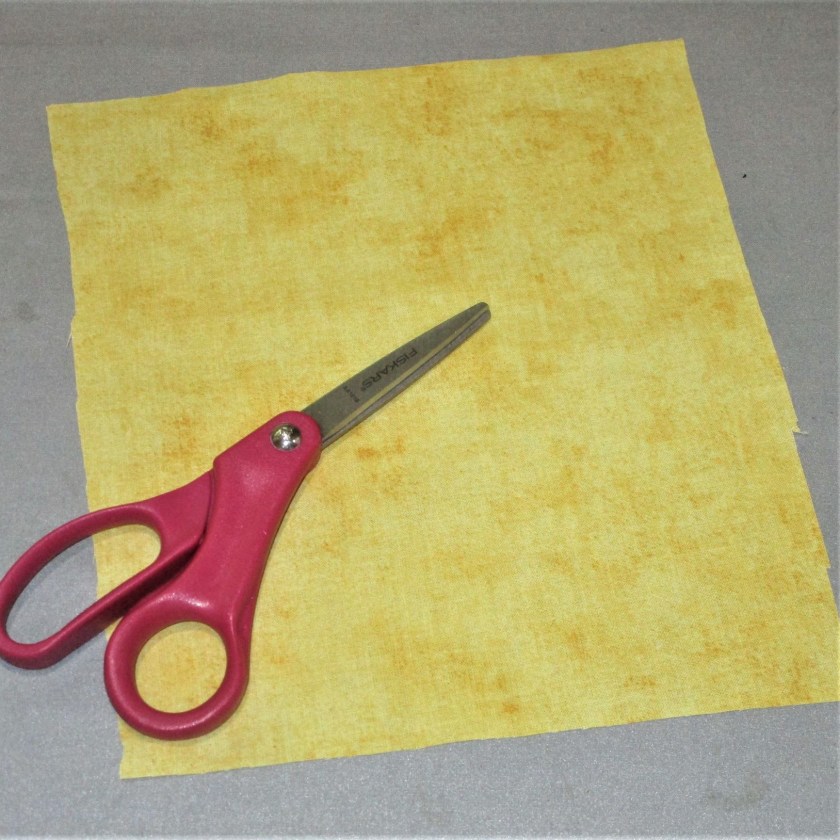
Step 2. Cut out a square. It doesn’t need to be perfect, but does need to be bigger than 7 inches.
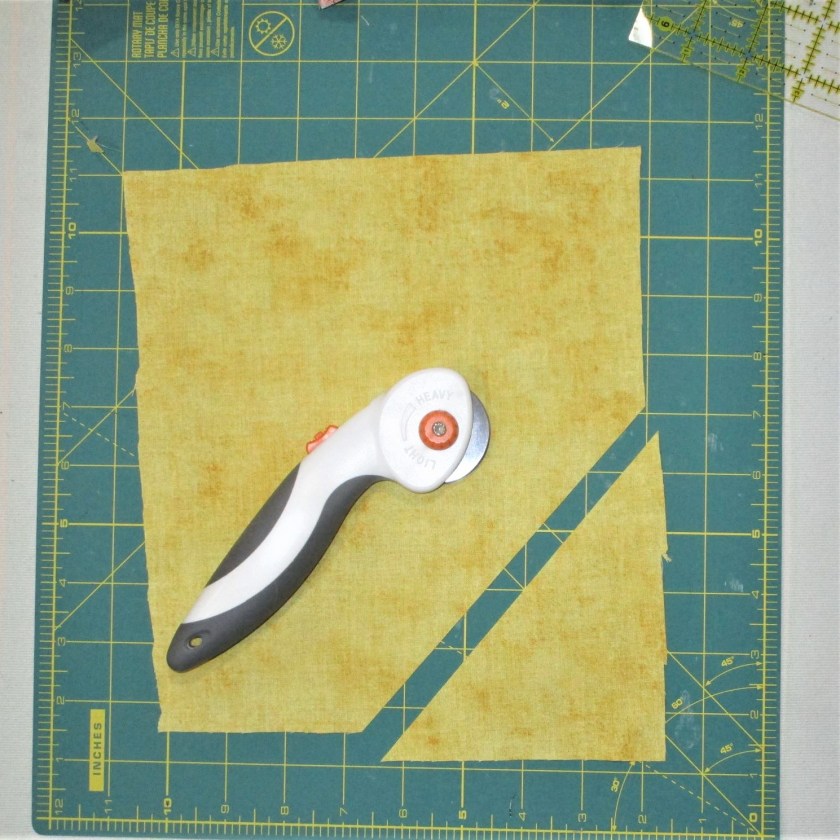
Step 3. Cut off a corner.
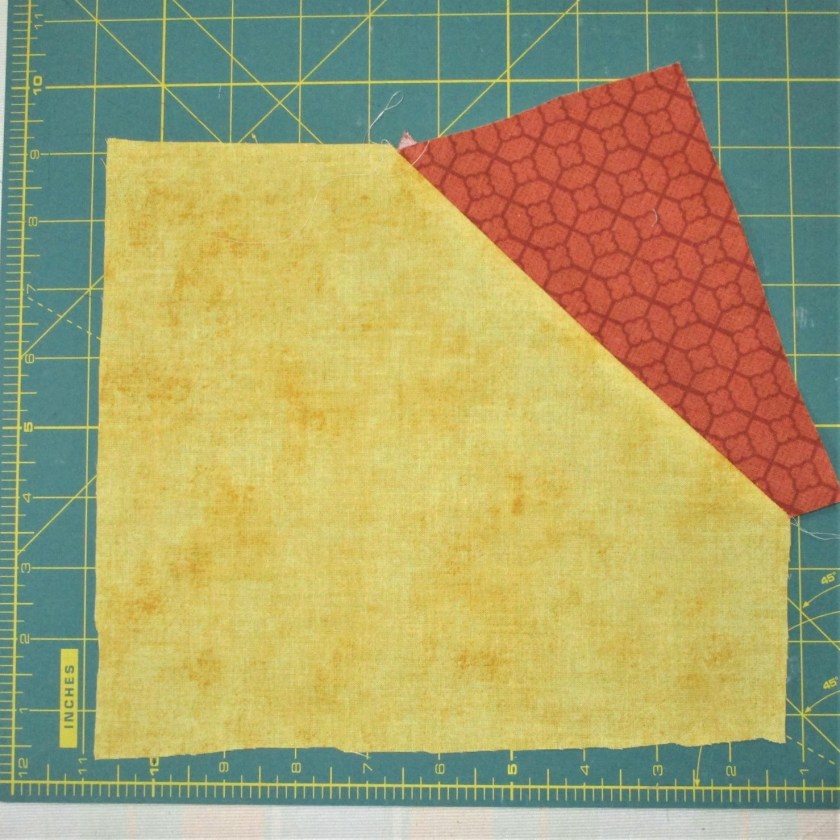
Step 4: Cut out a triangle from one of the other fabrics. Sew it to the square at the cut edge.

Step 5: Cut through the square, across both pieces of fabric.

Step 6: Sew in a stick.
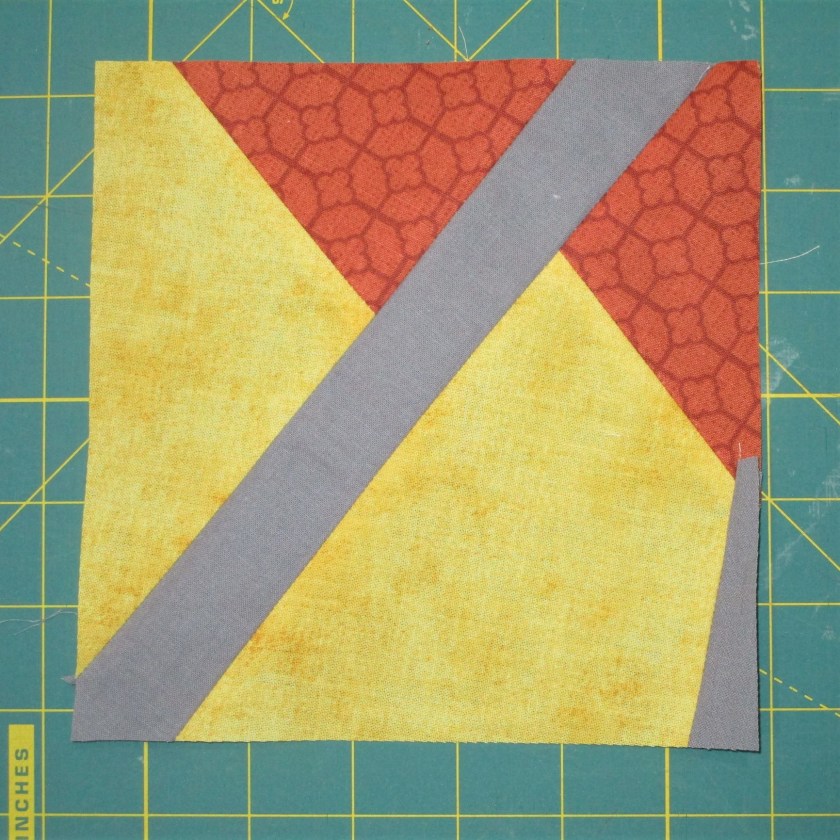
Step 7: Press seams open and trim the block with a 6 and 1/2 inch square ruler.

Repeat steps 2 through 7 until you have enough blocks for the size quilt you want to make. Use all the different combinations of your three fabrics. Your blocks might look like these.

Or they may look entirely un-like these!

Now the fun begins. Lay out your blocks in rows. Move them around, arranging the blocks until they look “pleasing to you.” Lacking a design wall, I laid mine on the floor.
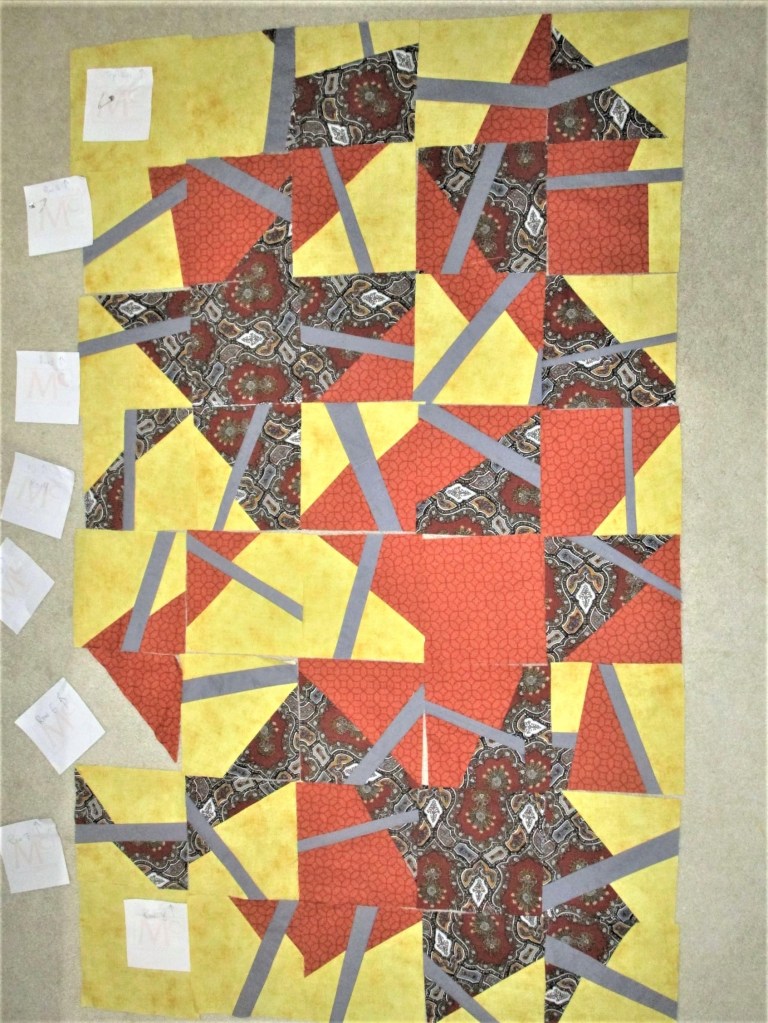
This arrangement is pleasing to me.

So far, this has been painless. Nay, it has been truly pleasurable. I plan to add more yellow blocks around all sides. Some of them will have patterned fabric crumbs and a few “sticks” sewn into them. Some may not.

While I acknowledge there will be corners to sew, I plan to adopt a laisser-faire attitude about the matching part. If this sort of design process is intriguing to you, I suggest you check out Joe the Quilter’s website to see more of his quilts.

Posted in quilting

Slightly Stuck

It’s been a while since I wrote about the state of “stuckness” For me, this means that the project is not flowing very well. Over the last few days, I have been toying with a technique called “Stitch and Flip”. I learned it from a BluPrint.com class on how to piece improvisationally. The instructor is Jacquie Gering.

https://shop.mybluprint.com/quilting/classes/improvisational-piecing-modern-design/35410

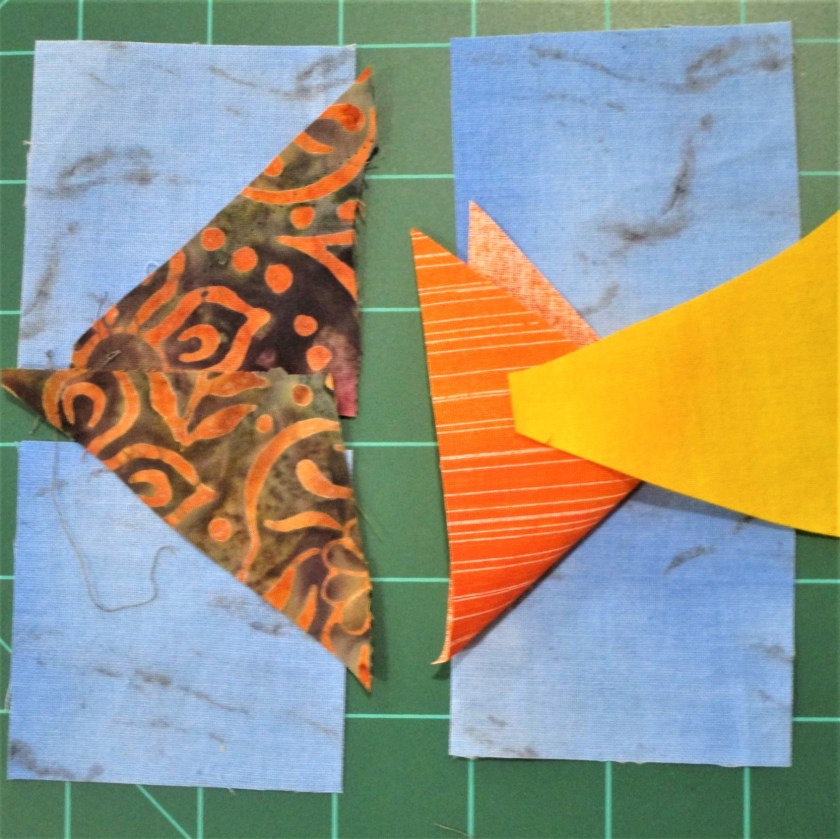
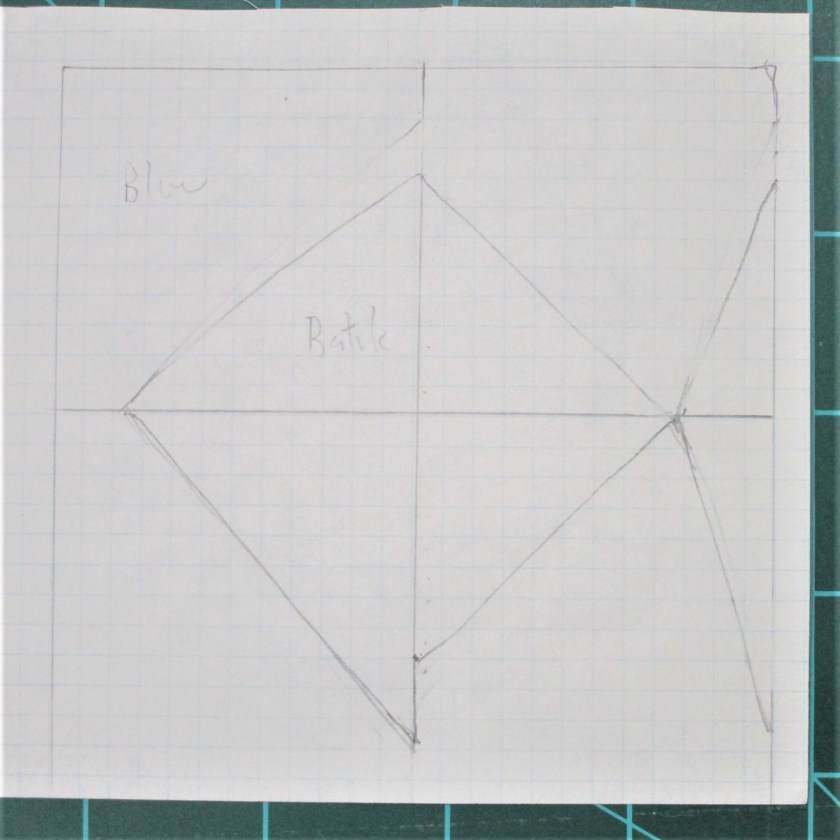
Basically, you sew a piece of contrasting fabric across the corner of a square, then flip the piece over to cover the corner. You can cover one, two, three or all four corners of the square. I was struck by how much the finished squares resembled little fish. This drove my desire to give it a try. Here is a sketch of what I envision:

And here are the fabrics I have chosen. The batik is the front half of the fish sewn over corners of two squares. On two more squares I am sewing triangles to represent the belly and tail of the fish.

Then the whole block is assembled. A four by one inch rectangle finishes the block.

I had hoped to easily make a several “schools” of these little fishes, with five or six in each block, ultimately creating an underwater scene on a lap quilt. Cute, Fun – right? But somehow I kept screwing up the assembling. Much ripping, muttering and re-sewing ensued. My completed blocks are not lining up right! I can’t seem to square them properly! In addition, I don’t have enough background fabric to proceed! And of course, the fabric I need is in Hobby Lobby, which is closed indefinitely!!!

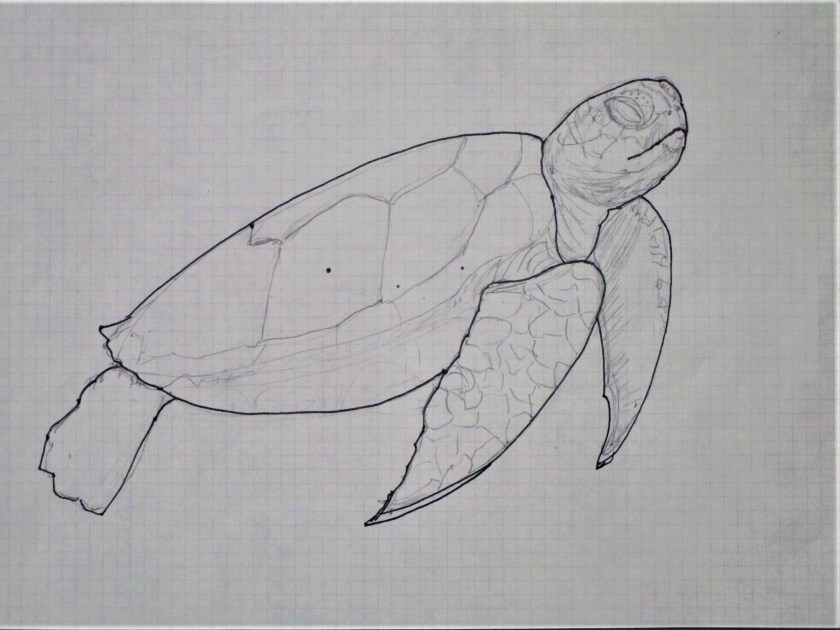
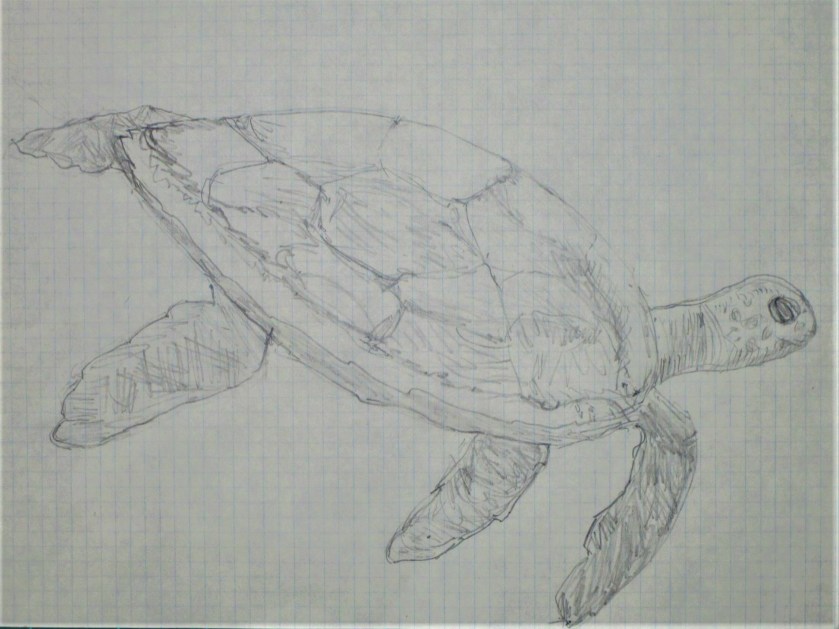
So this project is in limbo. I did sketch a few sea turtles, which might get included in this project, if I can figure out how to get them there.

So sadly, I will set the fish aside while I ruminate on the process. It won’t be the first or last time that I got stuck in the middle. Meanwhile my paint order from Dharma Trading has arrived. So I will play with paint until the lightbulb goes off in my brain.

Posted in hand embroidery, painting, quilting

Daily Fiber for One Year

Two Daisy Squared

Yes, friends, today marks one year since I started experimenting in the fiber arts and posting the results of my efforts. This mini quilt is my most recent object. It’s quite a fitting testimony to my adventures, because it showcases so many of the techniques that I have learned along the way. I have used fabric paint to tint the daisies, then mixed some of my hand painted fabrics with a few solids and prints to fashion the blocks. The whole thing was ditch stitched. I then hand quilted on top of the blocks with embroidery floss. Lastly, I painted enough fabric to border the whole piece. The completed work is sewn over a 16 inch square of artist canvas.

Let’s take a brief look back on how I got here.

Painting fabric with Dye-Na-Flow acrylic paint. Sun print using marbles and rice.

My enthusiasm for hand painting fabric actually started when I took a class on how to do this and then taught a class last spring. It was a big hit with all ages. I continue to experiment and now use this craft as a vital source of uniquely colored fabric.

Embroidered prayer flag.

As a girl, I embroidered my share of humdrum tea towels and pillowcase hems. But today – embroidery artists have moved this craft to new heights. I could never be that good. Or could I? I began to practice some basic stitches and decided that embroidery has a place in my work. For this project, I appliqued, embroidered and wrote with fabric markers to make five prayer flags. Here you see the Earth flag.

My first log cabin mini quilt, using hand-painted fabric

Quilting. Whoa. My mother is the most expert quilter that I know. She generously gave me her Bernina sewing machine. It seemed inevitable that I dip my toe into the venerable art of machine quilting. Any fiber artist worthy of the title needs to have some skill in putting together a quilt. And while I never expect to cover any beds with my quilts, I do see it as a robust art well suited for expressing my ideas.

Improv Mini Quilt with curved piecing.

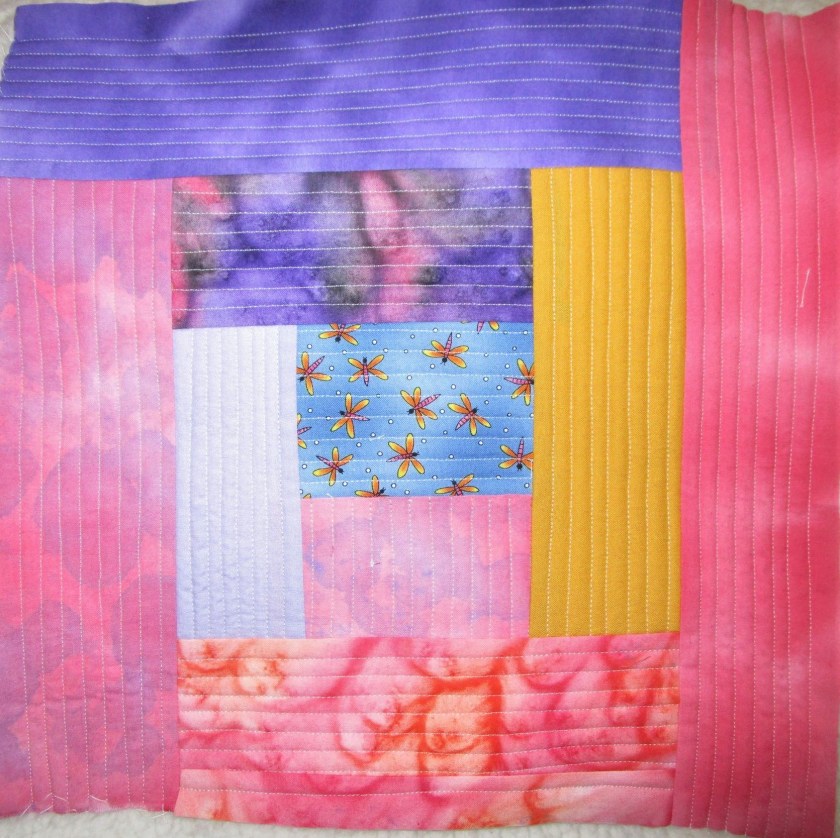
So by mid July, I was experimenting with improvisational mini quilts. These small gems are fun to do and can be completed in a day. In this one, I have combined applique, machine quilting and embroidery. If the machine stitching looks a little bunched up, it’s because I had not found my machine’s walking foot yet. It’s now in active use.

That about sums up my thoughts on a year of fiber objects. When I began this blog, I expected to use the site simply as a personal diary. My goal was to record my work and my thoughts about the work. But then nearly 100 readers found my site. I have such gratitude to those who choose to read and to comment on my humble posts. Your interaction with me has enriched me and my craft in many ways. I thank you for your time and caring attention.

Posted in quilting

Piecing with Free-Form Shapes

The first thing I did in my studio today was re-sew the wonky row of yesterday’s triangle quilt sampler. It looks better now, but certainly not perfect. I decided I could live it. Now I feel free to move on to free-form piecing, a skill I have been wanting to try for several weeks. This technique utilizes the rotary cutter, but not always the grid ruler. Leslie Tucker Jenison treats her rotary cutter as if it were a pen or a paint brush to do improvisational piecing. Her quilts look very gestural. You can see her tutorial at https://www.youtube.com/watch?v=4vT08esPfzw

I’m not ready to improvise yet. But I do have an idea for a semi-abstract design based on sunflowers. Here is the sketch of my idea.

This piece is divided horizontally into four rows. I assigned color values to the various sections, and divided each row into workable blocks. The fabrics I selected have a nice range of values, and three of them are solids. I think they will play nicely together in this design.

The next few hours were spent puzzling over the shapes, cutting, re-cutting, stitching, and, oh yeah, ripping out at least once. At the end of my allotted time, I had finished the three blocks of the bottom row. What do you think?

The width is going to be roughly 12 inches. I think it will end up about 24 inches tall.

So far, I really like it. It’s going to be an interesting experiment. And maybe even turning into very nice fiber object.