
The United States just legalized growing hemp. With the 2018 Farm Bill congress completely removes hemp and anything made from hemp from the Controlled Substances Act. The story of how this plant, which was grown for thousands of years, found wild in most of the Northern hemisphere, and used in making rope, canvas, paper, textiles and many other items, came to be banned as a controlled substance is a long, sad tale. As you can see by looking at the photo, it is impossible to differentiate hemp from its very close cousin, Cannabis sativa – better known as marijuana. When I became interested in hemp as a source for fiber art, I was fascinated by this tale of guilt by relationship.
The negative construct begins sometime around the turn of the 20th century. Until then, hemp had been grown here and used to make rope, ship sails, textiles and paper. Soon it became the subject of a negative marketing campaign, fueled by those with economic interests in removing it as a competitor to pulp lumber in the making of paper. It was an easy smear – the fear of its wicked cousin did the trick. After the release of the movie Reefer Madness growing hemp was banned by Congress in 1937.
This was not to be the end of the story. Along comes World War II. The Department of Defense was suddenly in need of hemp, but access to it suppliers in Southeast Asia had been cut off. Along came the “Hemp for Victory” campaign, sponsored by the U.S. government. For the duration of the war, growing hemp was encouraged, and had a ready buyer in the war department. Once the war ended, the government reverted back to its old stance (For it seems the congressional ban had never really been lifted.) There’s a lot more to the story. If you care to read about it, I recommend this paper by April M. Lugenbuhl: http://scholarworks.csun.edu/bitstream/handle/10211.2/2738/CAgeographer2001_p1-14.pdf?sequence=1
After experimenting with cotton and synthetic cord, I ended up choosing hemp to use in the macramé lesson for my fiber arts students. It is easier to manipulate than cotton floss, holds knots better than synthetic or cotton cords, and is not expensive. Today I will make a simple bracelet using hemp, wood beads and the square knot.

You will need about a yard of hemp cord, eight or so beads, one large bead or button, scissors, glue and a clip board. There are so many websites with excellent instructions, I feel it’s unnecessary to describe the steps here. Today I used this site: blog.rings-things.com/2013/05/07/how-to-macrame-a-hemp-bracelet/


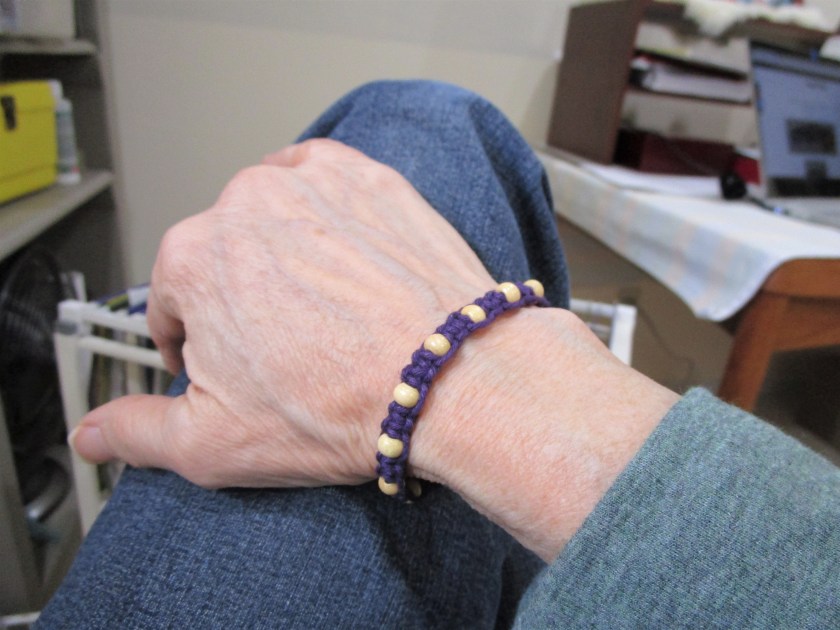
Gosh, just the one bracelet looks kinda puny. I think multiple bracelets is the way to go with this look. Any recommendations on additional colors?

 Daily Fiber