Posted in colorwork, hand embroidery, quilting

Oakleaf Hydrangea – The First Leaf

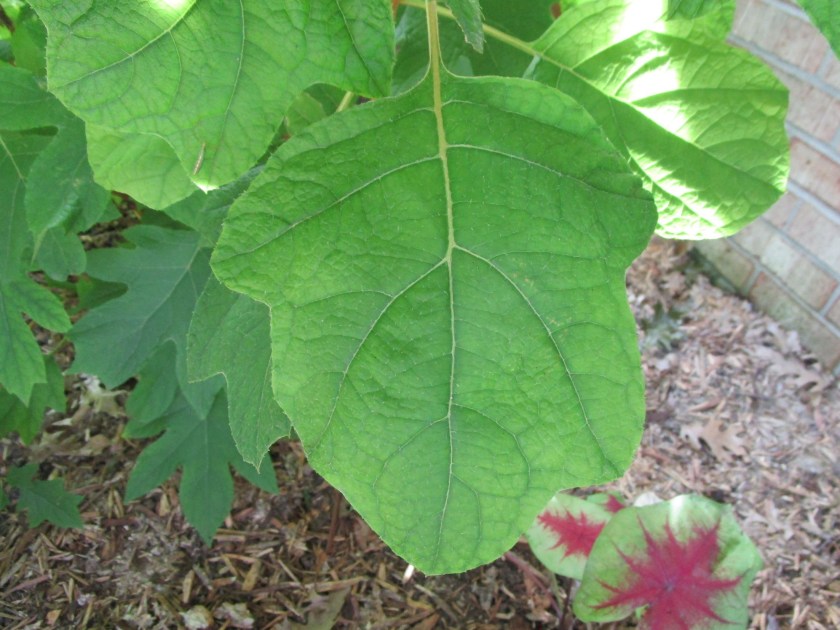
Yesterday and today I resumed work on the oakleaf hydrangea fabric paintings. Above you see the reference photo for the first leaf I am painting. I chose to do two experiments. Here are the two paintings after the first round of painting. The color wash – resist steps were complete and the paintings left to dry. In these photos, the water resist medium has not been washed out yet.
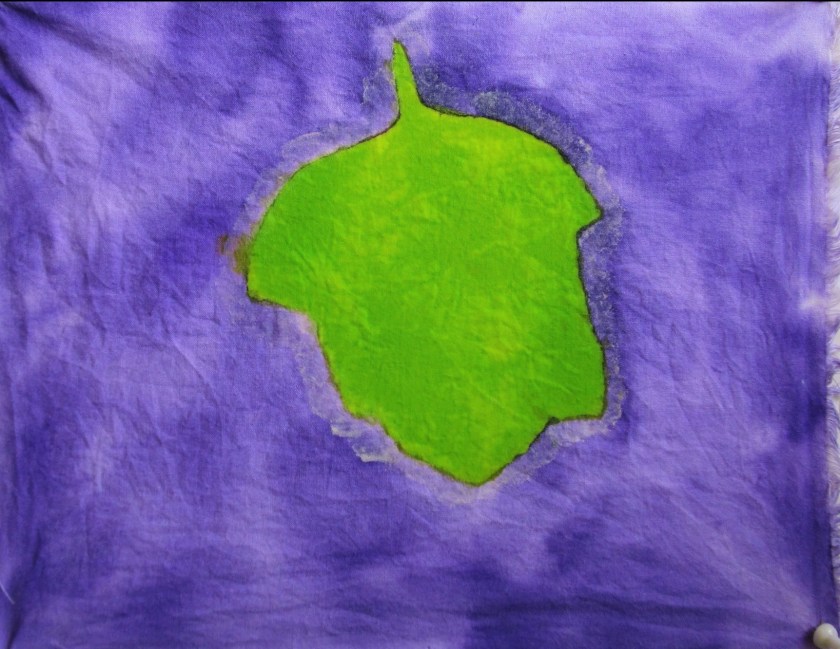
And here are the two paintings, washed, dried and with final details added, using Jacquard Textile paint inTurquoise and Goldenrod, so palette was quite limited.

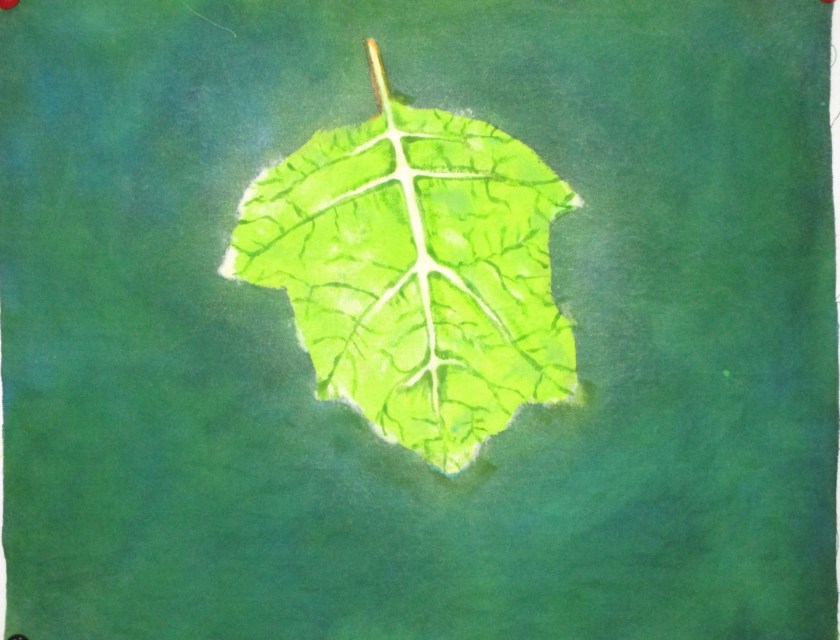
It was a learning experience, trying to paint on dry fabric with thicker paints. I discovered how to add depth to the background by dry brushing. And I learned that my skill in painting delicate lines needs work. After the pieces dried, I pressed them and continued on to the stitching phase. I chose to work with the purple piece first, hand quilting with embroidery floss. Instead of backing with regular batting, I used cotton flannel, since it would be easier to push the needle through.
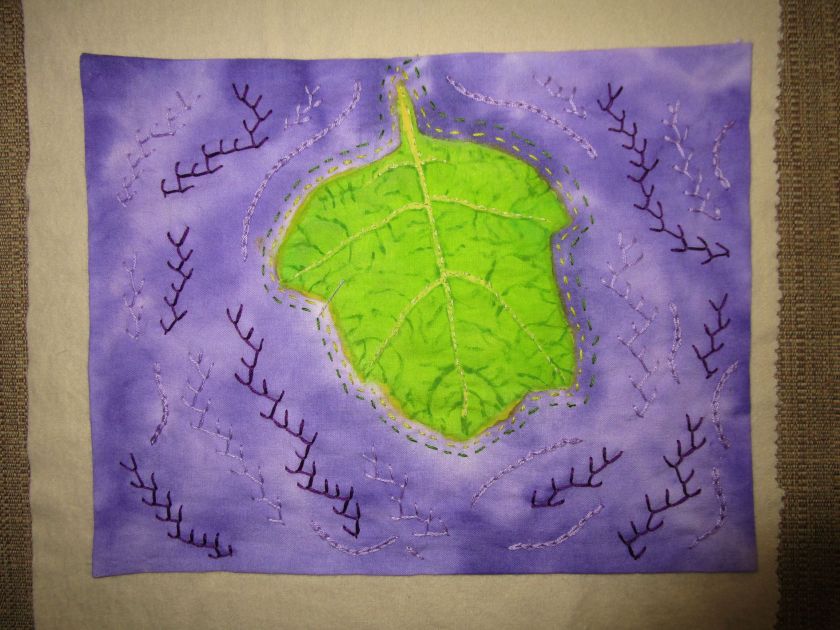
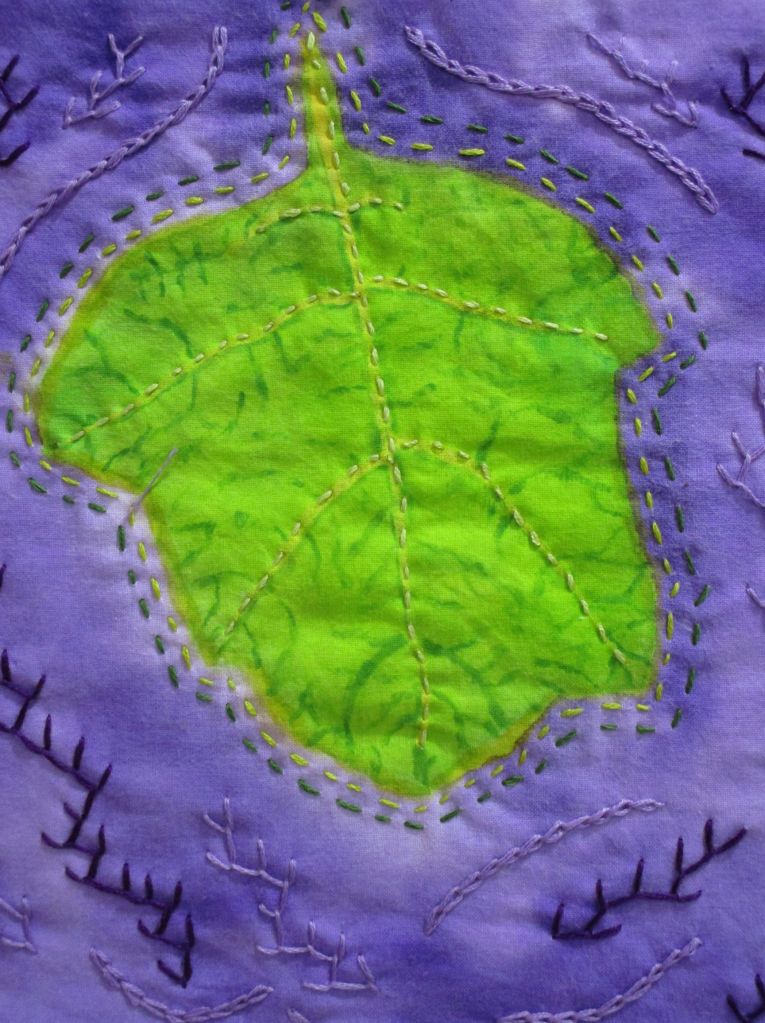
I carefully stitched over the major leaf veins, and then made two borders around the leaf margin. After finishing the leaf, I just improvised the background, using two shades of purple and two stitches – feather and chain.

So far, undecided about how to stitch down the edges. The choices are blind stitch or use a decorative blanket stitch. Does anyone have a recommendation?

Posted in quilting

Jubilee Quilters Show

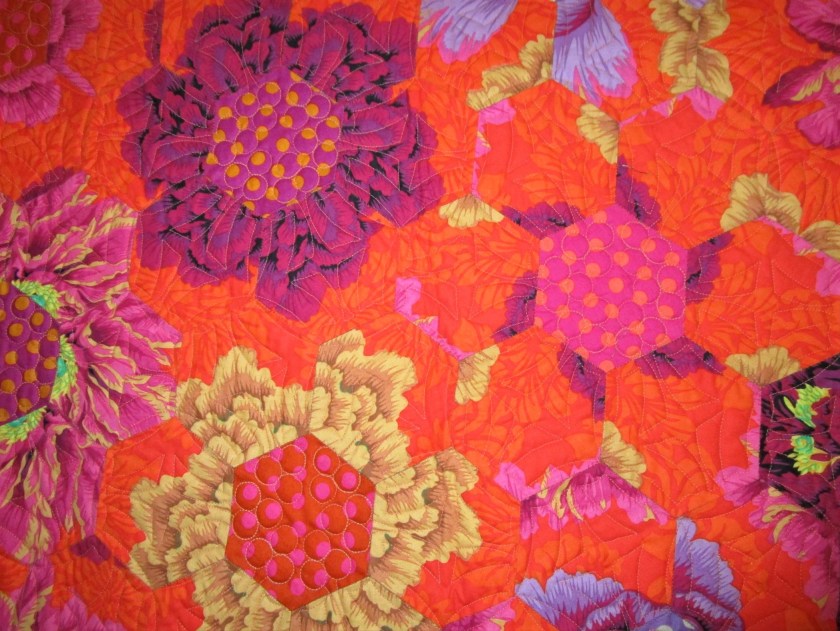
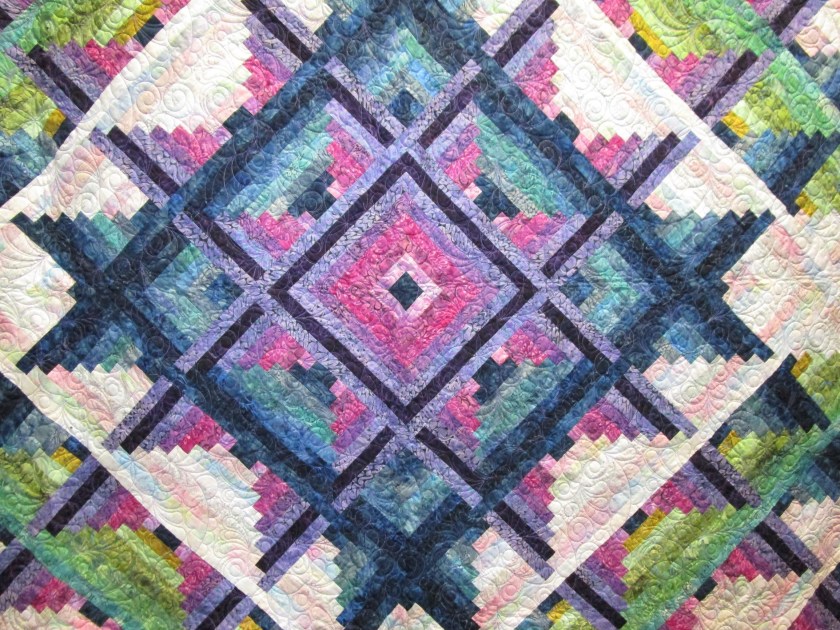
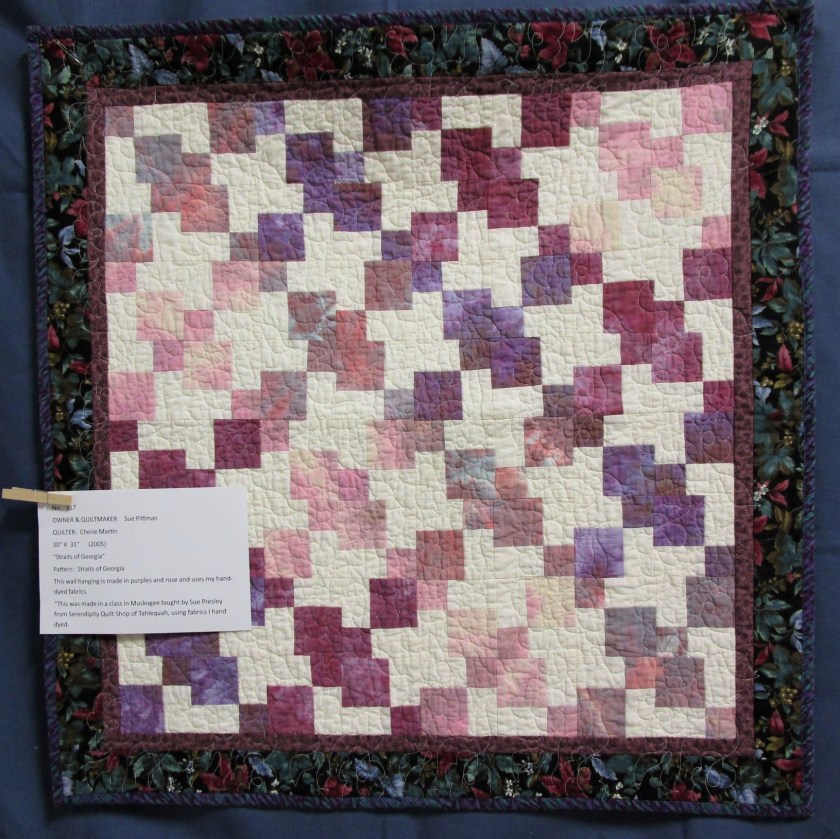
Yesterday I attended a show hosted by our local quilt group. To say it was inspirational is an understatement. Who knew that in our little county of 50,000 residents there were so many superb fiber artists? Because the organizers permitted photography, I took a number of images. It was hard to narrow it down to favorites, but I am pleased to share the following:

This is called a Bargello pattern.
Technically superb. How did the maker create all those perfectly round circles?
Created using a jellyroll group of fabrics. Name of quilt is “Ocean Deep.”
My favorite wall hanging quilt. The giraffe is created with dozens of flower shapes sewn atop one another. The birds and vines are fussy cut applique.
My favorite large quilt. It is a log cabin style, using batik fabrics.
I chose this one because the maker used hand-dyed fabrics for her squares.

I admired the quilt below for its irregular and artfully placed strips, as well as for the cute applique ladybugs. The maker created it while recovering from a lung transplant. She finished the squares before passing away in 2008. Her grandmother sewed the top together.

I hope you enjoyed these quilts, and found them as inspiring as I did.

Posted in colorwork, painting

Colorwashed Landscape

Fireweed

We are busy day today, getting ready for hosting company. So instead of working up a new fiber object, I thought I would share this colorwashed piece of fabric which I made a few months ago. How it came to be is somewhat interesting, at least to me.

I started with a square of white cotton poplin. Using slightly wavy strokes and starting at the top, I applied blue, purple, red and green. Before the fabric dried, I used the “scrunch” technique – crumpling the fabric in various places. This causes the paint to run and dry unevenly, resulting in the dark creases you see above. Immediately, I thought it looked like a view of the Rocky Mountains. Dark brown and black appeared in the creases where the red paint met the purple and green. This reminded me of the mountains in recovery from a forest fire. To enhance the effect, I printed on the fabric in brown and green with blocks cut in jagged shapes, to represent the tree trunks, both living and dead. I painted snow on the mountains. Then I used fabric markers to delineate the sky and a field of pink blooming fireweed.

This landscape feels to me as if it appeared by magic.

Posted in colorwork, drawing, hand embroidery, sewing

Inspired by O’Keefe

My fiber efforts have been rather uninspired over the last two days, so no new posts. Then I picked up this book written by Georgia O’Keefe. It is an autobiography told in her own words and in beautifully reproduced images of her paintings. It got my creative thoughts moving again.

While she spent most of her life living in and painting the American Southwest, in the early stages of her career O’Keefe was best known for her large-scale paintings of flowers. Here is what she has to say about these works:

Nobody sees a flower – really – it is so small – we haven’t time – and to see takes time, like to have a friend takes time. If I could paint the flower exactly as I see it no one would see what I see because I would paint it small like the flower is small. So I said to myself – I’ll paint what I see – what the flower is to me but I’ll paint is big and they will be surprised into taking time to look at it.

Exhibition catalog, An American Place, 1939

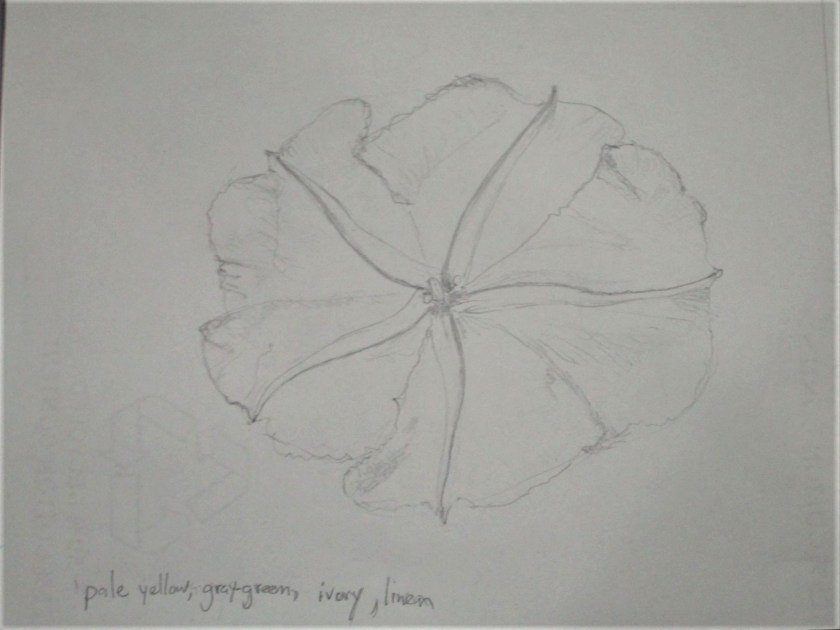
So I decided to create a fiber flower, because I want to look closely at a flower. I chose to make a Moonflower, partly because of its star-like shape, and partly because I don’t see them growing around here. When I lived in Texas, I grew some moonflowers. It was way too hot to enjoy the garden during the day. Instead I sat outside at dusk, when I could watch the moonflowers swirl open.

Here is a pencil sketch I made of my moonflower:

I plan to use white poplin for the flower, with fabric paint on the shaded areas and embroidery on the bright areas. Here are some green fabrics I have chosen for the background and the flower shape I will cut from the white poplin.

The next steps are to piece together and sew the background.

Background with paper template showing flower placement

Tomorrow I paint.

Posted in colorwork, quilting

Lemons to Lemonade: Tales for fiber artists

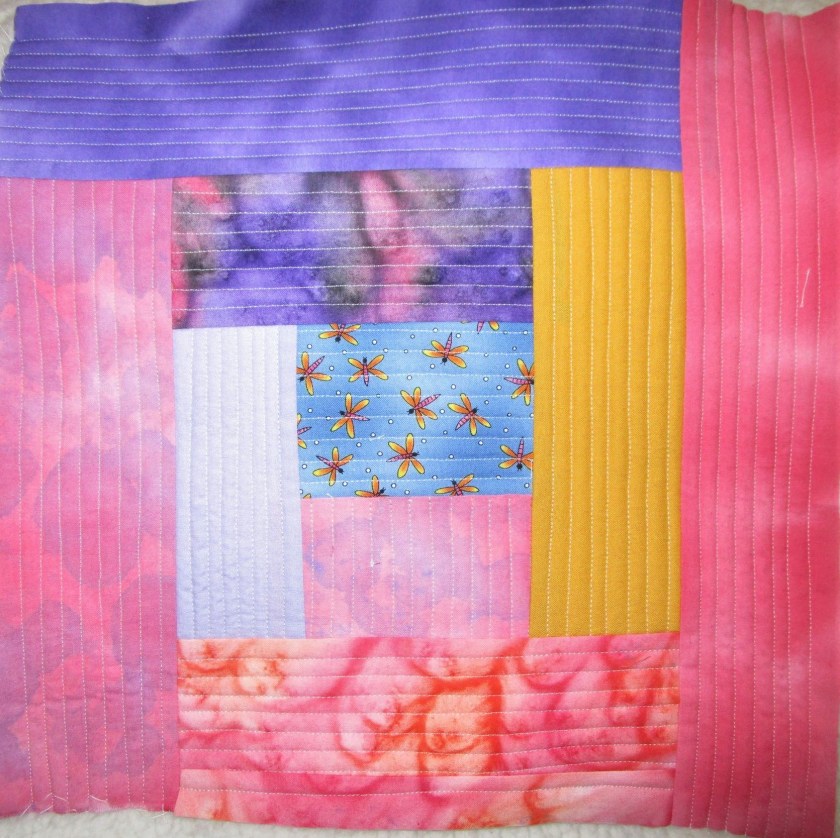
Once upon a time, there was a sad fiber artist. Alas! She had spoiled her hand-painted fabric by her own foolish actions. But she didn’t give up hope. Soon her mistakes were transformed into a pretty little quilt block through the magic of cutting them into small pieces and sewing them log-cabin style to some batting.

Today’s lesson is to keep everything. You never know. You could use all the ugly ducklings to make a beautiful swan.