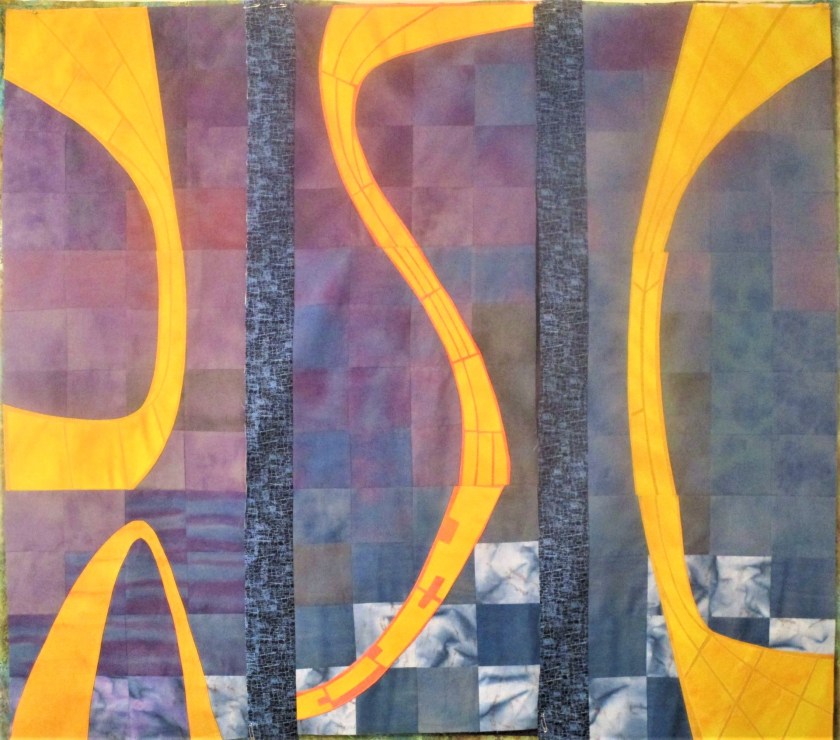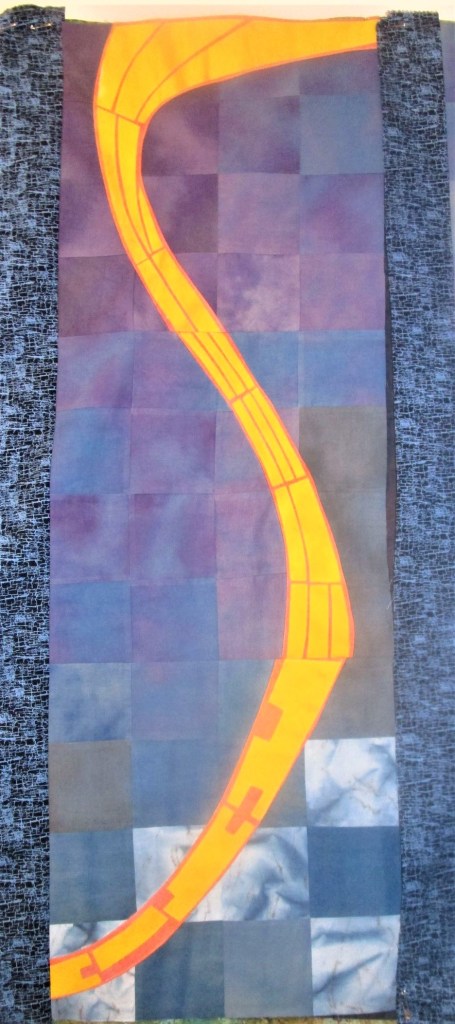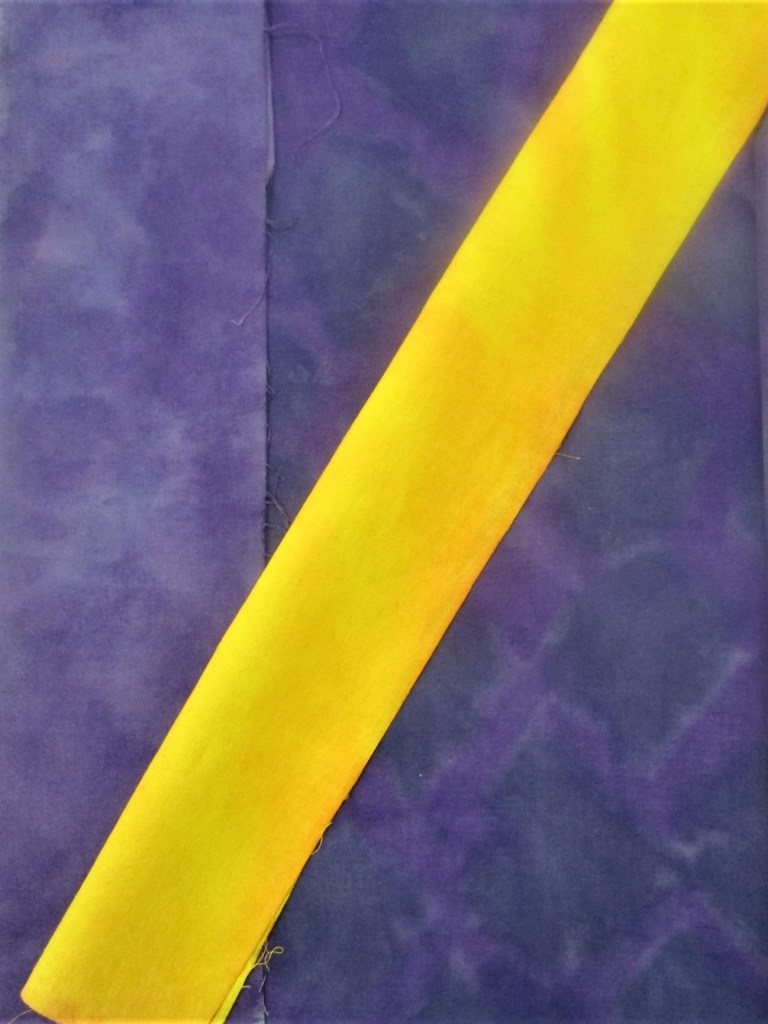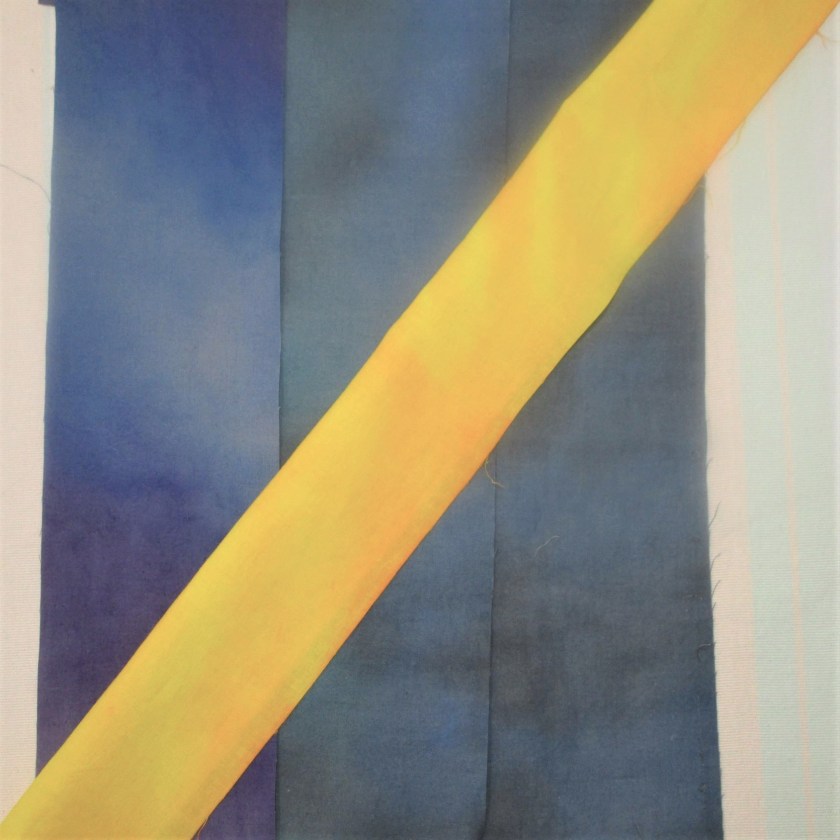
I have finally finished piecing the Gateway Arch quilt. Next I stitched the blocks into three panels.
Left
Center
And Right.
Before I move on to making the quilt sandwich and quilting, I will be adding some details to the blocks using fabric paint and possibly some embroidery. This step will allow me to practice a new technique I learned over the holiday.
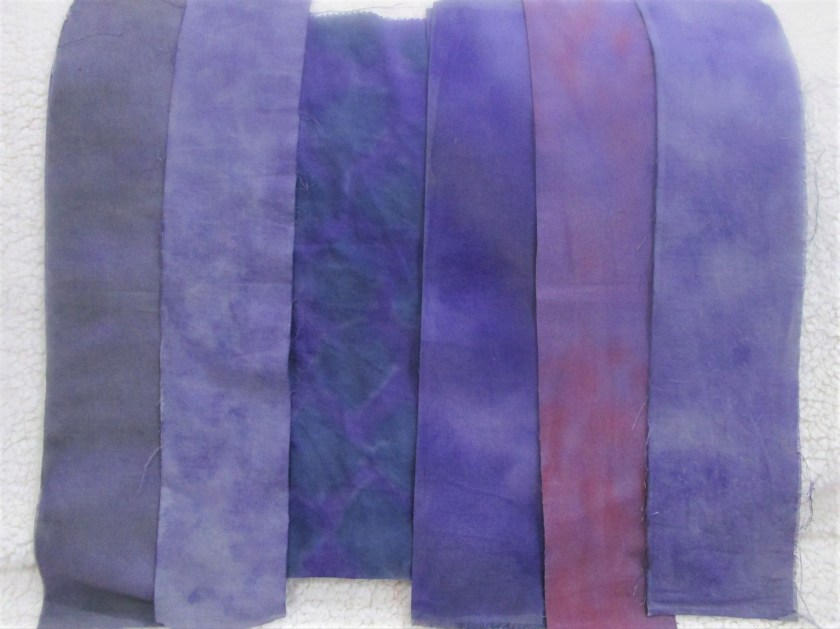
I last wrote about this project on November 16th – almost a month ago. In that post I made a list of next steps. While I have completed all but a few of those steps, I started to lose enthusiasm for the project while painting my fabric. It seems that all of my fabrics began to look alike. I told myself that the background fabrics SHOULD look alike, otherwise they wouldn’t retreat into the background. But I still wanted more texture and movement in the colors. So I decided to go back to Cindy Walter’s fabric painting class, to review my technique and discover what I’m missing.
That did the trick. I worked a few variations on color washing and finished painting the background fabric. I now have enough fabric to start building the quilt blocks.
Looking at all the difference in the fabrics, it’s clear to me that I need to organize them in a way that illustrates the scene I want to paint. The solution came to me while I was in the shower. (Why do I get my best ideas while washing my hair?) The Arch stretches itself across three different backdrops.
Water.
City.
And sky
I have my design, my structure, my fabric and my pattern. Now I can begin to sew.
As much as I enjoyed our little trip to visit family, it’s nice to be back into my routine. Just as an aside, the faux suede baby booties, while slightly too big, were well accepted by little L. In the meantime, she had also acquired two other items of footwear – a pair of sneakers and a pair of snow boots. She did a brief baby runway show, modeling all of the above. It was so funny to watch her toddle around the house awkwardly, although looking quite pleased with herself and her ability to work the crowd.
Back at home, I have picked up where I left off on various fiber projects.
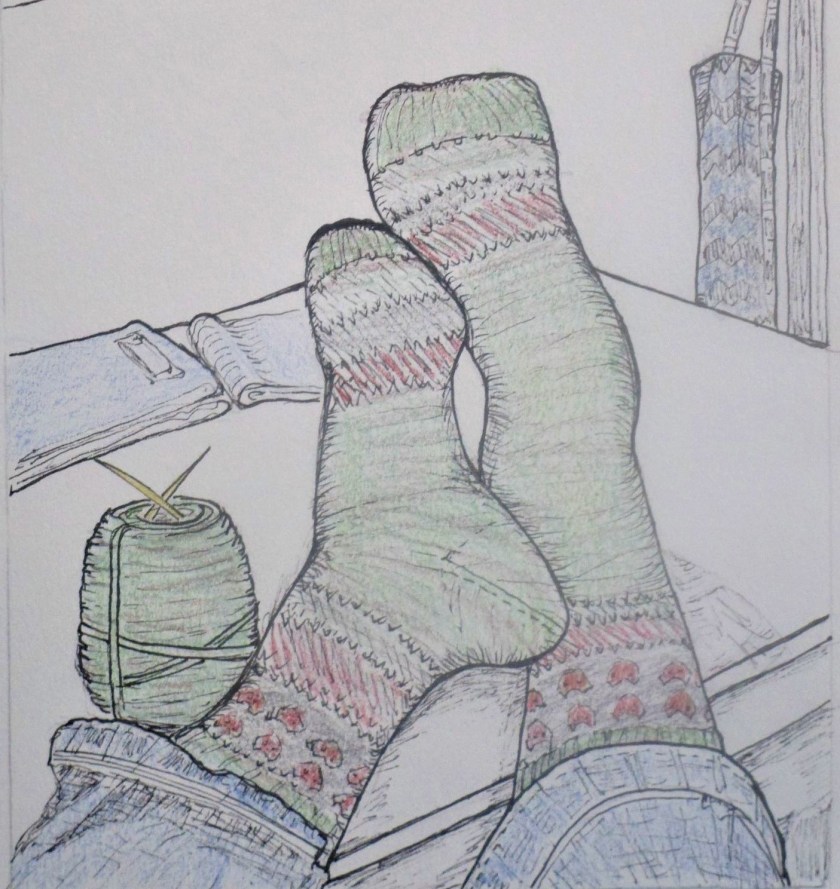
First of all, I’m knitting a birthday surprise for my daughter. (A big clue to the surprise is found in the sketch above.)
Secondly, I’ve resumed efforts toward making the Arches quilt. It’s amazing how just writing down the next steps motivated me to work. I have finished drawing the full-size patterns for each block. And by completing this step, I have been able to determine exactly how may squares of each color will be required. Over the past two days I have been painting the background fabric. I chose to paint the background squares on a gray fabric, in order to keep the background looking like the night sky.
…..With apologies to readers who might be tiring of images of leaves.
I’m experiencing momentum on the oakleaf hydrangea project. While I intend to create 12 leaf blocks, I promise that I won’t blog about every single one of them. But I think today’s block is worth a few words and images. Here is the reference photo.
After making my sketch on the fabric, I masked the veins with resist and applied a pale emerald green wash. In this photo the piece has dried, and the leaf is covered in resist before undergoing the second wash.
I went really dark.
After the paint dried overnight, I pressed the background in an effort to set the color, then washed out the resist. Before I started painting in the details, I sampled several colors of paint over the pale emerald on waste fabric, because I had no idea what color would give the effect I wanted. I ended up applying yellow-orange, let it dry, and then painted in the major and minor veins.
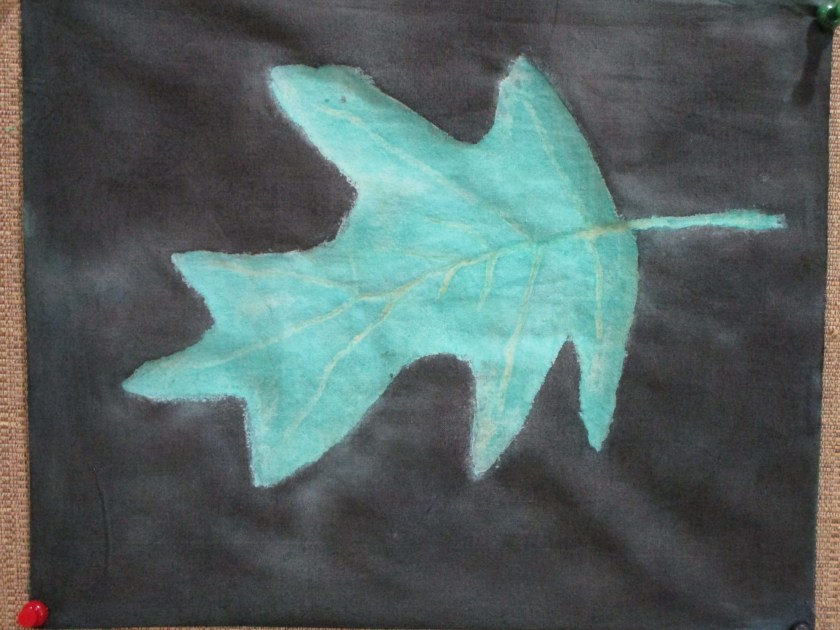
This image has strayed pretty far from the reference photo! It is no longer a summer leaf, but a slightly battered early fall leaf, getting ready to change color before dropping to the ground. I love the chalkboard look of the background. Because it is black, I was able to use an Ultra fine point Sharpie to draw the leaf margin.
Beside the patio lives a beautiful oakleaf hydrangea. Every morning, I drink my coffee in its shadow and admire the sunlight shining through the leaves. I have been wanting to incorporate these wonderful leaves into my fiber art all summer long.
If you look carefully at the photo, you will notice that there is a variety of leaf shapes presented by this plant. There can be three, four or five lobes on a leaf. It seems that the baby leaves start out almost round and the lobes develop as the leaf matures. I have decided to do a mosaic of the leaf shapes with fabric paint and resist on cloth.
Here are two of the drawings I made of these shapes. I will be using the shape outlined in black ink for today’s paintings.
There are two experiments today. In one, I use the water based resist on the leaf shape, paint the background, then remove the resist and paint the leaf. In the second experiment, I paint the entire piece, add resist to the leaf shape and over-paint the background. Here is a photo of both experiments in the first stage. The lines are traced and a yellow tinted resist is applied to both swatches. The left swatch has the whole leaf covered in resist.
Experiment one. I used a violet background.
Wet paintingThis photo show the fabric after the resist is washed away. The yellow leaf veins didn’t stick, but some of the yellow outline is still visible.in this photo I applied resist all around the leaf shape before painting the leaf itself.Paint on leaf still wet. Only a little green leaked out on the lower right side.
Experiment two. I started by applying yellow tinted resist to the veins and outline, then covered the entire fabric with yellow-green paint.
Paint is still wet.Paint has dried. I applied additional resist over the leaf area before painting the background.Finished leaf, still wet.
I am happy with today’s experiments. I like the dark velvety color of experiment two. But experiment one has potential. Both are now ready for additional paint effects.