Posted in collage, painting, quilting

Friday Finish: Badlands

The inspiration for this art quilt came to me during our trip to Roosevelt National Park in July of 2021. I was captivated by the sandwich layering of rock, running in parallel lines that eroded down over thousands of years. It suggested to me a string pieced quilt. For the next several months I thought about my concept and puzzled over how I could bring it to life in fabric.

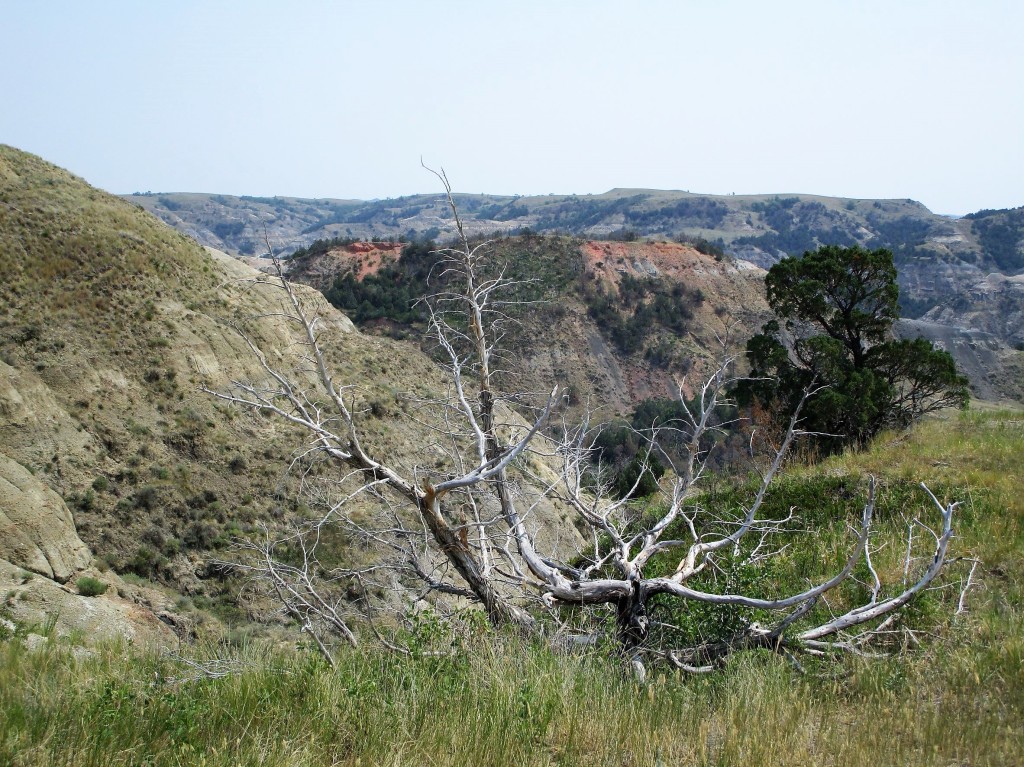
Our photographs were disappointing. It was high noon, and pervasive smoke dulled the light. No shadows were in evidence and the colors were muted. I decided to rely on an internet image for my working reference photo,

Photo from vangorentalmn.com

To get from concept to finished art is a long process. I started by making a value sketch. Next, I drew a pattern to scale, identifying major segments and eliminating excessive detail.

Here’s the part all fiber artists (including myself) find extremely creative: choosing fabrics. Since I like to use watercolor, I painted my swatches. After assigning a hue and value to each segment on my pattern, I picked out the fabrics to best achieve my color scheme of orange, blue-purple and blue-green.

Here’s an aside about the fabric I chose. Ultimately, I couldn’t find fabrics that had the colors and textures that I needed. To get there, I painted on printed fabric for most parts of the quilt. I also selected a few batik prints that were close enough, with only minor adjustments to color.

With the design decisions made and fabric selected, I began to assemble the quilt. All of the techniques that I used in making this quilt I learned from two fiber artists: Annette Kennedy and Gloria Loughman.

http://annettekennedy.com/about

https://www.glorialoughman.com/about

I thank these artists for giving me the skills I needed at the time I needed them.

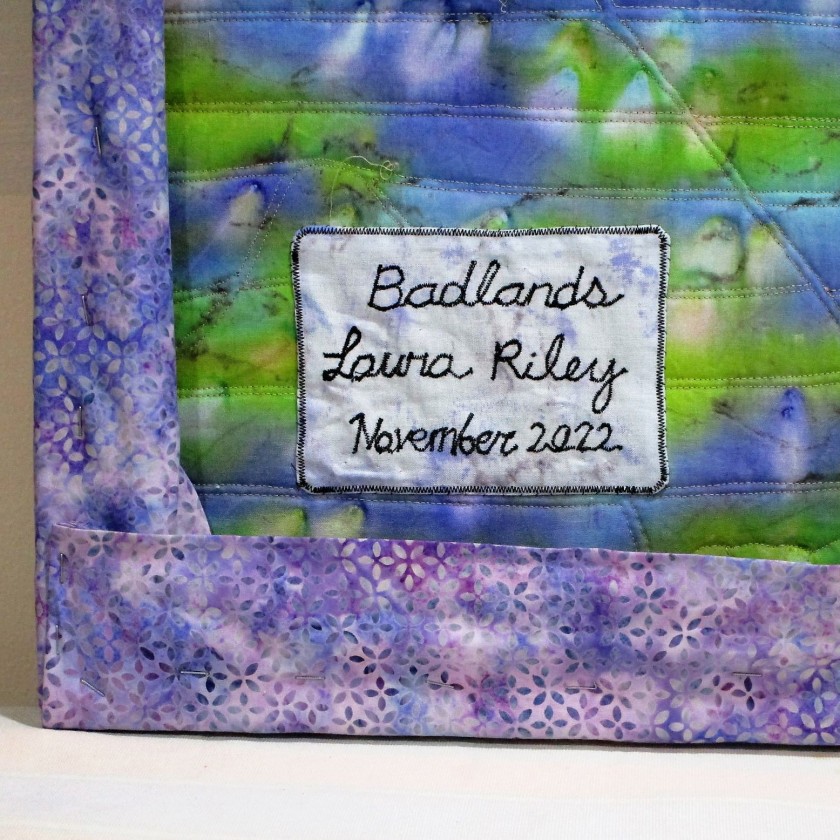
And here is Badlands in its final form:

The design is invigorated by lines running in parallel diagonally and horizontally. Where the diagonals meet, triangles are formed. These shapes lead the eye to the center where two focal points have a quiet conversation across the river valley.

As a final note, I want to acknowledge the influence on my style of pop artist David Hockney. A print of his painting, Garrowby Hill, hangs over our fireplace.

My imagination has traveled that blue road countless times over the past twenty years.

Posted in embellishing, painting, quilting

Experiment with Stitch and Slash

While perusing available art quilt technique tutorials, I discovered another use for my hand-painted fabrics. Carol Ann Waugh teaches a modern take on reverse applique in her class on Craftsy. She calls it Stitch and Slash. It was inspired by the traditional molas made by the Kuna women of Panama.

In Carol’s interpretation of the mola, four pieces of fabric are selected and layered together. Then a design is chosen, marked on the back of the pile and stitched into layers. The similarity with the traditional molas stops here, when Carol gets out her seam ripper and slashes away at the assembled fabric Instead of nice, neatly stitched edges, she ends up with frayed, textured ones.

Okay, I thought, I have the perfect set of fabrics to try this out.

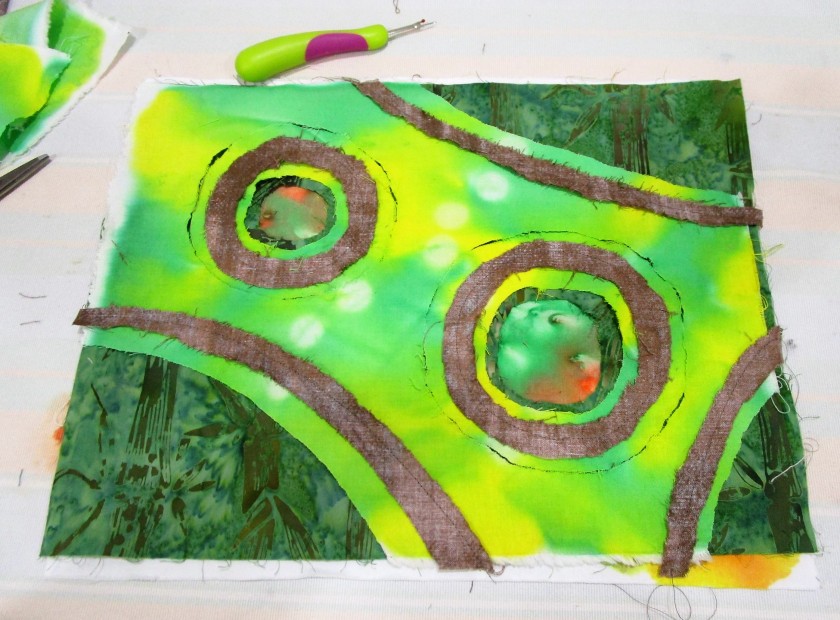
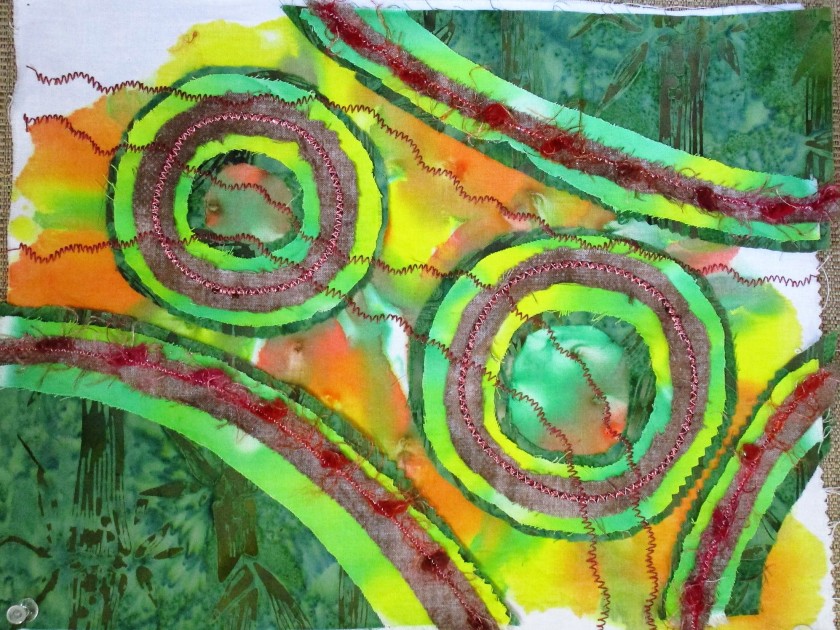
The two painted pieces are layered with a dark green batik print and a brown textured print. You see here the back side of the brown fabric, which I will be using for the top layer. Nearly all of the this layer will be cut (or torn) away.

Here is the back of my piece, showing marks stitched through.

Getting started with the slashing: You see in this photo all the top layer is gone, part of layer two gone, and the center of the circles showing the bottom layer.

This ripping took more time and was a little trickier than I expected.

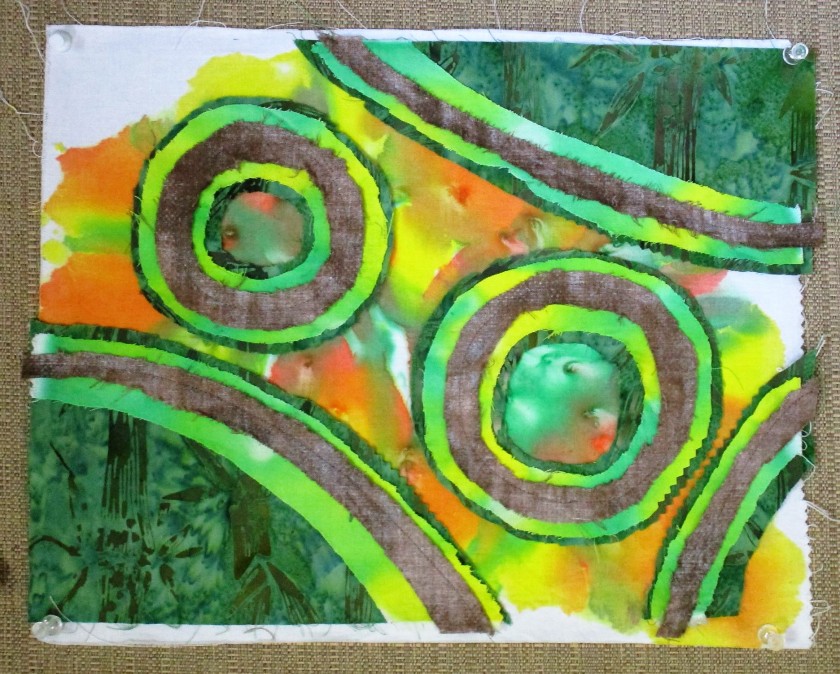
All the excess fabric is now removed.

I was excited by how well the painted design is showcased.

The next steps are really just embellishments. To start, various ribbons and yarns are couched down over the seams. (Couching is just a zig-zag stitch worked over the ribbon/yarn/cord.) After that, it’s time to explore thread and machine embroidery options. I went with metallic yarns and threads in warm colors and dark shades.

To finish up, I made a quilt sandwich with batting and backing and stitched it together using free motion quilting.

My Stitch and Slash sample suggests to me how much the trees are suffering from drought and temperatures above 100 degrees. I will call it Heat Wave.

You can find Carol Ann Waugh’s class here:

https://www.craftsy.com/class/stitch-slash/

Posted in painting

Patio Decor – Stage Two

Back in May, I started a painting on fabric for the purpose of decorating my patio.

https://wordpress.com/post/dailyfiberfun.wordpress.com/5098

It was May, and the weather for patio-sitting was perfect. But I didn’t finish my painting – I had become obsessed with the Shell Lake Story quilt, and could think of nothing else.

Now that the quilt is finished, AND lovely patio-sitting weather has returned, I got out the fabric paints to work on stage two of the painting.

At the end of stage one, I had a 15 by 30 inch canvass with a nice background on it.

The lovely green-colored folds already looked like geranium leaves. The blank-looking orange blobs will become geranium blossoms.

Using Jacquard Textile paint in colors green, ruby red and goldenrod, I started working from the right side of the canvas to the left. Here is the painting after my first two sessions:

Only one more blossom to go. Today I finished it up,

Hm, it’s pretty obvious that I got better at painting as I went along! While the far left blossom is more carefully painted, it lacks the bright highlights of the first two. This was caused by the tone of the underpainting, which was predominately violet instead of yellow, like the other ones. The only way to fix this is to apply opaque paint. The risk in doing that is overworking the painting.

So I guess I will leave well enough alone.

My next steps are to square up the fabric and staple it to the back of the frame.

Posted in colorwork, painting

Decorating the Patio – WIP

While rooting through the garage this week, I found this frame.

I decided that I could make a decor item for my patio, which also could hold various gardening implements on a row of hooks. But what I really wanted was to fill the opening with an abstract painting of geraniums. Something like this:

I picked up a remnant of solid white cotton twill. It seemed to be sturdy enough to stand up to outside conditions. After I washed and dried the fabric, I cut a piece approximately 3 inches wider and longer than the frame opening. Now the fun starts.

My fabric paint choices included green, emerald, red, and yellow. I mixed some violet into the yellow to make a gold color. After about twenty minutes of messing around I had a nice background painted.

To give a little variety to the patches of color, I scrunched up the fabric.

And here is my panel, fully dry and ready for further paint layers.

I’m excited by this result, and keen to work on this fiber object some more.

Posted in collage, embellishing, quilting

Catbird Sings Reveal

In his Guide to Birds, David Sibley describes the gray catbird’s song thusly:

” …a rambling, halting warble with slow tempo…low hoarse notes with high sharp chips and squeaks interspersed….little repetition and little mimicry.”

…..which is, while accurate, a rather dry and technical explanation for what I heard that day:

Catbird Sings

In my final arrangement of this fiber object, I ditched the blue fabric which I was going to use as a framework for the “notes and chips.” Instead, I let the purple satin cord act as a highway for the eye to travel to each vocal outburst. I also unified the color of the lower section by overpainting the batik print using violet.

Close up of bird hidden in purple shrubbery

The free motion stitching wasn’t overly planned. I mostly just followed the clues given by the appliques and the color changes in the background.

Upper section finished with closely spaced stitching and pearlescent paint

I hope you enjoy “seeing” this catbird’s song, as much as I enjoyed listening to it.