Posted in colorwork

Wednesday Color Experiments

While perusing Bethan Ash’s book on quilt collages, I suddenly realized something.

I have been experimenting with fabric paint on quilt cotton for the past two years. And yet I have never used the most basic of all paint techniques: Spatter!

I decided to remedy that omission today. First, I went to my fabric stash and picked up some muslin.

This most basic of all fabrics is lightweight and inexpensive. I cut a width of fabric piece, dividing into three rectangles to match the size of my work surface.

I decided on three color schemes: primary colors, secondary colors and artist’s choice option. For my spatter tools, I chose a 2 inch brush, 1 inch foam brushes and a toothbrush.

After pressing the muslin, I laid the first piece on my white board. Then I spritzed it lightly with water. Working from lightest to darkest shade, I dipped the brush into the paint and then shook, jiggled, and tapped it over the muslin until the drops reached all areas of the fabric.

Yellow, Red and Blue

Since it was a sunny day, I took the first one outside so it could dry quickly right on the board. Once dried, I moved on to the secondary colors.

Orange, Green, Violet

This is a very pretty combination.

For my last combination of colors, I chose magenta as the first color. I had purchased this paint recently and hadn’t even opened the jar. To accompany the magenta, I mixed the left-over violet with the left-over blue to get a cool purple. The third color will be black.

I like this sample the best.

You may be wondering how I plan to used these samples. Well…….I’m not exactly sure. But since I am pondering improvisational collage quilts today, odds are good that they will get fusible adhesive attached to them and cut up into smallish pieces.

Then I will play.

Posted in painting

Trying again Watercolor Canvas

On Thursday I wrote about a product called watercolor canvas. My experiment was to see how well watercolor paint could be used on this surface.

https://dailyfiberfun.wordpress.com/2020/11/05/experiment-with-watercolor-canvas/

I concluded that the results were less than stellar.

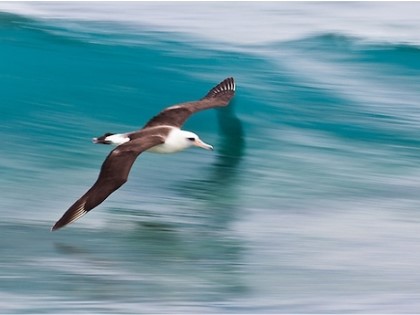
Today I am doing a side by side comparison using watercolor paint and fabric paint. My reference photo is an albatross.

I chose this because of the water background and because it would be quick to paint.

First I gave the sheet a good soaking in warm water, laid it on a waterproof board and squeegeed the excess water out. I was trying to break or reduce the amount of primer/sizing on the canvas. After it dried overnight, I cut it in half and started painting.

Colors used were cobalt blue, turquoise, paynes grey and burnt sienna. There seemed to be no difference in this result versus my first attempt. It was clear to me that the canvas had been primed with paint – probably acrylic.

Next came the textile paint. This paint is acrylic so I had high hopes. As I normally do when painting on fabric, I mixed the paint with a floating medium to thin it.

Colors were sapphire blue, turquoise, burnt sienna, gray and white. The experience of pushing the paint/medium combination around on the canvas was not pleasant. It had the consistency of snot and clumped up quite a bit. I will admit that it dried just fine and did hold some of my paint strokes pretty well.

The conclusion is that neither media gave a good result.

So I will probably abandon the canvas pad for purposes of fiber arts. Maybe some of my art association friends who work in regular acrylic paint would like to try it.

Posted in painting

Experiment with Watercolor Canvas

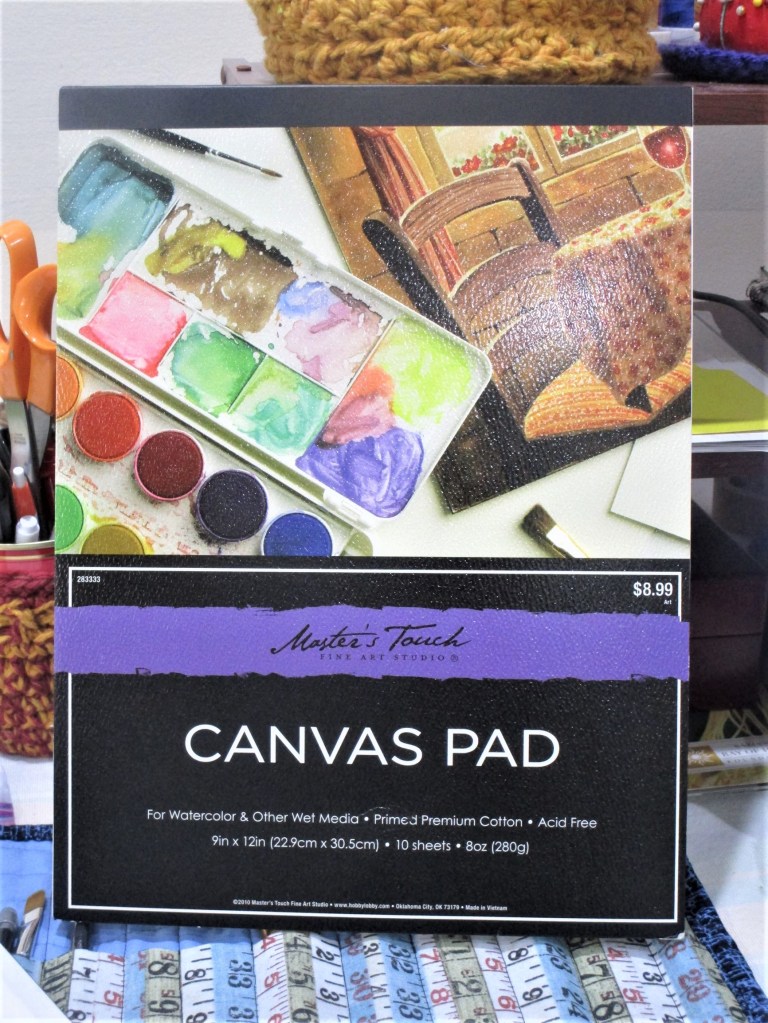
I spotted this item at Hobby Lobby, which piqued my curiosity:

It is described as a canvas pad, suitable for watercolor and other wet media. It is primed, 100% cotton. At $9.00 for 10 sheets, it’s not exactly a cheap paper. It is a soft fabric-like sheet, obviously the same sort of stuff that is stretched over wood frames used by oil and acrylic painters. Yet it promises that watercolors work as well.

I had two questions: First, does it really take paint the way standard cotton watercolor paper does? Second: Does it behave like cotton fabric? For me, that means, can I sew on it, press it and use it on an art quilt?

Today was the day to try. My current project features ducks swimming on a pond. So I got out a reference photo and started a watercolor painting.

It was weird. The paint didn’t want to soak into the canvas. Whatever primer was added made it slightly water repellent.

As I continued to paint, the canvas started to accept the paints, at least a little. My wash went down – thinly, but eventually dried just fine. Getting the colors built up on the duck took a lot of patience. Here’s what I got:

As I removed the painter tape from the edges, I noticed that the tape had not kept the paint out. So no crisp line. That’s okay, I can always cut off the margins.

Next I had to see if the paint would stay put. I wet a brush and moved it along the wash area. The paint was lifting quite a lot, and quickly. So I can’t use a painted canvas in an item that will be exposed to water.

What about heat? I took the iron to the image, pressing gently at first. With a cloth over the duck, I then pressed at a higher heat (rayon setting) and held the iron in place for several seconds.

At first, there appeared to be no effect. Eventually I noticed that the canvas had rippled in response to the heat. The paint looked fine, but I also noticed some shiny places on the ducks’ head and neck. Obviously, at least one of the paint pigments had a binder or bit of metal that melted in response to the iron.

At this point I stopped my experiments. Next time I plan to apply my needle, thread and scissors. Maybe even run it through the sewing machine.

To be continued……

Posted in drawing

More Inktober: More Experiments

Since I am basically a beginner at this, I consider all of my drawing experiments. But this week, I decided to adopt a more playful approach.

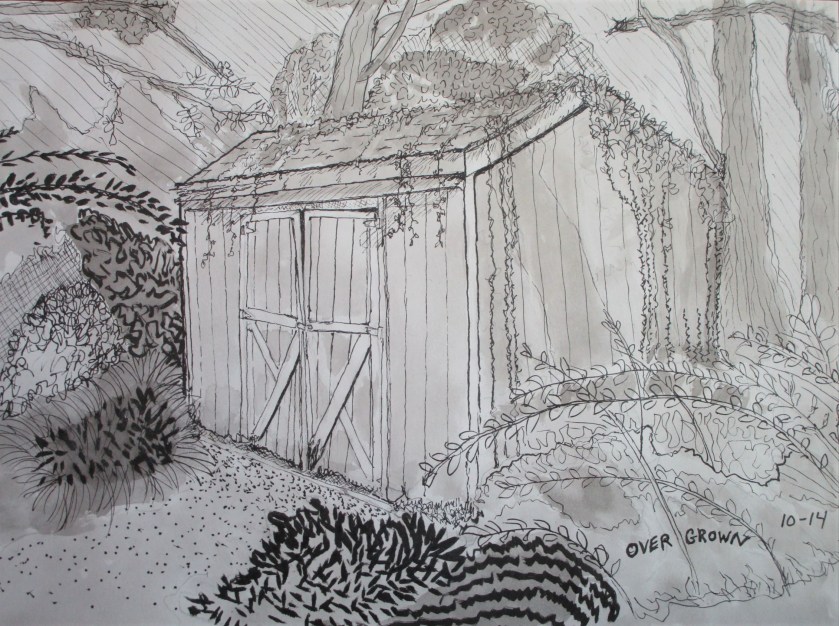
Overgrown: Playing around with ink wash.

Legend: Nessie show herself.

The paper is seriously rippled. I learned that I must use a stronger paper for ink wash.

Wild: Drawing the young jaguar that I appliqued earlier this year.

Colored paper as a background.

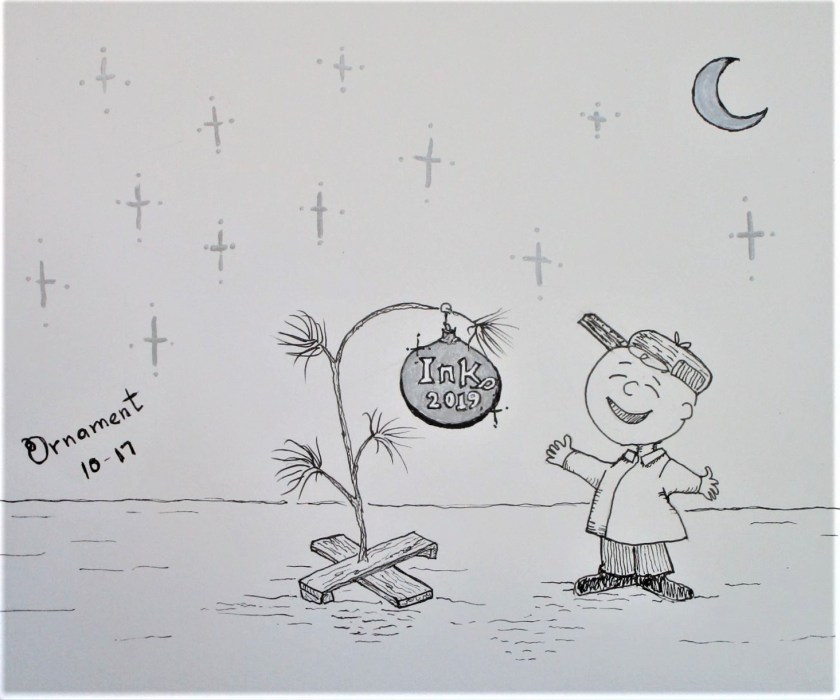
Ornament: Comic book style.

Misfit: Who invited that bird into our flock?

Sling: The challenge of drawing a fishing net.

More fun next week.

Posted in colorwork, painting

Consolidate. Gestate. Internalize.

For the past three days I have been irresolute about making new fiber objects. I haven’t been idle – not a chance of that! But I felt more internal about my efforts than external, that is, not ready to show or talk about them.

Consolidate: (verb) 1. to join together into one whole. 2. to make firm or secure.

Gestate: (verb) to conceive and gradually develop in the mind.

Internalize: (verb) to incorporate within the self as conscious or subconscious guiding principles through learning.

If you ever start to feel you are stuck creatively, I suggest you reframe your status with the verbs above. It could be that you are not stuck at all but are internalizing.

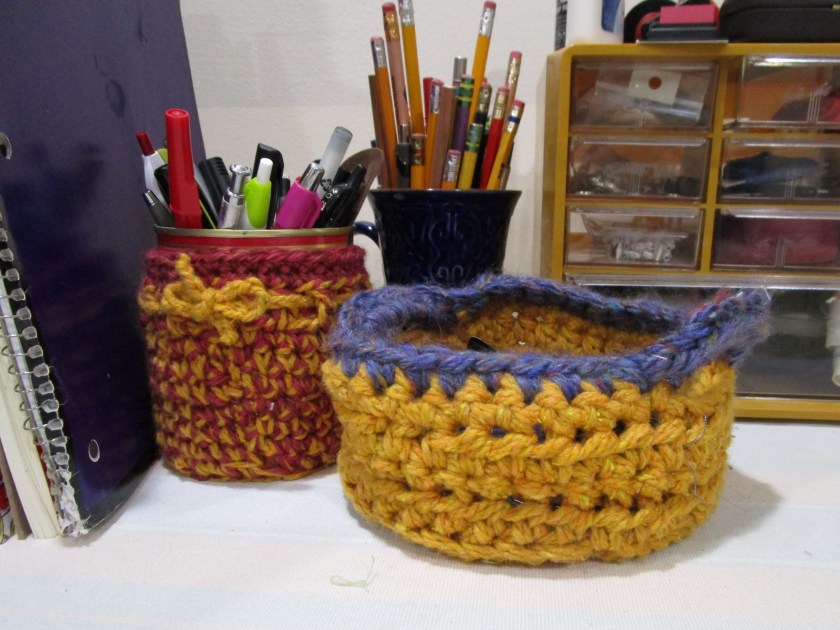
A week ago, I agreed to offer fiber arts lessons again to the local homeschool association. To keep from being overwhelmed, I suggested that I teach project or workshop-type lessons. So part of my time has been spent on writing syllabi for these workshops. The first topic is crochet. I propose to teach crochet in the round.

View of my worktable with two crocheted baskets in use.

I finished the syllabus for this workshop and made this sample.

It has been a while since I’ve created with yarn. It felt good to get back to it.

Secondly, I have been fooling around with pattern and paint on my color washed fabrics. Using foam, felt, cotton yarn and cardboard, I made these stamps.

Stamps sitting on color wash sample

I then proceeded to use them on this sample as well as a dark gray sample. My paint selection included Jacquard Textile paints, which are semi-transparent, Pebeo Setacolor opaque white, and some metallic acrylic paint I had laying around. Here are my doodles.

I’m loving the dark sample, especially the way the white opaque shapes and the glittery bronze shapes jump forward from the brooding background.