Actually, this experiment came to mind while I was viewing Cindy Anderson’s blog “Sew Much Fun.” She had made some quilt blocks in the shape of birds. Check it out here:
https://wordpress.com/read/blogs/35439603/posts/27018
After admiring her work, I began to think that it reminded me of the puzzle Tangoes.

This ancient Chinese puzzle started when a man named Tan dropped a 4 inch tile on the floor and it broke into seven pieces. Putting the pieces back together proved more challenging than he expected. Eventually, Tan began to visualize various forms that could be built with the seven shapes – animals, people and abstract forms.
Over the years the puzzle gained a large following, resulting in up to 16,000 possible solutions. The version that I have includes a deck of cards with 54 solutions. I decided to design a quilt block out of one of these images. Here is the one I chose:

To start with, I searched the Internet to see if anyone else has published a quilt block that looks like this arrow. While I found many different forms of arrow shaped blocks, none resembled this design.
Realizing that the design is actually a made from two triangles, I tried to make each triangle and them sew them together. After much cutting, pressing and sewing, I came up with this. It is actually a full inch bigger than the Tango shape.

A good start, but the proportions are wrong and it was very wasteful to make. Hm,
So I slept on it. It finally occurred to me that I could solve the lower triangle by making the stem of the Maple Leaf block. And the upper triangle could be solved by making a nine patch block, with two solid strips and one 3-patch strip then slicing the block on the diagonal. This solution would allow mass production of the block with a lot less waste.


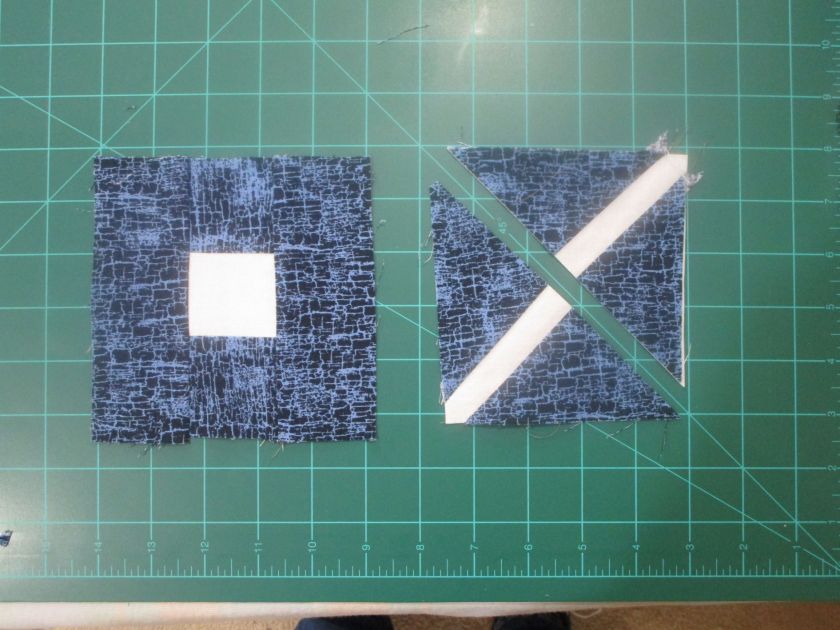
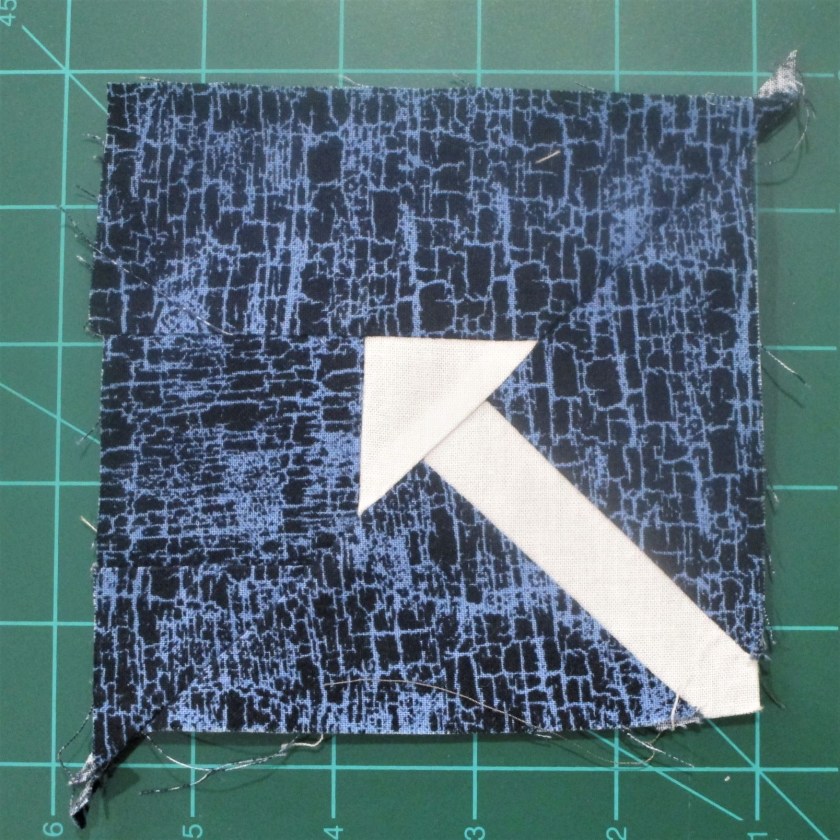
Here is my solution compared to the Tangoes solution. It’s still not quite right…

But it is close enough to require only tweaking. I would like to narrow the stem and widen the arrowhead. Also, it would be good to make the external block dimension 4 and 1/2 inches square, so that the finished size will end up a 4 inch square. (Sigh) I do believe a little math will be necessary if I hope to use this quilt block in a future fiber object.








 Daily Fiber