Posted in quilting

SAHRR Round 6 and a revisit to Round 4

It is the final week of the 2024 Stay at Home Round Robin challenge. In my last post, I had part-way finished the round 5 challenge (the number 4) but was flummoxed by the Round 4 challenge (square in a square). Working many hours on my quilt this week, I managed to sort out and assemble round four, as well as the second side of round 5. If you are following this, I recommend that you get comfortable, because this is a long post.

Let me start by sharing two inspiration photos.
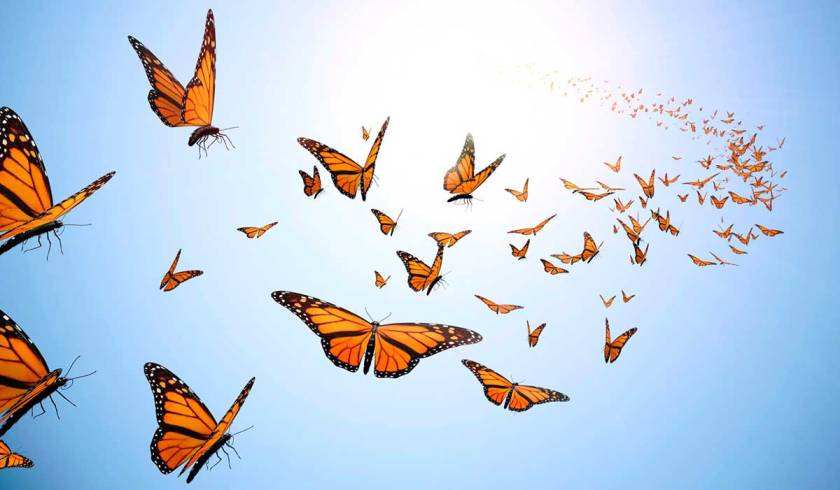
A kaleidoscope of butterflies.

A boatful of refugees.

It’s possible that the connection between these two images isn’t obvious. When I tell you that the theme of my quilt is migration, my choices will make more sense to you.

For at least a year I have wanted to paper piece some butterflies and use them in a quilt about migration. I even went so far as to design three different patterns in multiple sizes. After fooling around with them, I ended up putting them away for a later date. It’s now 2024 and, it’s clear to me that now is the time for the butterflies.
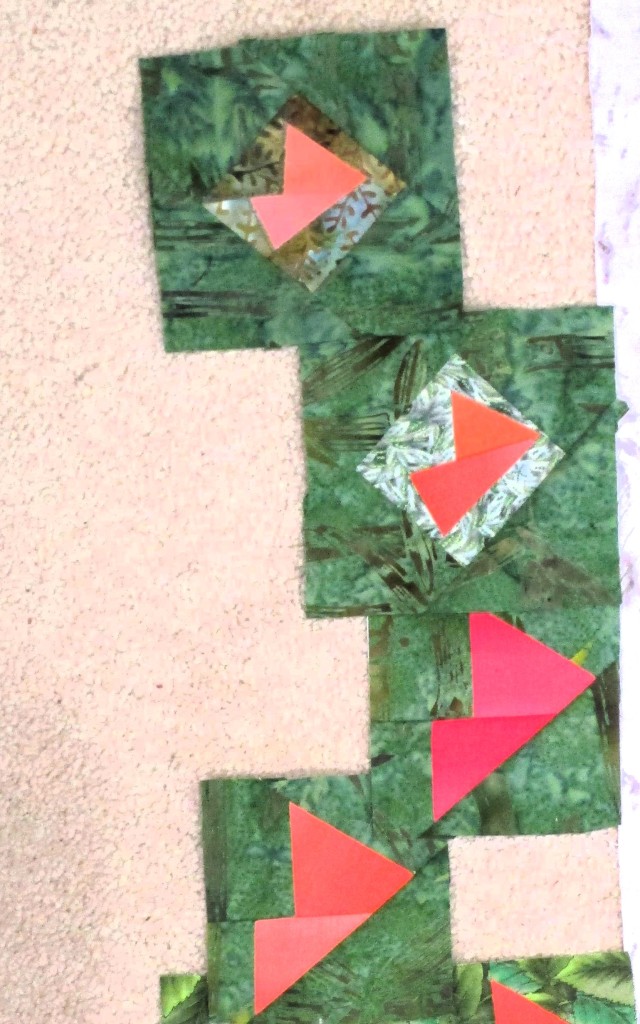
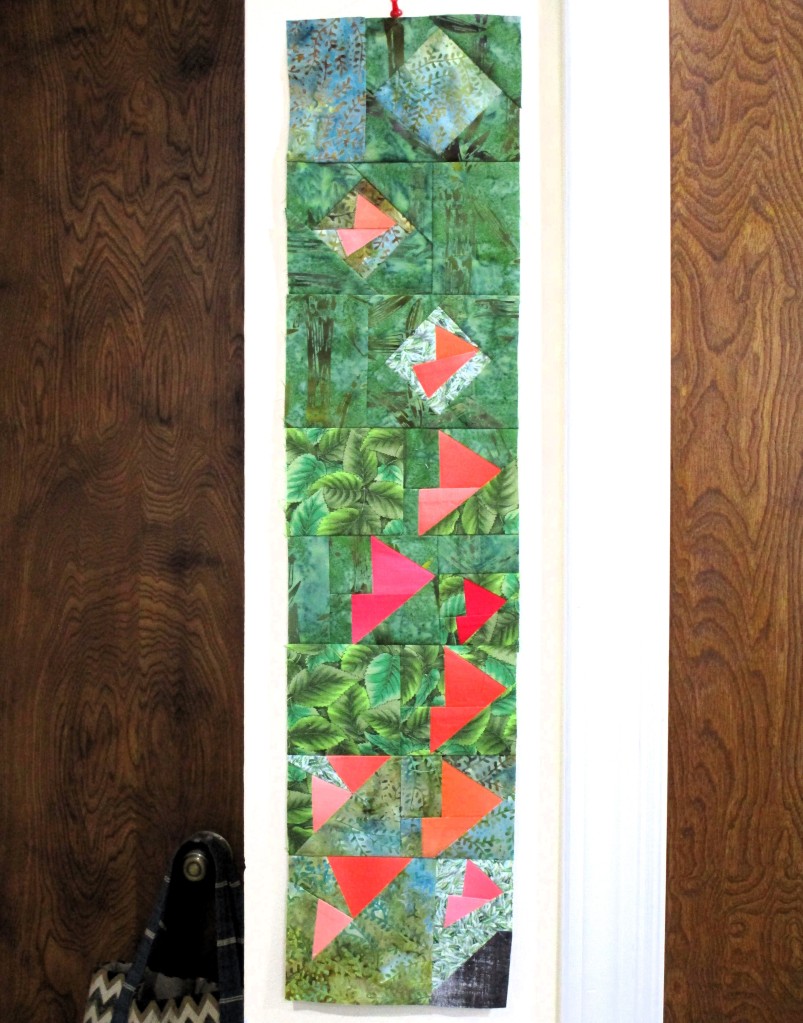
Most of my paper pieced butterflies were in plain blocks. But because Round 4 is square in a square challenge, I used two small butterflies as centers

This border took me almost three days to design and construct, but I don’t regret any of the time, or the mess left behind. The result exceeds my expectations.
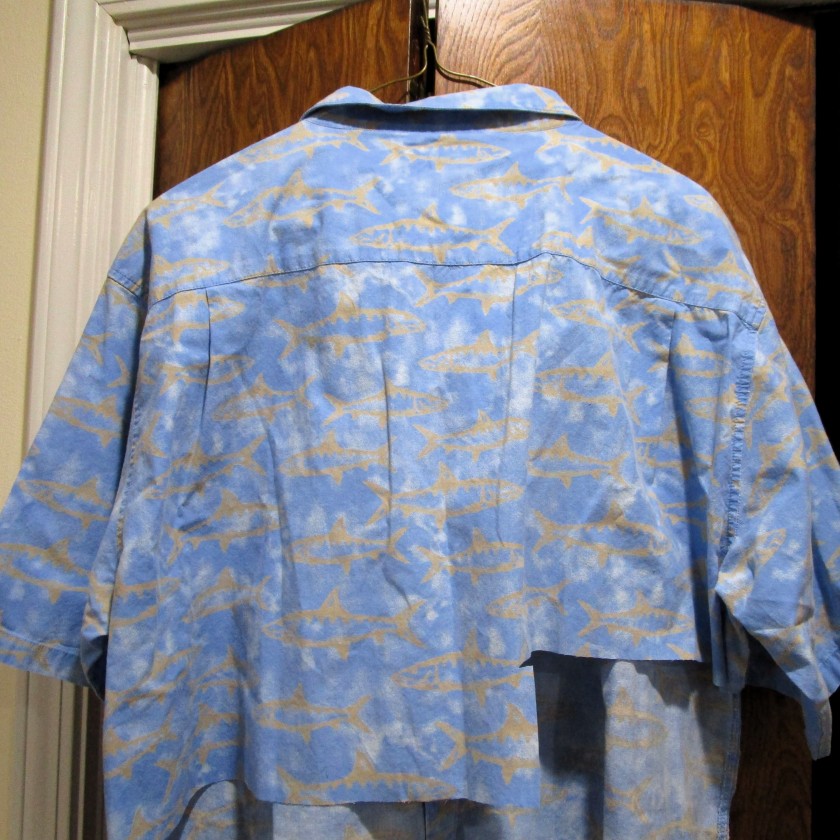
Moving on to the top border, which also is included in my Round 4. Here is the shirt I cut up to get the fish fabric.
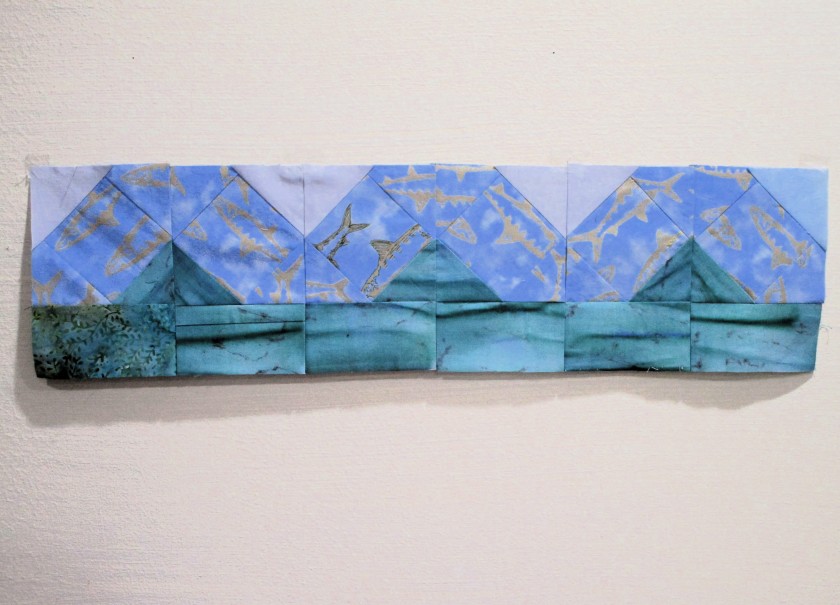
I wanted to sew the blocks in a manner that gave the illusion of fish swimming upstream. Here is my first attempt, which was a total fail.
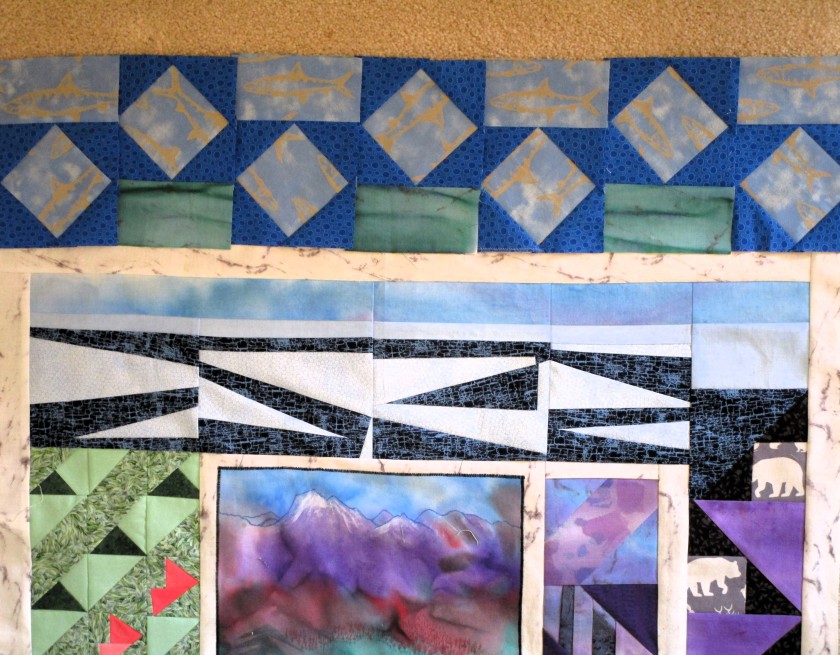
To move forward, I did what everyone else does. I looked at other quilters’ work. I noticed one quilter put together a square in square that totally changed the appearance of the block, simply by mixing up the corner triangles’ colors. The lesson: you can use more than one color. Ahhhhh! Out came the seam ripper to completely disassemble my entire border. I threw away all the corners and made new ones. Now I have six square in square blocks that work together the way I envisioned.
Deep, breath – on to my refugees. Using my inspiration photo, I made a sketch that caught the essential elements. Then I turned the sketch into a pattern. Because the shapes of the people are not straight lines, this part of the design was not made by paper piecing. It was appliqued to a background of sky and water.

The finished block is 12 x 6 inches.
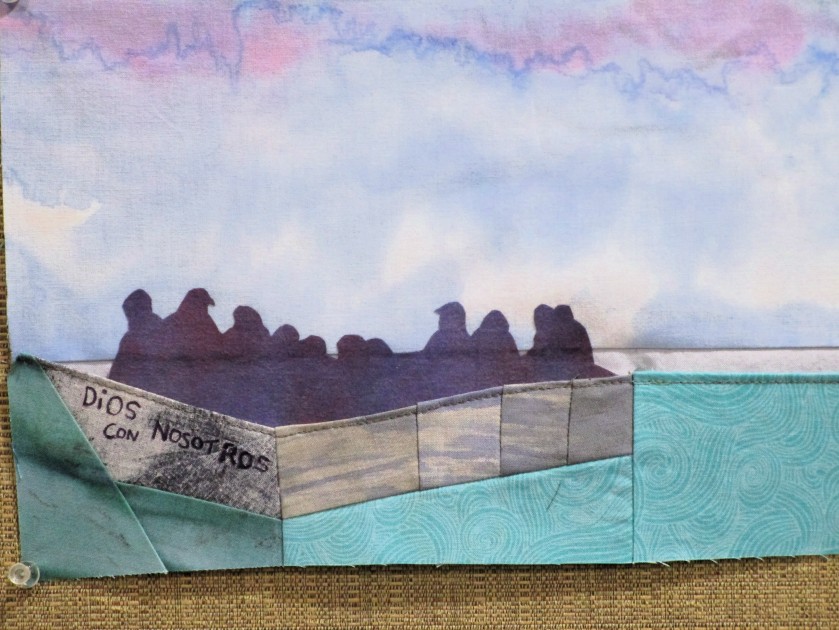
And if you look closely, you can see how I met this week’s challenge by adding the lettering that appeared in the inspiration photo.
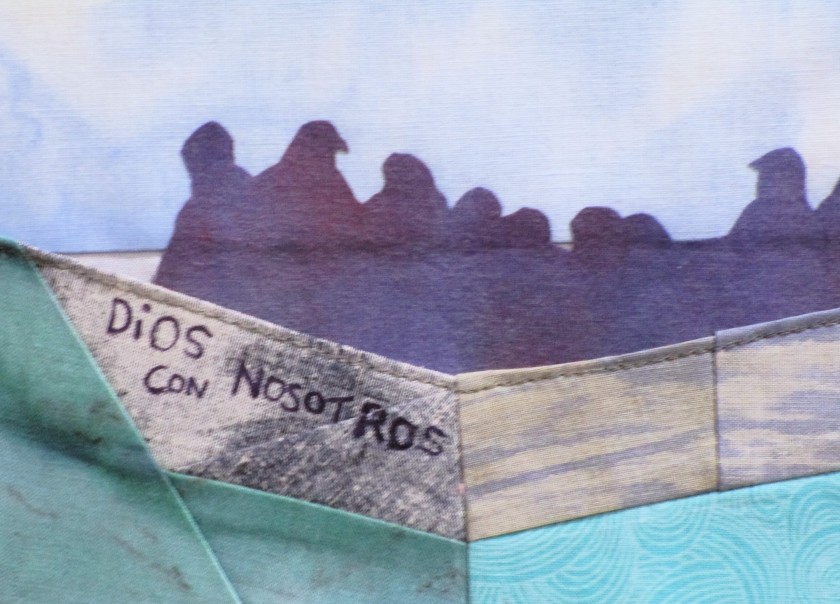
I wrote the words with a purple fabric pen.

This morning, I threw together several four-patch blocks to fill in the right side of the quilt. And while it’s not completely sewn up, and two corners need transition blocks, this quilt top is close enough to a finish that I can post it on the linky party site.
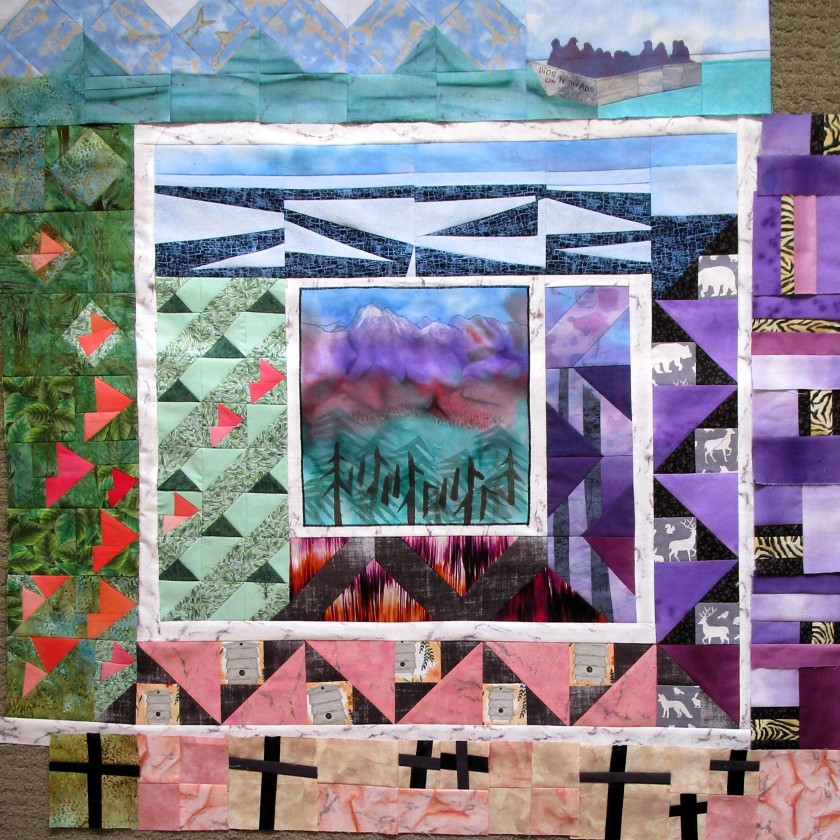
MIGRATION WORLD

If you are still with me, thanks for reading all of this. It felt important to me to share my process. Maybe it’s a way to clear my mind for what may come next.

This week’s Linky party is hosted by Kathleen McMusing. Visit her to see the quilts of other participants.

Posted in quilting

SAHRR 2024 Border One: Grateful

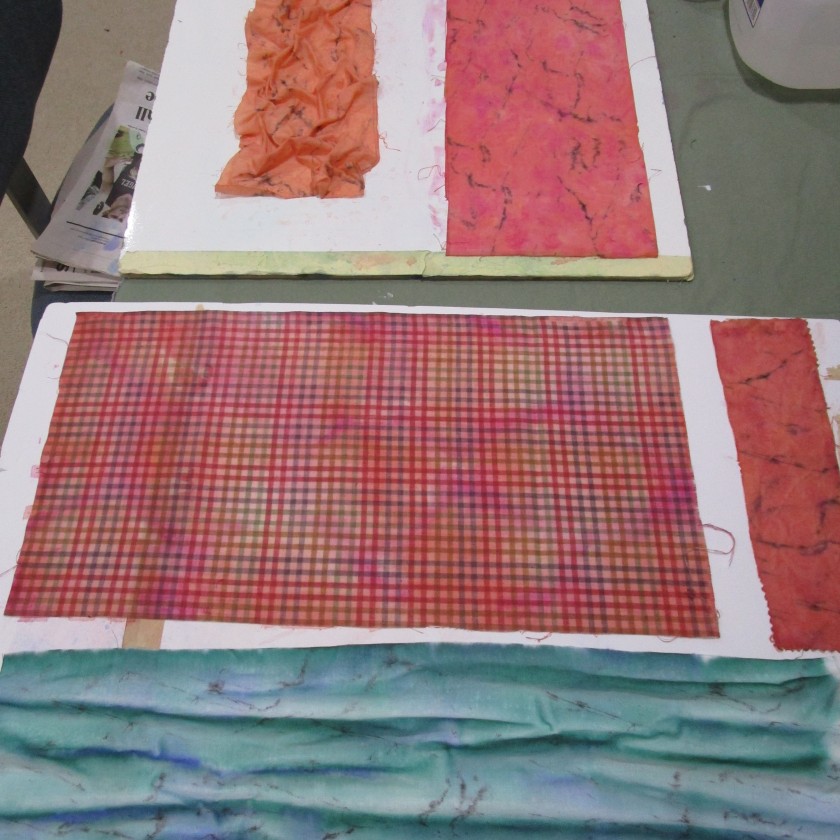
I’m grateful to Pieceful Wendy for choosing the signature block for the 1st round of this year’s Stay at Home Round Robin. I’m also grateful to myself for pre-planning this project instead of winging it each week. You see above some of the fabrics I have painted (along with a nice purple solid.)

Here’s a few more that I painted. Most are commercially printed fabrics. I just added a few layers of color using Jacquard Dye-Na-Flo fabric paint.

These will soon appear in my SAHRR quilt rounds.

Okay – fabrics are at the ready, time to sew.

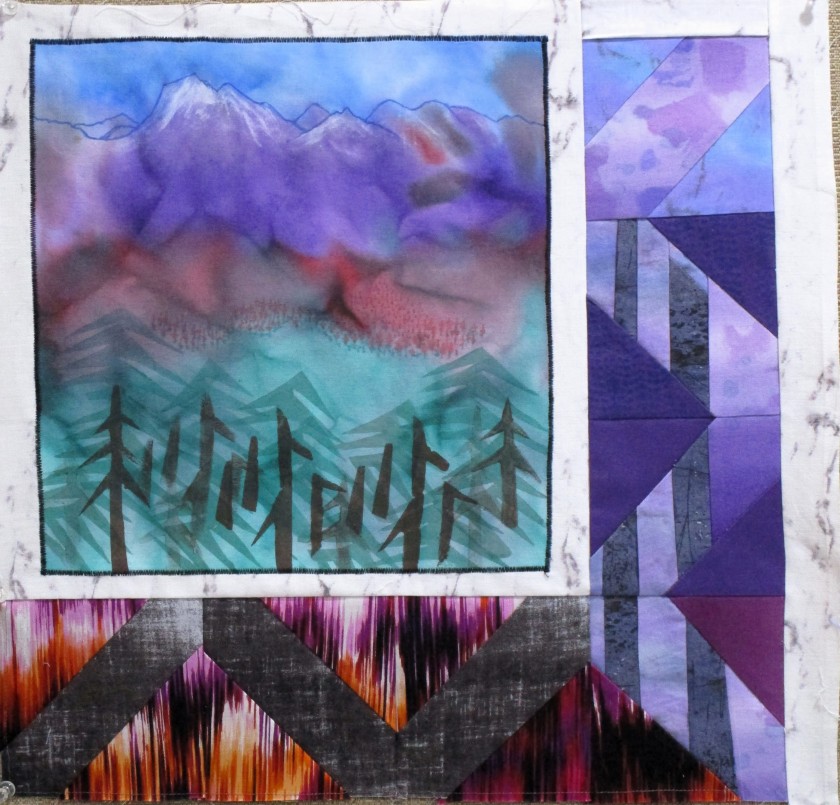
In reviewing my project map, I see that the colors purple and red are to dominate the first round, which will be attached to my center panel’s right and bottom sides. The right side will extend the trees of the panel into the border. The bottom will represent the forest fire. 

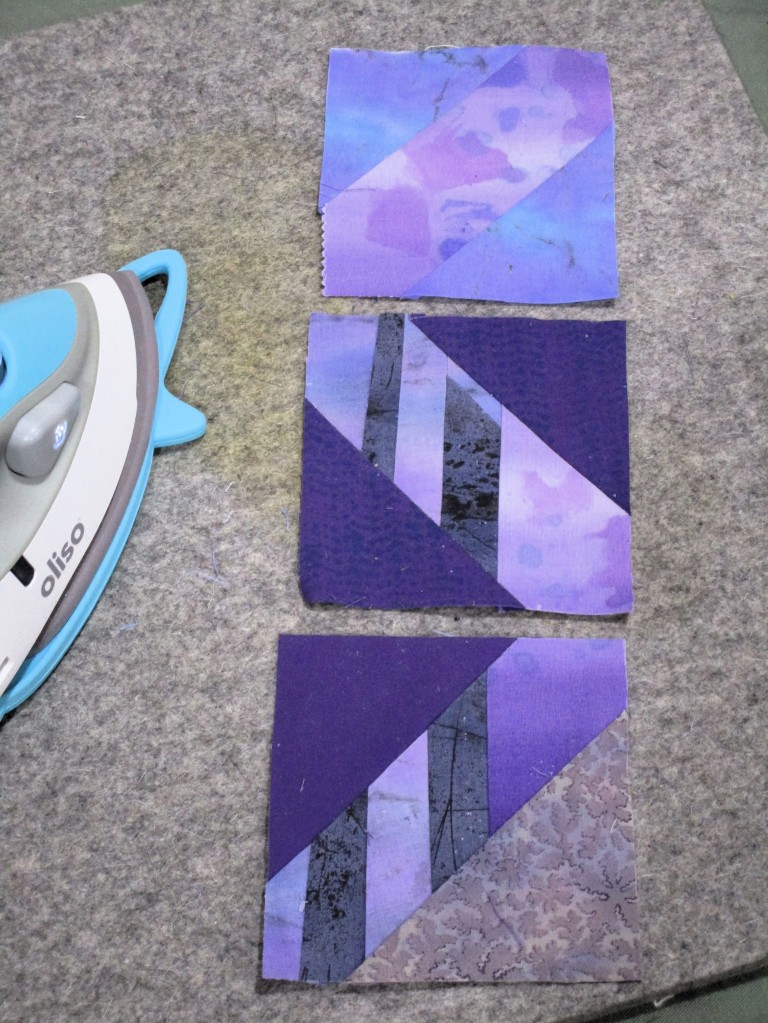
I started with the trees. They will go in the center strip of the signature blocks. I cut fabrics that looked tree-like and some smokey purple fabric and made a strip set. Then I cut some purple squares to use in the corners.

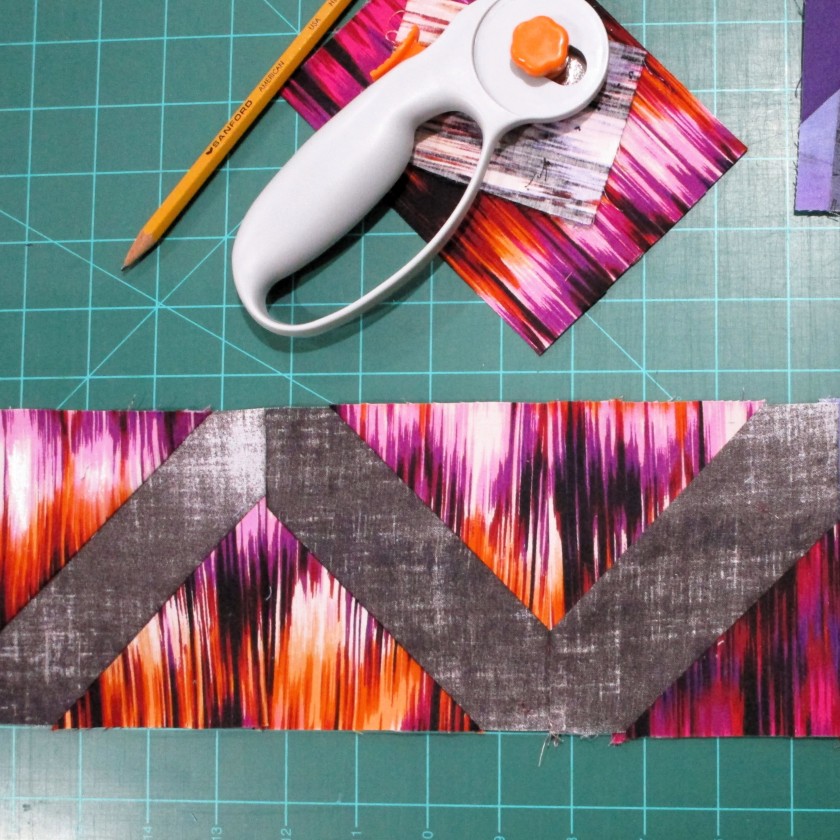
That’s the right side done. For the bottom, I got out some flame-like fabric that used to be part of a dress that no longer fit. It was cut up a few years ago and saved for just this moment. How fortunate for me.

Do you feel the heat yet?

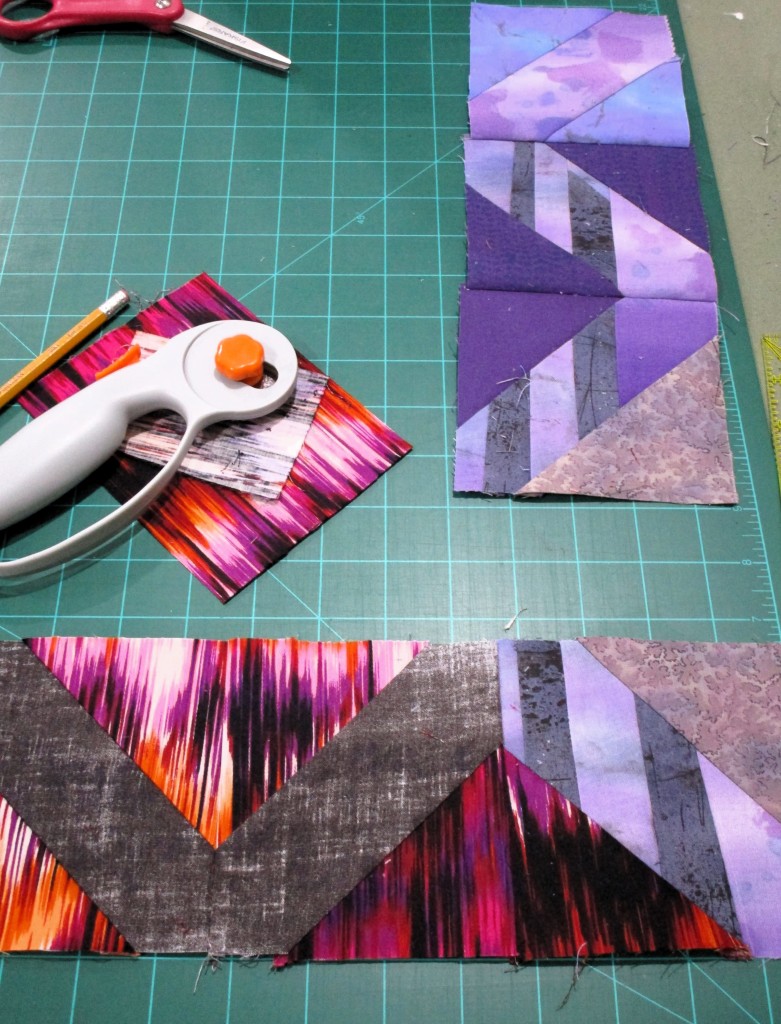
After making a corner block that integrated the two sides, I sewed the blocks together.

Jan 29: After viewing a photograph of my work, I swapped out one of the fabrics in the corner block. Then I joined up the first round to the center panel. 

I also decided to use white fabric with a marble print as sashing around each group of blocks. SAHHR Round one is made of 4 inch finished blocks. My quilt is now 16″ and ready for the next round.

Be sure to check out all the SAHRR 2024 participants’ projects posted at the Linky party. You can find that HERE.

Posted in quilting, recycling

SAHRR 2024 begins this week

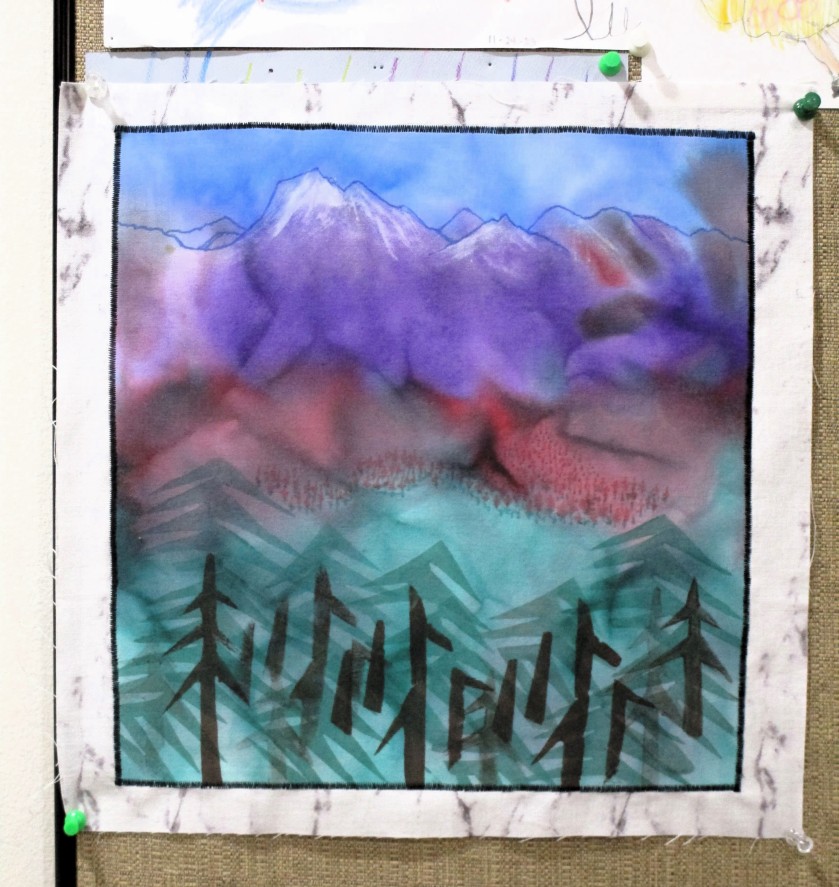
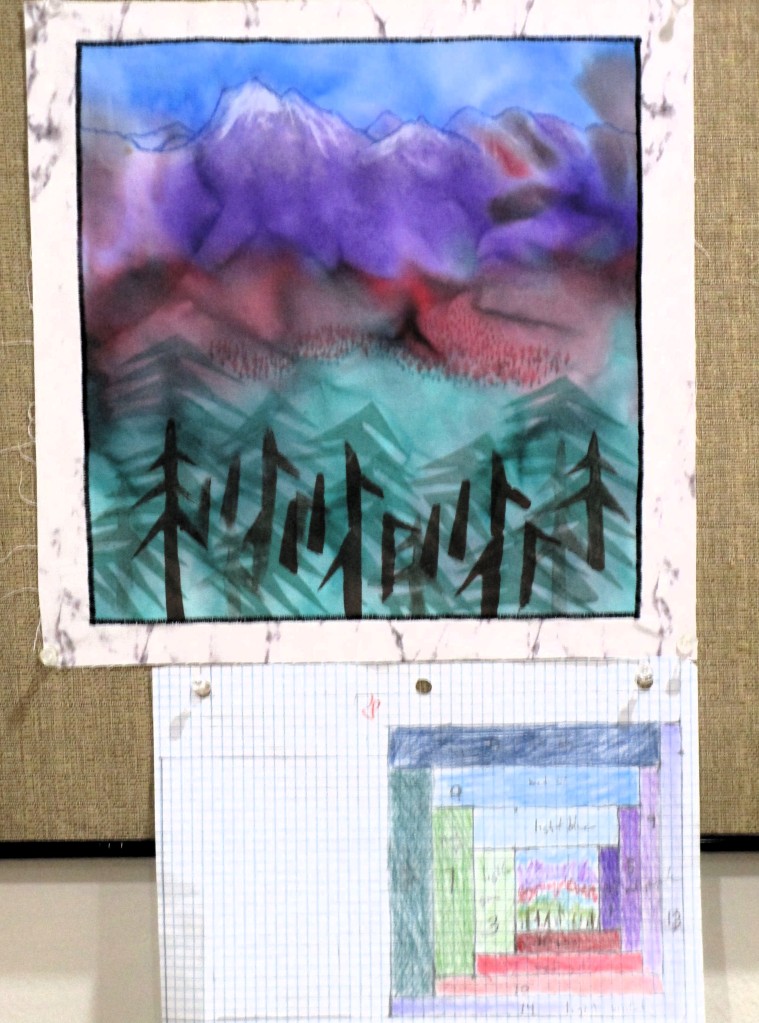
Last week I posted a number of choices for my center block in the annual Stay At Home Round Robin quilting challenge. Readers of this blog will not be terribly surprised to hear that I chose the mountain painting on fabric.

Now I am forced to consider the short-comings of my choice. First of all, it wasn’t square, having a slightly portrait layout. I sliced off the top and bottom to the limit that I was willing to sacrifice the image. It was still out of square.

My solution was to applique it to a 12 1/2 background. By choosing to applique instead of piece, I avoided seam allowance, retaining more of the painting. With a center block finishing at 12 in., I have lots of options for sizes of the rounds to come.

The second shortcoming became clear when I observed that the painting was mostly one value – it’s medium value nearly throughout. There are some darks, but no real lights. I’ll have to find a way to bring in some light, perhaps with embroidery.

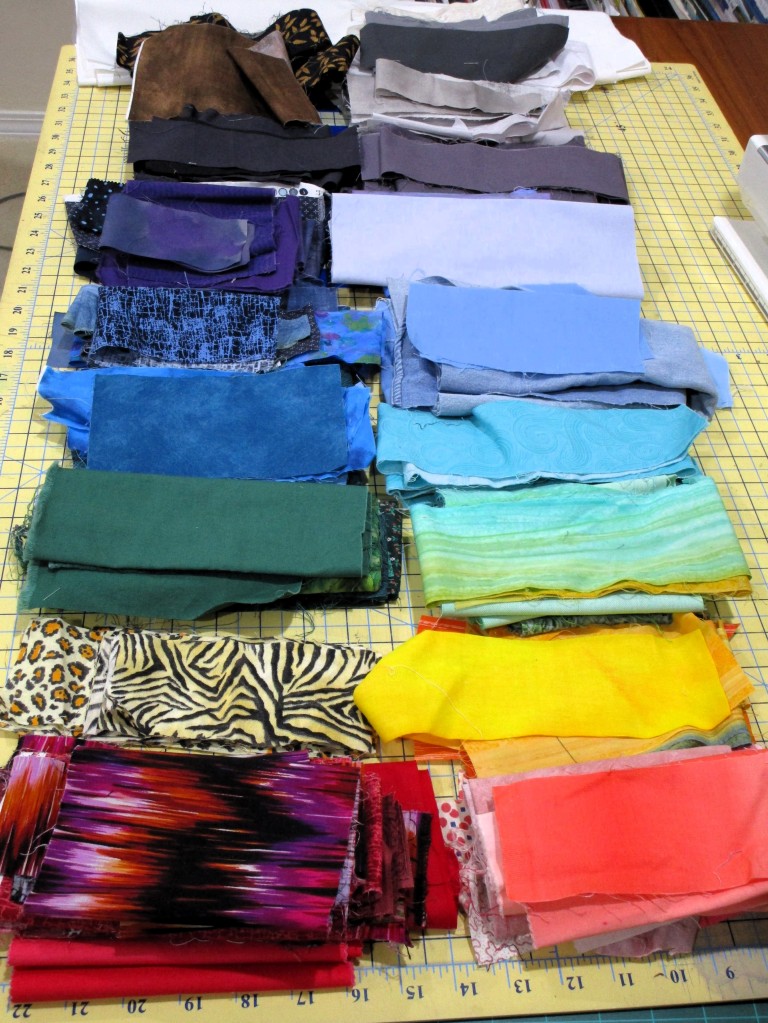
Now I am confronted with a number of design decisions. I have resolved to make the entire thing out of scraps, if I can manage it. Coming up with the palette was easy. It will be an analogous one, featuring a range of colors that exist in the painting. Purple, blue, teal and cool greens will predominate, with a generous dash of reds as accent. Here are the eligible scraps, organized by color and value.

With any luck, I can avoid buying more fabric, outside of the backing.

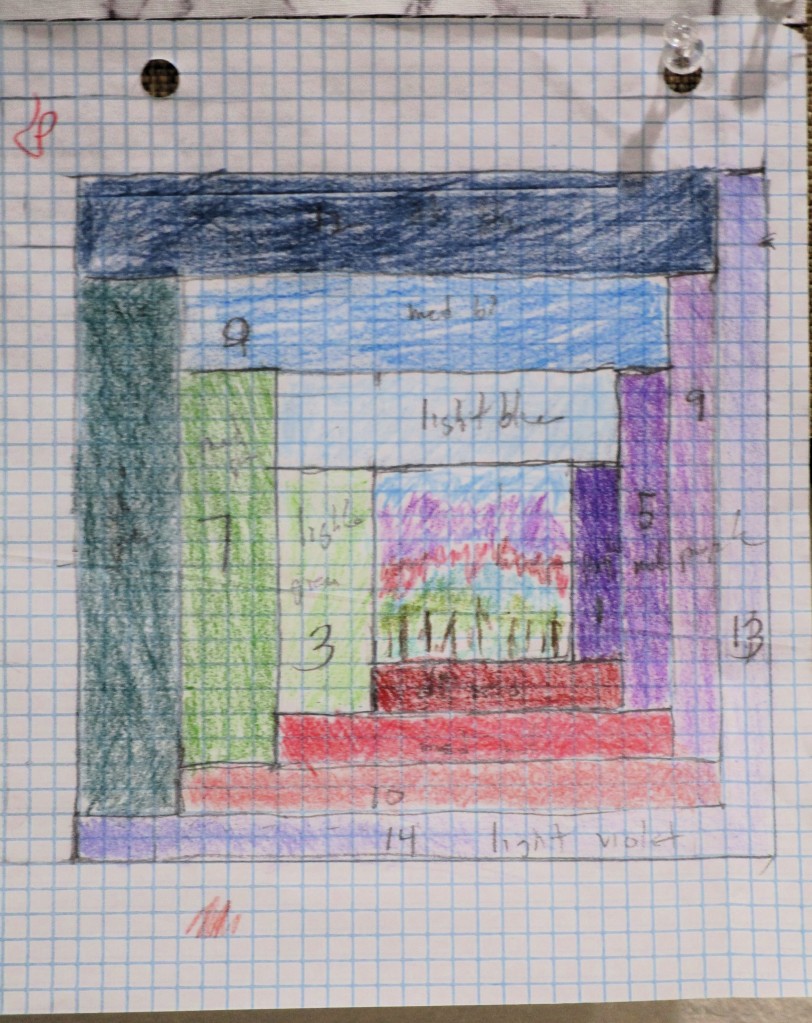
The final design decisions that I can make prior to getting the first clue concern size and layout. I spent hours thumbing through books and looking online before I made my choices. Ultimately, I settled on a square, with an expected size of 45 inches, more or less. My plan is to add the rounds in log cabin fashion, keeping each round within a strict color range. To see how it would work I made a mock-up using colored pencil on graph paper.

I’m old school. No computerized design program assistance in my studio.

To see all the challenge participants’ center blocks, click Here.

Posted in quilting

Wednesday: Considering a new project

At present, I have various works in progress and finished objects that I could write about today. But January is the month that Quilting Gail and her co-horts begin work on the annual Stay at Home Round Robin quilt. So I am pivoting.

During the past three years I have participated with joy. I’d really like to continue round robin-ing this year. But I am in a quandary about my center block. Thinking about SAHHR in December, I had the idea to use paper pieced squares in this year’s center block. I but never got around to making them. Now, feeling pressed for time, I’m reluctant to work on a deadline in a technique in which I have little experience.

This morning, I decided the answer may lie in the objects I made during my first year of practicing fiber arts. It was a time when I was bursting with ideas but short on skills. As I rummaged through my portfolio from 2019 to early 2020, I found six fiber objects with potential to become a center block of a small quilt.

Shall we audition them together?

Candidate 1:

This was an early experiment with fabric paint. I took two different paintings, cut them into strips and wove them together, using satin stitch to close up the cut edges.

Candidate 2:

This is a rejected block from my oakleaf hydrangea wall-hanging. The background is covered in snippets of hand embroidery with irregular blanket stitch on the edges.

Candidate 3:

I was discovering what fabric markers can do. This painting is done on lightweight muslin and would need to be mounted on sturdier fabric.

Candidate 4:

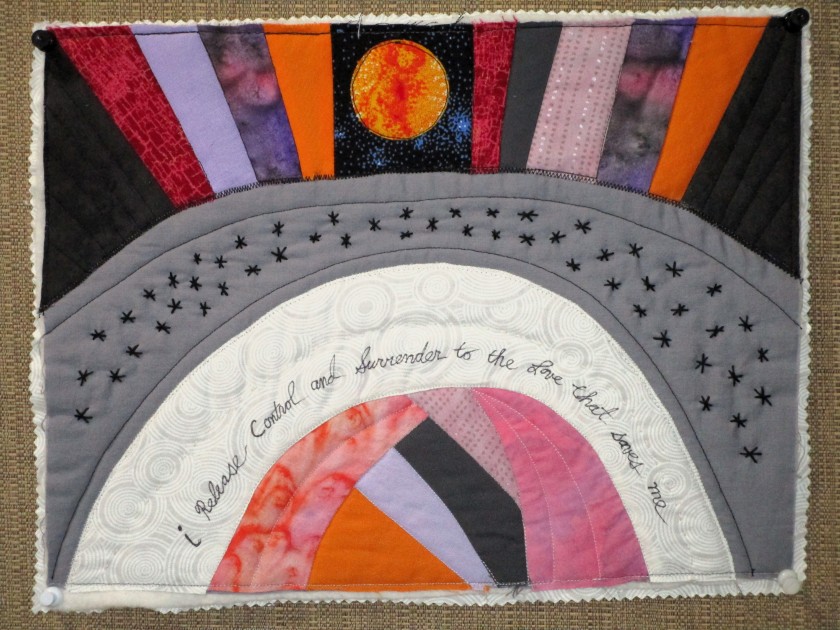
A mini art quilt, this was inspired by what I saw in my head with eyes closed during a yoga class. I was practicing curved edge piecing.

Candidate 5:

Inspired by one of Bill’s photographs, this block was a practice piece for a larger work I never completed. The technique is confetti applique. While I would consider putting this one in an SAHHR quilt, I’ve yet to give up on my original concept.

Candidate 6:

A very early experiment in fabric painting, I “saw” a scene of a mountain area recovering from a forest fire. The initial paint application was enhanced with brown stamps of bare and broken trees. The middle ground is meant to represent fireweed which moves in quickly after a fire ends.

This last block is the one I am leaning toward the most. I have some ideas for expanding on the theme of environmental devastation and recovery.

What do you think about my options? Even if you are not a quilter, I am interested in learning the block that attracts your eye the most. Which one has the highest potential from the aspects of design, color and originality?

Posted in knitting

WIP – Mosaic Stitch Swatches

For today’s post on work in progress, I’d like to share my adventure in choosing a mosaic stitch design for my crescent shawl.

To get started, I picked up Barbara Walker’s excellent Treasury of Knitting Patterns, published in 1968. Chapter Four (Color Changing Patterns) contains advice and 76 different examples of mosaic stitch. The first one I tried is called Rippled Chevron.

For the 1st pattern repeat, I used stockinette stitch. The second repeat was knitted in garter stitch. I liked this pattern, and it was quite easy. The garter stitch version would work better with my shawl design.

Continuing my swatch, I went for something more complicated: Dotted Diamond.

I love the look of this pattern. After knitting it I began to see how an exciting piece of knitting could be made by working a sequence of different mosaic stitches with different background yarns and one foreground yarn.

All of this swatching around is very fun and instructive. But I concluded that Mrs. Walker’s patterns were all very geometric looking. I craved a pattern that appeared more curvilinear – almost flower-like. So my next step was to use the advanced search option on Ravelry to find some flower-like mosaic patterns. This took a good hour. Eventually I discovered a pattern for socks that incorporated mosaic designs inspired by Native American symbols.

https://www.ravelry.com/patterns/library/burntwater-socks

This is getting closer to what I had in mind. After making a few final adjustments and switching to a bigger needle, I started knitting the resulting pattern into my shawl. By yesterday evening I was half-way finished with the 50-row pattern.

I love what’s happening here. My original swatch was too narrow to give me any idea of the secondary pattern in the design. When several pattern repeats are worked, the wing-like lines between the circles clearly stand out. This makes me happy.

Barbara’s treasury is truly a treasure. If you can get your hands on this book, you will find it immensely useful in expanding your knowledge and skills. Kudos also to Mary the Hobbit, who designed the Burntwater socks. This pattern could easily become my next sock project.