For the past several weeks I have had been knitting on two projects.
Let’s start with the Arrowhead Lace Interrupted cardigan.
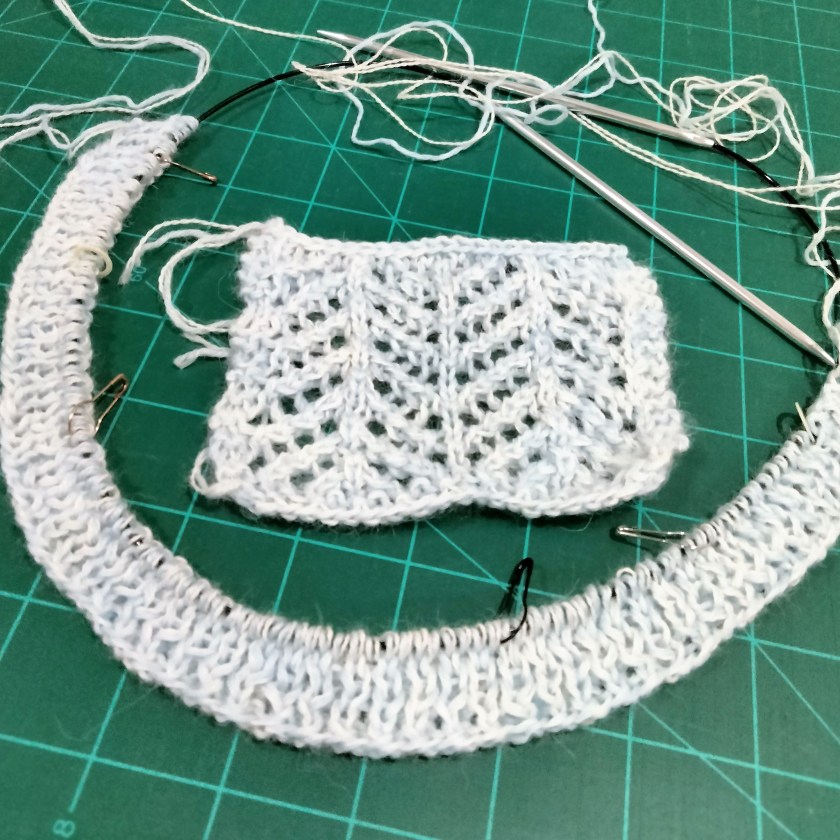
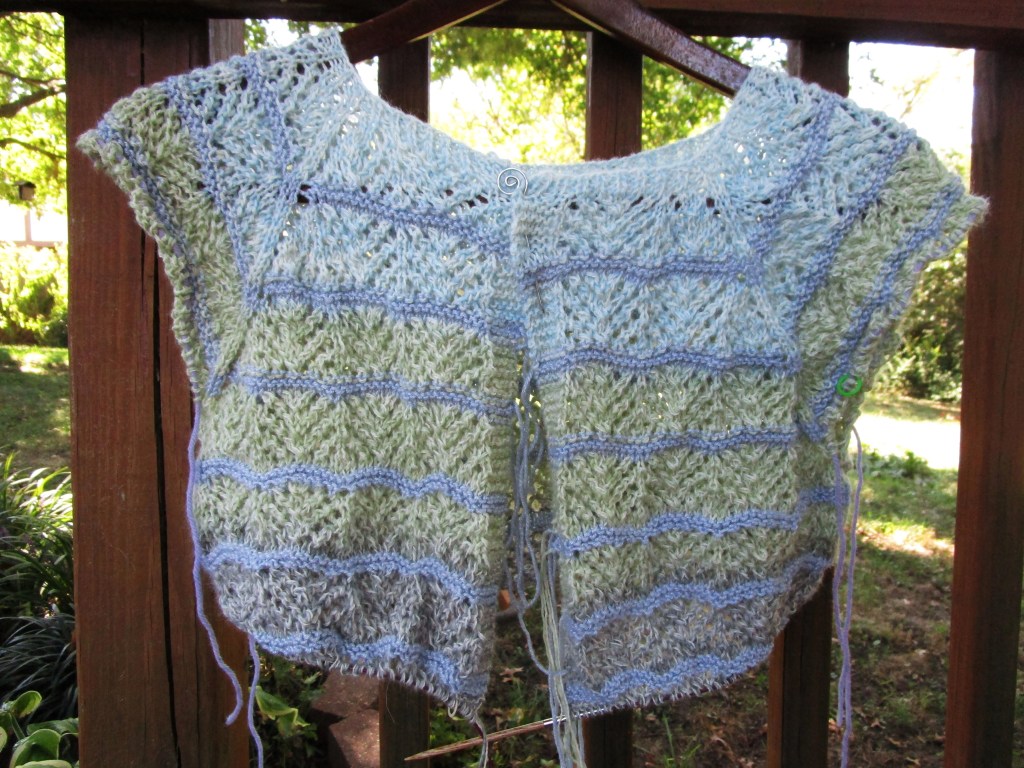
As of last week, this project has been sent to Time Out. Here is where I am so far.
It’s looking pretty good. However, during the last repeat of the arrowhead lace sequence, I discovered pattern row 1 was short by two loops. And in my efforts to “fix” it, I lost three more loops!. Gah!
I’m having a much better time knitting the Biome hat. https://www.ravelry.com/patterns/library/biome-hat The biggest challenge for me has been reading a chart that has 120 stitches per row with no pattern repeats.
After struggling to keep track of where I was on the long row, I decided to stack the two sheets together, held on a clipboard with a purple strip of paper to mark the current row. This proved to be much more manageable.
When I reach the end of the first sheet, I simply insert the second under the purple place holder. Using this practice, I easily completed 20 rows of the 50-row chart.
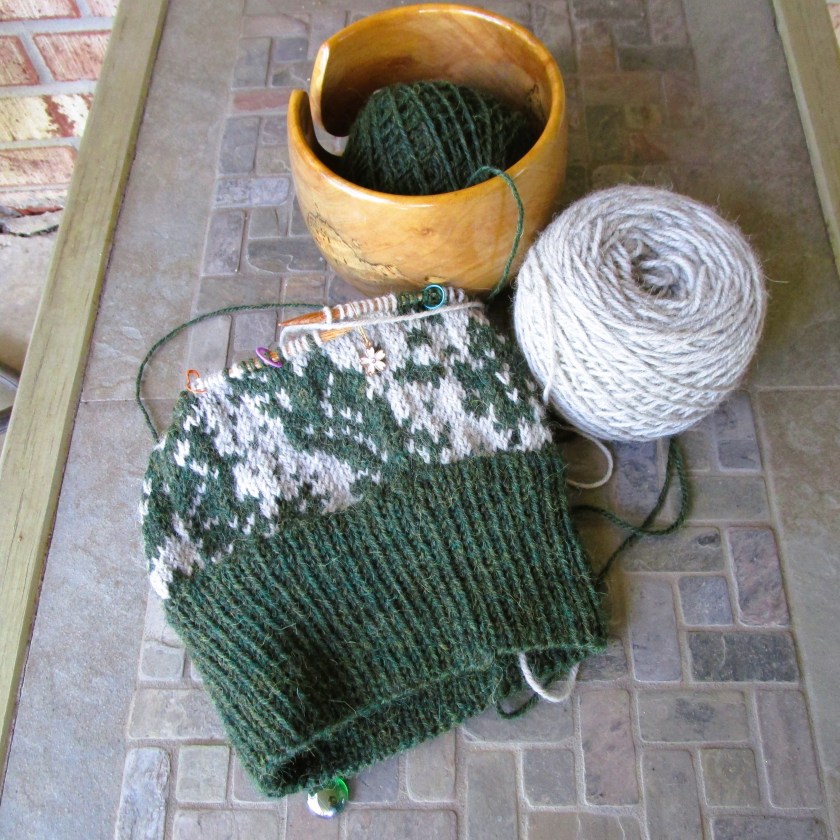
Here’s a better look at the Biome, in sunlight.
I’m calling the hat Summer Smoke, because the North Woods of Wisconsin was blanketed in smoke from Canada while I was visiting this summer. I purchased the yarn at North Wind Fiber and Book store, in Spooner, WI.
I think this hat looks pretty cool so far. It will go to Henry on his birthday in November. I expect there will be requests from other family members for Biome hats once they get a look at it.
Honestly, the project itself is not completely different. It’s a hat. It’s a 2-color hat. It’s a 2-color hat knitted in fair-isle technique. The difference lies in the chart.
It was generated by computer using a program coded by designer Rianna Suen.
In her words, “Simplex noise is a clustered randomness algorithm. When translated into knit stitches, it produces a colorwork pattern with an organic look.” The upshot of it is that no two patterns will be alike. Each time you click on the link, the algorithm runs and displays a new chart. If you don’t like what you see, move a variable and run it again. Save a few runs and use the pattern that you like the most.
My chart looks hand drawn, because it is. I was unable to get a workable print-out of the computer-generated image. So, I hand copied it, just like the monks did in an era prior to the invention of printing. Ha, take that! 21st century.
Here are my yarns.
Ultra Alpaca is an old friend. I used it and loved it many years ago in making a skirt with a colorwork band at the hem. The beige skein I selected is natural undyed fiber. The forest green was selected by Henry, who will receive the hat when completed.
I’ve got the band finished.
It’s now ready for me to start working from the chart. I’ll expect that the work will go slowly. There is no pattern repeat that can be memorized. Each row is unique and there are 50 of them.
If you like to experiment with your knitting, check out the Biome Hat on Ravelry.
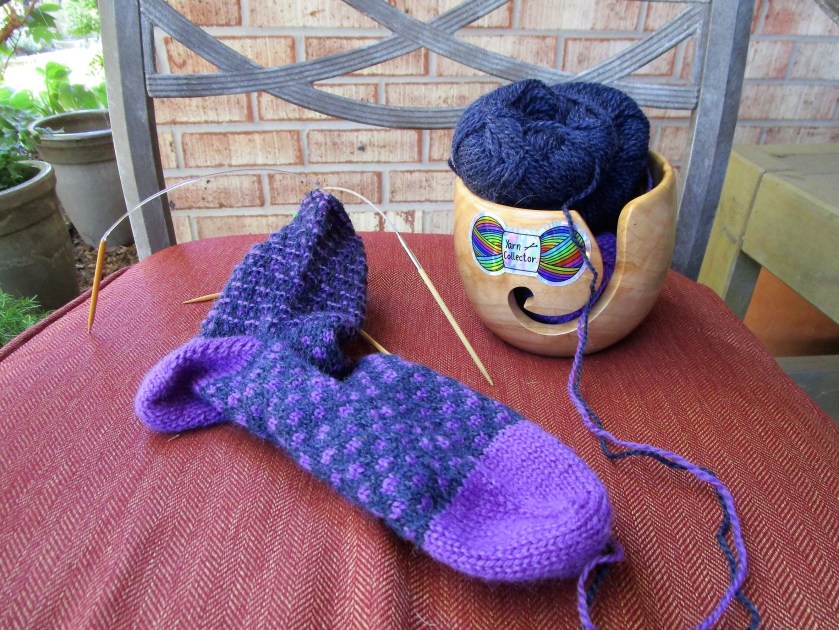
Having returned from another trip to Wisconsin and a week of recovery, I am back to sock work. The challenge is to knit socks for each member of my daughter’s family. This is part 3 of 4 – son-in-law’s pair. He has a very long foot. To make certain that I have the length right, I took the started sock with me so he could try it on.
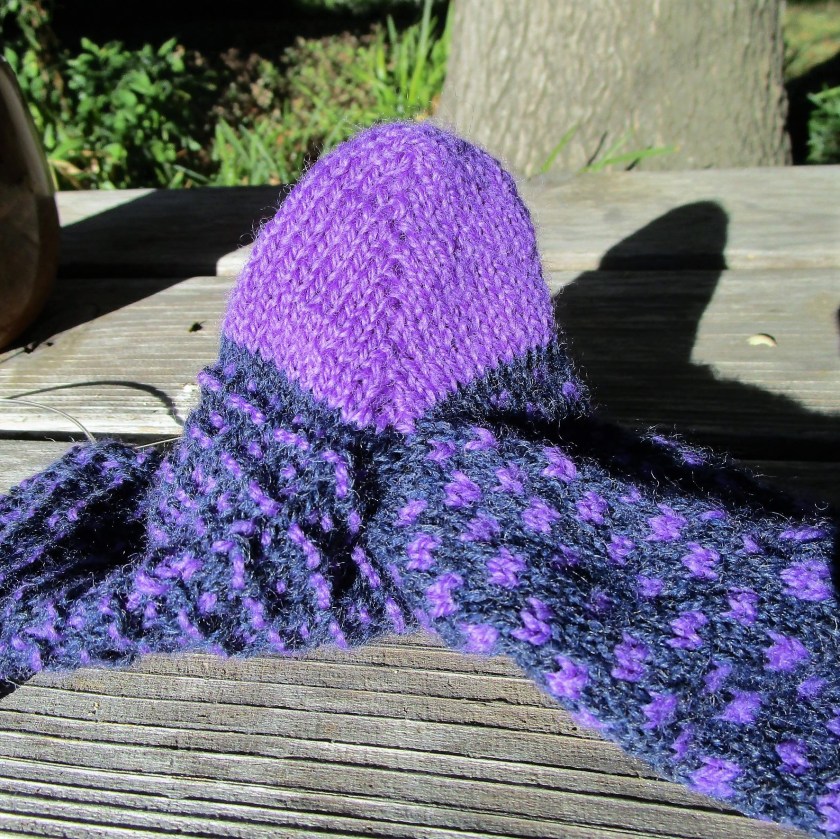
Try on a sock that is still on the needle? How can this be? This act can be done if the knitter works the sock from the toe up. Having recently learned the Turkish cast-on I am knitting my first pair of toe-ups. Thank you, Suzanne Bryan.
The pattern I have chosen is Fairlee, offered by Berroco yarns on Ravelry.
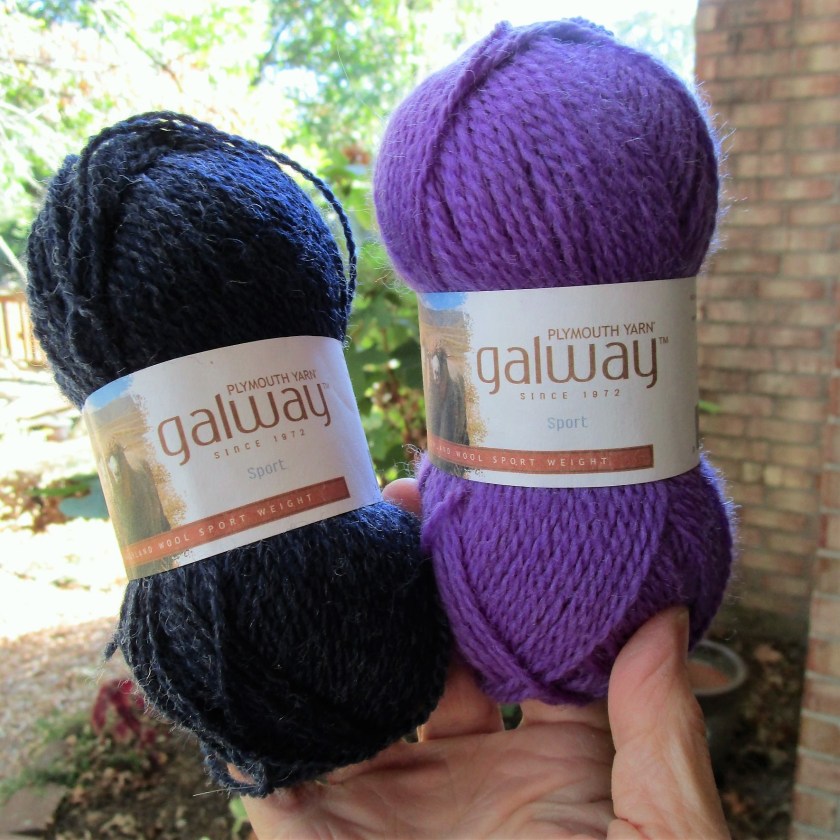
This pattern is designed with Berroco’s Vintage yarn in dk weight, which I heartily recommend. But for SIL, I chose an all-wool Plymouth yarn called Galway.
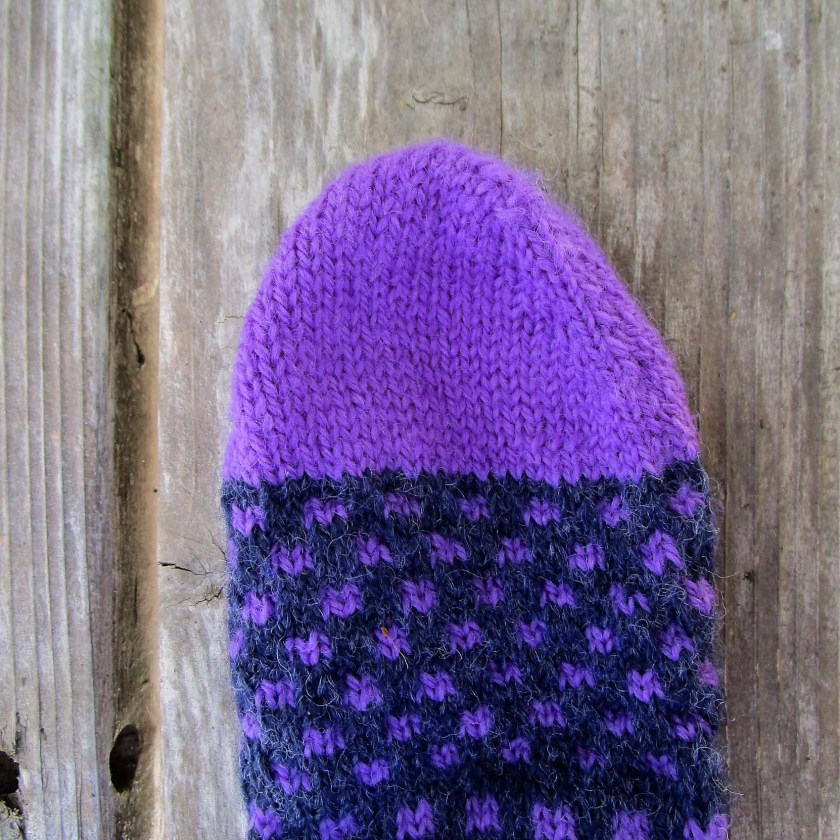
It is a sport weight, but I am working it stranded. You will notice that I modified the pattern in the foot section by working a cute little dot design with two colors. I hope that this will result in a warmer, stronger sock that felts a bit.
PHOTO SHOWING BEAUTIFUL SHORT ROW TOE STARTED WITH TURKISH CAST-ON
SHORT ROW HEEL FOLLOWS THE FOOT
The cuff is knit from a chart, incorporating some purl bumps. I really like this design element, but it has been tedious to knit. I find the second circular needle is always getting in the way. Thankfully, I’m almost finished with this section.
That’s about all I have to report today. Later this week, I will catch you up on the status of my Badlands art quilt. It is coming along well.
So my objective for this week is to prepare to knit socks – at least 4 pair! Just to make things interesting, I have set up a few criteria for these projects.
They will use as much of my stash yarn as possible. You can see in the photo above that I have a fair selection which includes DK as well as fingering weight. Having gathered my yarns together in this bowl certainly helps me begin to think about color pairing of partial balls.
I will choose patterns new to me so that I will have variety and new skills to learn.
The new patterns will be available on-line from free pattern sources.
So far, I’m doing pretty good! I had no trouble finding patterns that I like without spending a dime. Some of these are written for DK weight. Here are my choices of patterns so far and the swatches I worked up for them.
VERTICALLY STRIPED SOCKS by NOVITA
Making use of a very graphical but easy stranded design, this pattern is knit at 24 stitches per 4 inches. These socks look fun, sturdy and very warm. The yarn I swatched here is Knitpicks Hawthorne Bare in a dk weight and Berroco Vintage dk. Full disclosure regarding the pattern: I downloaded it a few years ago and now can no longer find it on the ‘Net. I did see similar designs offered on the Novita website.
YAMADORI
This pattern by Ema Marinescu is available through knitty.com. She says the design was born “from my finally embracing variegated yarn.” To achieve this effect, the yarn chosen should have short color changes. This skein of Wisco Sock in colorway Caterpillar by Ewetopia certainly qualifies. With a tight gauge (34 st per 4 inches) and slipped stitch pattern, the resulting socks can’t help but be warm and sturdy.
LEMON DROP with BUNNIES
I have already made this Universal Yarn sock pattern once for my granddaughter. This time around, I will change it up by replacing the Lemon Drops chart with the Bunny Got Back chart, which is a sock pattern also offered by Universal Yarn. The designer is Amy Gunderson. The main color is an unidentified skein of cream wool in my stash. I’m pretty sure it is a superwash wool from Knitpicks. The variegated yarn is also Knitpicks and the solid dark is Berroco Heritage sock weight.
FAIRLEE
I’m pretty excited to try this pattern. Designed by Amy Christoffers for Berroco, Fairlee is designed for their Vintage dk yarn. She calls them slipper socks, so they will be great for scooting around the house during winter. But I think they will also work well inside boots during the worst winter weather. I’m showing a swatch of Berroco Vintage dk, but I will need to purchase more of this yarn to make these socks. My stash is a bit lacking in this weight.
Okay, so I’m keen to get started. If any of these patterns interest you, you may want to click through the following links:
This project was begun about 2-3 weeks ago. In my initial post I brought up two main points:
An unconventional sock yarn.
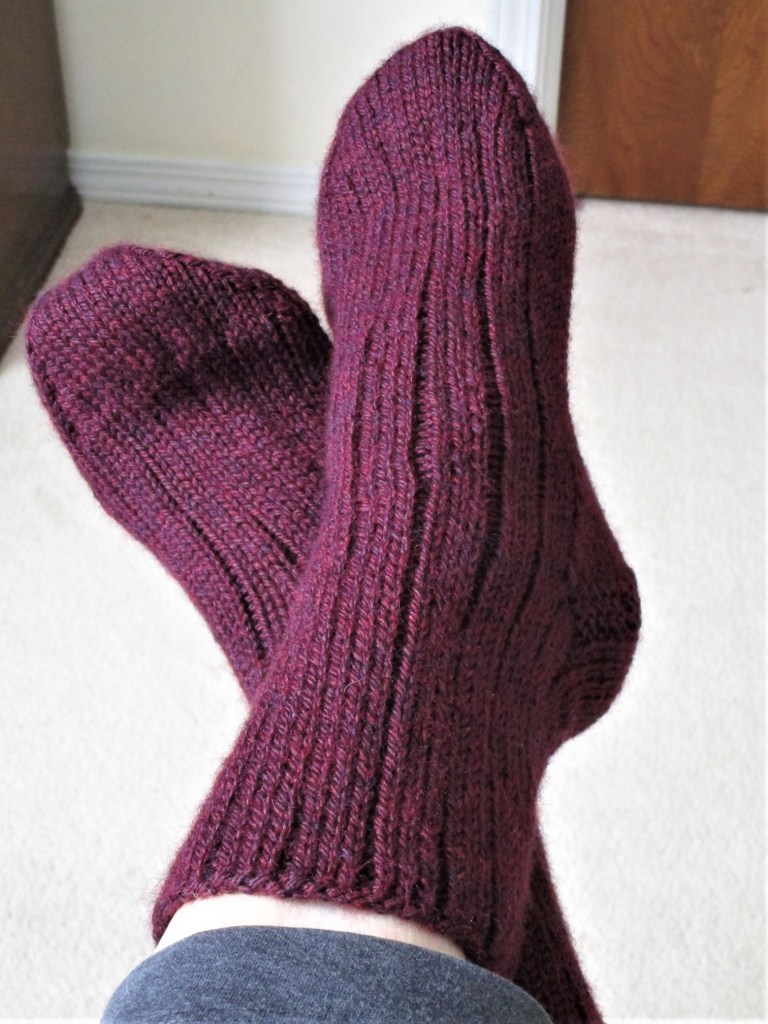
This Berroco yarn is a dk weight, not a sock weight. It contains 52% acrylic, 40% wool and 8% nylon. The knitted fabric is soft, stretchy and strong, all of which are highly desirable in a good pair of knitted socks.
The other point is the method of sequential knitting:
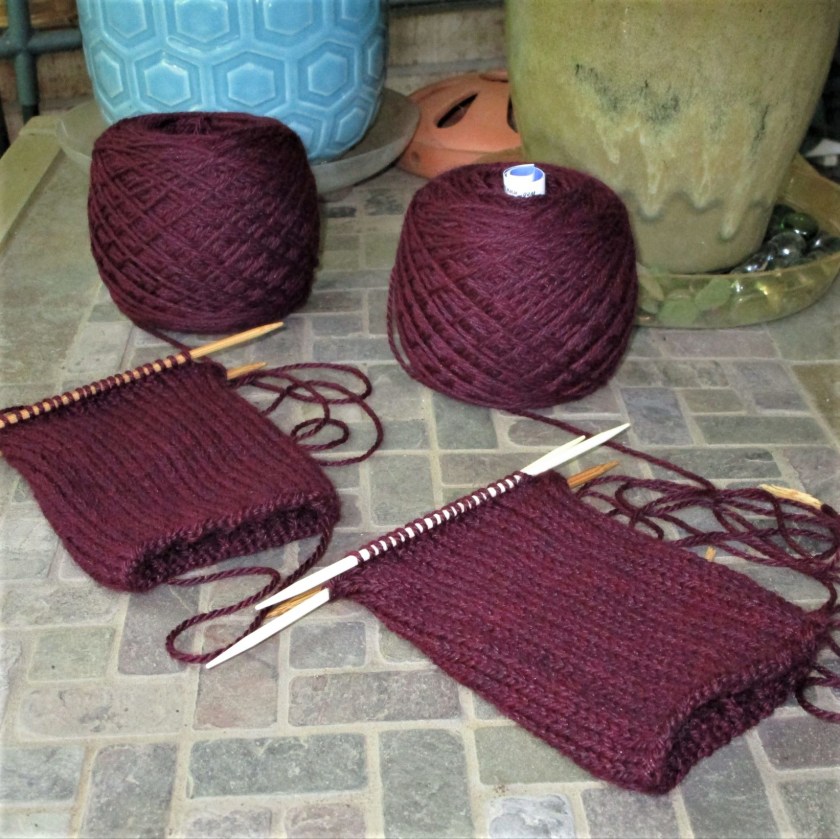
I used two skeins, two sets of sock needles and worked the socks in sequence: leg, heel flap, gusset, foot and toe. Frankly, I loved this work method. It provided for variety in the knitting and resulted in finishing both socks at the same time without the use of a long cable needle. Given my fairly extensive collection of doublepoints, I would choose to use this method again.








 Daily Fiber