Posted in knitting

Repost: Cast-on Monday: I-Cord Fun

My class on knitting I-cord jewelry starts Saturday October 22nd, at my local art association. So today, I am reposting my blog on this topic from earlier this year.

——- Laura Kate———

Last week I was recruited to teach a class at my local art association. I said yes, but I was at a loss on what to present. The introductory knitting classes which I taught last year were very lightly attended. I had to do some recruiting just to get a minimum number of students.

Thinking about possible roadblocks to knitting, I came face to face with certain inalienable facts about the craft:

  1. The learning curve is steep.
  2. Projects take a long time to finish.

What if I narrowed the number of skills required to a minimum, and what if I used these few techniques to make quick-to-complete projects? ……………..

The answer is I-Cord! This little add-on is used for strings for tying knitted hats and other decorative frou-frou. All it takes is a few yards, a cast-on, and repeated knit stitches over a very short row.

So today I am researching and stitching up all kinds of I-cord accessories. These projects will include jewelry so I will need a selection of beads.

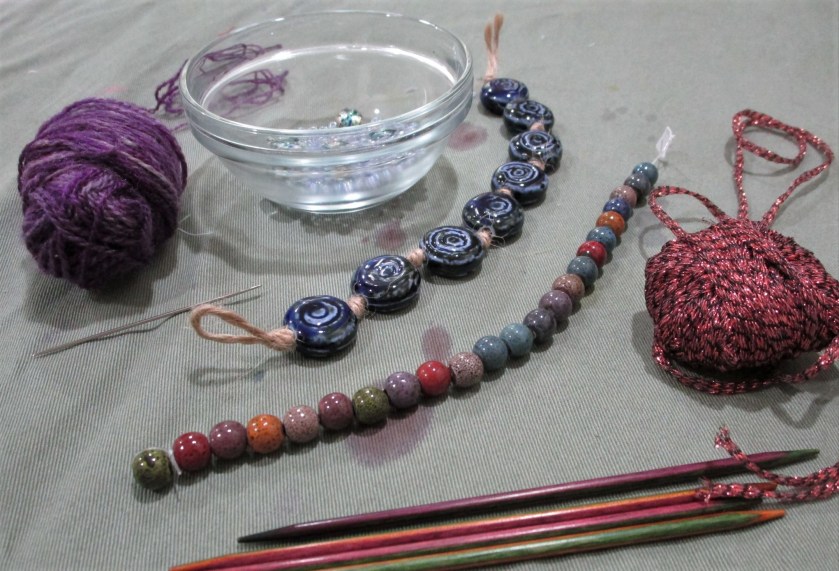
The two strings in the left of the photo were purchased today. All the others I had acquired in the past 3 or 4 four years.

I also perused my stash for left-over fingering weight yarn. (No shortage here.)

To kick things off I worked up this 18-necklace using tonally dyed merino wool and some porcelain beads.

https://www.ravelry.com/patterns/library/simple-beaded-i-cord
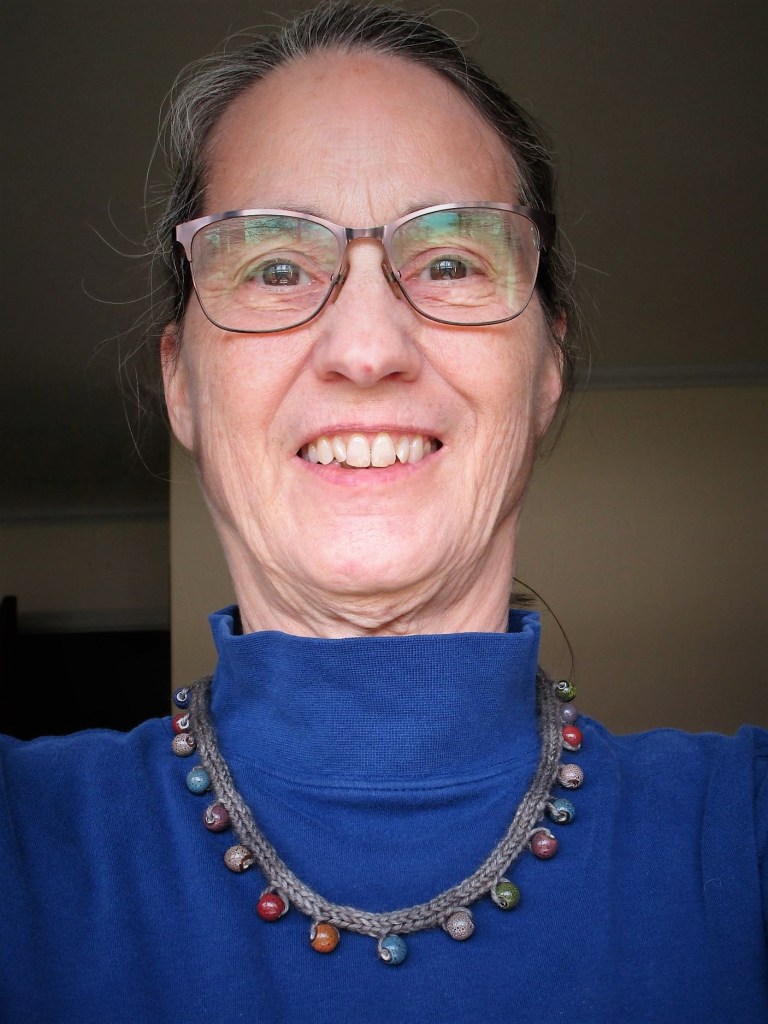
My version is made with just one strand because I had only 24 beads. I love how each bead dangles below the cord. I am wearing it over a shirt, but this necklace would also be soft against bare skin.

A bracelet is next.

http://lovingtopurl.blogspot.com/2017/02/3-colors-knitted-i-cord-bracelet.html
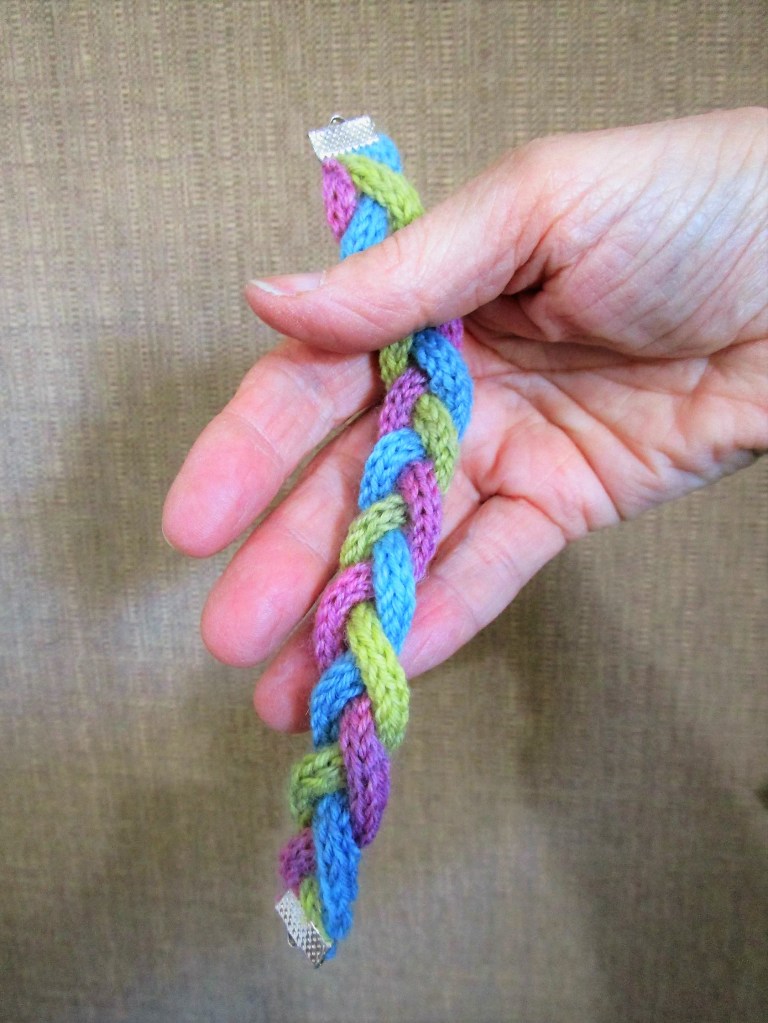
I sewed one end of the three strands together, braided them and then sewed the other end. The crimping finial is designed for holding ribbons so that they don’t fray.

For my third item, I switched to worsted weight yarn and move up to a size 5 needle. I was so happy to use up the left-overs of this lovely variegated Malibrigo merino.

This necklace doesn’t use a pattern. It will be made to my own specifications.

And here are my three I cord samples as of dinner time.

This should be enough material to work up a class proposal. I will also try making a headband and a multi-strand necklace.

Posted in knitting

Cast-on Monday: I-Cord Fun

Last week I was recruited to teach a class at my local art association. I said yes, but I was at a loss on what to present. The introductory knitting classes which I taught last year were very lightly attended. I had to do some recruiting just to get a minimum number of students.

Thinking about possible roadblocks to knitting, I came face to face with certain inalienable facts about the craft:

  1. The learning curve is steep.
  2. Projects take a long time to finish.

What if I narrowed the number of skills required to a minimum, and what if I used these few techniques to make quick-to-complete projects? ……………..

The answer is I-Cord! This little add-on is used for strings for tying knitted hats and other decorative frou-frou. All it takes is a few yards, a cast-on, and repeated knit stitches over a very short row.

So today I am researching and stitching up all kinds of I-cord accessories. These projects will include jewelry so I will need a selection of beads.

The two strings in the left of the photo were purchased today. All the others I had acquired in the past 3 or 4 four years.

I also perused my stash for left-over fingering weight yarn. (No shortage here.)

To kick things off I worked up this 18-necklace using tonally dyed merino wool and some porcelain beads.

https://www.ravelry.com/patterns/library/simple-beaded-i-cord

My version is made with just one strand because I had only 24 beads. I love how each bead dangles below the cord. I am wearing it over a shirt, but this necklace would also be soft against bare skin.

A bracelet is next.

http://lovingtopurl.blogspot.com/2017/02/3-colors-knitted-i-cord-bracelet.html

I sewed one end of the three strands together, braided them and then sewed the other end. The crimping finial is designed for holding ribbons so that they don’t fray.

For my third item, I switched to worsted weight yarn and move up to a size 5 needle. I was so happy to use up the left-overs of this lovely variegated Malibrigo merino.

This necklace doesn’t use a pattern. It will be made to my own specifications.

And here are my three I cord samples as of dinner time.

This should be enough material to work up a class proposal. I will also try making a headband and a multi-strand necklace.

Posted in embellishing

Easy Peasy Tassel Necklace

I’m back to the Daily Fiber blog, after a pretty long vacation trip. The fatigue of the trip has sapped my creative energy. So I thought it would be best to make an easy fiber object on my first day back.

This little necklace showed up in a women’s clothing catalog I paged through recently. It’s very fetching, but to me, not a good value at $70.00. I’d like to try my hand at my own version.

To make the tassels, you will need one skein of embroidery floss for each tassel, some jewelry jump rings, a few beads, lobster claw fasteners, thread cutters, tapestry needle, and glue.

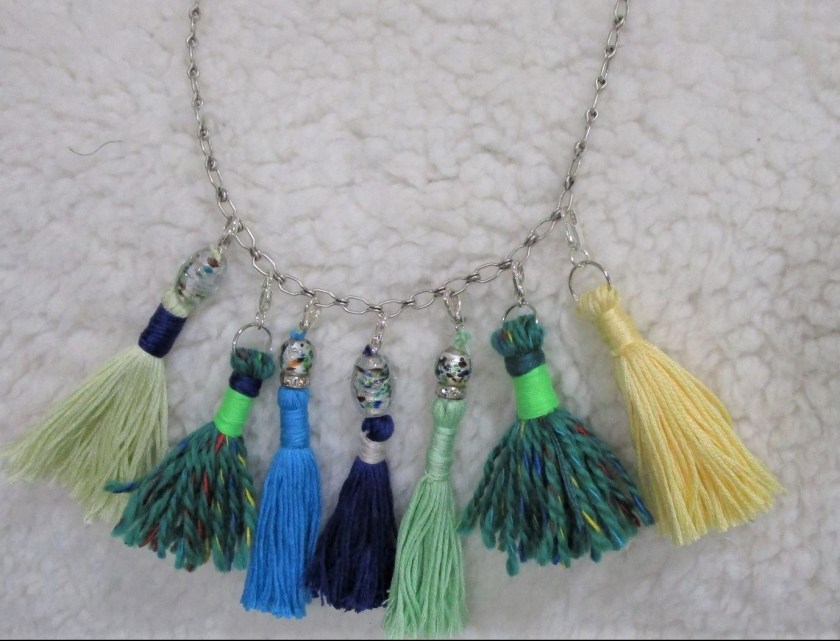
Here are the first six tassels completed.
  1. With the paper sleeves still on the floss skein, slip a jump ring to the skein’s center, or tie the skein tightly in the middle with a piece of floss. Slip off the paper sleeves.
  2. Fold the skein in half, holding the ring or floss tie at the top. With another piece of floss about 12 inches long (matching or contrasting,) make wraps around the top of the tassel, working down the tassel about an inch or as desired. Tie the two ends together with double overhand knot.
  3. You can hide the knot by threading the ends on a tapestry needle, then push the needle up through the wraps coming out of the top of the tassel. Do this one end at a time.

At this point, you can finish off the tassel by attaching a lobster claw clasp to the ring, or if you used a floss tie instead tie the ends to the clasp. A drop of glue on the knot will keep it from coming loose. Cut the excess thread away. If you want to add beads, they can be threaded on the ties before you attach the clasp.

Trim tassel ends to length desired and you’re done! Here is my finished necklace. I spent less than $10, including the chain.

For this necklace, I made an additional couple of tassels out of yarn.

What a coincidence! This necklace goes very well with my new shirt!

Posted in knitting

Wool, Silk and Glass

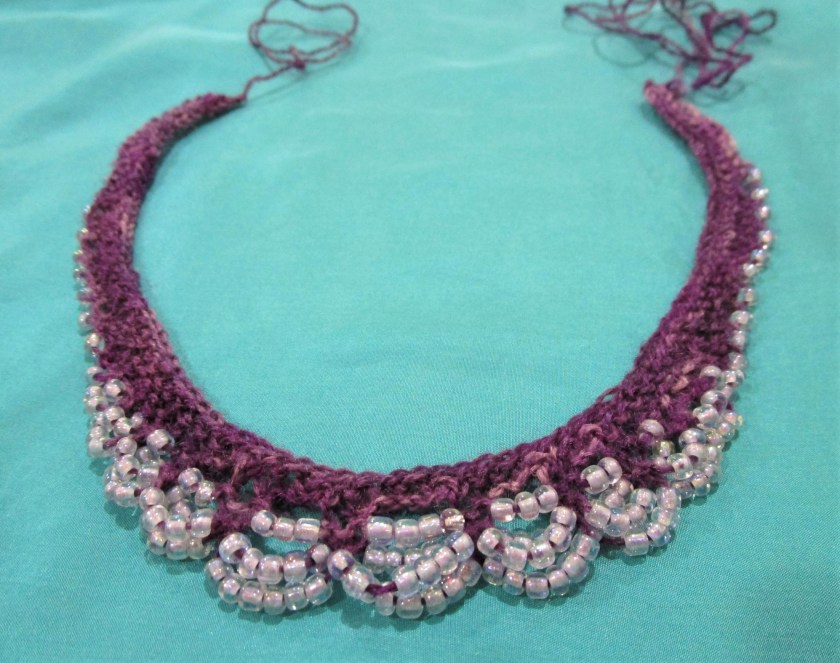
Today’s fiber project combines yarn with glass beads to make a fun, easy and beautiful necklace. I like this because I can make the whole thing in an afternoon. Also, I’m always on the look-out for unusual accessories to jazz up my standard daily look of jeans and t-shirts. You see in the photograph the makings of two necklaces. I chose the purple variegated yarn and the iridescent beads in the glass dish. The yarn is a lace-weight blend of merino wool and silk called Stream from Willow yarns. The pattern, by Carol Metzger, is called Scallop-Edge Beaded Necklace. I’ll have a go at making up a design for the ribbon yarn and ceramic beads on another day.

Cast-on and first row completed.
Notice that all the beads were strung on the yarn before starting to knit.
Necklace bound off but without the jewelry fittings

After weaving in the yarn ends, I used all-purpose thread to sew a jump ring to one end and an alligator clasp to the other. Here I am modeling the finished work. Photography courtesy husband Bill.

It’s so light and delicate. I can hardly tell that it’s there.

No special skills were needed to make this necklace. I recommend that you use a floss loop to thread the beads, or buy a special bead needle from a craft store. Carol’s pattern can be found on Ravelry at https://www.ravelry.com/patterns/library/scallop-edge-beaded-necklace.