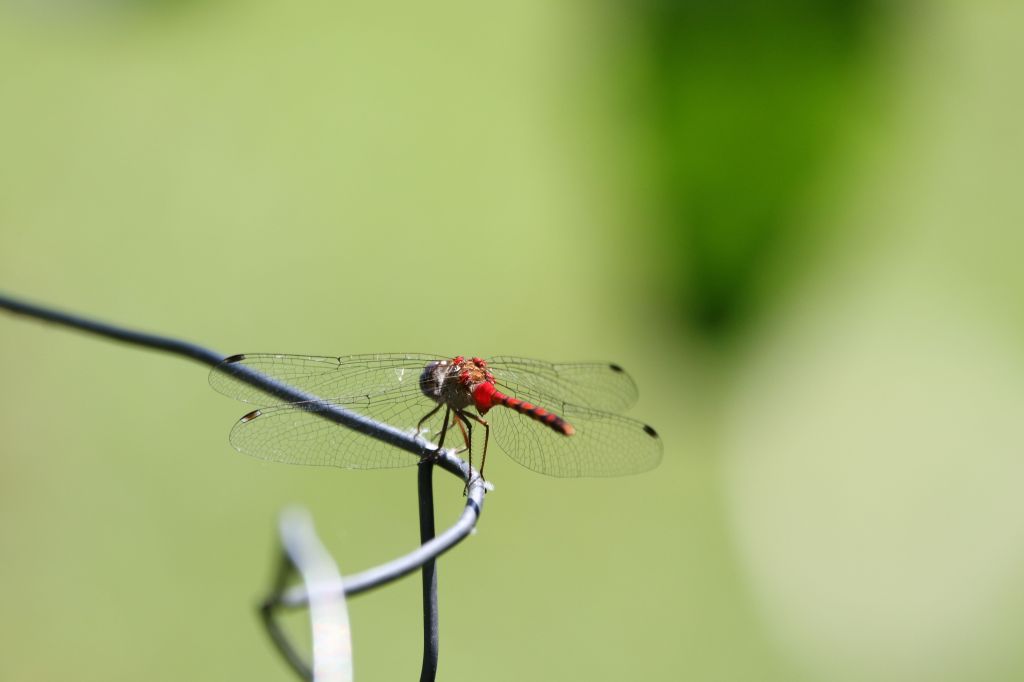
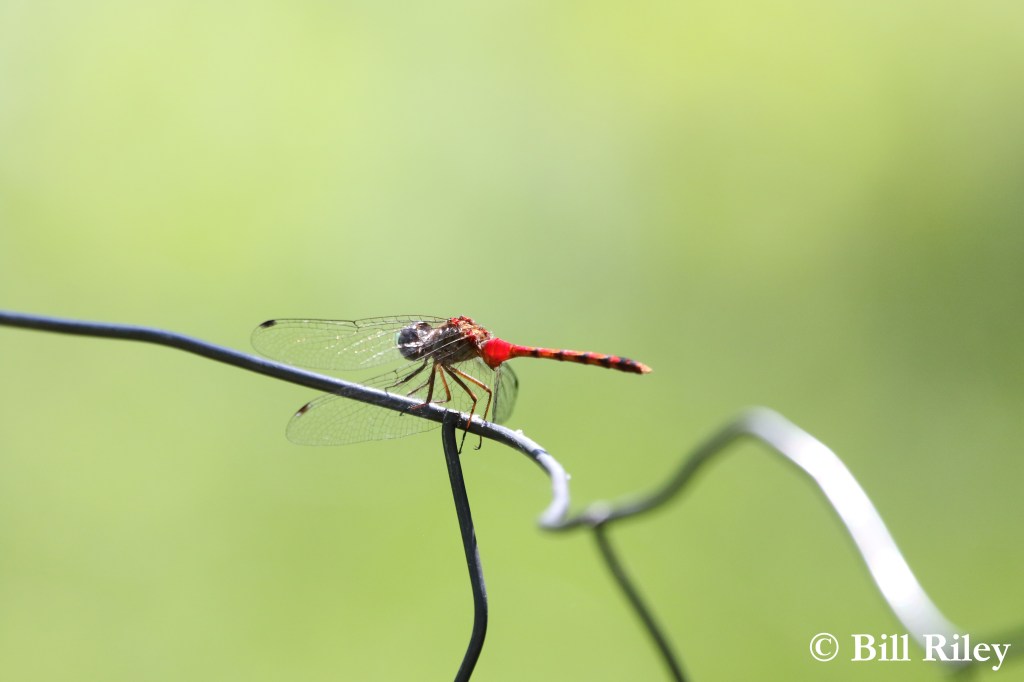
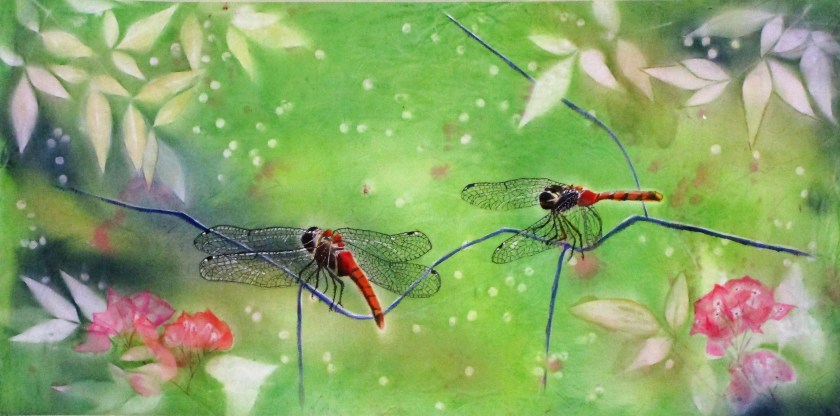
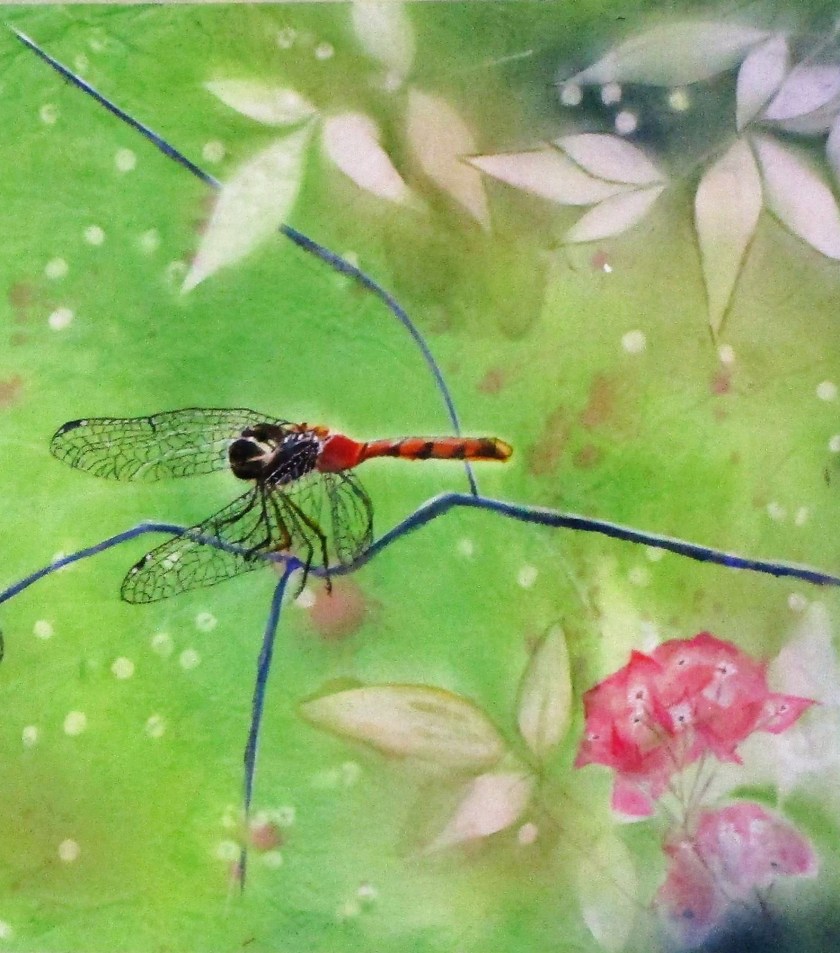
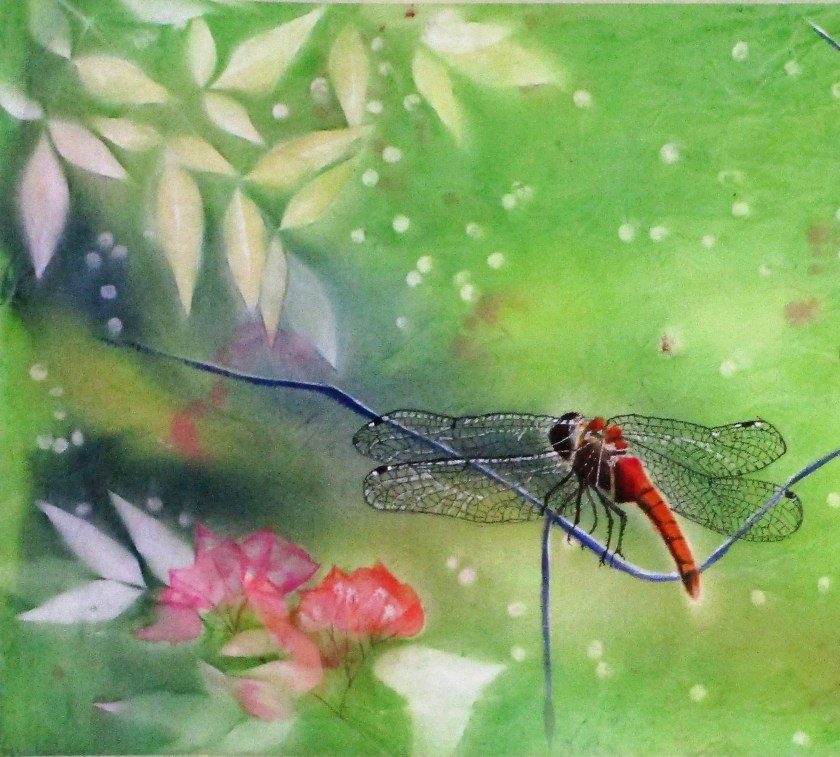
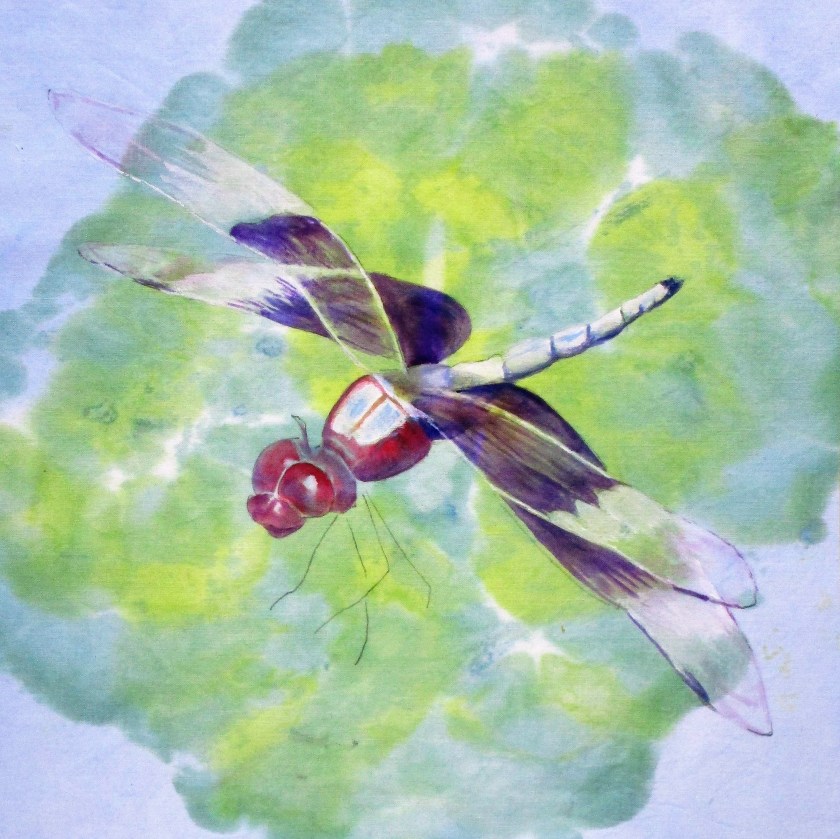
The process of painting dragonflies on postcards broke open my mental block.
I started painting fabric right away, after swatching the colors I want to use.
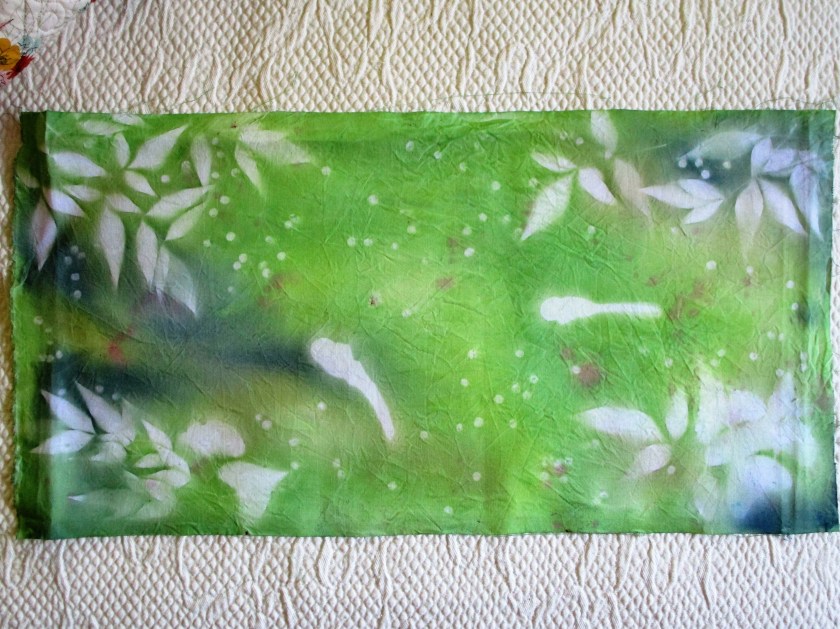
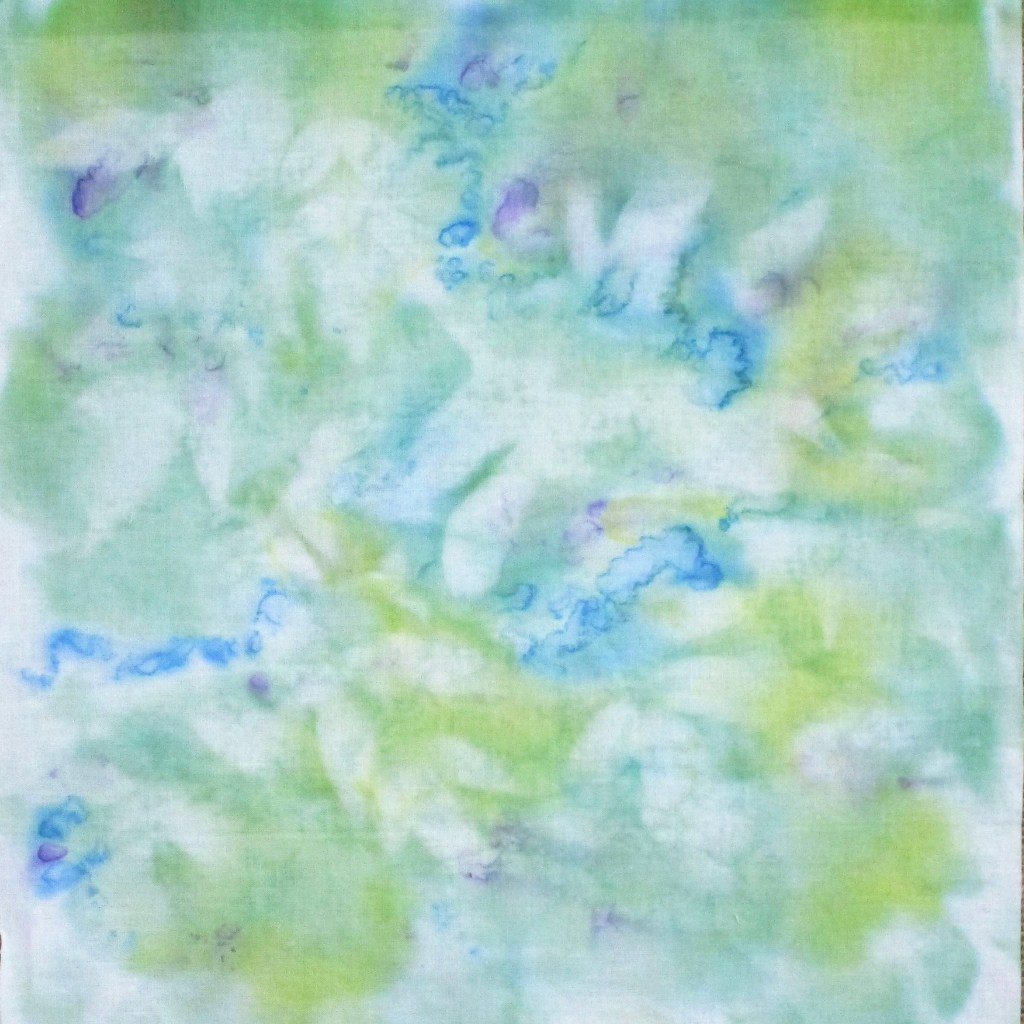
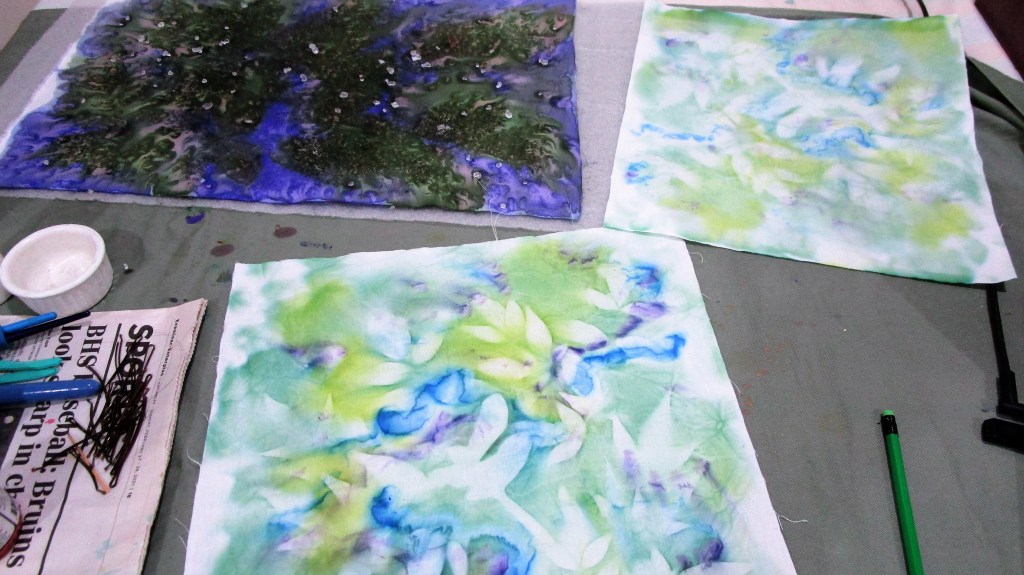
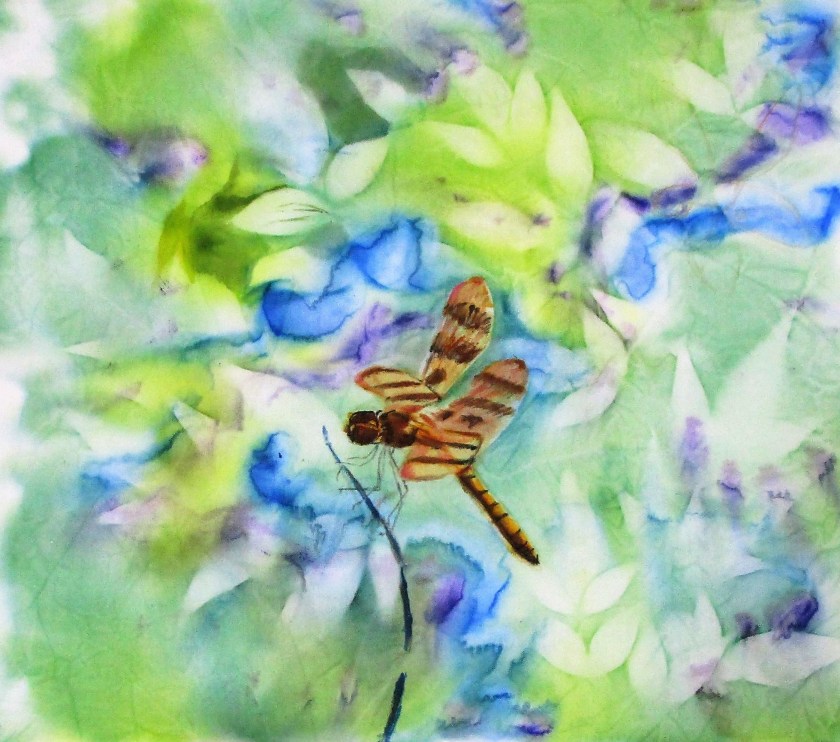
Using these colors and a variety of techniques, I painted backgrounds on rectangles of white quilting cotton. Earlier I had cut out dragonfly body shapes from craft foam. These shapes and an assortment of leaves were laid on the painted fabric to serve as masks. Laying the pieces in the sun printed the masked shapes.
The next day, I did more fabric painting, just to make sure I had enough selection.
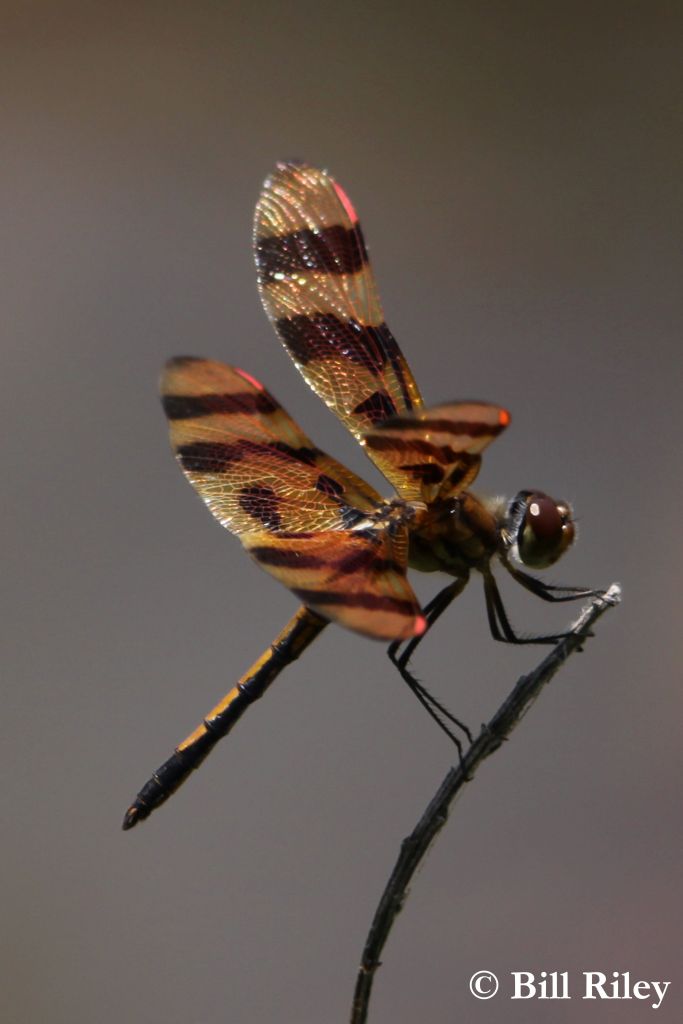
With the backgrounds prepared, I began inserting the dragonflies into the pieces.
Day 34:
Day 35
I’m in love with this last guy. He will be the focal point of the finished product.
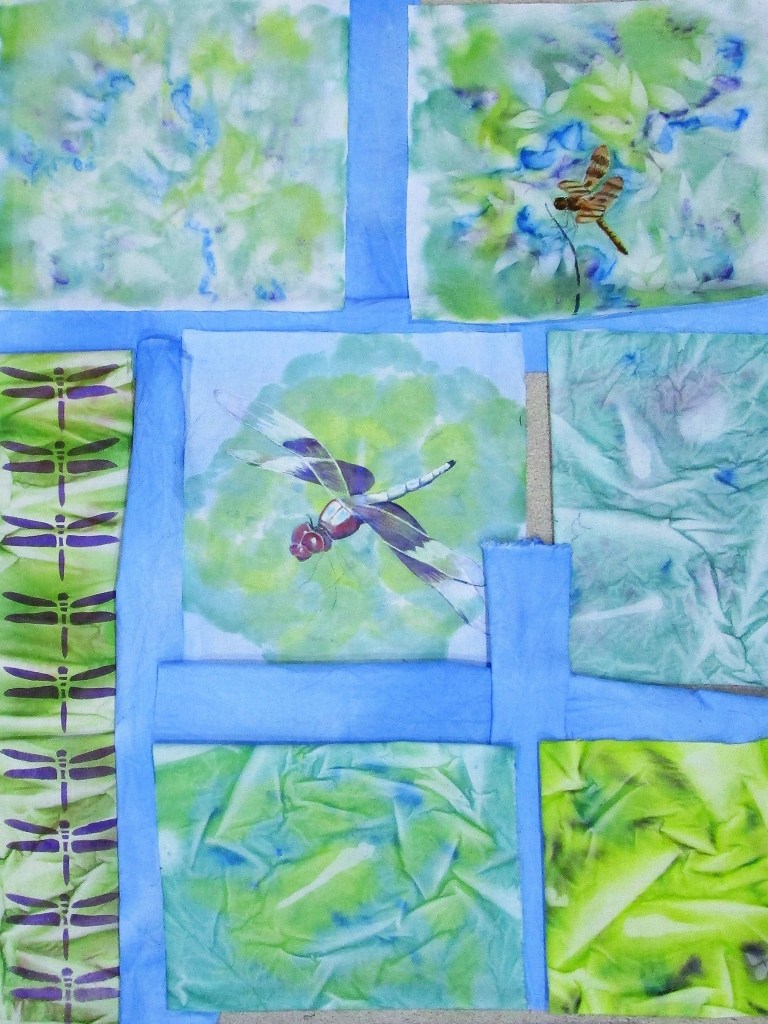
In the next week I plan to add finishing touches to these two paintings and begin work on the rest. My layout calls for five paintings sewn together with blue borders in between them. What happens after that is done will take a bit more cogitation.
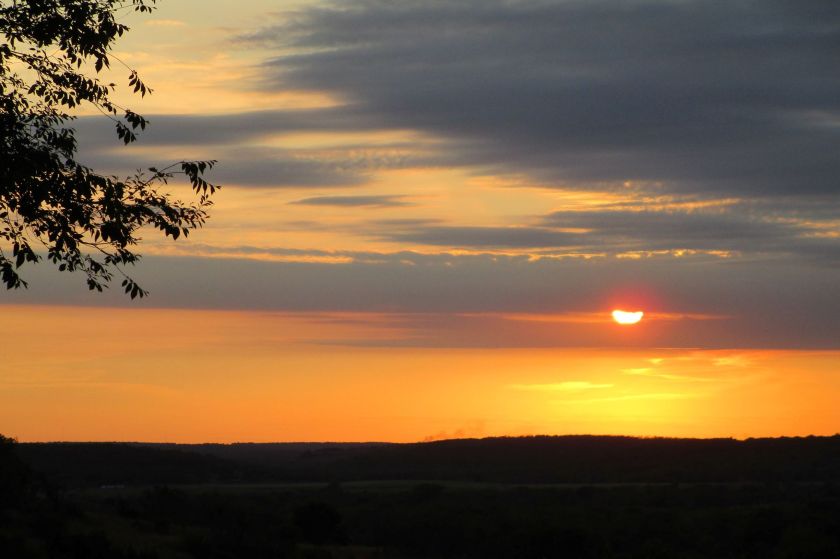
Three years ago, I was inspired by this photograph to make a small art quilt.
I had taken this picture while on the drive back home from Wisconsin. The colors and the layers made me think of a strip pieced quilt. In 2020 I used several hand-painted fabrics to create an abstract landscape.
While I no longer have this quilt, (it was gifted to my god-daughter) I still have the photograph. Using it as a reference, I reproduced the lower right section of this quilt in watercolor.
It was a quick and fun exercise. But it got me to thinking about derivative artworks. What else did I make that can inspire a new piece in a different medium?
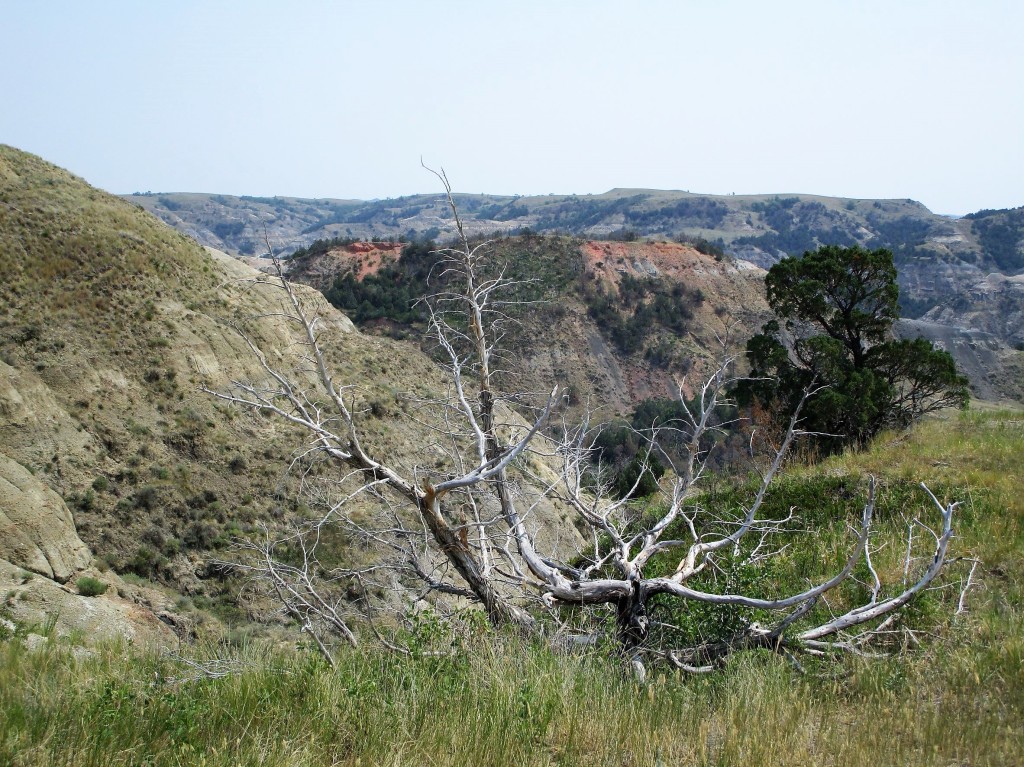
The inspiration for this art quilt came to me during our trip to Roosevelt National Park in July of 2021. I was captivated by the sandwich layering of rock, running in parallel lines that eroded down over thousands of years. It suggested to me a string pieced quilt. For the next several months I thought about my concept and puzzled over how I could bring it to life in fabric.
Our photographs were disappointing. It was high noon, and pervasive smoke dulled the light. No shadows were in evidence and the colors were muted. I decided to rely on an internet image for my working reference photo,
Photo from vangorentalmn.com
To get from concept to finished art is a long process. I started by making a value sketch. Next, I drew a pattern to scale, identifying major segments and eliminating excessive detail.
Here’s the part all fiber artists (including myself) find extremely creative: choosing fabrics. Since I like to use watercolor, I painted my swatches. After assigning a hue and value to each segment on my pattern, I picked out the fabrics to best achieve my color scheme of orange, blue-purple and blue-green.
Here’s an aside about the fabric I chose. Ultimately, I couldn’t find fabrics that had the colors and textures that I needed. To get there, I painted on printed fabric for most parts of the quilt. I also selected a few batik prints that were close enough, with only minor adjustments to color.
With the design decisions made and fabric selected, I began to assemble the quilt. All of the techniques that I used in making this quilt I learned from two fiber artists: Annette Kennedy and Gloria Loughman.
I thank these artists for giving me the skills I needed at the time I needed them.
And here is Badlands in its final form:
The design is invigorated by lines running in parallel diagonally and horizontally. Where the diagonals meet, triangles are formed. These shapes lead the eye to the center where two focal points have a quiet conversation across the river valley.
As a final note, I want to acknowledge the influence on my style of pop artist David Hockney. A print of his painting, Garrowby Hill, hangs over our fireplace.
My imagination has traveled that blue road countless times over the past twenty years.
This past week, I completed the sewing phase of Badlands art quilt. All segments are sewn in, and all but one is quilted.
Quilt lines are not visible in this photo.
The next step in my workplan has me using textile paint to add shading and lines. I learned the technique from a tutorial by Annette Kennedy through Craftsy. Annette is known for her realistic landscape quilts. She is an award-winning fiber artist.
So, I have a lot of trepidation about slathering a perfectly nice quilt with paint.
The paints I use are Jacquard Textile Color. I will mix them with a floating medium recommended by Annette. It dilutes the paint, making it lighter and keeping it from drying too fast.
Before painting:
In this photo, I have started shading the large mountains in the foreground. You will also see the applique I have made for my focal point, painted and ready for fusing.
I’m still nervous, but I am trusting that everything will come together in the end.
When I last wrote about this art quilt project, I was waiting on a delivery of fabric.
Here is what my quilt looked like at that point.
I had selected some fabrics from my stash. The sky and horizon segments had been painted and positioned. My first module of background ridges was cut-out, fused and stitched together. I liked it a lot. But it was clear to me that I needed more orange and purple fabrics to really represent the scene as I designed it.
This photo shows my reference image and the three batik fabrics that arrived from Fabric.com last month. I was pretty impressed that the fabric colors looked just like they did on my computer screen.
So, full steam ahead with the work!!
Half-way assembled:
In this photo all the segments are finished and in place but one – the lower right. You see the segment’s base fabric that I plan to use.
At this stage I am very encouraged, and kind of excited. The lines and colors of the work represent my inspiration very well.
After I finish sewing down and quilting the background and middle ground, I will turn my attention to the focal point and foreground. Then comes a bit more painting of details before the final assembly.