Posted in quilting

SAHRR 2024 Challenge 3: Brave World

Our host for the Stay at Home Round Robin challenge this week is The Darling Dogwood. She suggested that we use triangles. That should not be difficult to achieve. Many, many traditional blocks are made of triangular pieces. I decided to browse the very useful Quilter’s Recipe Book, by Celia Eddy to get some ideas that would work well with my design. In addition to using triangles, I needed a pattern that was not too difficult and would work well in a long row.

Here’s a four-square block called Brave World.

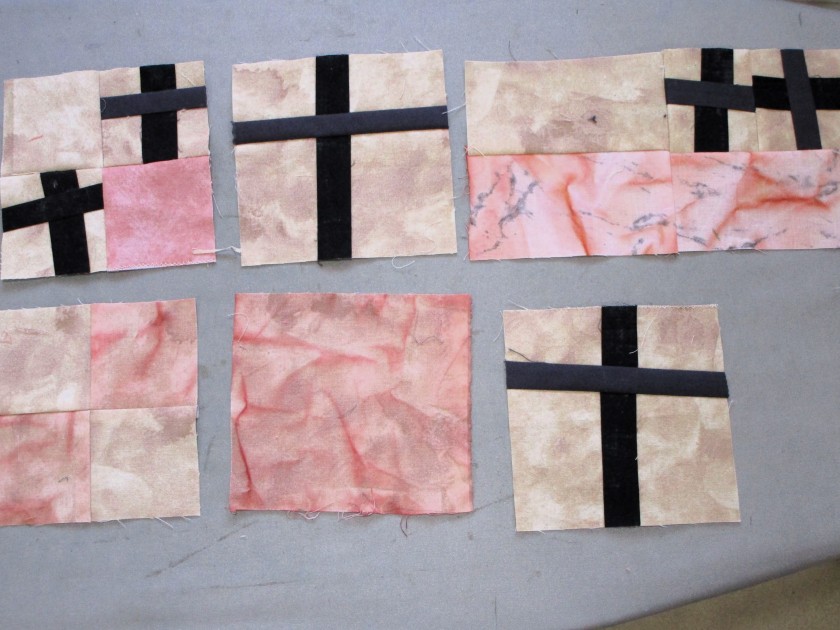
Each unit is composed of three triangles and a square and four units make up one block. I have specific plans for the square piece, so I say yes to Brave World. But to make it work for my border, I will only make 2 units. Here are two test blocks:

This photograph gives you a broad hint at the subject matter for this week. I have fabric with some animal silhouettes. These are the creatures of the forest and arctic ice that have been displaced by fire and melt. I also have some beehives. No bees though. They are out of the picture for now.

Bottom edge border

Right-side border

Lower right corner

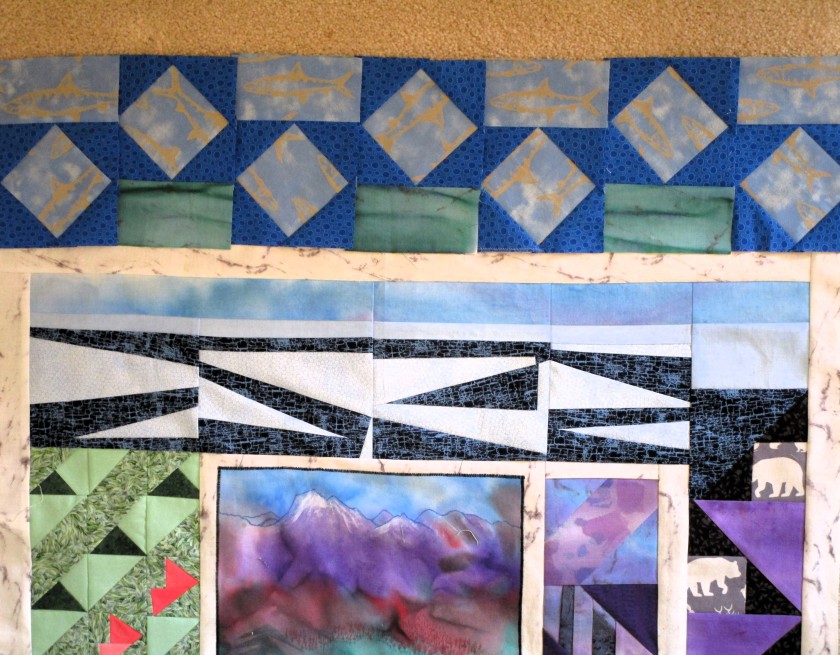
And here is my quilt at the conclusion of the round.

I like the way that the triangles in round one are in conversation with the triangles in this round. You may notice the white sashing. I am using this design feature to outline the borders like a snail’s trail. My quilt is now 30 inches square.

Thanks for stopping by. If you want to see the work of other quilters who are taking the challenge, enter the linky party HERE.

Posted in quilting

Wednesday: Considering a new project

At present, I have various works in progress and finished objects that I could write about today. But January is the month that Quilting Gail and her co-horts begin work on the annual Stay at Home Round Robin quilt. So I am pivoting.

During the past three years I have participated with joy. I’d really like to continue round robin-ing this year. But I am in a quandary about my center block. Thinking about SAHHR in December, I had the idea to use paper pieced squares in this year’s center block. I but never got around to making them. Now, feeling pressed for time, I’m reluctant to work on a deadline in a technique in which I have little experience.

This morning, I decided the answer may lie in the objects I made during my first year of practicing fiber arts. It was a time when I was bursting with ideas but short on skills. As I rummaged through my portfolio from 2019 to early 2020, I found six fiber objects with potential to become a center block of a small quilt.

Shall we audition them together?

Candidate 1:

This was an early experiment with fabric paint. I took two different paintings, cut them into strips and wove them together, using satin stitch to close up the cut edges.

Candidate 2:

This is a rejected block from my oakleaf hydrangea wall-hanging. The background is covered in snippets of hand embroidery with irregular blanket stitch on the edges.

Candidate 3:

I was discovering what fabric markers can do. This painting is done on lightweight muslin and would need to be mounted on sturdier fabric.

Candidate 4:

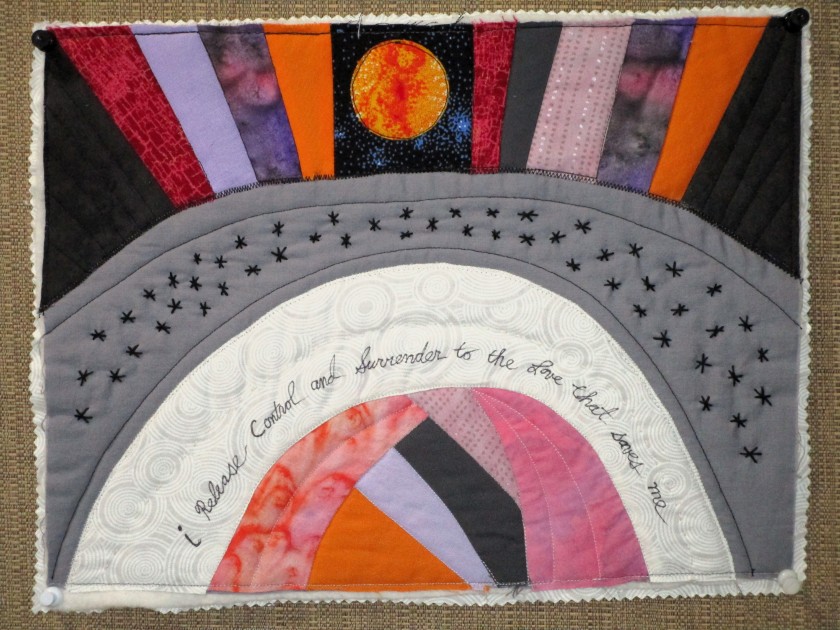
A mini art quilt, this was inspired by what I saw in my head with eyes closed during a yoga class. I was practicing curved edge piecing.

Candidate 5:

Inspired by one of Bill’s photographs, this block was a practice piece for a larger work I never completed. The technique is confetti applique. While I would consider putting this one in an SAHHR quilt, I’ve yet to give up on my original concept.

Candidate 6:

A very early experiment in fabric painting, I “saw” a scene of a mountain area recovering from a forest fire. The initial paint application was enhanced with brown stamps of bare and broken trees. The middle ground is meant to represent fireweed which moves in quickly after a fire ends.

This last block is the one I am leaning toward the most. I have some ideas for expanding on the theme of environmental devastation and recovery.

What do you think about my options? Even if you are not a quilter, I am interested in learning the block that attracts your eye the most. Which one has the highest potential from the aspects of design, color and originality?

Posted in hand embroidery

WIP Wednesday: Dragonfly Quilt

It’s been more than two months since I’ve reported on progress with my dragonfly art quilt. For the last few weeks, I have been adding detail with embroidery.

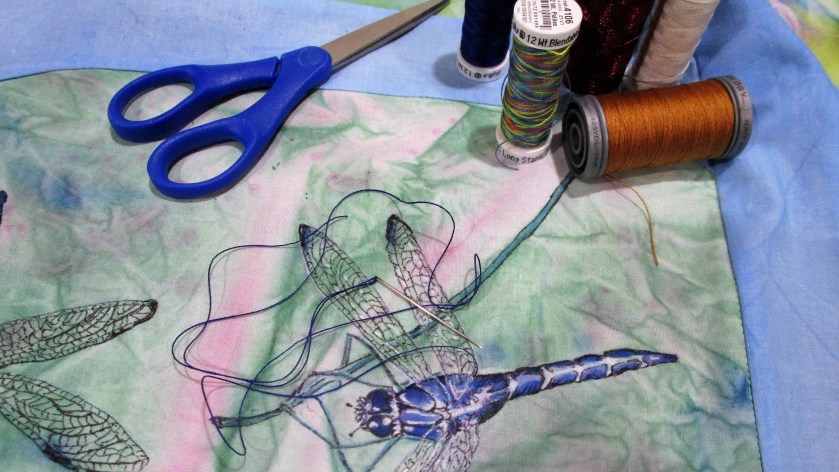
In this stage, I am using various colors of thread, including a metallic, to outline the subjects’ bodies and fill in and outline the wings. The box of machine embroidery threads that I collected from my mother’s work room contains many beautiful threads that work well together with DMC floss to enhance my dragonflies. I’m so grateful to have received it from her.

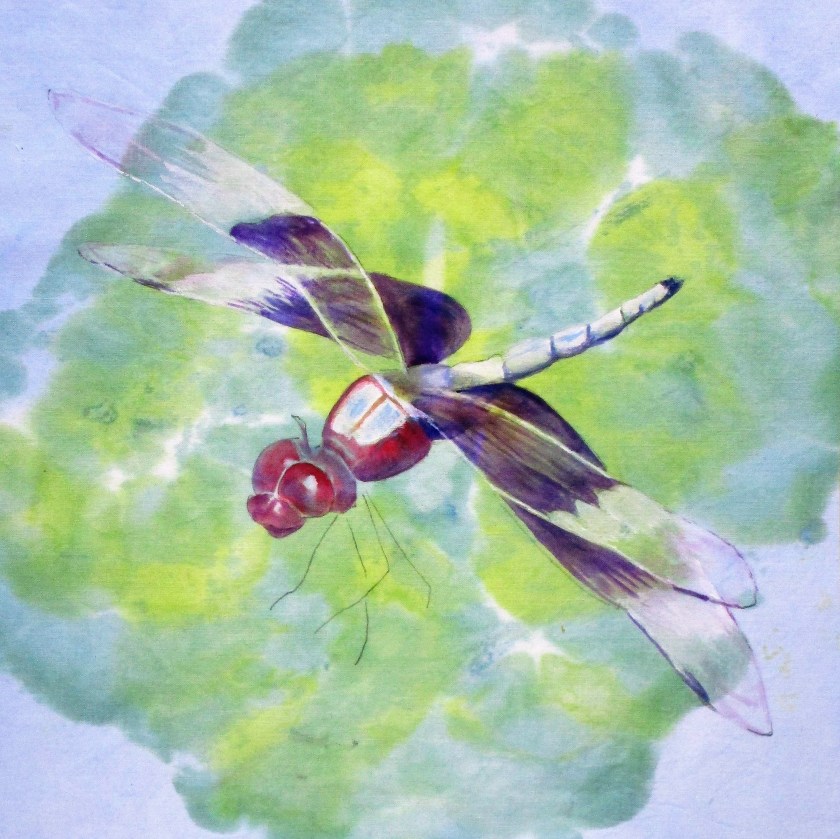
I started my work with the main panel. In the painting stage, I had indicated the wings using faint lines in a sketchy manner. Ditto for the legs.

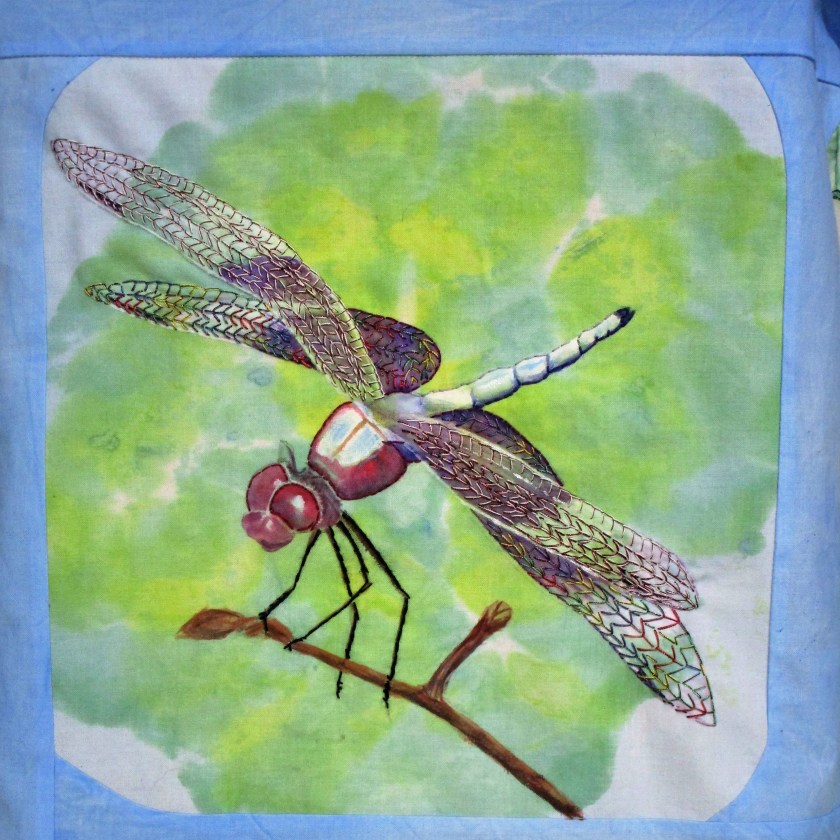
Now with metallic and matte threads held together, I stitched the delicate veining using (appropriately) the fly stitch. The legs were done in a black fuzzy thread, which helps to indicate the scaliness I observed in the original photograph.

I love the way the threadwork gives depth and liveliness to the painting.

After I’m finished embroidering the dragonfly bodies, I’ll sew on the border and backing. When that is complete, I’ll move on to hand quilting the whole thing.

Posted in painting

100-Day Project: Days 36,37,38

I could have called this post Wednesday WIP. But since I worked from three of Bill’s photographs to create this panel of the dragonfly art quilt, I prefer to focus on the inspiration.

As noted above, I am still working with dragonfly photographs. In this installment, I selected two images of the same dragonfly……….

…….plus one photo of some bougainvillea blooms.

The three images will be combined in a horizontal panel measuring 12 x 24 inches.

On the first day I painted the background. I dipped the scrunched white cotton into two different pigment baths, wringing it out in between soaks. After smoothing the fabric onto my dry erase board, I placed two dragonfly shaped masks, several sprigs of dried leaves, and a sprinkling of dried peas. Next, I dropped on a little bit of purple and magenta paint, then set the board outside in the sun to dried.

It didn’t take long.

I took my time painting the dragonflies. Today I finished up by drawing the delicate wing veins. Next the background got more attention. I enhanced the leaf shapes with color, then painted a long line across the panel – my interpretation of the wire plant support seen in the photos.

A closer look…………

another…….

Again I used Micron pens, watercolor pencils and a little white Gelli pen for the finishing touches.

Posted in painting

WIP Wednesday: Dragonfly Art Quilt

I have been busy painting dragonflies on my hand-painted backgrounds. The process is really fun! I have also been researching dragonflies. They are amazing animals.

Did you know that some dragonflies can live for six years? That is pretty good for an insect. Granted, up to four years are spent as naiads, in water. They look kind of like shrimp. Adult dragonflies have six legs, yet they cannot walk. They use their legs to snatch prey in flight, which they then tear apart and eat while still flying. If you were the size of a fly, you would find dragonflies terrifying.

So far, five of my panels have dragonflies on them.

I cut a stencil to make these two panels

In addition to Jacquard textile paint, I am using watercolor pencils and Micron pens. The paint is thinned with FolkArt floating medium, which permits better blending and lengthens the drying time.

Here is a mock-up of the quilt layout I’m considering.

If I go with this layout, the finished piece will be 28 x 36 inches.

Two more panels need dragonflies, and then I will consider painting some details on some of the backgrounds.