Posted in painting

Patio Decor – Stage Two

Back in May, I started a painting on fabric for the purpose of decorating my patio.

https://wordpress.com/post/dailyfiberfun.wordpress.com/5098

It was May, and the weather for patio-sitting was perfect. But I didn’t finish my painting – I had become obsessed with the Shell Lake Story quilt, and could think of nothing else.

Now that the quilt is finished, AND lovely patio-sitting weather has returned, I got out the fabric paints to work on stage two of the painting.

At the end of stage one, I had a 15 by 30 inch canvass with a nice background on it.

The lovely green-colored folds already looked like geranium leaves. The blank-looking orange blobs will become geranium blossoms.

Using Jacquard Textile paint in colors green, ruby red and goldenrod, I started working from the right side of the canvas to the left. Here is the painting after my first two sessions:

Only one more blossom to go. Today I finished it up,

Hm, it’s pretty obvious that I got better at painting as I went along! While the far left blossom is more carefully painted, it lacks the bright highlights of the first two. This was caused by the tone of the underpainting, which was predominately violet instead of yellow, like the other ones. The only way to fix this is to apply opaque paint. The risk in doing that is overworking the painting.

So I guess I will leave well enough alone.

My next steps are to square up the fabric and staple it to the back of the frame.

Posted in painting

Trying again Watercolor Canvas

On Thursday I wrote about a product called watercolor canvas. My experiment was to see how well watercolor paint could be used on this surface.

https://dailyfiberfun.wordpress.com/2020/11/05/experiment-with-watercolor-canvas/

I concluded that the results were less than stellar.

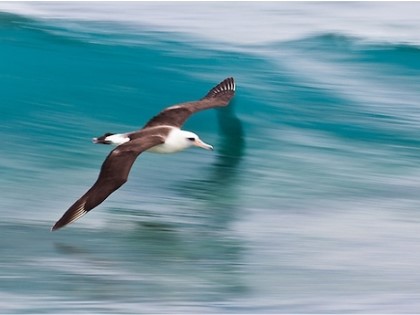
Today I am doing a side by side comparison using watercolor paint and fabric paint. My reference photo is an albatross.

I chose this because of the water background and because it would be quick to paint.

First I gave the sheet a good soaking in warm water, laid it on a waterproof board and squeegeed the excess water out. I was trying to break or reduce the amount of primer/sizing on the canvas. After it dried overnight, I cut it in half and started painting.

Colors used were cobalt blue, turquoise, paynes grey and burnt sienna. There seemed to be no difference in this result versus my first attempt. It was clear to me that the canvas had been primed with paint – probably acrylic.

Next came the textile paint. This paint is acrylic so I had high hopes. As I normally do when painting on fabric, I mixed the paint with a floating medium to thin it.

Colors were sapphire blue, turquoise, burnt sienna, gray and white. The experience of pushing the paint/medium combination around on the canvas was not pleasant. It had the consistency of snot and clumped up quite a bit. I will admit that it dried just fine and did hold some of my paint strokes pretty well.

The conclusion is that neither media gave a good result.

So I will probably abandon the canvas pad for purposes of fiber arts. Maybe some of my art association friends who work in regular acrylic paint would like to try it.

Posted in painting

Open for Business

We are at Phase Two of pandemic recovery here in OK. That means our governor has allowed non-essential retail stores to re-open. I celebrated by visiting the local craft store three times so far to re-stock on some things and to buy new supplies for mounting my FOs.

I am following Cindy Anderson’s advice for attaching fabric works to stretched artists canvases.

https://wordpress.com/read/blogs/35439603/posts/27143

On the advice of blogger Melody Johnson…..

http://mixitupmel.blogspot.com/2014/07/small-quilt-presentation.html

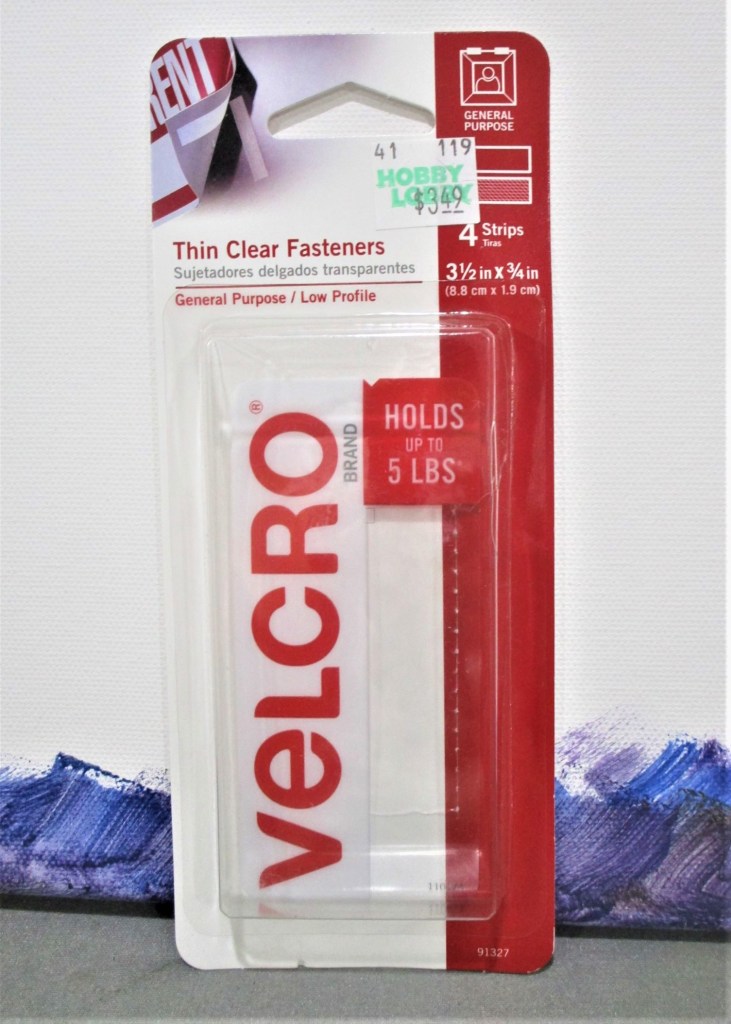
…….I have acquired this little item.

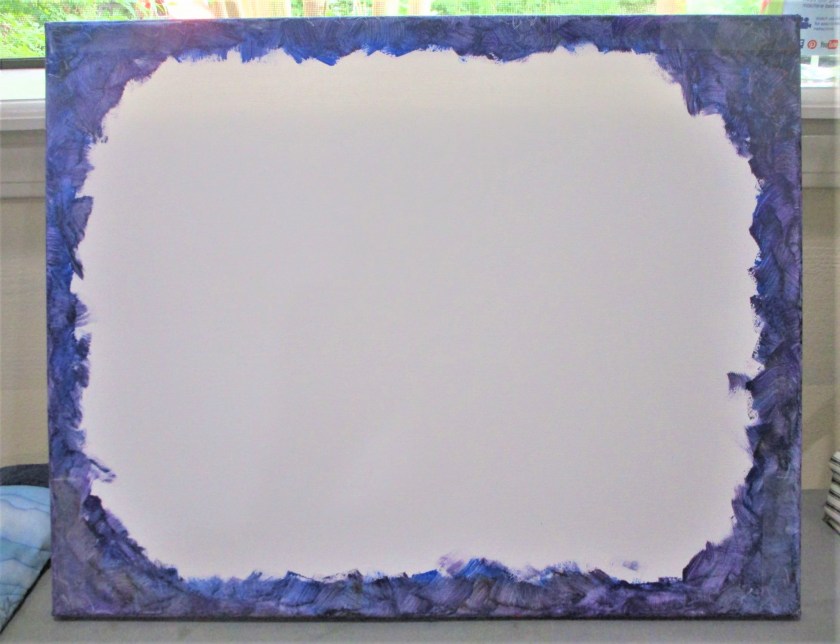
Today I will be mounting my Just Trees piece. For this one, I want to paint the canvas around and on the edges. This requires me to work with acrylic paint. I chose four colors of thin craft paint that has been in my stash for years. Here is my finished canvas, showing a wet-on-wet technique.

The colors will blend easily with the purple border on my fiber object.

I took at break for lunch while the paint dried. Then I attached the Velcro tape and waited for 15 minutes, per the package instructions.

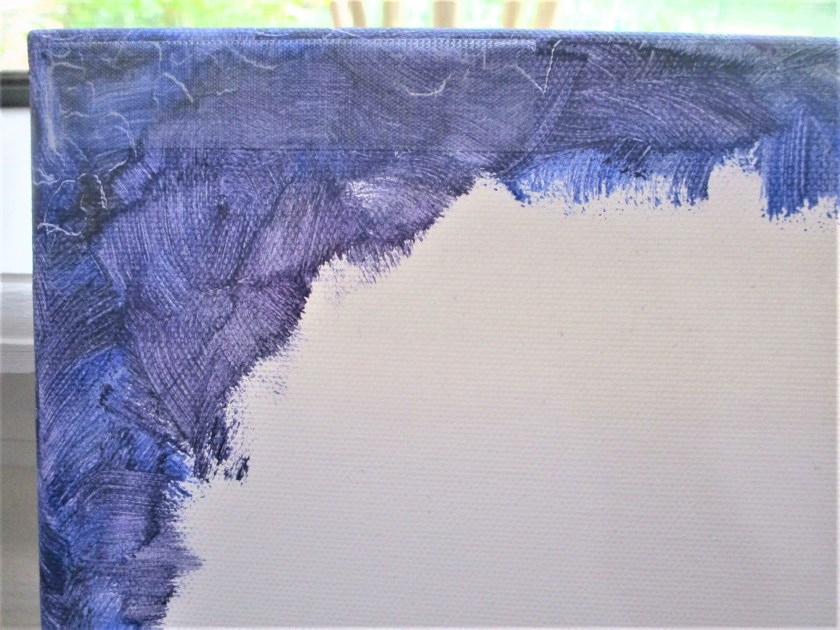
Hook side of Velcrolook closely at upper edge of corner.

Lastly, I attached the quilt, pressing the two sides of Velcro together. It worked like a charm.

Just Trees – Now show ready

View of the quilt from the right edge, showing paint:

It is very satisfying to get my work up on the wall. I had a lot of fun today, playing in paint, and I look forward to getting all of my finished art quilts show-ready.

Posted in colorwork, painting

Consolidate. Gestate. Internalize.

For the past three days I have been irresolute about making new fiber objects. I haven’t been idle – not a chance of that! But I felt more internal about my efforts than external, that is, not ready to show or talk about them.

Consolidate: (verb) 1. to join together into one whole. 2. to make firm or secure.

Gestate: (verb) to conceive and gradually develop in the mind.

Internalize: (verb) to incorporate within the self as conscious or subconscious guiding principles through learning.

If you ever start to feel you are stuck creatively, I suggest you reframe your status with the verbs above. It could be that you are not stuck at all but are internalizing.

A week ago, I agreed to offer fiber arts lessons again to the local homeschool association. To keep from being overwhelmed, I suggested that I teach project or workshop-type lessons. So part of my time has been spent on writing syllabi for these workshops. The first topic is crochet. I propose to teach crochet in the round.

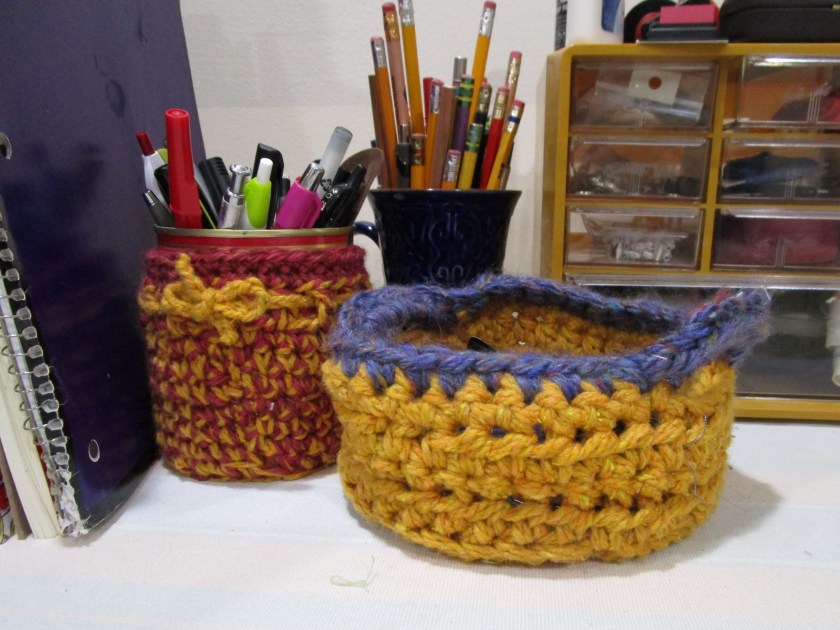
View of my worktable with two crocheted baskets in use.

I finished the syllabus for this workshop and made this sample.

It has been a while since I’ve created with yarn. It felt good to get back to it.

Secondly, I have been fooling around with pattern and paint on my color washed fabrics. Using foam, felt, cotton yarn and cardboard, I made these stamps.

Stamps sitting on color wash sample

I then proceeded to use them on this sample as well as a dark gray sample. My paint selection included Jacquard Textile paints, which are semi-transparent, Pebeo Setacolor opaque white, and some metallic acrylic paint I had laying around. Here are my doodles.

I’m loving the dark sample, especially the way the white opaque shapes and the glittery bronze shapes jump forward from the brooding background.