Posted in collage, quilting

Sunflower Fiber Object Progress Report

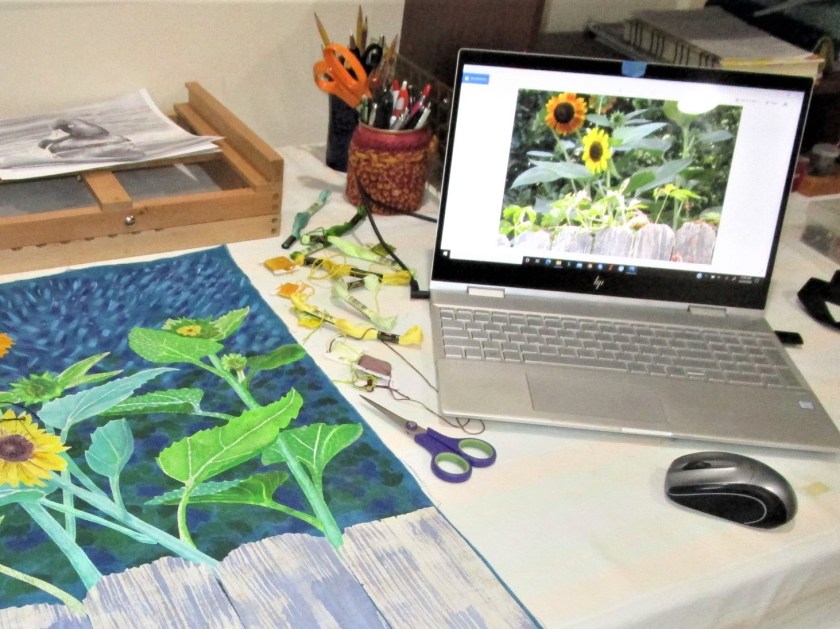
For the past three days I have been working steadily on the small art quilt that was inspired by the sunflowers in my garden and influenced by Vincent Van Gogh. I’m about half way through. Today I want to share a bit about the process I am using.

While the technique I have chosen to use is applique, the design process for most art quilts is similar. Start with an image. I used a photograph, but drawings are also good choices. Decide on size and dimension. Then enlarge the image to fit.

This enlargement is about 18 x 24. I have printed it in black and white because eliminating the color makes it much easier for me to judge relative values.

Using a tracing paper overlay, trace the image. During this stage many design decisions are made. You want to eliminate any visual clutter that doesn’t support the overall design. You can manipulate the different elements to strengthen your main thesis. For example, I altered the position of one flower and the tilt of the stems to accentuate the diagonal lines. It took me a long time to draw the pattern but I enjoyed the process.

Final Design

This pattern will be the map from which the entire assembly is guided. I drew in some directional lines that suggest details for painting on later. You see that I assigned numbers to every element. This will help me trace and cut out all the pattern parts.

Detail of sunflower in upper right of pattern

Now the part that every quilter just adores: Choosing colors and fabrics! Since I am a budding painter, I made a quick color chart in water color paint.

I’m trying to use an analogous color scheme. But my parameters are pretty wide, extending from violet through to yellow-orange. For this quilt I will assign the darkest colors to the background and the lighter ones to the elements .

Even though I did go shopping, in the end I chose fabrics mostly from my stash.

Next I traced each element onto freezer paper, cut them apart and pressed them onto the fabrics. Following the drawn lines, I cut out each pattern piece. Keeping them organized and up off the floor is the main challenge!

In my last post, you saw how I painted the background fabric. Here is the background again, up on my design wall and ready to accept the fabric appliques.

I use a fusible webbing called Wonder Under to glue the appliques to the background. I won’t go into detail on that step. The product’s packaging tells you what to do.

First I assembled the flowers, each of which had several fabrics. Once that was done I started attaching appliques to the background. Any pieces that lie behind another piece go down first. I started from the top. Here is a photo with about half the appliques on:

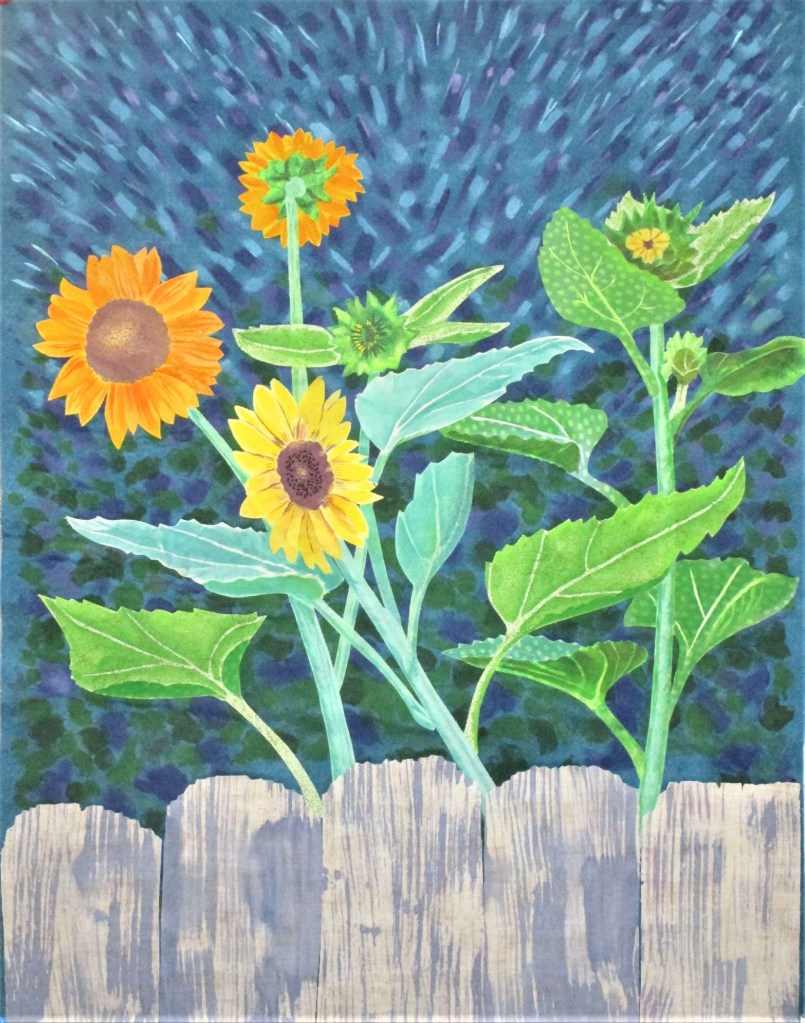
Here you see all of the flowers and leaves attached. This is where I left it yesterday.

I’m pleased with the result. I like it so well I may not even attach the fence applique – just let the flowers float in mid air. What do you think?

Posted in painting

Channeling Vincent Van Gogh

If you read my post dated October 1, you will remember that I have a desire to make a fiber object featuring sunflowers. As a reminder, here is the photograph I took this summer that will form the basis of my design.

I got pulled off my work when I decided to make a “confetti” sample on October 1st. It was great fun, but it won’t really give me the effect I want for this background.

So today, I am back on the trail of Van Gogh. I’ve studied some of his still life paintings, enough to get a handle on how he painted those dotted backdrops. I am trying it on the background fabric I have selected. It is a mottled pattern in a Prussian blue color. Certainly, it looks painterly in its own way, but it lacks the dynamic quality I seek.

I get out my Jacquard textile paints and, with new brush in hand, start at the top of the fabric. Directional lines and dashes are what I’m going for.

Sky complete, starting on foliage background.

As I work my way down the fabric, I move from thinner lines to fatter, more blocky shapes. These represent what I see when looking at the background of my photo: mottled light and shadow of leaves, branches, etc.

Middle section painted.

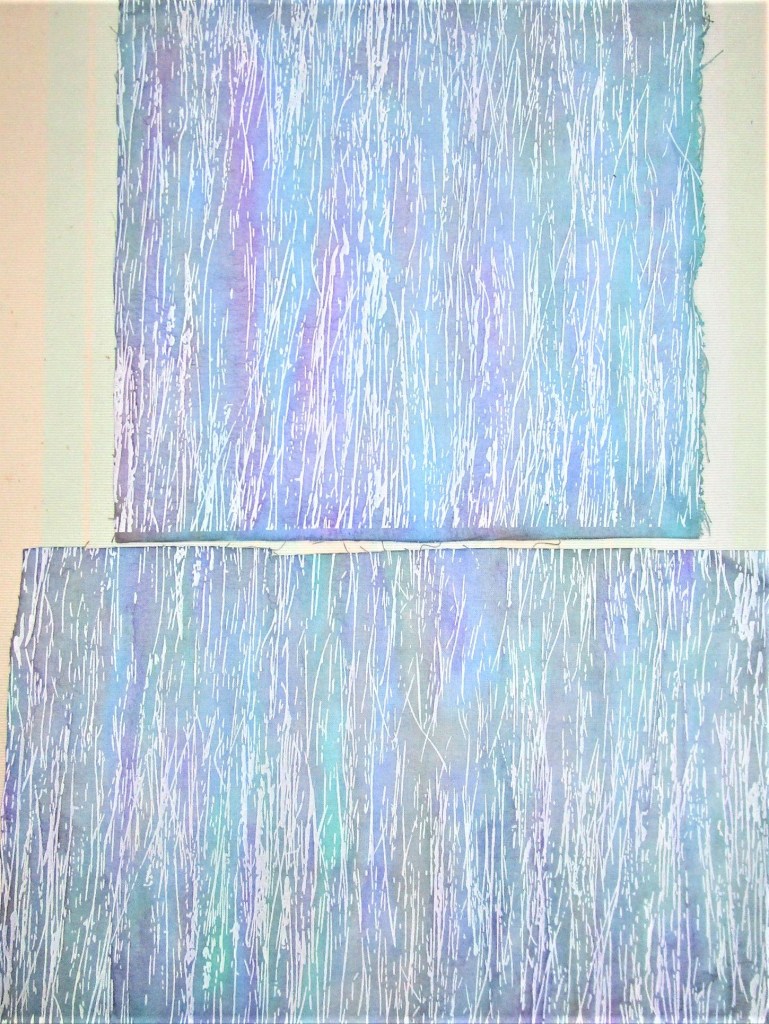
I leave the bottom of the fabric blank, because the foreground is the fence. I have another piece of fabric for this element. It will be painted with a dry brush technique to portray the weathered state of the boards.

Background with my test swatch of fence fabric. I make the marks in violet paint.

I found this process quite meditative. As the fabric gets filled with splotches, one pauses, studies the work, and asks oneself: Where do I put the next mark? What is it calling for? How will I know when it’s finished?

Mr. Van Gogh might have known, but I am only guessing.

Posted in sewing

Making a Paintbrush Wrap

My collection of water color brushes has been growing. Every time I take a new class on line, I end up purchasing new brushes. Storing them stuffed into my water jar just doesn’t work too well anymore. So I decided to make a roll-up brush holder from my quilting left overs.

You see in the picture my fabric selections. The log cabin square was made to practice free motion quilt stitches for Under the Sea quilt. The funny tape measure fabric was left over from the journal covers I made as gifts.

Let’s get started.

First, measure your brushes. The roll needs to be long enough to hold them all and tall enough to cover up the tallest brush. I cut the backing fabric 13 inches wide and 11 inches tall. The inner piece holds the brushes. I cut this fabric 13 inches by 12 inches and folded it in half, which gave 13 inches wide by 6 inches tall.

Fabric trimmed up and ready for sewing.

Sew them together around the outside edges. Next, mark the points where you want to make dividers. This was easy and fun with the tape measure fabric!

All my stitch lines came out straight. Yay!

Make a standard quilt binding strip and apply it around the four sides.

This fabric was left over from the Arches quilt border.

That’s pretty much it!. You will want to add a cord to tie the roll shut.

For now, I just grabbed a piece of ribbon, wrapped it around the roll and tied a bow. Eventually I will get a nice cord or strap. Or maybe I will add a toggle and loop.

But for now, I am ready to paint en plein air at a moment’s notice.

Posted in knitting

Farm Market Yarn

While we were in Wisconsin last month, we visited the Northside Farmers Market in Madison. My daughter was eager for me to meet the local yarn vendor who had a stall there. Yorkshire Rose Farm offers lamb and chicken products, and at this market, wool products including yarn. The proprietors, as suggested by the name, came over from England and have been farming in Wisconsin since 2008.

To my chagrin, I failed to get any photos of the stall or the couple, due to my need to corral the toddler. But I discovered that the farm had a blog, so you can read about it here:

http://www.yorkshirerosefarm.com/index.php/about-us

The yarn was displayed in groups by weight. I focused on the fingering weight. It was made from the wool of the Tunis breed. As expected in a natural yarn, it was a bit scratchy. I chose the colorway Peacock and Turquoise. It has short color repeats.

It seems to be a 2-ply yarn, in my mind very comparable to Knitpicks Palette. I found it combined beautifully with a grass-colored fingering twist yarn I had in my stash. Since the Tunis yarn has no nylon reinforcement, I decided not to use it to knit socks. Instead it will be made into a hat and/or gloves.

Here are the two yarns knitted in stripes.

And here they are in a stranded pattern called Rose Window.

Another option would be a mosaic stitch.

So, what do you think of the two yarns together? And should I work them in stripes or Fair Isle pattern?

Posted in Uncategorized

Sunday Walk on Pathfinder

Today was way too beautiful to spend it staying indoors. We walked.

Here are a few highlights from sights seen in the woods near our house today.

Fungi the color of Halloween

Such an intense orange color, these fungi begged to be photographed.

Oak Tree Tops

It pays to look up.

Bright berries and neon green leaves.

I don’t know the name of this shrub, but it was abundant in the flood plain.

Pond with reflected sky

I love the duckweed’s color. It’s so intense.

Great Blue Heron perched in a tree.

At the pond, there was also a snake sleeping next to the path. I didn’t take his picture.

Golden rod next to willows.

Goldenrod was the most glorious blooming plant today. It was a favorite of the bees.