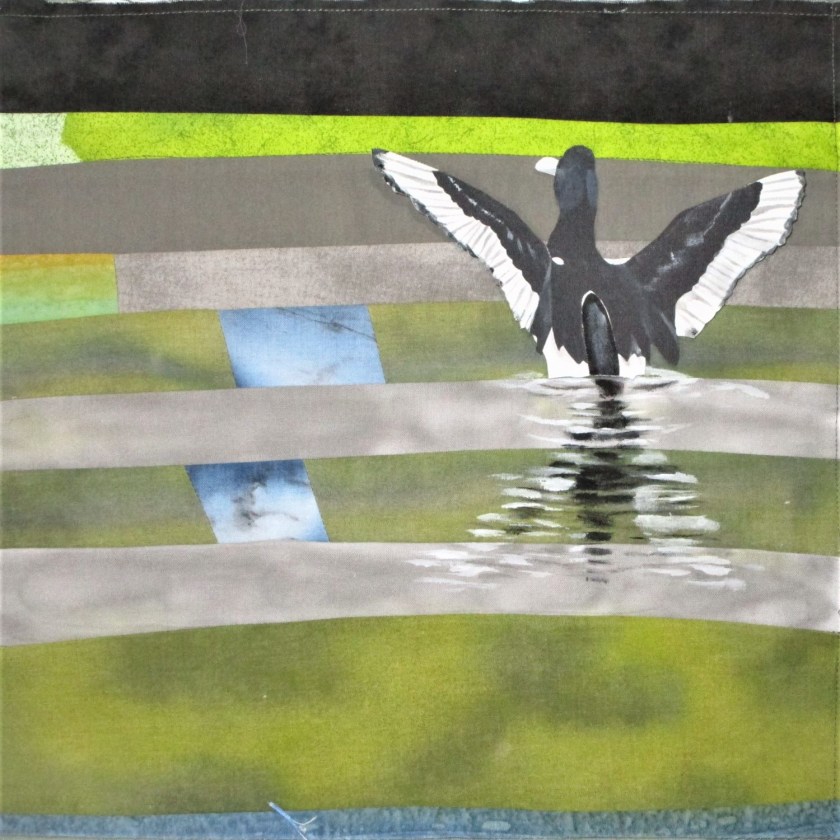
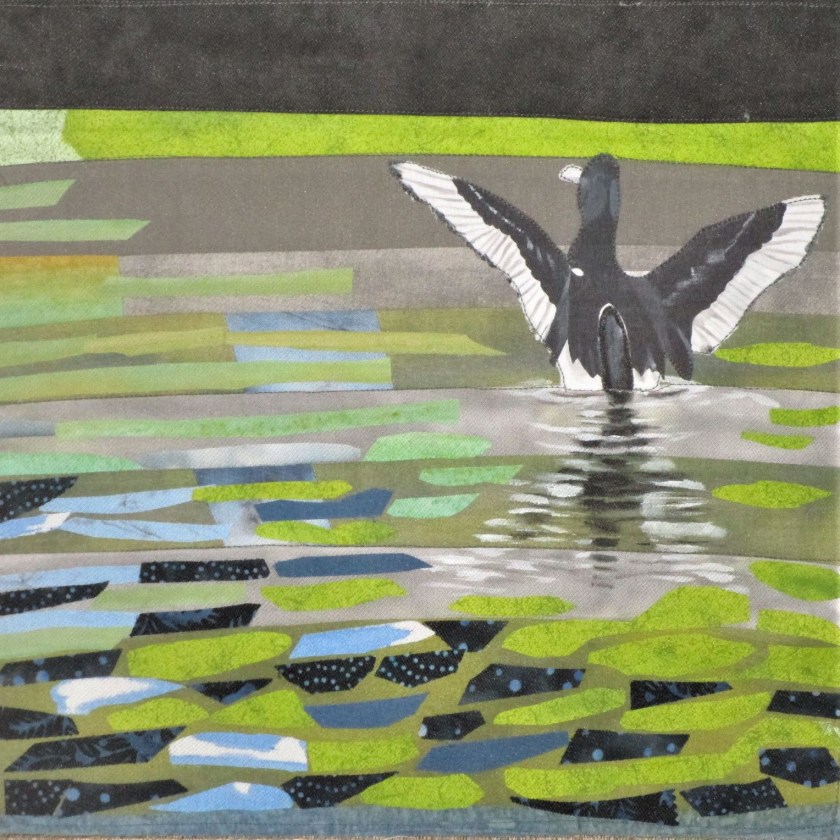
Today I finished up my practice sample for the Duckweed fiber object. This involved making the quilt sandwich and quilting.
I started with the walking foot and black thread. The stitching included wavy lines over the foreground and sewing around the duck. Next I switched to white thread and the free motion foot for creating the ripples around the base of the duck and outlining the duck’s wing feathers. I continued on my making white ripples to match the black ones in the foreground. To finish up, I used yellow-green thread to quilt the background.
As I worked, I began to like it more and more.
For the purpose of comparison, here is the inspiration photo.
And here is a close-up of my duck.
Making this piece was really good practice. I might do some things a little bit differently when I begin work on the main piece. I’ll give this project a few days rest and come back to it with fresh eyes.
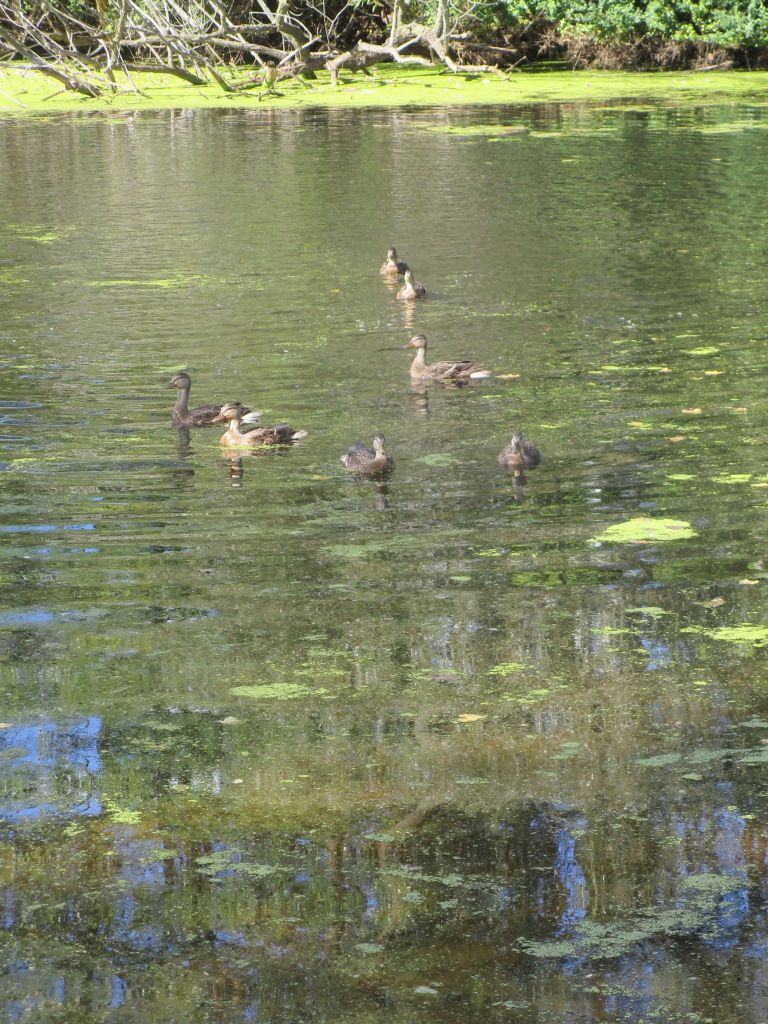
For the past couple of weeks I have been working on a new project. It’s inspired by this photo, which I captured in September at a nature reserve in Madison WI.
Mallards at Cherokee Marsh
I didn’t have any big expectations for this quick snap of a group of mallard ducks. But when I looked at it on my computer, I was captivated by the foreground – a mish-mash of colorful and spotted reflections. How might I create this look in fabric?
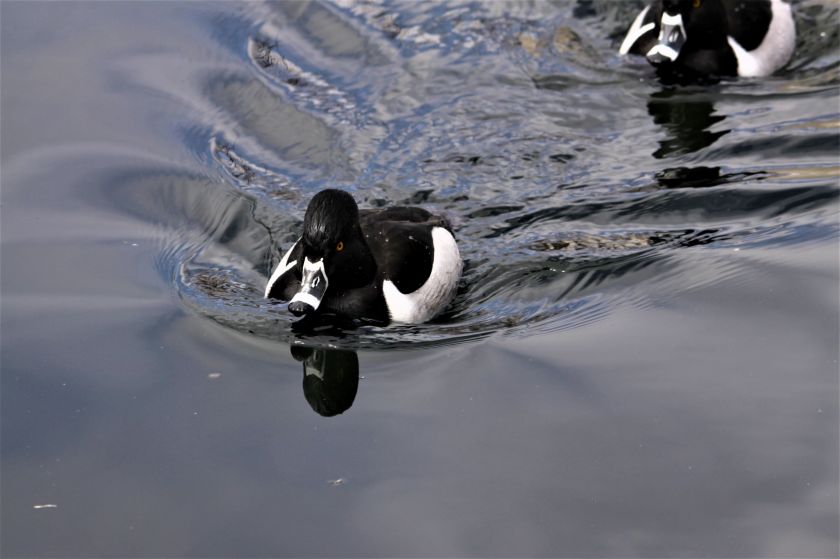
For this project I chose to use ring-necked ducks instead of mallards.
Male Ring-necked Ducks.
I love the black and white coloration and the crispness of its markings. Since this species of duck is also native to Wisconsin, I decided that it was a fair exchange.
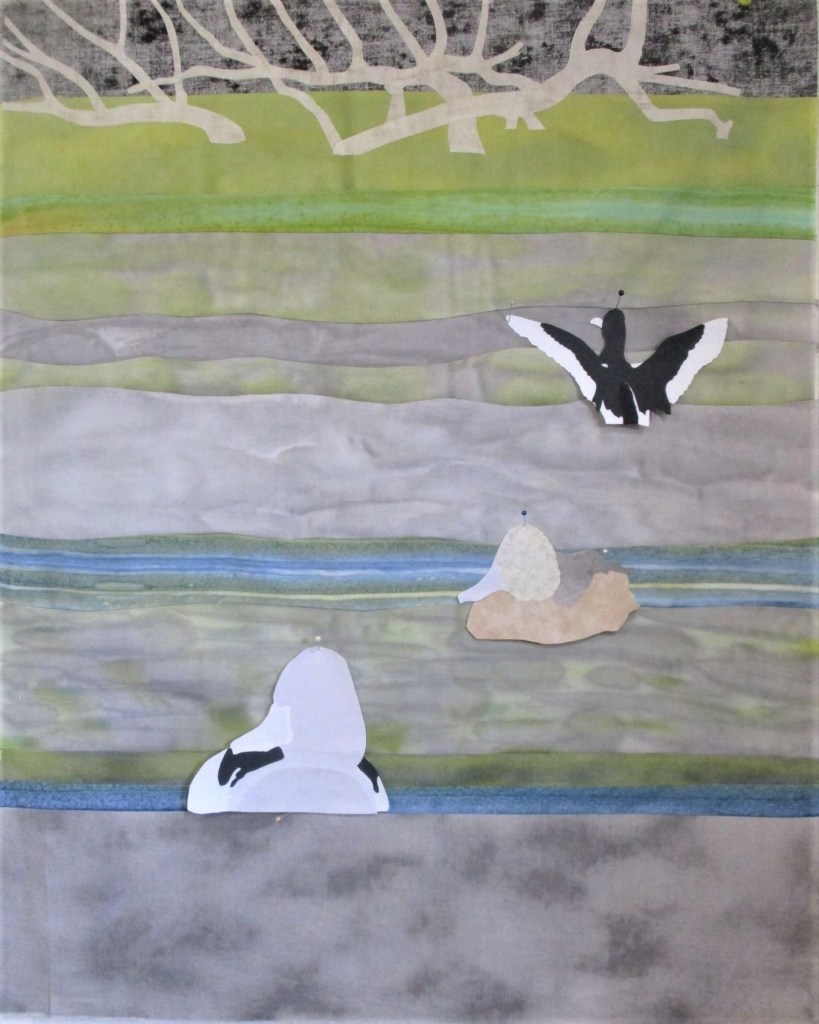
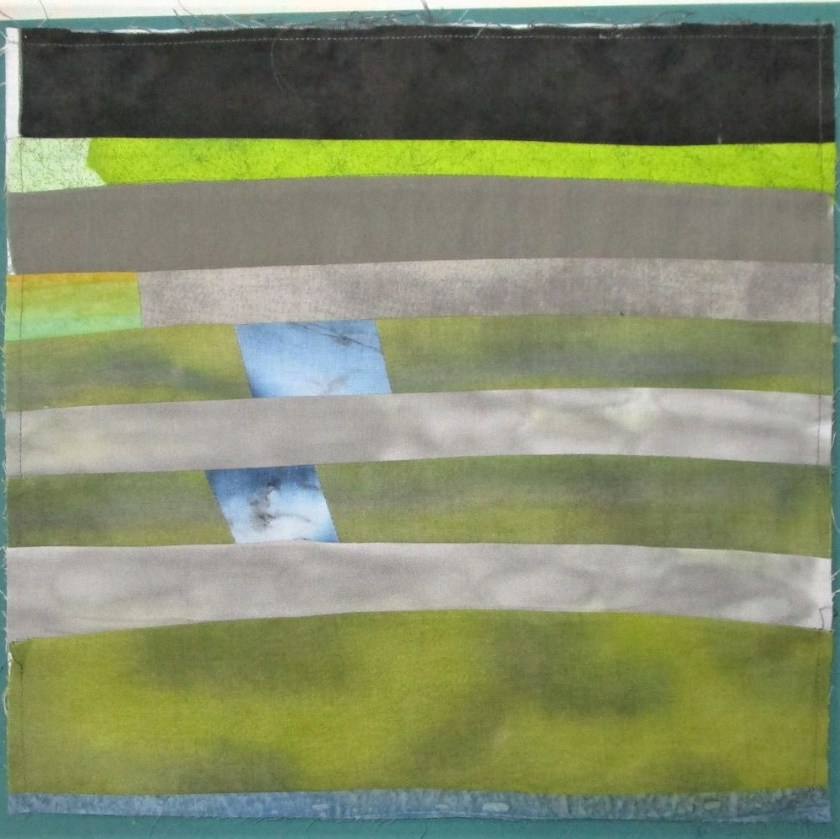
For the background, I selected some commercially printed and hand-painted fabric. these were sewn together in strips. Next I pieced together the first three ducks.
Eventually details will be painted on the ducks with fabric paint.
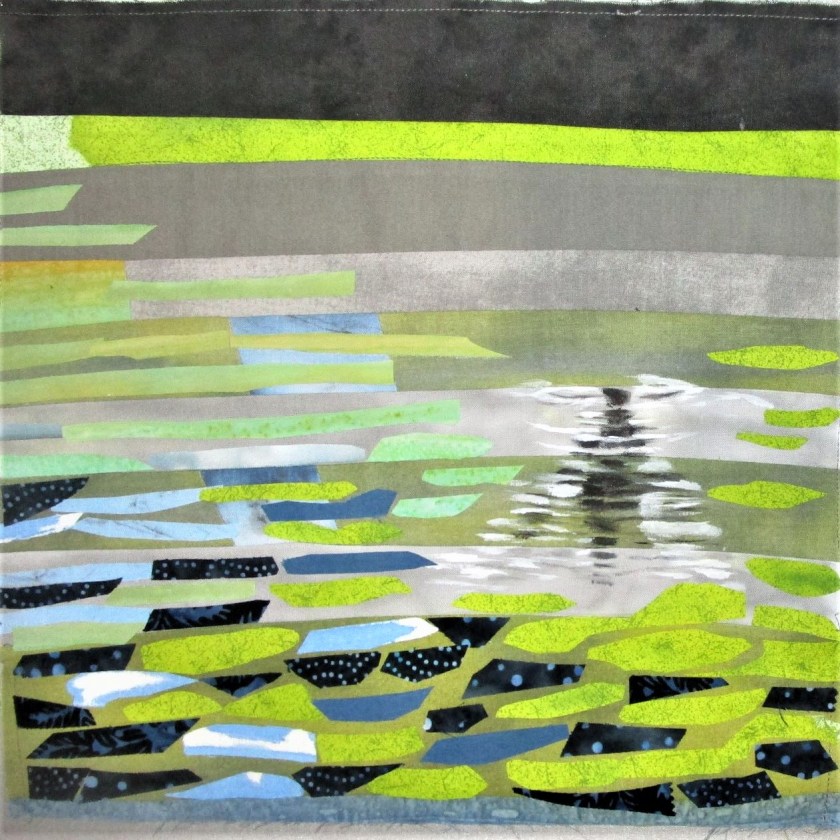
I took a pause for a few days. I want to use the confetti technique to render the mottled foreground. But this is a very new technique to me. So it makes sense to practice first.
I put together an extra duck so I could practice painting his reflection.
I like the pose of this one.
The next step? Go to U-tube to watch some instructional videos on the confetti technique. I had done this already, but the second viewing helped me work up my confident. With the prepared fabric in hand, I applied fusible webbing to the backs and cut them up into pieces. For the next hour or so, I fiddled around with layout.
Practice block with reflection and confetti foreground.
Did I mention that the title of this work is “Duckweed?” I guess I forgot to say. When I was at the marsh, it was the duckweed that really caught my attention. It was growing about the pond profusely in an intensive shade of green. This is what I am attempting to depict with my confetti pieces.
I next fused the duck in place and stitched a piece of tulle over the whole sample. The purpose of the tulle is to make the quilting easier. Here is where I left off today:
I’m fairly happy with my work. But I want to try rendering the reflection in the confetti technique instead of paint. I also want to work on the shapes of the confetti pieces.
I am in need of easy knitting – especially for evening TV watching. Here is my latest cast-on.
The multi-color yarn was purchased at the Madison Northside Farmer’s Market. It is made from Tunis wool, spun and hand-dyed by the lady who raises the sheep. The light green is a Cloud-born fingering weight. (Former Craftsy yarn line.)
I concluded that the results were less than stellar.
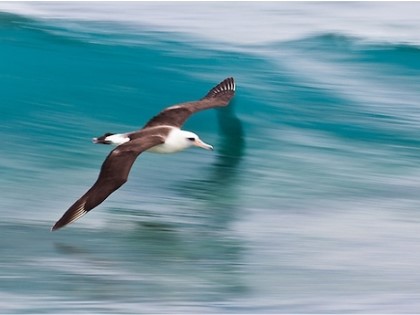
Today I am doing a side by side comparison using watercolor paint and fabric paint. My reference photo is an albatross.
I chose this because of the water background and because it would be quick to paint.
First I gave the sheet a good soaking in warm water, laid it on a waterproof board and squeegeed the excess water out. I was trying to break or reduce the amount of primer/sizing on the canvas. After it dried overnight, I cut it in half and started painting.
Colors used were cobalt blue, turquoise, paynes grey and burnt sienna. There seemed to be no difference in this result versus my first attempt. It was clear to me that the canvas had been primed with paint – probably acrylic.
Next came the textile paint. This paint is acrylic so I had high hopes. As I normally do when painting on fabric, I mixed the paint with a floating medium to thin it.
Colors were sapphire blue, turquoise, burnt sienna, gray and white. The experience of pushing the paint/medium combination around on the canvas was not pleasant. It had the consistency of snot and clumped up quite a bit. I will admit that it dried just fine and did hold some of my paint strokes pretty well.
The conclusion is that neither media gave a good result.
So I will probably abandon the canvas pad for purposes of fiber arts. Maybe some of my art association friends who work in regular acrylic paint would like to try it.
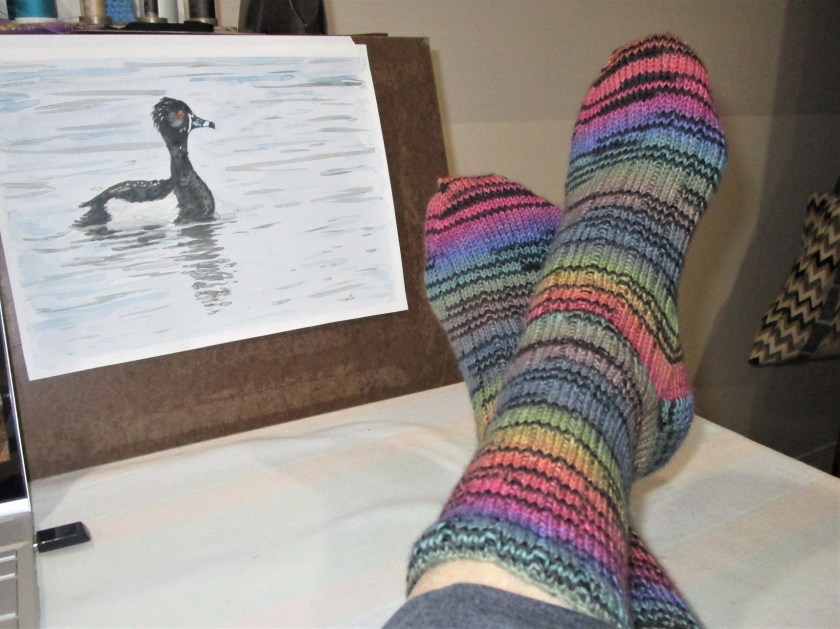
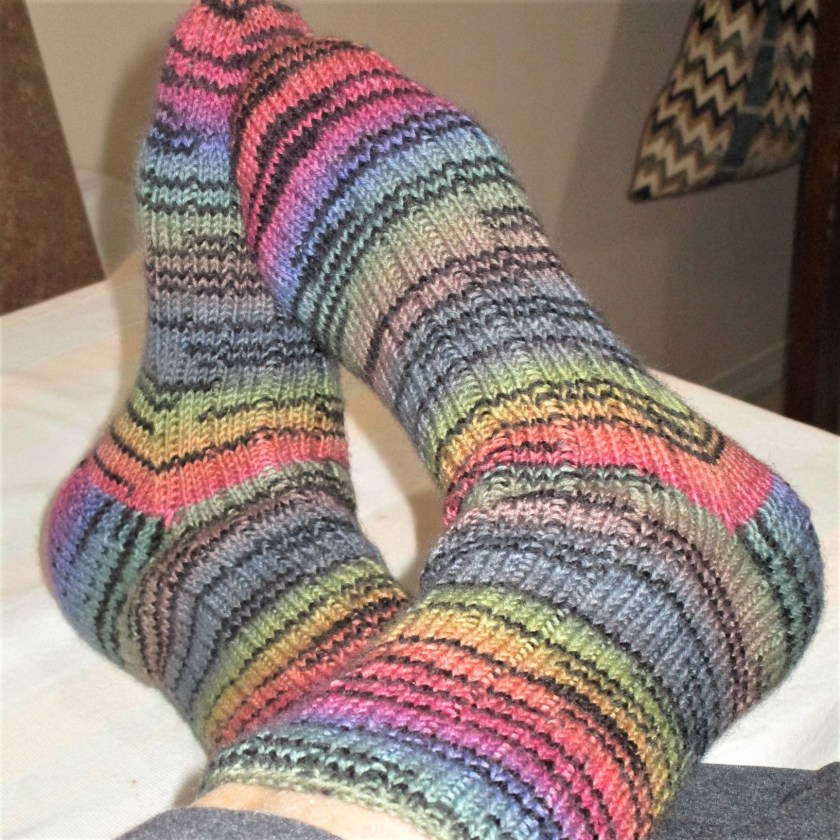
If my feet look relaxed in the photo, it’s because these socks were a delight to knit.
The long sections of leg and foot never got boring. How could they, with the ever-changing panorama of colors unfolding. The yarn was excellent – no splitting, no knots. This is one of the yarns I purchased at North Wind shop in Spooner, WI.
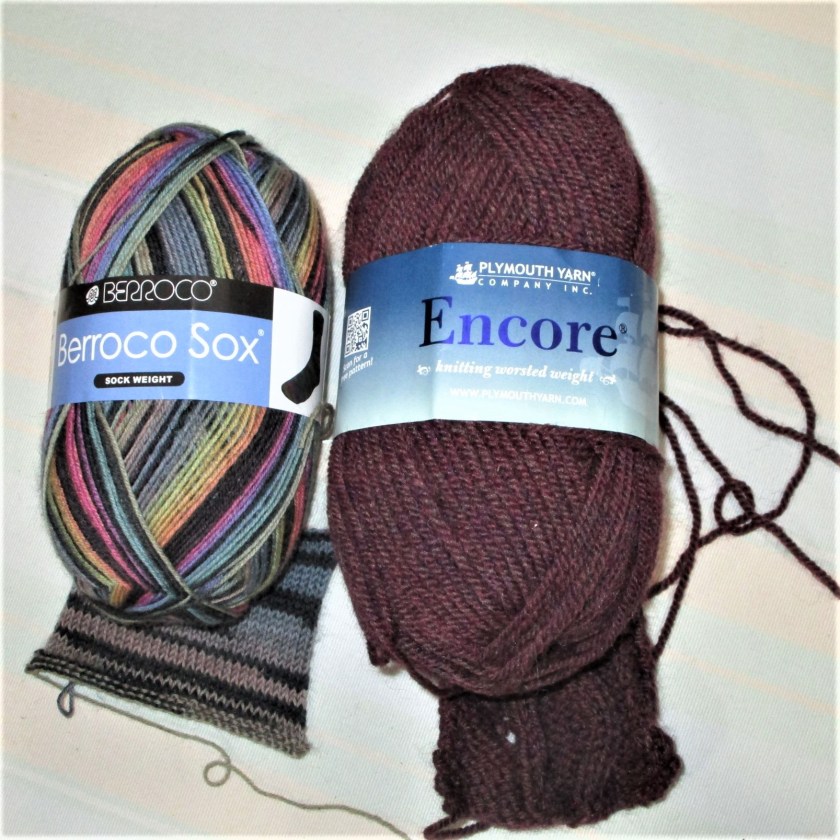
It was the ball on the left, Berroco Sox – a nice blend of wool and nylon.
I chose to knit a 3 by 1 rib pattern again. This time I continued with the rib after I finished the heel shaping. It circles the foot, which makes the socks hug it nicely. For the shaping, I used Hermione’s Everyday Sock pattern, available on Ravelry.







 Daily Fiber