This past week, I completed the sewing phase of Badlands art quilt. All segments are sewn in, and all but one is quilted.
Quilt lines are not visible in this photo.
The next step in my workplan has me using textile paint to add shading and lines. I learned the technique from a tutorial by Annette Kennedy through Craftsy. Annette is known for her realistic landscape quilts. She is an award-winning fiber artist.
So, I have a lot of trepidation about slathering a perfectly nice quilt with paint.
The paints I use are Jacquard Textile Color. I will mix them with a floating medium recommended by Annette. It dilutes the paint, making it lighter and keeping it from drying too fast.
Before painting:
In this photo, I have started shading the large mountains in the foreground. You will also see the applique I have made for my focal point, painted and ready for fusing.
I’m still nervous, but I am trusting that everything will come together in the end.
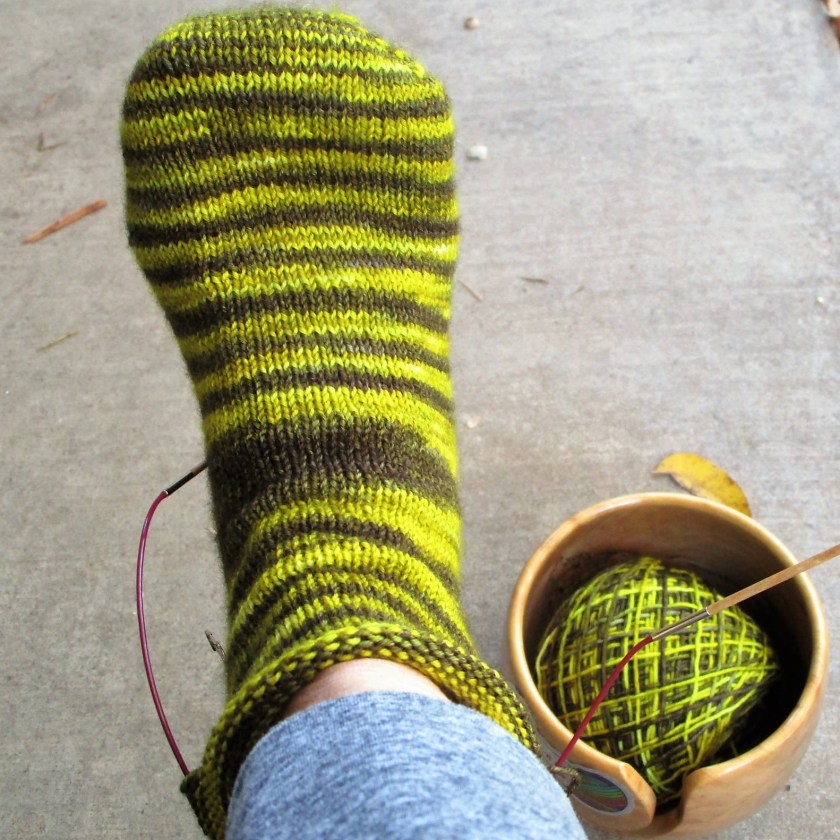
As of today, the completion rate on my sock challenge is 75%. Newly added to the sock pile is a pair I am calling Dots and Dashes.
This is the largest pair of the challenge, with a foot length of 10 1/2 inches. I used 100% natural wool in two colors and a pattern from Berroco called Fairlee. I would rate the skill level for this pattern as intermediate, which matches the rating assigned by the Berroco designer. They are described as slipper socks – I’m assuming that’s due to the fact they are written for dk weight yarn.
Modifications that I made include the two-color pattern on the foot, which came from Barbara Walker’s Treasury of Knitting Patterns. It’s in Chapter Four, Two-Stitch Check, version 1.
The second modification is the bind-off. The pattern calls for a sewn tubular bind-off. That looked like a hassle to me, so I worked Jeny’s Surprisingly Stretchy bind-off for one-by-one rib instead.
You can find the original Berroco pattern on Ravelry, or visit my post dated October 3rd for the embedded link.
One more to go. I had to order some needles, so I won’t be casting-on the last pair yet. Tune in on Monday to see what goes on my needles next.
My class on knitting I-cord jewelry starts Saturday October 22nd, at my local art association. So today, I am reposting my blog on this topic from earlier this year.
——- Laura Kate———
Last week I was recruited to teach a class at my local art association. I said yes, but I was at a loss on what to present. The introductory knitting classes which I taught last year were very lightly attended. I had to do some recruiting just to get a minimum number of students.
Thinking about possible roadblocks to knitting, I came face to face with certain inalienable facts about the craft:
The learning curve is steep.
Projects take a long time to finish.
What if I narrowed the number of skills required to a minimum, and what if I used these few techniques to make quick-to-complete projects? ……………..
The answer is I-Cord! This little add-on is used for strings for tying knitted hats and other decorative frou-frou. All it takes is a few yards, a cast-on, and repeated knit stitches over a very short row.
So today I am researching and stitching up all kinds of I-cord accessories. These projects will include jewelry so I will need a selection of beads.
The two strings in the left of the photo were purchased today. All the others I had acquired in the past 3 or 4 four years.
I also perused my stash for left-over fingering weight yarn. (No shortage here.)
To kick things off I worked up this 18-necklace using tonally dyed merino wool and some porcelain beads.
My version is made with just one strand because I had only 24 beads. I love how each bead dangles below the cord. I am wearing it over a shirt, but this necklace would also be soft against bare skin.
I sewed one end of the three strands together, braided them and then sewed the other end. The crimping finial is designed for holding ribbons so that they don’t fray.
For my third item, I switched to worsted weight yarn and move up to a size 5 needle. I was so happy to use up the left-overs of this lovely variegated Malibrigo merino.
This necklace doesn’t use a pattern. It will be made to my own specifications.
And here are my three I cord samples as of dinner time.
This should be enough material to work up a class proposal. I will also try making a headband and a multi-strand necklace.
When I last wrote about this art quilt project, I was waiting on a delivery of fabric.
Here is what my quilt looked like at that point.
I had selected some fabrics from my stash. The sky and horizon segments had been painted and positioned. My first module of background ridges was cut-out, fused and stitched together. I liked it a lot. But it was clear to me that I needed more orange and purple fabrics to really represent the scene as I designed it.
This photo shows my reference image and the three batik fabrics that arrived from Fabric.com last month. I was pretty impressed that the fabric colors looked just like they did on my computer screen.
So, full steam ahead with the work!!
Half-way assembled:
In this photo all the segments are finished and in place but one – the lower right. You see the segment’s base fabric that I plan to use.
At this stage I am very encouraged, and kind of excited. The lines and colors of the work represent my inspiration very well.
After I finish sewing down and quilting the background and middle ground, I will turn my attention to the focal point and foreground. Then comes a bit more painting of details before the final assembly.
Having returned from another trip to Wisconsin and a week of recovery, I am back to sock work. The challenge is to knit socks for each member of my daughter’s family. This is part 3 of 4 – son-in-law’s pair. He has a very long foot. To make certain that I have the length right, I took the started sock with me so he could try it on.
Try on a sock that is still on the needle? How can this be? This act can be done if the knitter works the sock from the toe up. Having recently learned the Turkish cast-on I am knitting my first pair of toe-ups. Thank you, Suzanne Bryan.
The pattern I have chosen is Fairlee, offered by Berroco yarns on Ravelry.
This pattern is designed with Berroco’s Vintage yarn in dk weight, which I heartily recommend. But for SIL, I chose an all-wool Plymouth yarn called Galway.
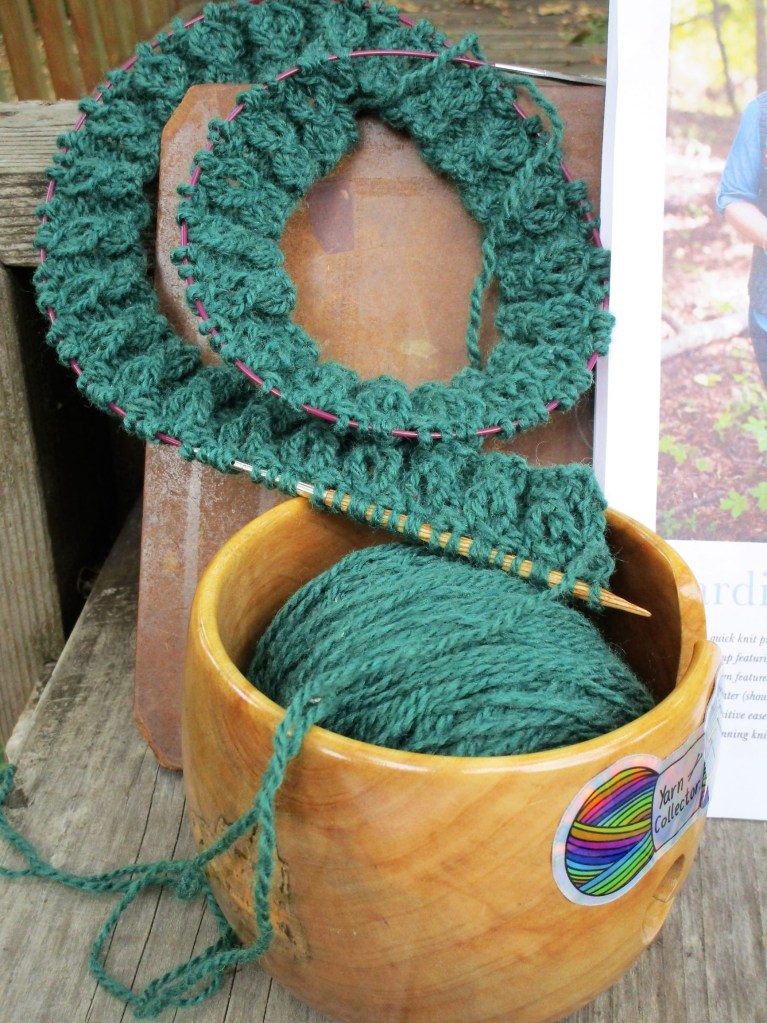
It is a sport weight, but I am working it stranded. You will notice that I modified the pattern in the foot section by working a cute little dot design with two colors. I hope that this will result in a warmer, stronger sock that felts a bit.
PHOTO SHOWING BEAUTIFUL SHORT ROW TOE STARTED WITH TURKISH CAST-ON
SHORT ROW HEEL FOLLOWS THE FOOT
The cuff is knit from a chart, incorporating some purl bumps. I really like this design element, but it has been tedious to knit. I find the second circular needle is always getting in the way. Thankfully, I’m almost finished with this section.
That’s about all I have to report today. Later this week, I will catch you up on the status of my Badlands art quilt. It is coming along well.