As we approached the end of Christmas week, it became clear that we wouldn’t be able to complete every joyous job. The weather was a bit of an obstacle, and we also ran out of time. Some in our group felt that we needed to recognize stuff we did that wasn’t on the list.
So we did.
Extra Stuff is Written in Black Sharpie.
Don’t forget to bring your black sharpie to Christmas week to write in your choices,
Okay my friends, I have been concentrating on knitting projects that use up stash yarn for just about seven months now. I have knit two-color cowls, socks and mittens; three color scarves; and four-color shawls. Yet, based on the looks of my yarn closet, I still am not making a big dent in the wool. Soooo much remains. Argh!
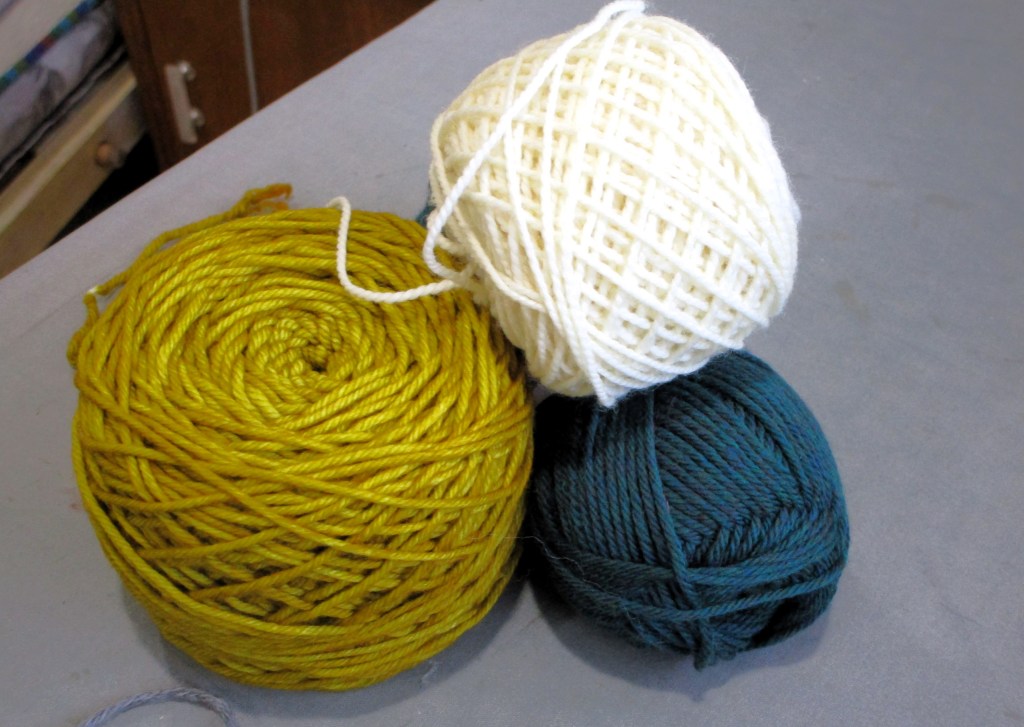
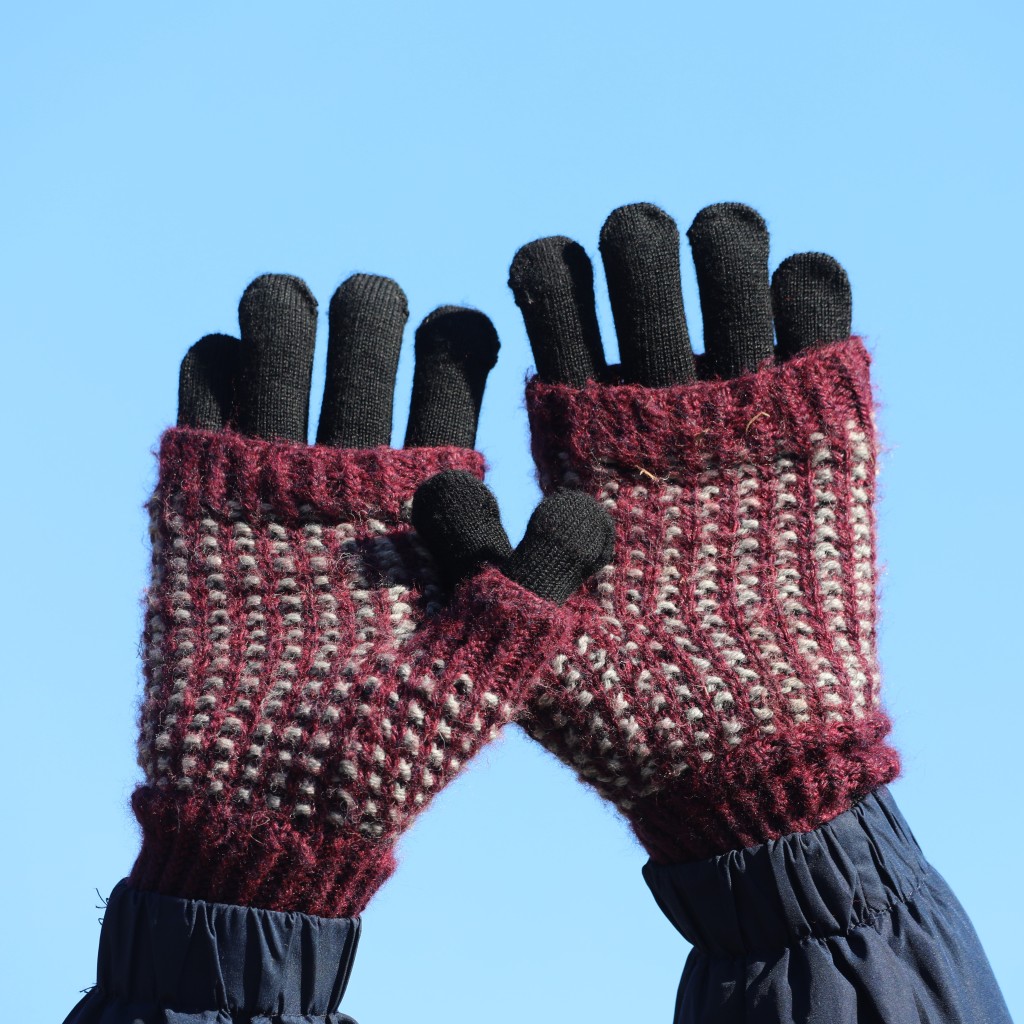
At this point, I am dropping my careful technique of pulling full skeins of compatible colors, weighting the volume of yarn then selecting a pattern that will make use of the mass. Now it’s just grab anything and cast on, then think about what it will become. Hence my current cast-on using these pitiful pieces of yarn.
There’s not much to work with and the weather is getting colder. The obvious answer is fingerless gloves. I happen to have a quick and easy pattern sourced from Klamath Basin Wool Works. It’s called Off-the-grid mitts.
As I recall, these are available as a free download from the site.
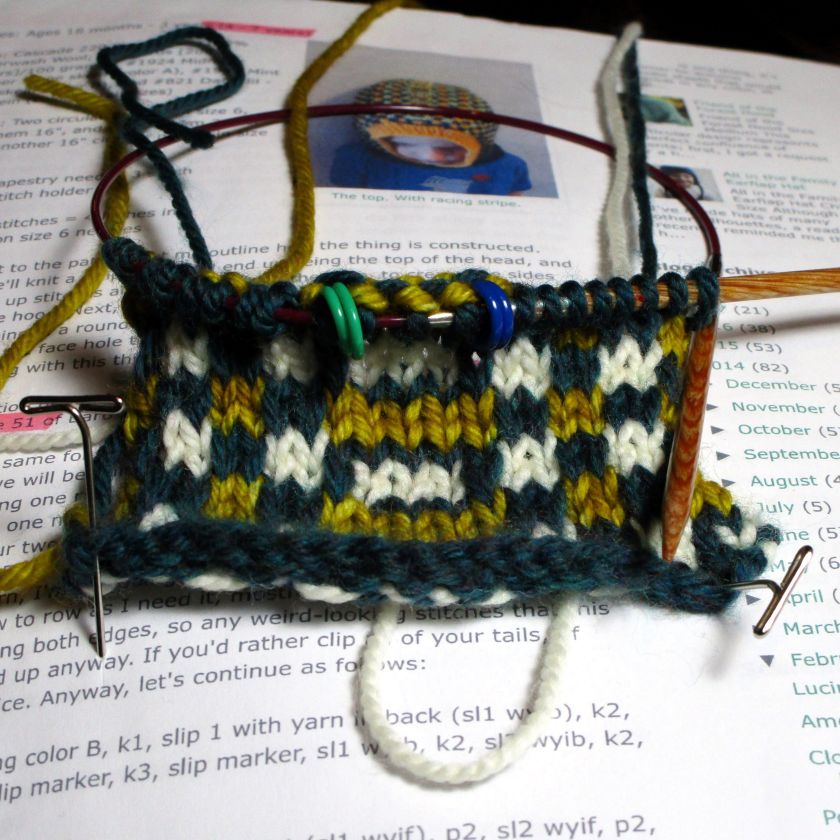
Here’s my start, using size 3 double point needles.
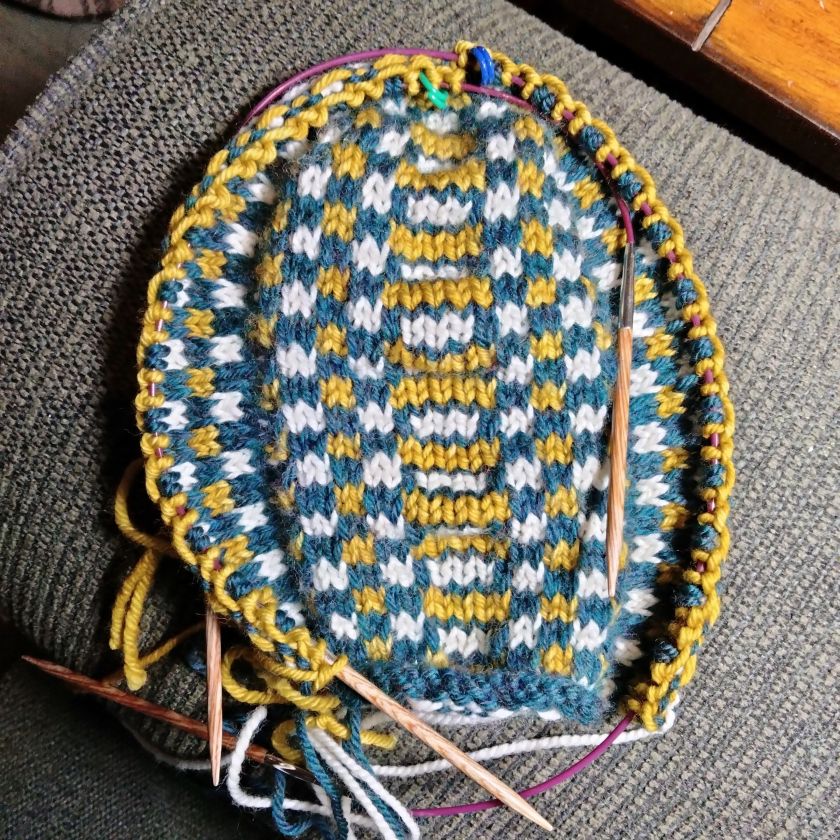
Off the grid is an appropriate name for this pattern. It is a playful reference to the grid-like texture which results from the mosaic stitch. (Slip one and knit one for two rows, then knit two rows of the main color.) In the end, you will have something to warm your hands if you live off the grid.
This knit should go fast, satisfying my manic need to keep knitting. Then, in a cooler frame of mind, I can return to a more methodic way of using up my left-overs.
It’s been a pleasant and productive week for me. You see in the image that I have finished the second sock of the Mary Delany pattern.
This is the first time I have stranded two yarns across the heel. For the past few years I have been seeking construction techniques that reinforce the areas of the sock foot which always get holes. Logic tells me that two strands are stronger than one.
I used one blended yarn and one all-wool yarn. Fiber content includes acrylic, alpaca and sheep’s wool. Time will be the measure of success in this test of tensile strength!
The pattern is by Kate Davies, and I will again insert the link to it. I must confess to substituting another Fair Isle pattern for the pattern’s. Your results will vary.
My second finish of the week is the Winter Birds watercolor painting based on Bill’s photographs. My composition is compiled from three of his photographs.
The two chickadees are cozied up to a pinecone, with the pine’s branches and needles as background. Working out the best layout was a wonderful challenge. My goal for the painting was to suggest bird camaraderie during the depths of winter.
WINTER CHICKS
This painting is about done. I still need to clean up some edges, tone some of the masked areas and add a highlight or two. All fun stuff. And it’s finished in time to slip it into a frame and hang it on the wall before Winter officially begins.
After laying in masking fluid, I used hansa yellow deep, transparent orange, pyrrol scarlet, burnt sienna, Winsor green blue shade, Cerulean blue and ultramarine blue. My new favorite black mix is ultramarine blue and transparent orange.
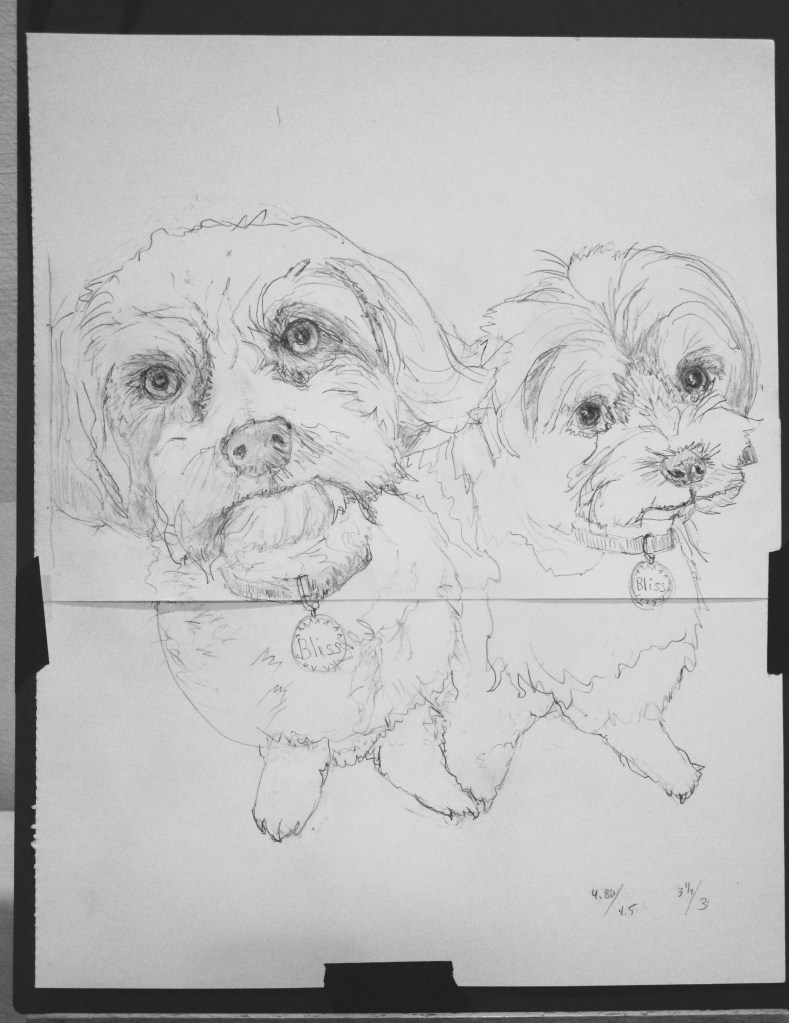
On this sketching Sunday, I have two quick (sort of quick) sketches for the viewers to consider. First is my value study for the chickadee painting I am planning.
This image is a combination of the two chickadee photographs that Bill gave me for the 100Day Project.
He also gave me this delightful and slightly mysterious photograph of Lu’s face, as she peered through a wood structure at the CITY Museum in St Louis.
I did this study,
I intend to refine the drawing further, then ink like I did her brother’s portrait a few weeks back. This will be no. 44 in #The100dayproject.
I’m onto a new project that, I hope, will enhance my home while using up a ton of fabric scraps that are stacking up in my studio. It all started when I got tired of looking at the naked drapery rod over my bedroom window.
So I did what any practical woman would do. I browsed images in Pinterest to find out what is trending in home decor these days. Here’s what grabbed my attention:
QUILTED BORDER ON PLEATED DRAPES
I like the look, but wasn’t too keen to make this curvy pattern. Instead, I seek to emulate the look of slate mosaic, like the tile border in my shower.
Settling on a pattern of 1-inch squares surrounding a 2-inch center, I pulled all the gray, beige and white fabric left over from my past quilt projects. Next,I sliced them into 1 and 1/2 inch strips, then sewed these together in twos, and fours.
The white strips will serve as sashing between blocks.
Strip sets on the work table.
Attaching the strips to the center, cutting back extra.
After three sessions, I have 25 blocks made with low volume, neutral colors. My estimate is that I will need about 30 for the two borders, depending on how long my draperies end up.
Time to lay out a few to see how the border might look.
Gosh this would be easier if I had a design wall (sigh.) Maybe I’ll have room for that in the next house.