Posted in sewing

Appliqued Greeting Card

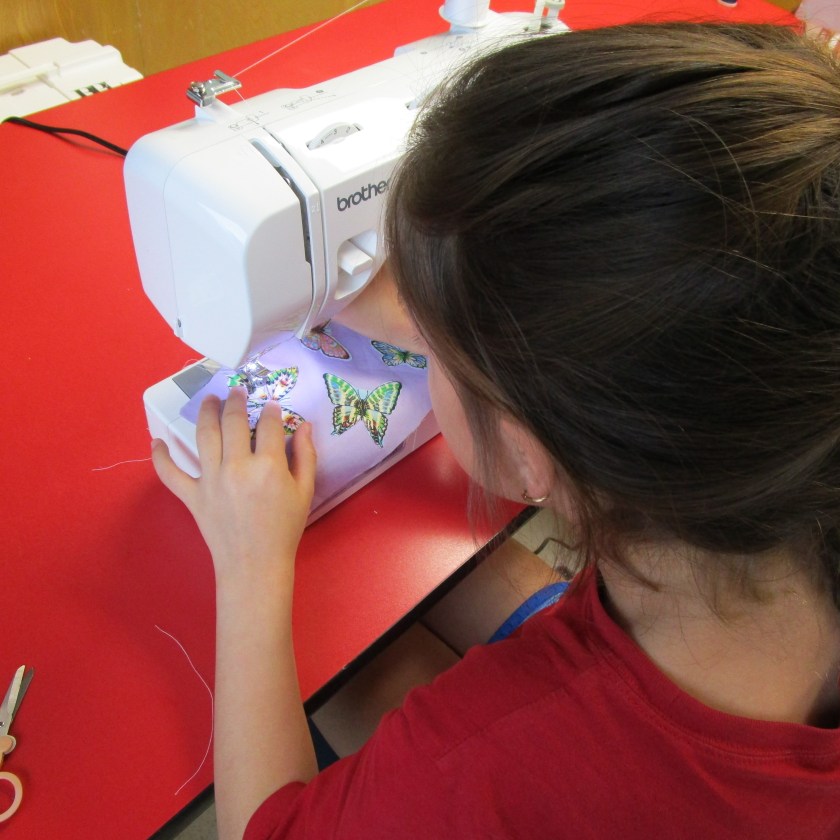
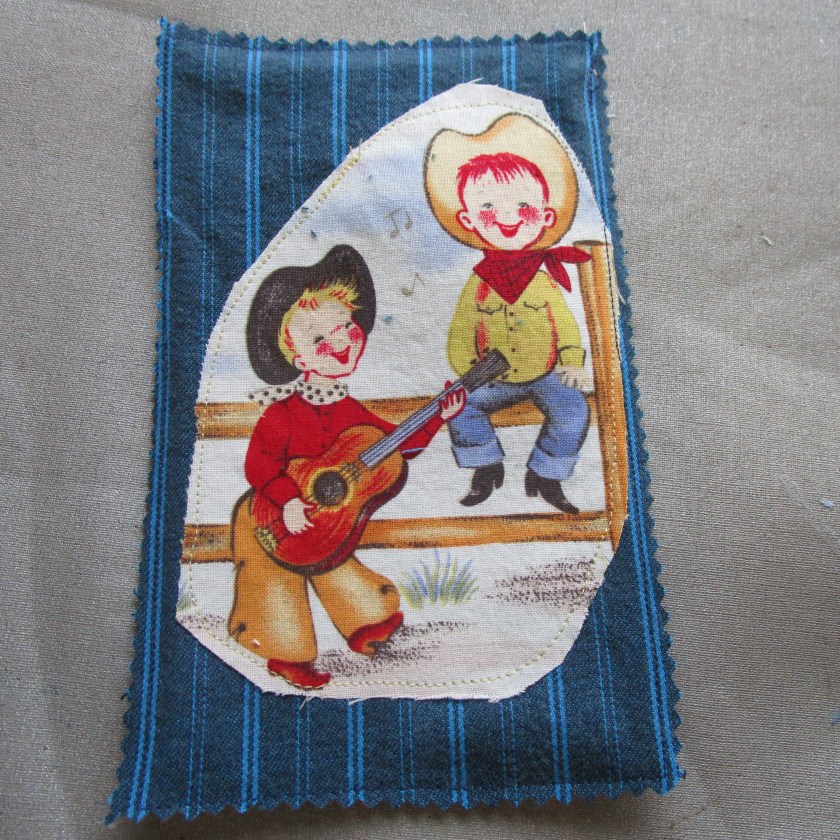
Today’s fiber object is motivated by necessity, not just fun. You see, last week I started my fiber arts students on machine sewing. They all seemed to love it. This week, I promised a project using the machine to sew applique. “What’s applique?” they all asked. After puzzling over what type of project to introduce, I took a page from my own playbook and settled on making greeting cards. This is a cross between the seed packet project and the paper woven letter project.

MATERIALS: 2 or 3 colors of cotton fabrics, Wonder Under fusible web, medium weight fabric stabilizer, ( I used Pellon) thread, fabric pen or Sharpie, card envelope.

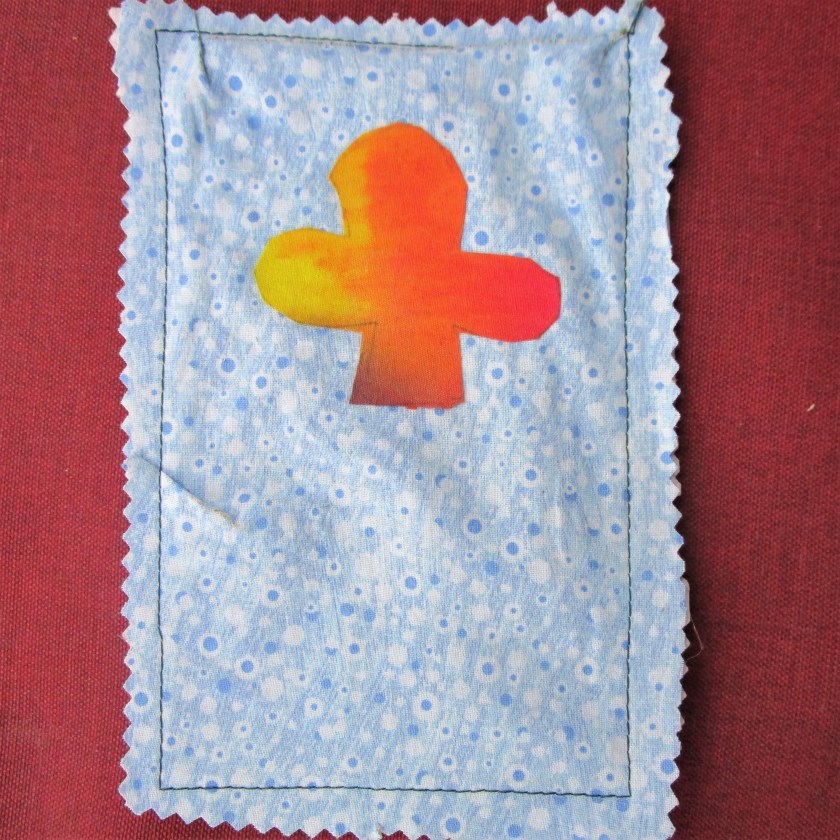
Measure and cut background fabric and Pellon to be the same size as the envelope. Set these aside. Choose a shape or pattern for your applied design. I chose to make a tulip in a pot, because I had some flower patterned fabric. Cut pieces of Wonder Under about the size of your pattern shapes. Draw your shapes on the smooth side of the web if you are not using an image on the fabric. Position the smooth size of the Wonder Under up, and press it on the wrong side of your patterned fabrics pieces.

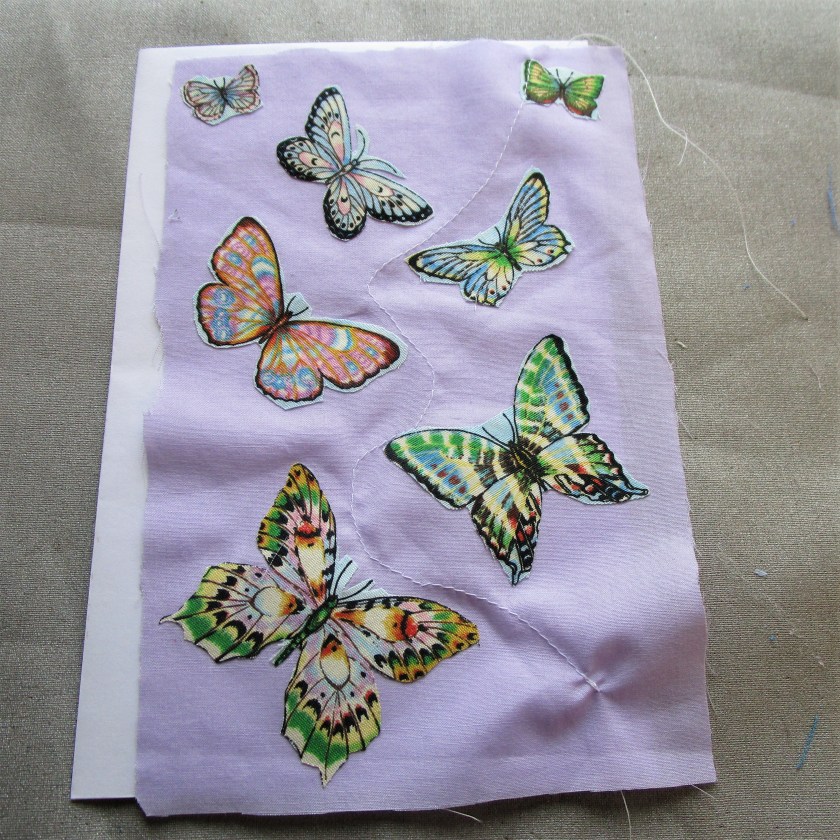
Cut out the shapes. Pull off the paper backing so that the adhesive is exposed. Arrange your shapes onto your background fabric and press in place.

Stitch around the shapes of your design with a straight stitch, using matching or contrasting thread. Pin the Pellon to the back of the piece. Stitch around all the edges with a 1/2 inch seam allowance. Trim the edges with pinking shears to within 1/4 inch of the edge stitching.

Your card is ready for your message. Write on the back side. Use an ultra-fine Sharpie to write a nice long letter, or use colored markers to print a short wish.

You could also draw a picture, if you like

All done and ready to mail.

Posted in colorwork, quilting

Free Motion

Ah, Freedom! Something we long for when pressed with daily obligations. Something we were promised by our founding fathers, along with life, liberty and the pursuit of happiness. But when is freedom not really that great? I’ve discovered in life that a complete lack of restrictions often leads to mental paralysis. If I have unlimited choices, how do I decide what to do? Which way to go?

Okay, enough philosophy. We’re talking free motion quilting today. In this technique, the machine is set up so that all motion is created by the operator. Forward, backward, sidewise, whatever. Even though I have done almost no quilting before, given an opportunity to quilt, I choose the free motion type.

So my experiment today starts with a piece of fabric which was a previous experiment in color:

This was colored by layers of stamping. The dots were created with bubble wrap. The shell motif was printed with a stamp I made. Lines were added with fabric pens. Today I want to quilt on it. My plan is to sew curvy lines around the groups of motifs, then add a center dot in each group of shells. Finally, I will stitch down the ivy stem.

The first step is to make a sandwich, which includes a muslin base, fiber batting middle and the pattern fabric on top. The sandwich is basted with safety pins.

Next is to set up the machine. Sorry, no photo of this. The steps are to attach a little circular embroidery foot and lower the feed dogs. For those who don’t sew, feed dogs are the two serrated plates underneath that move the fabric through the machine. Now I’m getting a little nervous. Better do some practicing:

A little wobbly. This is much trickier than I expected it to be.

Taking a deep breath, here I go.

This isn’t a totally bad result. I liked making the little spirals, and they turned out good. The lessons I learned are

  1. I should have chosen a fabric with no pattern on it for my first attempt.
  2. A thread color with higher contrast to the background would have been a better choice.
  3. It’s important to let up on the foot control when you slow or stop moving the fabric with your hands.
  4. With greater freedom comes greater responsibility.
Posted in Uncategorized

Growing Hemp in the U.S. – Stop, Go, Stop, Go

Photograph of Cannabis indica leaf (hemp)


The United States just legalized growing hemp. With the 2018 Farm Bill congress completely removes hemp and anything made from hemp from the Controlled Substances Act. The story of how this plant, which was grown for thousands of years, found wild in most of the Northern hemisphere, and used in making rope, canvas, paper, textiles and many other items, came to be banned as a controlled substance is a long, sad tale. As you can see by looking at the photo, it is impossible to differentiate hemp from its very close cousin, Cannabis sativa – better known as marijuana. When I became interested in hemp as a source for fiber art, I was fascinated by this tale of guilt by relationship.

The negative construct begins sometime around the turn of the 20th century. Until then, hemp had been grown here and used to make rope, ship sails, textiles and paper. Soon it became the subject of a negative marketing campaign, fueled by those with economic interests in removing it as a competitor to pulp lumber in the making of paper. It was an easy smear – the fear of its wicked cousin did the trick. After the release of the movie Reefer Madness growing hemp was banned by Congress in 1937.

This was not to be the end of the story. Along comes World War II. The Department of Defense was suddenly in need of hemp, but access to it suppliers in Southeast Asia had been cut off. Along came the “Hemp for Victory” campaign, sponsored by the U.S. government. For the duration of the war, growing hemp was encouraged, and had a ready buyer in the war department. Once the war ended, the government reverted back to its old stance (For it seems the congressional ban had never really been lifted.) There’s a lot more to the story. If you care to read about it, I recommend this paper by April M. Lugenbuhl: http://scholarworks.csun.edu/bitstream/handle/10211.2/2738/CAgeographer2001_p1-14.pdf?sequence=1

After experimenting with cotton and synthetic cord, I ended up choosing hemp to use in the macramé lesson for my fiber arts students. It is easier to manipulate than cotton floss, holds knots better than synthetic or cotton cords, and is not expensive. Today I will make a simple bracelet using hemp, wood beads and the square knot.

You will need about a yard of hemp cord, eight or so beads, one large bead or button, scissors, glue and a clip board. There are so many websites with excellent instructions, I feel it’s unnecessary to describe the steps here. Today I used this site: blog.rings-things.com/2013/05/07/how-to-macrame-a-hemp-bracelet/

Gosh, just the one bracelet looks kinda puny. I think multiple bracelets is the way to go with this look. Any recommendations on additional colors?

Posted in Uncategorized

Bent Out of Shape

We’ve all felt it. It happens at home, at work, while driving or walking. An unintended slight. A harsh word of criticism. A rude gesture flung from the window of a passing car. Generally, we are able to return to our earlier state with no visible change. Well, perhaps another minor scar on our psyches. Our treasured objects can also get “bent out of shape.” Frequently this means the end of the item. But, just like us, some of our fiber objects can be restored to their original shapes with the application of some attention, a warm bath, and a gentle massage.

This little brown sweater had an unfortunate encounter with the agitator of the washing machine. Not that I would machine wash my sweaters. But sometimes a sweater can slip in unnoticed, by clinging to other garments on the way to the laundry. Notice that the left edge has been dragged down several inches, pulling the neckline with it. The fiber content is cotton and cashmere, so there is hope that the remedy will be sufficient.

  1. Fill a sink with tepid water and add a small squirt of mild soap. I use liquid dish detergent or sometimes shampoo. Drop the garment into the water. Let it get thoroughly wet. Now, squeeze the garment, working the entire thing gently without a lot of pulling.
  2. Drain the water out. Squeeze out the excess soapy water. Draw another basin of water, also tepid. Rinse the sweater by squeezing the water through. Drain water away, squeeze out excess water.
  3. Lay the sweater on a bath towel, roll the towel up, and massage the roll for a minute or two.
  4. Unroll the towel, remove sweater to a flat space. I lay mine on the guest room bed. Gently pull the misshapen sections back into alignment. You may insert small towels into the sleeves to help with shaping.
  5. Leave alone until thoroughly dry.
There now. Feeling better, dear?

It worked. Those tiny wrinkles can be pressed out with an iron set to low.

Posted in weaving

Weaving with paper

I first learned about paper weaving when I was creating lesson plans for my fiber arts students. I teach a class of home-school students every Friday. We explore lots of fibery things, including weaving. Paper is an excellent medium for a beginning weaver. It’s abundant, cheap, and easy to manipulate. The students worked with colored craft paper, but I like using magazine clippings and photographs.

I came up with an idea of weaving together photographs and letters. The photo could be of the sender or the recipient. I imagined that the photo would increase the sentiment of my words. For this project, I decided to write a letter to my daughter. Here are my warp and weft paper pieces:

Here are the papers after weaving: Use tape to secure the paper strips on the back and a glue stick for loose bits of paper under the front edges.

Be sure to weave around the faces. It’s also good to show the hands.

To go with the color scheme of pink and blue, I chose a blue felt-tipped pen.

Finished Letter

I think this was a successful experiment. Now I need to find a super big envelope!