Posted in colorwork, painting

DIY Fabric Color – Pattern

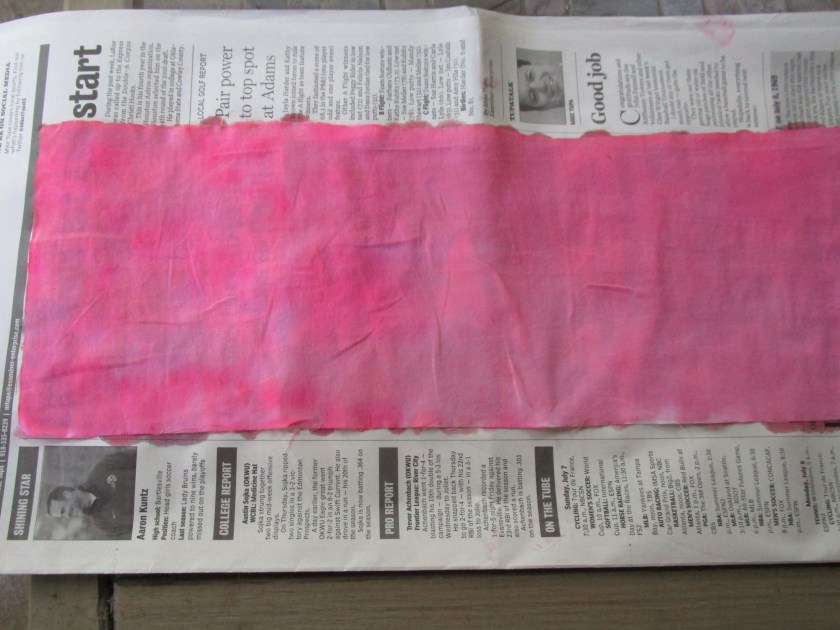
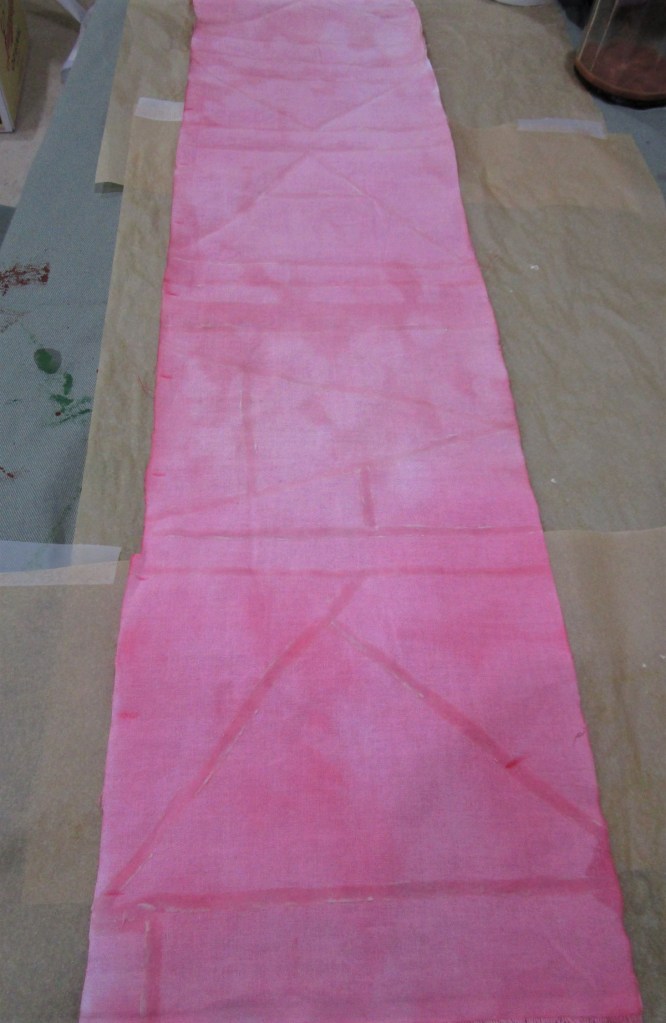
Today I will be enhancing the fabrics I color washed yesterday with more color. I’m excited to try water-based resist, a product new to me. I will be using it on the pale pink strip of fabric, also pictured, above.

The product came with a little applicator. I quickly discovered that it was impossible to get the gloppy resist paste into the tiny opening on the applicator. So I moved on to using a narrow paintbrush. But first, I wanted to try some crayons, just to see if the crayon marks would resist the paint. Here is my swatch all crayoned and resisted, before I flowed in the paint.

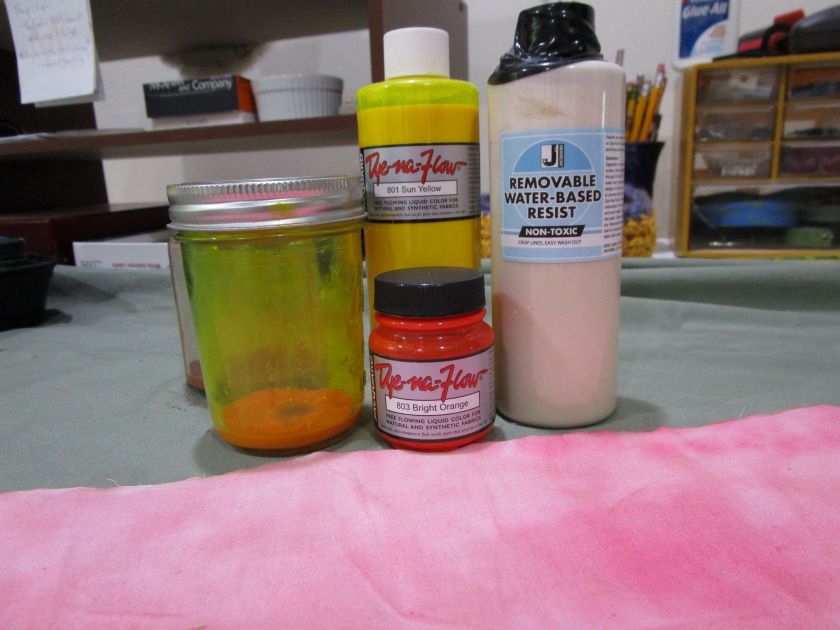
I mixed yellow, orange and ecru Dye-Na-Flow paint to get a bright gold color.
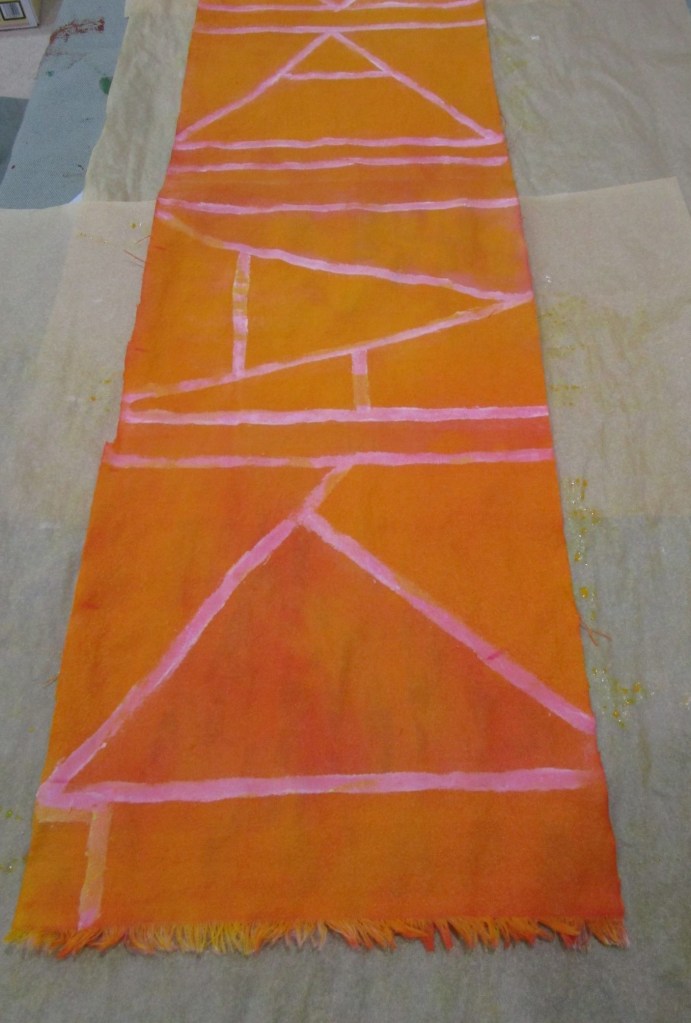
Tomorrow we will see whether the resist worked. Next I moved on to the striped piece of fabric. I wanted to print it with the following item:
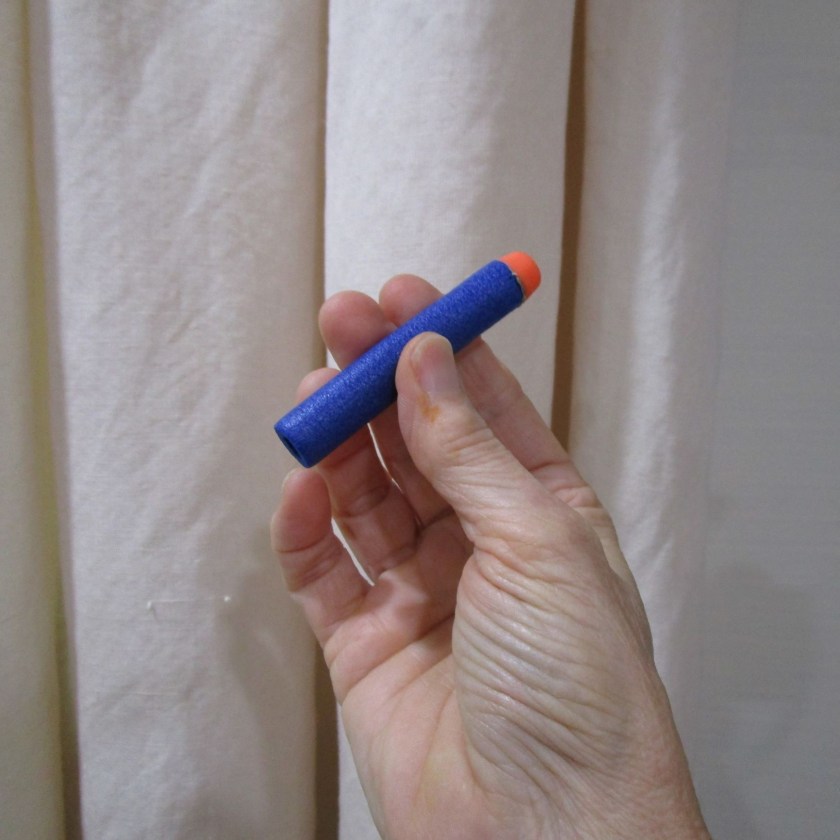
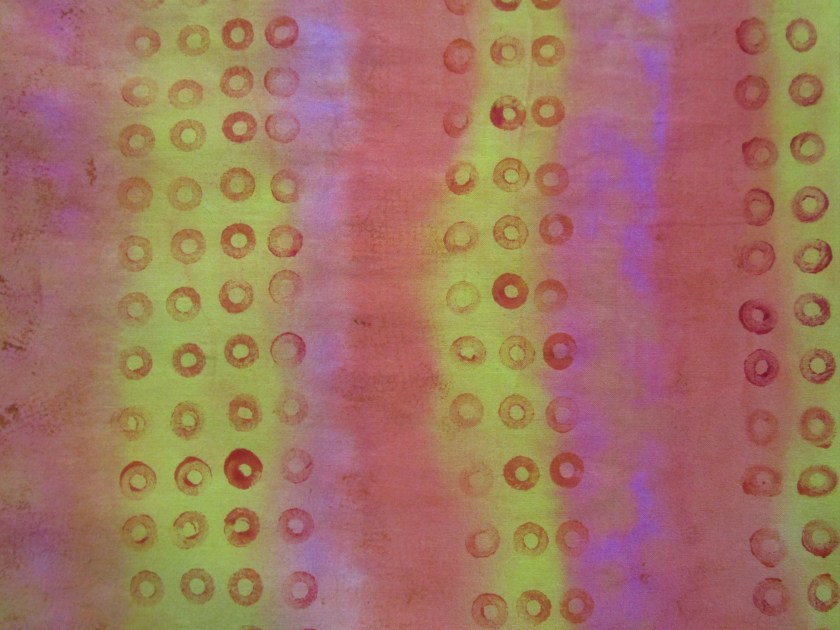
Any one who is related to a son or a grandson will recognize a foam nerf bullet. I will be printing with the back end of the bullet, which makes a very nice circle. Here is the fabric before and after printing with orange Jacquard Textile paint.
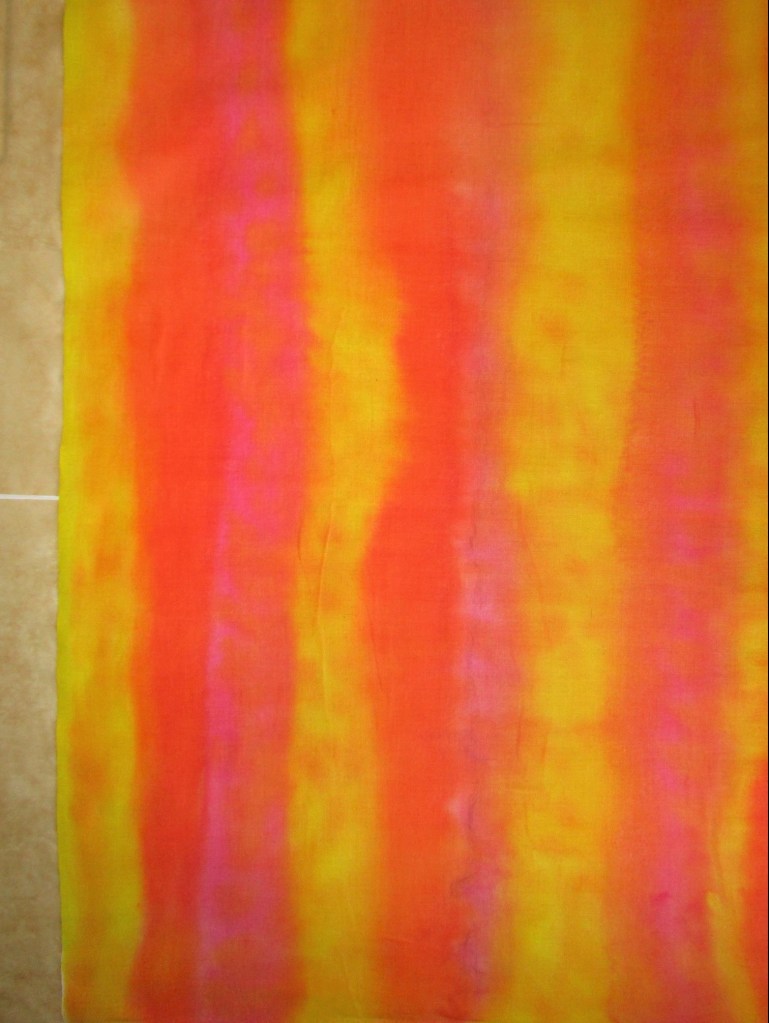
Before. (In this image the paint is still wet.)
After

I would say that this fabric is unique.

Addendum to this post: I thought you might be interested in seeing these fabric swatches after they were washed, dried and pressed.
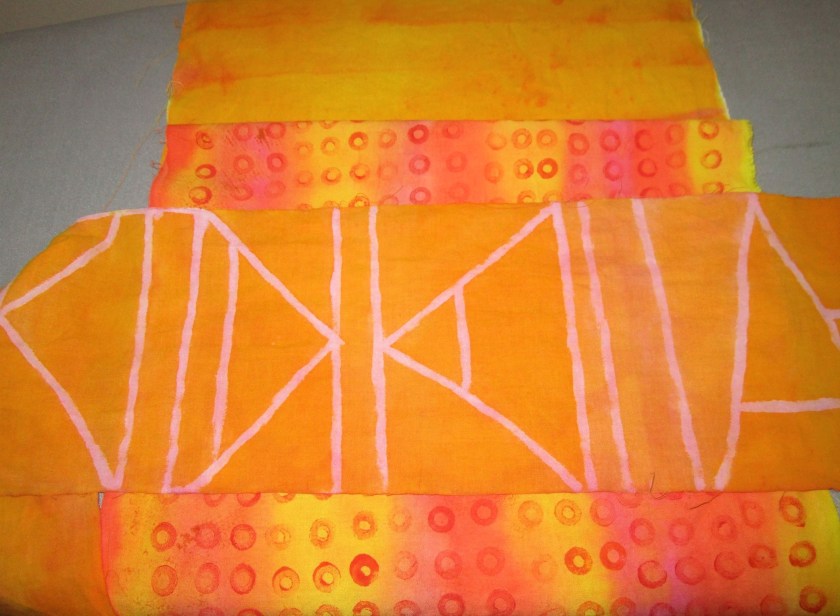
I’m pleased with these swatches, but especially so the water resist piece. Even though the lines did not resist all the way through the fabric, the front of the piece shows the pink lines clearly. The only negative is that the resist hasn’t completely washed out of the fabric. I will probably need to give the fabric an additional soak.

Posted in painting

DIY Fabric Colors

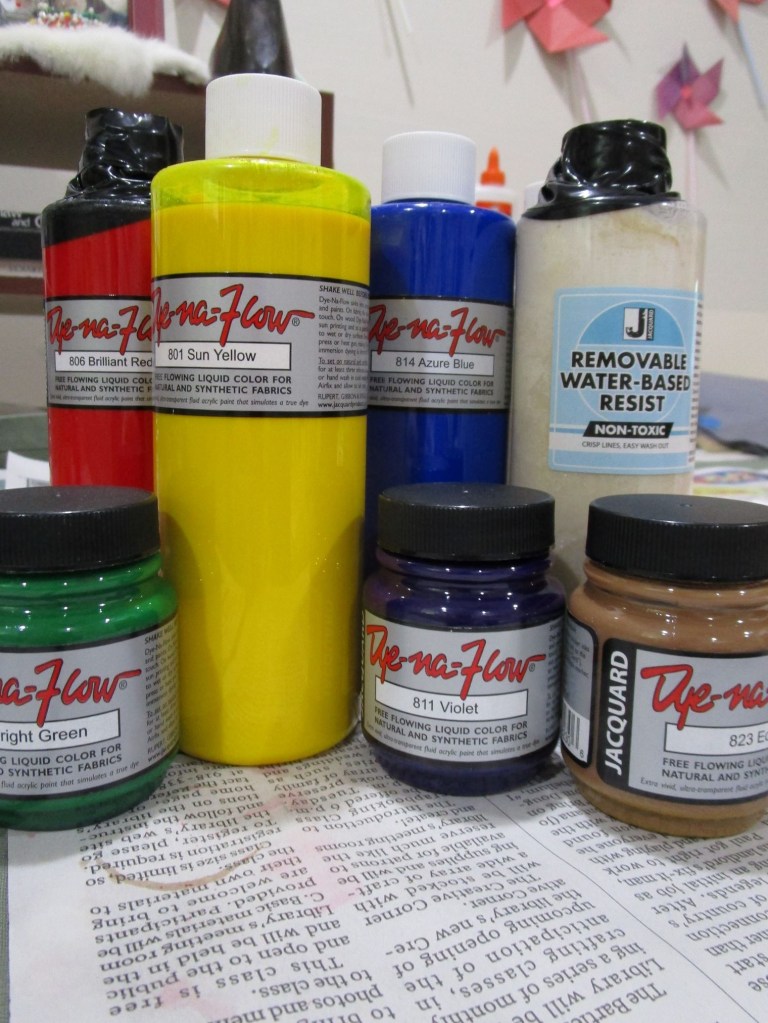
Recently I ordered a LOT of Dye-na-Flow fabric paint from Dharma Trading Co. https://www.dharmatrading.com/ Now that I have the quilting bug, I want to create my own fabrics. I know, there are thousands of beautiful quilt fabrics out there in retail world. But most of them are just not for me. And the ones I do like are kinda pricey. So here I go, making my own.

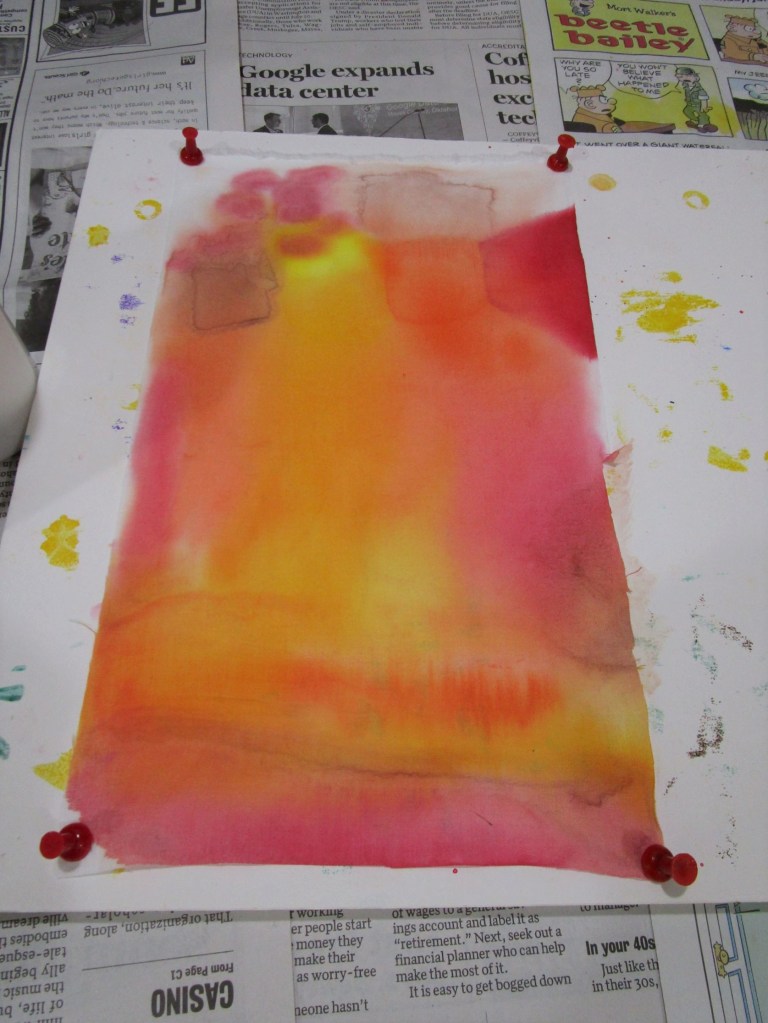
I had purchased several yards of white and light gray solid fabric specifically for coloring. I have an idea for designing a sunset scene. So today I am coloring the white fabric with warm colors such as yellow, orange, gold, and pink. Here is my swatch fabric where I tested a few combinations.

There’s also a little bit of ecru in the mix.

I plan to use 4 inch strips in my project, so I cut the fabric into 13″ wide pieces. This will yield three strips per piece, and incidentally, be a workable size for painting. Here are the results of today’s work:

Stripes of sunset colors. The orangey stripe should fall into the center of the 4 inch strip.
This gold turned out very well. I added some orange stripes and splatters. The stripe will go across the strips.
This was the tail end piece. It may be enough for one strip. It looks a bit blue in this photo, but I assure you that it dried pale pink.

It was a relaxing and productive afternoon. I look forward to working on the gray fabric. It will be interesting to see how it reacts to the sheer fabric paint.

Posted in quilting

Piecing with Free-Form Shapes

The first thing I did in my studio today was re-sew the wonky row of yesterday’s triangle quilt sampler. It looks better now, but certainly not perfect. I decided I could live it. Now I feel free to move on to free-form piecing, a skill I have been wanting to try for several weeks. This technique utilizes the rotary cutter, but not always the grid ruler. Leslie Tucker Jenison treats her rotary cutter as if it were a pen or a paint brush to do improvisational piecing. Her quilts look very gestural. You can see her tutorial at https://www.youtube.com/watch?v=4vT08esPfzw

I’m not ready to improvise yet. But I do have an idea for a semi-abstract design based on sunflowers. Here is the sketch of my idea.

This piece is divided horizontally into four rows. I assigned color values to the various sections, and divided each row into workable blocks. The fabrics I selected have a nice range of values, and three of them are solids. I think they will play nicely together in this design.

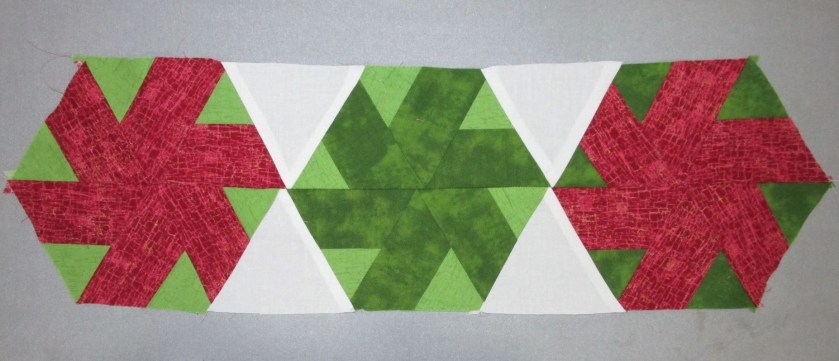
The next few hours were spent puzzling over the shapes, cutting, re-cutting, stitching, and, oh yeah, ripping out at least once. At the end of my allotted time, I had finished the three blocks of the bottom row. What do you think?

The width is going to be roughly 12 inches. I think it will end up about 24 inches tall.

So far, I really like it. It’s going to be an interesting experiment. And maybe even turning into very nice fiber object.

Posted in quilting, sewing

Triangles – the Finale

“When we last saw our heroine, she had cut and sewn all the pieces needed for a triangular quilt sampler. Let’s check in on her now.”

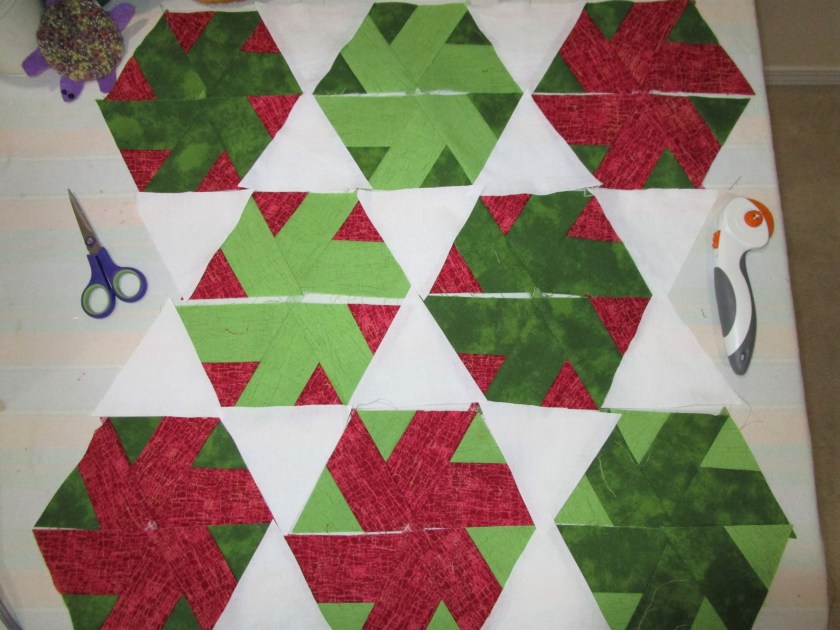
Okay, folks, not quite all the pieces. In reviewing my block cut, it seemed that two more hexes would be necessary if I wanted a complete sampler of the technique. So I cut and sewed two more. Here are my pieces before beginning assembly:

Here is my preliminary layout

This quilt is made up of six rows, grouped in twos. For the middle section, I will use two triangles at each end, to fill in the gaps where my cutting tools are sitting in the photo. Assembling each row is fairly simple. I start at the left and sew the pieces together in the normal fashion. The drama begins when the grouped rows are sewn to each other. Will the white triangle points match up and the hexes join properly?

Row 1 and 2. Not quite a match. I also notice a decided curve in the top edge. Wish I had see that before I proceeded to the next step.
Rows 3 and 4. Better! The edges are straighter also.
Rows 5 and 6. Best! Everything matches and is straight.

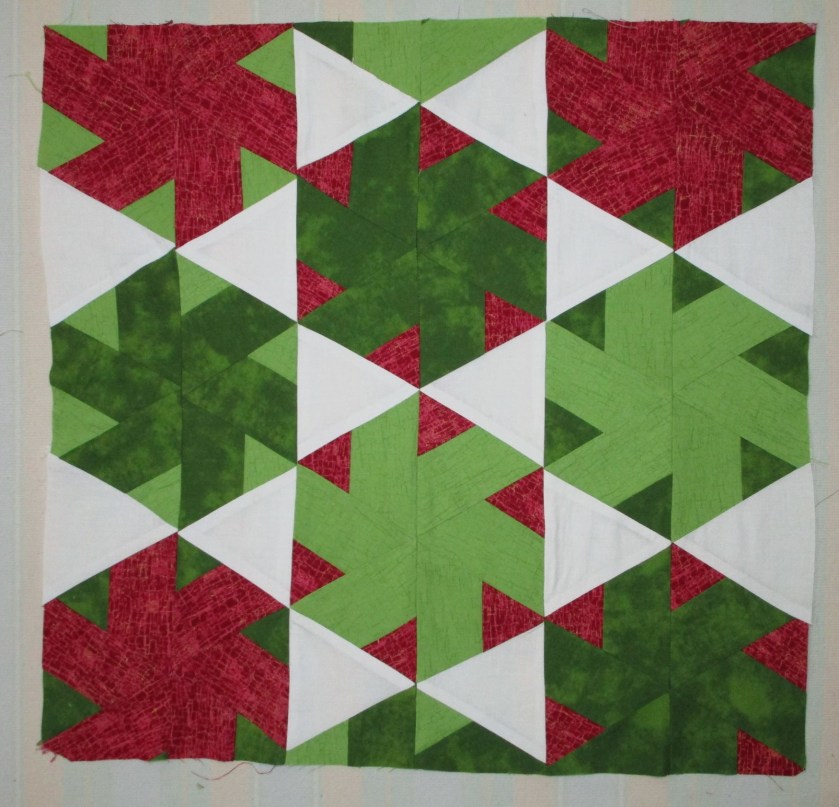
And here is my sampler all sewn together. I did a quick trimming of the outer edges, but I don’t have a long enough cutting mat or Omnigrid ruler to properly square it up.

I’m happy with this so far. This view is of the quilt turned sideways. You can see rows one and two on the left, with the decidedly wavy edge. I will probably remove these rows and try to straighten the edges before re-attaching.

Posted in quilting

More Piecing: Get to the Point

It is a really fine day to be in my fiber studio. The sky started out pouring with rain, and it ended up raining very hard again this afternoon. Today my goal is to practice piecing with triangles. For some reason, I find this shape way more interesting than a square or rectangle. I have been on-line viewing a wonderful tutorial by Johanna Figueroa, through BluPrint.com. You can find this lesson at https://www.mybluprint.com/playlist/5055/10267

Her first lesson is based on a Japanese block she discovered. She calls it Jelly Girl. Here is an image of her example quilt:

As you can see, it is a hexagon pattern. But inside each hex is a swirling shape made up of six triangles. The hexes are spaced apart with white equilateral triangles. She promises that it will be easy to piece together.

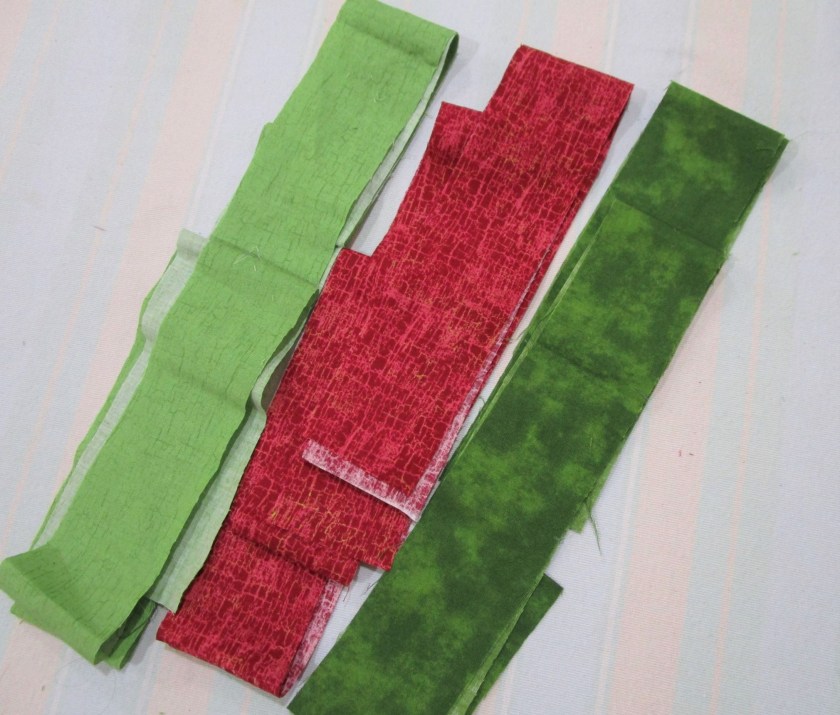
I have small amounts of these three fabrics, so this will be a sampler. To start the project, the fabric is cut into 2 and 1/2 inch strips, across the grain.

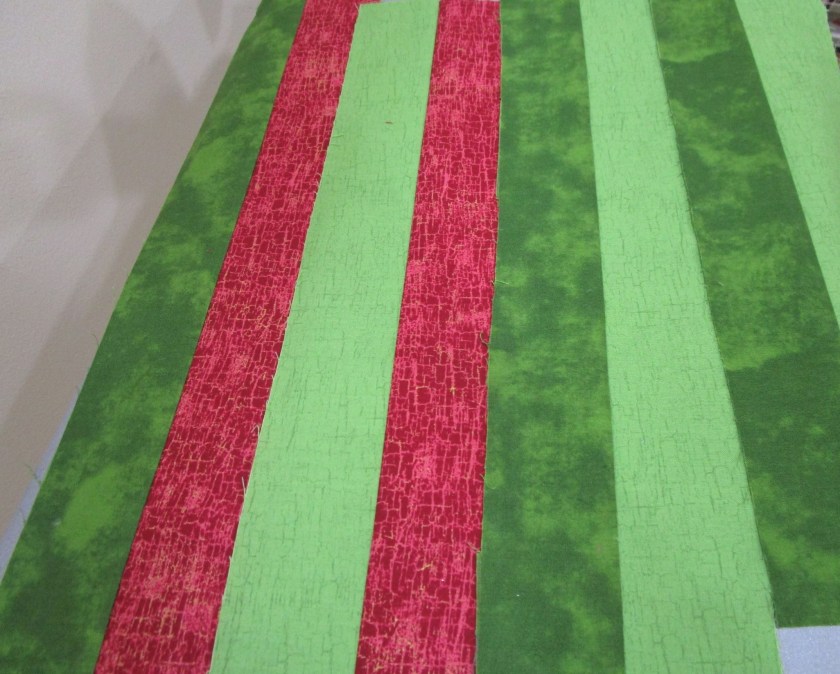
Next the strips are sewn together in twos. Here are my strips after pressing.

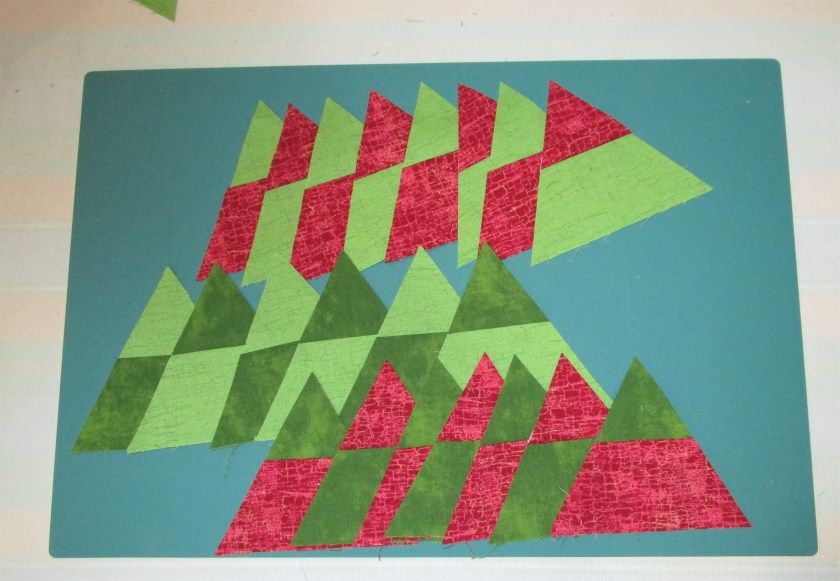
This is where the triangle part comes. Using an Omnigrid ruler that has lines for 60 degree angles, the strips are cut into equilateral triangles. For the three types of strips, I ended up with six types of triangles.

They look like Christmas trees!

Next six triangles are laid out into hexagons. Only three of the triangles are sewn together at a time. The two halves of the hexes will not be joined until the rows are sewn together.

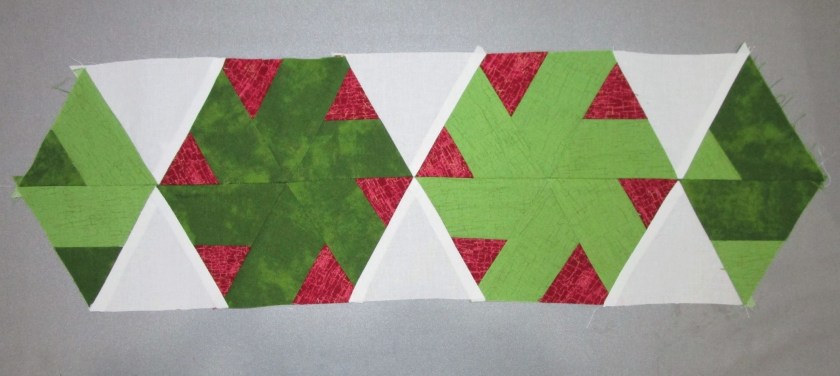
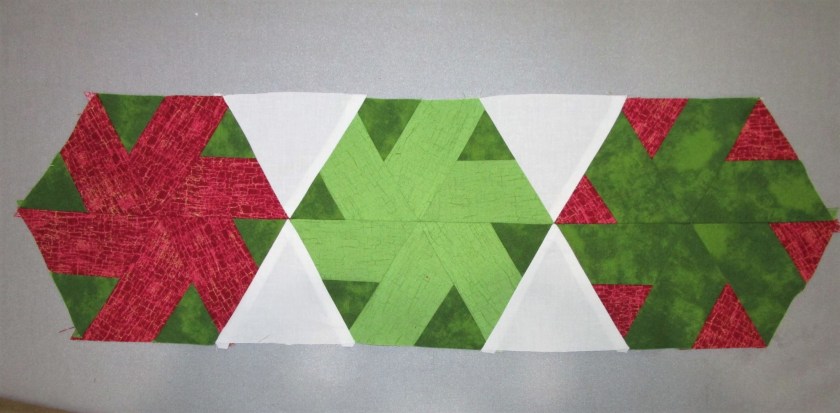
Here are my results at the end of the day:

I love the whirligig shapes.

I also cut the white equilateral triangles, which will be used as spacers. This colorful sampler will get finished next time.