Posted in knitting

July Knitting

The wild storm that blew through here Sunday night left behind the most glorious, cool and dry air. With early morning temperatures in the upper 60’s, it’s just fine for knitting en plein aire. What better project for summer knitting than baby sweaters?

The knitting you see in the photo is the body of a sweater for Baby L. By the time real sweater weather arrives, she will be one year old. So I have sized this sweater in the 12-18 month range. This design is a yoked and button cardigan with a very full body slightly gathered at the chest. Here is my schematic.

I feel excitement at my future of making many knitted garments for a little girl. So many design elements to choose from – the head spins. I would call this one a vintage style, which is built upon a 12-stitch lace pattern sourced from Barbara Abbey’s The Complete Book of Knitting (1971 by Viking Press.) I will use Elizabeth Zimmerman’s percentage system and instructions for the Fair Isle yoke sweater found in The Opinionated Knitter (Schoolhouse Press) to fashion the yoke. The sweater is constructed from the hem up. As Elizabeth writes, “Body to underarm, sleeves to underarm, UNITE, which … sounds rather like a rallying call.”

Below please note the instructions from Abbey’s book and accompanying chart for the baby fern lace pattern: FYI, my gauge in pattern is 20 stitches = 4 in.

Now what to do with the sleeves? I decided that they would be bloused sleeves, not tapered, so as to match the body. In studying the lace pattern, I noticed that the lace panels are separated by a 3-stitch mini pattern of garter – stockinette – garter. If I expand this slightly and add two more garter stitches between the stockinette, I will have a 7 stitch pattern that works well with the lace. Here is how it looks:

Knitted outdoors this morning, enjoying sixty-seven degree air.

So that’s all the major decisions made. I will use the same 7-stitch pattern on the yoke. I only have two balls of this Berroco “Comfort” yarn. If I run low of yarn at the yoke, I will throw in some contrasting color rows. Oh, this is going to be fun!

Posted in painting

Painting Hydrangea Leaves

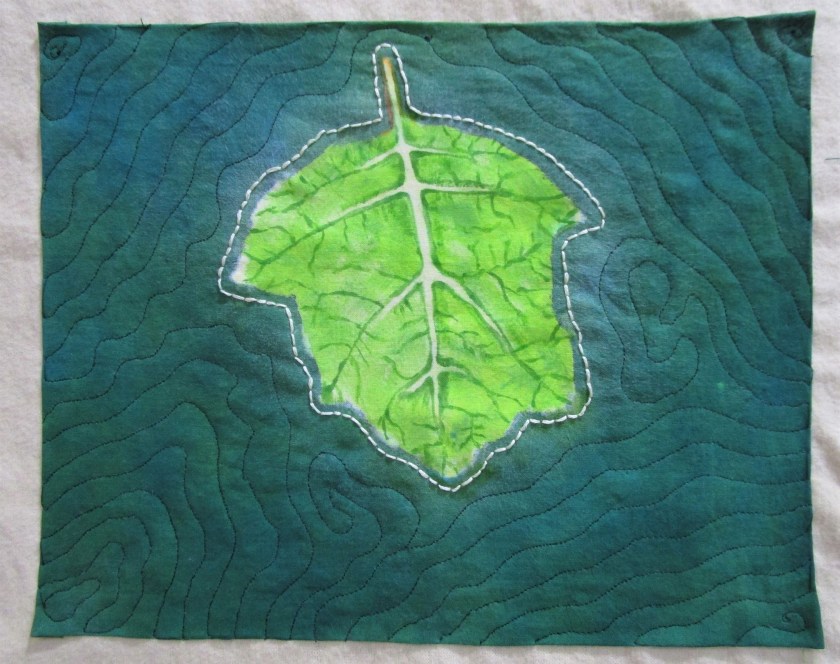
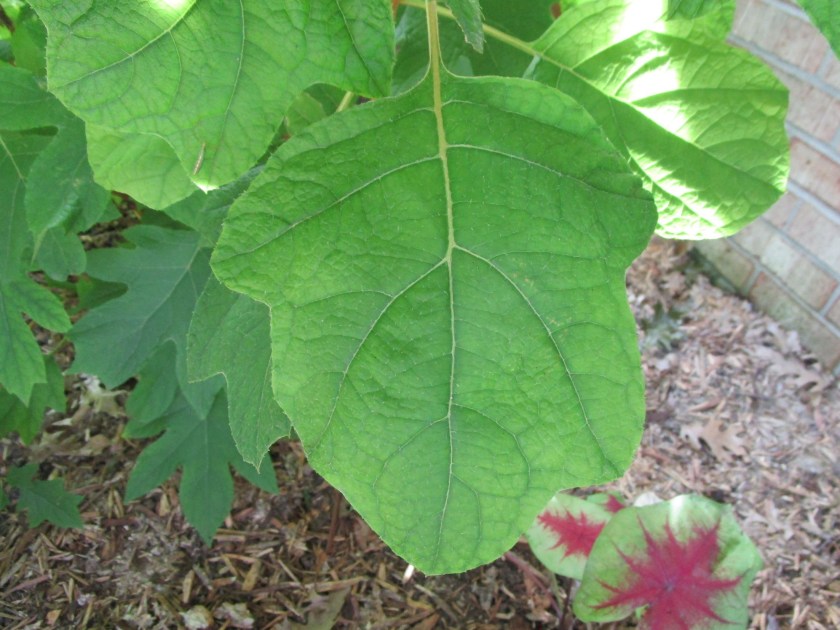
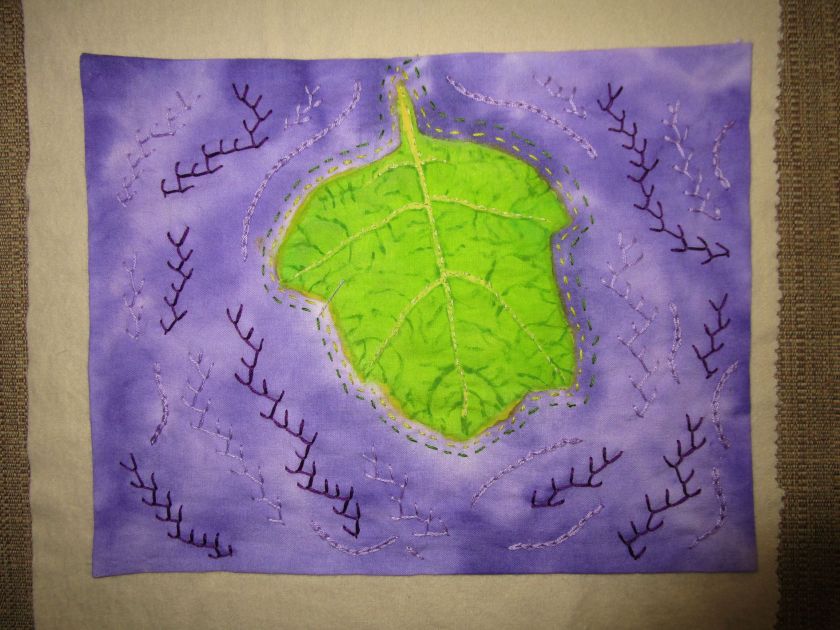
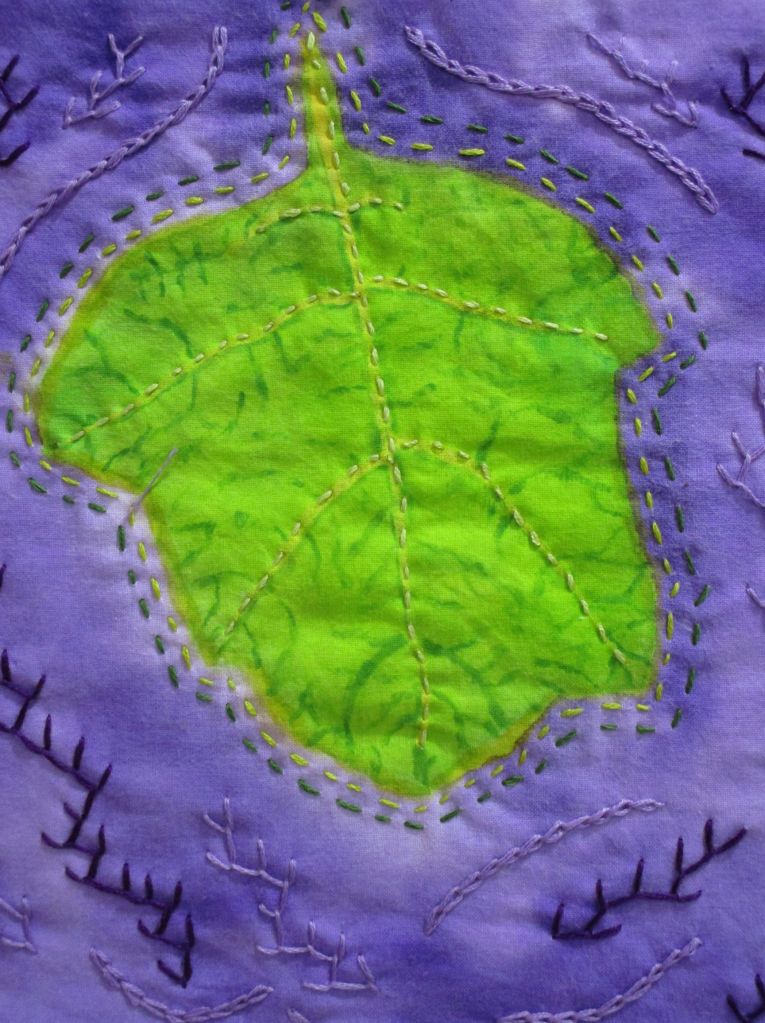
Beside the patio lives a beautiful oakleaf hydrangea. Every morning, I drink my coffee in its shadow and admire the sunlight shining through the leaves. I have been wanting to incorporate these wonderful leaves into my fiber art all summer long.

If you look carefully at the photo, you will notice that there is a variety of leaf shapes presented by this plant. There can be three, four or five lobes on a leaf. It seems that the baby leaves start out almost round and the lobes develop as the leaf matures. I have decided to do a mosaic of the leaf shapes with fabric paint and resist on cloth.

Here are two of the drawings I made of these shapes. I will be using the shape outlined in black ink for today’s paintings.

There are two experiments today. In one, I use the water based resist on the leaf shape, paint the background, then remove the resist and paint the leaf. In the second experiment, I paint the entire piece, add resist to the leaf shape and over-paint the background. Here is a photo of both experiments in the first stage. The lines are traced and a yellow tinted resist is applied to both swatches. The left swatch has the whole leaf covered in resist.

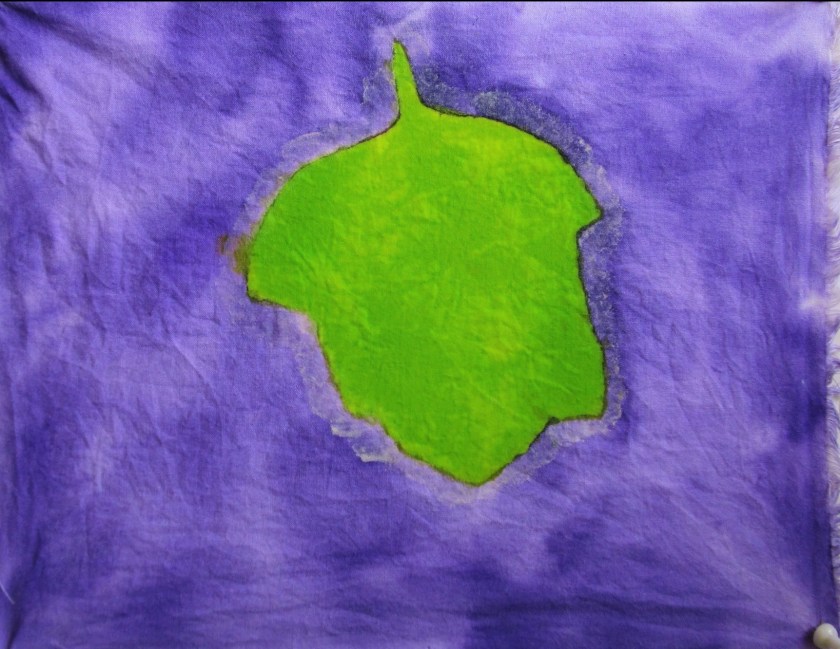
Experiment one. I used a violet background.

Wet painting
This photo show the fabric after the resist is washed away. The yellow leaf veins didn’t stick, but some of the yellow outline is still visible.
in this photo I applied resist all around the leaf shape before painting the leaf itself.
Paint on leaf still wet. Only a little green leaked out on the lower right side.

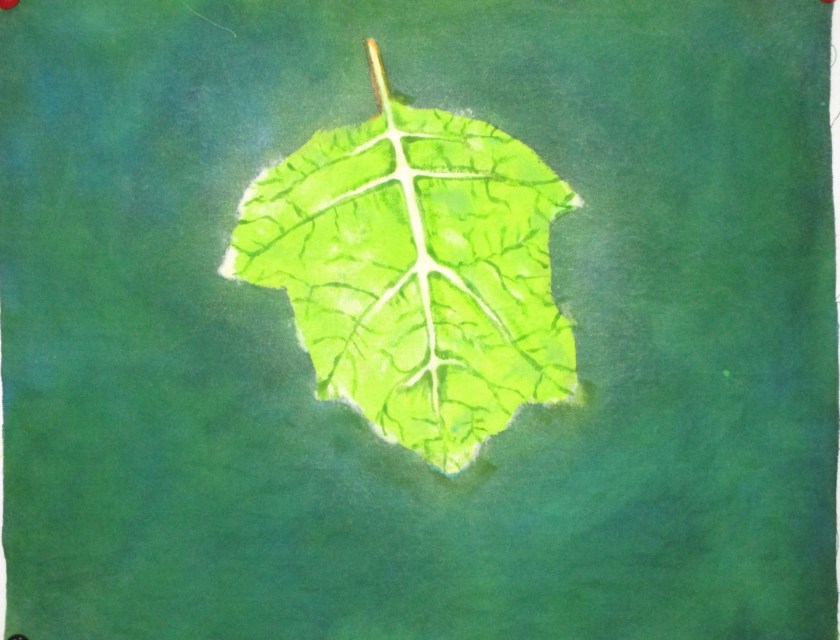
Experiment two. I started by applying yellow tinted resist to the veins and outline, then covered the entire fabric with yellow-green paint.

Paint is still wet.
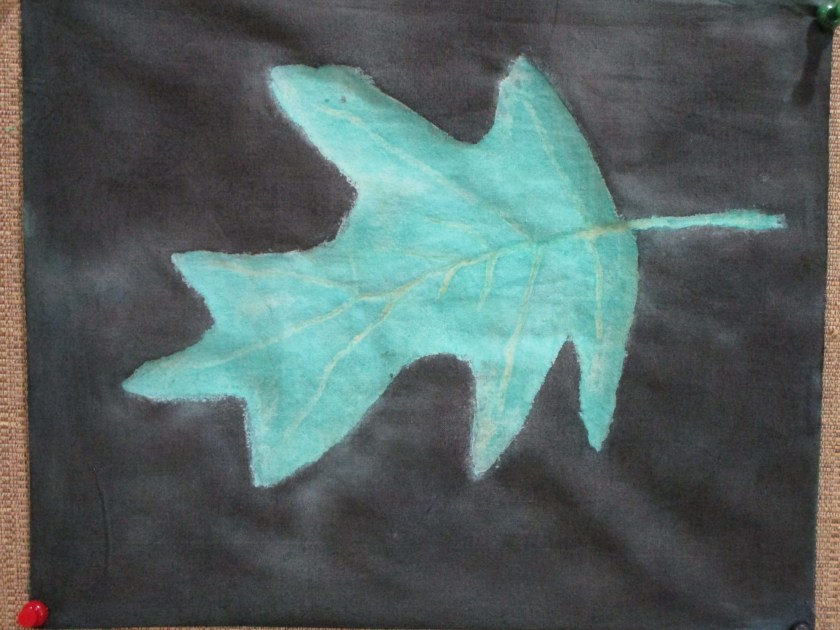
Paint has dried. I applied additional resist over the leaf area before painting the background.
Finished leaf, still wet.

I am happy with today’s experiments. I like the dark velvety color of experiment two. But experiment one has potential. Both are now ready for additional paint effects.

Posted in hand embroidery, quilting

Mojo Mini Quilts

This project is inspired after viewing a class by Suzie Williams, on BluPrint.com. The gist of the lesson is to improvise a mini quilt which illustrates one of various design principles. These quilts are sized to be framed as wall art. I chose to base my design on the concept of Rhythm. Here is my sketch (just a few swooping lines, really minimal) and my chosen fabrics.

I had recently purchased the black printed fabric, which is just a scrap in the picture. I like the idea of repeating bars of the circle shapes on a background of orange.

The design is cut up, so that it can be pinned to the fabric and fabric cut out. I am using a gray background fabric. Each element is appliqued to the background, using glue as baste. I had never basted fabric with white glue before, but it seems to work just fine. Here is the design at the beginning of the layout stage.

Truly fun little cogs in multi colors.

After a few adjustments to the design, and more than one re-cut of the shapes, I finally have all the pieces in place, glued down, pin basted and ready for sewing.

Hmm, what color thread will I use?

I started by zig-zagging along the raw edges, to minimize fraying. Next I stitched some swoops of machine quilting in black and orange. Finally, I finished up with hand embroidery. It was fun choosing floss and stitches to accentuate the circles.

Here is the finished mini quilt, ready for framing or binding.

Detail of hand embroidery

What a fun project, even if it did take most of the day to complete! The Mojo Mini quilt class can be found here: https://www.mybluprint.com/playlist/11422/20696

Posted in colorwork, painting

Consolidate. Gestate. Internalize.

For the past three days I have been irresolute about making new fiber objects. I haven’t been idle – not a chance of that! But I felt more internal about my efforts than external, that is, not ready to show or talk about them.

Consolidate: (verb) 1. to join together into one whole. 2. to make firm or secure.

Gestate: (verb) to conceive and gradually develop in the mind.

Internalize: (verb) to incorporate within the self as conscious or subconscious guiding principles through learning.

If you ever start to feel you are stuck creatively, I suggest you reframe your status with the verbs above. It could be that you are not stuck at all but are internalizing.

A week ago, I agreed to offer fiber arts lessons again to the local homeschool association. To keep from being overwhelmed, I suggested that I teach project or workshop-type lessons. So part of my time has been spent on writing syllabi for these workshops. The first topic is crochet. I propose to teach crochet in the round.

View of my worktable with two crocheted baskets in use.

I finished the syllabus for this workshop and made this sample.

It has been a while since I’ve created with yarn. It felt good to get back to it.

Secondly, I have been fooling around with pattern and paint on my color washed fabrics. Using foam, felt, cotton yarn and cardboard, I made these stamps.

Stamps sitting on color wash sample

I then proceeded to use them on this sample as well as a dark gray sample. My paint selection included Jacquard Textile paints, which are semi-transparent, Pebeo Setacolor opaque white, and some metallic acrylic paint I had laying around. Here are my doodles.

I’m loving the dark sample, especially the way the white opaque shapes and the glittery bronze shapes jump forward from the brooding background.

Posted in painting

Color wash – The Dark Side

Okay, no Star Wars reference intended – I am talking about painting on a dark solid fabric. This is what I chose to do today. My goal is to make swatches that will represent the night sky in a future fiber object. Here are my chosen fabrics:

The gray solid will be used for most of the work. I chose the white marbled fabric because the black lines are vaguely cloud-like. Here we go:

With the gray fabric pieces cut roughly 13 by 21 inches, I painted one with blue and black and the other with violet, blue and black. I used foam brushes and loose, wavy strokes. Then I blended all the blotches together and lay the fabrics flat to dry. Here they are after drying.

Blue-Black
Violet, Blue and Black

The original gray is still visible, but it just shades the colors into a deeper range. I like the brooding, atmospheric effect. Next is the white marbled fabric.

I stuck with the blue paint, but darkened it by mixing in black for a monochromatic color scheme. At the last minute, I decided to scrunch the wet fabric.

And here is the swatch after it has dried.

Whoa!

This looks nothing like a night sky to me. It more resembles fast-moving water rippling over rocks. This piece could inspire a new fiber object for a later day.