Posted in knitting

From the Design Idea folder

Dear Fellow Makers,

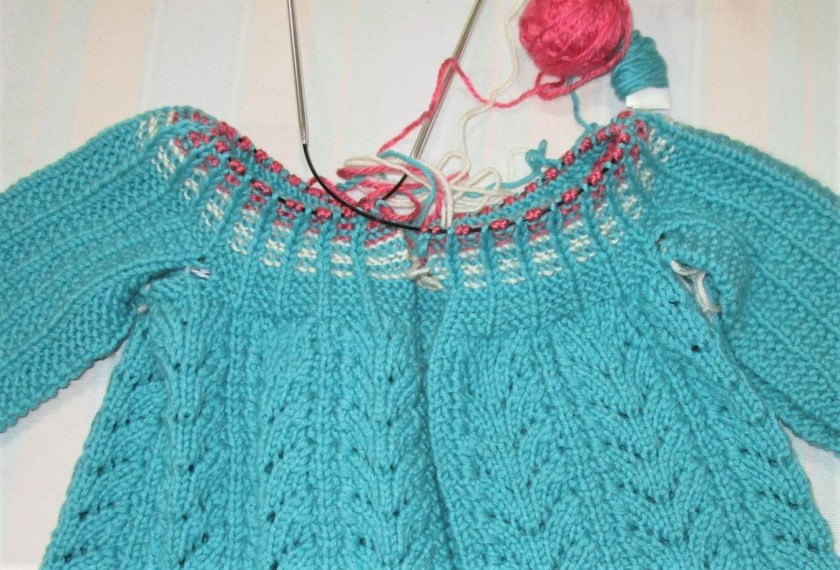
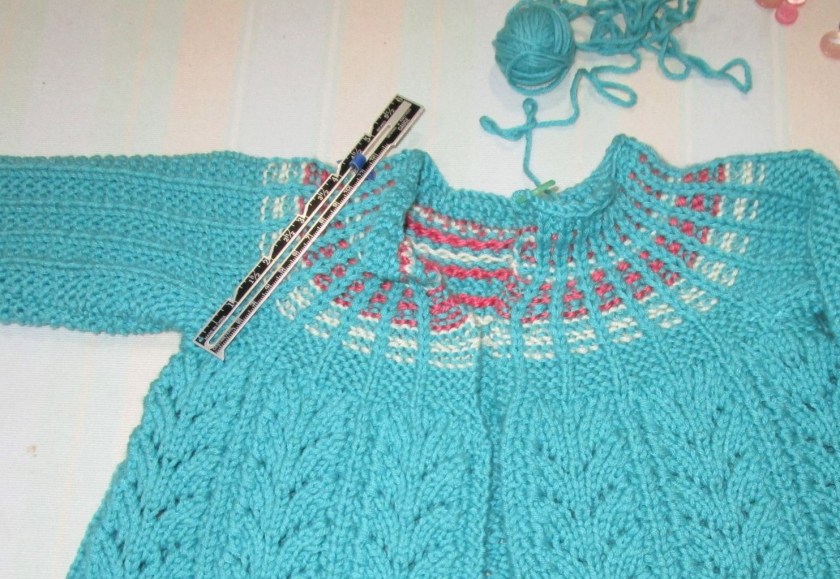
Over the past few days I have been engaged in work on fiber objects that take a lot of time to complete, such as painting the hydrangea leaves for a wall hanging and knitting a sweater. So I don’t have anything new to share on the blog today.

In perusing my design book, I was reminded of a project that I made in 2013. It has an interesting story which involves knitting sweaters for a little boy.

Have you ever worked hard on a hand-made gift, only to have it rejected on the spot by the recipient? I have! As a new grandmother, I was joyfully knitting sweaters annually for my grandson. One year it was an Elizabeth Zimmerman design (the modular Tomten Jacket described in The Opinionated Knitter.) After unwrapping it, said grandson simply cast it aside. (sigh.) I resolved never to let that happen again. For his birthday sweater the following year, I chose soft, brightly colored acrylic yarn and came up with a design that no little boy could resist.

Like all boys, my grandson loved trucks – BIG trucks and BIG earth-moving equipment. I decided to make a rugby style sweater with the image of a John Deere digging machine on the back. This project required a custom chart and my husband gleefully helped me to create it.

The picture was downloaded from the JD website, but the grid required a little adjustment. In knitting, the number of stitches per inch almost never matches up with the number of rows per inch. To avoid compressing the image, the squares of the grid need to be fatter than they are tall. I gave husband my gauge (stitches per inch and rows per inch.) He calculated the ratio and used spreadsheet software to adjust the grid to match. From this chart it was relatively simple to knit using a combination of stranded and intarsia techniques.

Upon receiving his gift the following birthday, my grandson jumped for joy.

“It’s an excavator, it’s an excavator!!”

This sweater was happily worn for several years in all kinds of weather.

One final note: If you try this technique, you may find it helpful to outline the details of the image in black yarn. This will help the image come together.

Posted in knitting, recycling

A Little Remake

In March my daughter gave me three garments that were in need of a remake. I have already dealt with the silk blouse and the brown cardigan. The third was a blue wool baby sweater which got machine washed in hot water by mistake. The consequence was that it thoroughly felted and shrank down to the size of a doll’s coat.

I had been mulling over what I can make from a felted sweater. No ideas came forth. Then I shifted my thinking and considered what could be done with the felt itself? Remembering a conversation that I had with my grandson, about the poor performance of hand-knitted mittens in wet snow, I hit upon the idea of felt mittens. Melting snow will rarely, if ever, penetrate a heavy felt garment. Could I make mittens for the baby with this felt?

To start with, I cut off the sleeves. They looked vaguely mitten-like.

Using a crewel needle and sock yarn, I blanket-stitched around the lower edges of the sleeves. Then I picked up and knit into the blanket stitches and joined for knitting in the round. I knitted the cuff downward in rounds. After a few rounds, I started 2×2 ribbing for about an inch. Then I decreased, knitting another five rounds and bound off loosely.

Cuff finished. Beginning thumb for right hand mitten.

The process for the thumb was similar, except I had to slice a one-inch gash in the heavy felt. About eight rounds of knitting later, I decreased with k2tog, pulled the yarn through the remaining loops and fastened off.

Here comes the fun part. I cut down the top edge, making the total length of the mitten 5 inches. The upper edge was closed with running stitch and then sewn with blanket stitch all around. Using pink and red yarn, I embroidered a heart on the back of the mitten.

The letter R is for Right Hand Mitten!

Right hand mitten is done. I do hope that this will be a workable mitten. Now to make the left hand mitten to match.

Rainbow Beanie Baby, holding the mitten for me while I make the second one.
Right-Hand Mitten’s buddy has arrived.
Posted in colorwork, painting

Another Hydrangea Leaf

…..With apologies to readers who might be tiring of images of leaves.

I’m experiencing momentum on the oakleaf hydrangea project. While I intend to create 12 leaf blocks, I promise that I won’t blog about every single one of them. But I think today’s block is worth a few words and images. Here is the reference photo.

After making my sketch on the fabric, I masked the veins with resist and applied a pale emerald green wash. In this photo the piece has dried, and the leaf is covered in resist before undergoing the second wash.

I went really dark.

After the paint dried overnight, I pressed the background in an effort to set the color, then washed out the resist. Before I started painting in the details, I sampled several colors of paint over the pale emerald on waste fabric, because I had no idea what color would give the effect I wanted. I ended up applying yellow-orange, let it dry, and then painted in the major and minor veins.

This image has strayed pretty far from the reference photo! It is no longer a summer leaf, but a slightly battered early fall leaf, getting ready to change color before dropping to the ground. I love the chalkboard look of the background. Because it is black, I was able to use an Ultra fine point Sharpie to draw the leaf margin.

Posted in colorwork, hand embroidery, quilting

Oakleaf Hydrangea – The First Leaf

Yesterday and today I resumed work on the oakleaf hydrangea fabric paintings. Above you see the reference photo for the first leaf I am painting. I chose to do two experiments. Here are the two paintings after the first round of painting. The color wash – resist steps were complete and the paintings left to dry. In these photos, the water resist medium has not been washed out yet.

And here are the two paintings, washed, dried and with final details added, using Jacquard Textile paint inTurquoise and Goldenrod, so palette was quite limited.

It was a learning experience, trying to paint on dry fabric with thicker paints. I discovered how to add depth to the background by dry brushing. And I learned that my skill in painting delicate lines needs work. After the pieces dried, I pressed them and continued on to the stitching phase. I chose to work with the purple piece first, hand quilting with embroidery floss. Instead of backing with regular batting, I used cotton flannel, since it would be easier to push the needle through.

I carefully stitched over the major leaf veins, and then made two borders around the leaf margin. After finishing the leaf, I just improvised the background, using two shades of purple and two stitches – feather and chain.

So far, undecided about how to stitch down the edges. The choices are blind stitch or use a decorative blanket stitch. Does anyone have a recommendation?