Posted in colorwork, quilting

Inspiration, Gestation, Implementation

INSPIRATION: The idea for creating a fiber object based on the Gateway Arch has been rattling around in my brain for some time. It really started way back in 2012, after my husband and I visited the Gateway to the West museum in St. Louis. At that time, he took a series of photographs showing every possible angle of the Arch at ground level. They are rather remarkable, taken as a group. Here is an example.

Earlier this year, I asked for copies of these images and began to imagine how a series of different views would look on quilt blocks. I printed out nine pictures and pushed them around against each other. In the end, I shelved the project. I decided that I really lacked the necessary technical skills to realize my idea.

GESTATION: Over the summer I completed several on-line quilting lessons and actually made a quilt based on my own design. I now feel ready to tackle the Arch project. So yesterday I pulled the photos back out and arranged them into a nine-block design with a look that pleased me. It took me hours to get it right.

IMPLEMENTATION: Dear me. Thinking about the many steps required to move a quilting project from the idea stage through to completion is giving me pause. Let’s take stock of where I am so far:

  • I have a design and a layout, pictured above. Each image represents one block at 1/3 scale. I’ve decided that I will need a paper template for each arch image, in order to draw and cut it accurately from the background material. For this task, I have located a pad of giant post-it notes. From it I have cut nine pieces that are 14 and 1/2 inches square.
  • Block Content: Each block will consist of 16 squares with a finished size of 3 1/2 inches. The flowing arch will be cut free-hand into the sewn blocks and inserted.
  • Colors: There will be three background colors in hand painted fabrics, moving from left to right they are purple, blue-purple, and blue. The arch section which winds through each block will be made of golden-orange-pink fabric. Here are some samples that I made earlier this year.
  • Other design decisions yet to be made: sashing or no sashing, type and number of borders, backing. While I plan to quilt it myself, I haven’t decided on a pattern yet.

Next steps seem to be

  • Draw to scale the templates for each block
  • Determine yardage needed for quilt top and purchase fabric
  • Cut fabric into manageable strips
  • Hand dye strips according to design plan
  • Cut out the squares
  • Practice cutting free-style curves.

A wise woman said, the journey of a thousand stitches begins with one thread.

Posted in sewing

Baby needs a new pair of Shoes

My granddaughter has spent her whole life barefooted. And now, just as she is learning to walk, winter weather has arrived. How is a beginning walker going to gain confidence in her stride if the ground is cold, wet, and slippery? This situation has been weighting on my mind so I decided to do something about it. Hence the quest to make baby boots. I have some yardage of fake suede lined in fleece. It looks really warm. Perhaps it can be fashioned into footwear?

I found the following pattern on Stitches and Sunflowers and began to answer this question. The maker professes that these really will stay on the baby’s feet.

stitchesandsunflowers.com/diy-baby-snap-booties/

After downloading the pattern pieces, I cut them out of the fake suede.

It’s important to flip the heel pattern piece over before cutting the second one.

Begin by sewing the heel piece to the sole. I changed my machine needle to a larger number to deal with the thick fabric before sewing.

Those quilting clips really came in handy today!

After attaching the heels, a piece of elastic is sewn at the upper edges. I then turned the top edge over to conceal the elastic.

Notice that I trimmed away the fleece from the seam allowances.

Next comes the toe piece. I again sheared back the fleece from the seam allowances on both pieces before stitching.

After turning right side out I have a pair of cute suede boots.

All that remains to be done is to sew in some fasteners. I’m thinking of going with Velcro, since it can be adjusted for fat or thin baby ankles.

Yes! Soft AND warm. My little friends approve.
Posted in knitting, painting

A Hunker-Down kind of day

The wind howled all night and by 8 am this morning, the temperatures were in the lower 30s. I’m told that this is today’s high. The temperature is still dropping and the wind continues to blow. It’s a good thing that I have plenty of fiber objects and other creative endeavors on hand. No need to change out of my comfy yoga pants.

Yesterday I began to learn watercolor painting on paper. It’s been a long-time goal of mine to study this art form. I signed up for Lindsay Weirich’s introductory course Hand-painted Holiday, which can be found at https://lindsayweirich.teachable.com/p/hand-painted-holiday

During an overly-optimistic moment several years ago I had purchased a water color set. I dug it out of a drawer and retrieved several tubes of paint. It took some muttering and a dull yarn needle to pierce some of the foil seals, but eventually I had small quantities of paint laid down onto a cheap plastic palette.

First the tags. Lindsey called these a warm-up exercise. After a few hours I had completed six or so gift tags. Here are some of my favorites:

Next came the cards. I worked the first of the series, stopping when I realized that the afternoon had flown the coop, it was 5 pm and time to cook dinner.

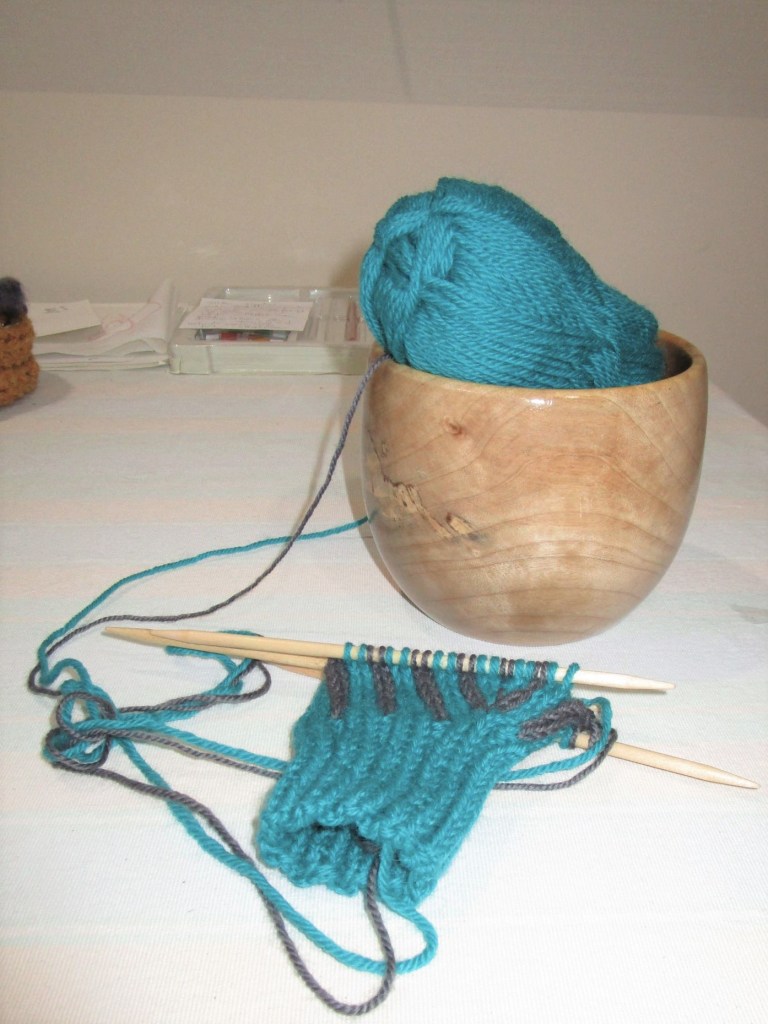
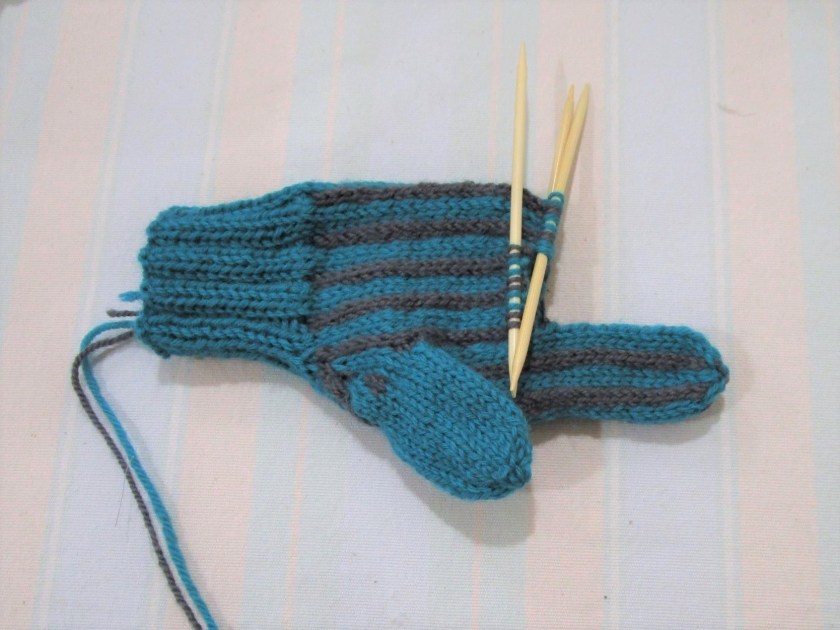
Taking a break from painting, I moved on to knitting. At this point, all of the holiday gifts that I wanted to make were finished and ready to be wrapped. (Mmm maybe I will attach some of those gift tags!) I suddenly remembered that daughter had requested a pair of mittens for her son. She specifically wanted stranded knitting, so the mittens would be extra warm. I found the perfect pattern on Ravelry. It will only require a few adjustments, including the insertion of a thumb gusset for better fit.

Here is my progress so far.

With the weather so brutal outside, there is a chance I can finish these mittens and another watercolor card before the sun comes up tomorrow.

Posted in Uncategorized

And now for something completely different

The craft of felting has got to be one of the oldest uses of wool. Pretty soon after (or maybe even before) early humans had begun to keep animals for meat and milk, they discovered the warmth of fleece. Early blankets required no manipulation to create – they were just matted, shed hairs of sheep, goats and what-have-you.

We can use of the propensity of wool to felt and make whatever we want. Today I want to make some felt balls to give to my granddaughter for Christmas. She is now walking and very interested in chasing objects across the floor. I read about felting balls in a library book – sorry I don’t remember which one, or I would reference it. The designer started with a jingle bell. I went to the dollar store and bought a bag of cat toys for a dollar. I had some fleece left over from teaching fiber arts.

The tools for this project are readily available in most homes: a plastic placemat, some bubble wrap, a large bowl with a fitted lid and a squeeze of dish soap. Merino wool bats are available from craft stores for a few dollars each. I used four colors of fleece for my balls.

First, separate the fleece into thin strips, then pull the strips apart gently every four inches or so. You want to expose the loose ends of the fibers. Begin wrapping the fleece strips around the ball, overlapping and pressing the fibers down on each other. Continue until the ball is covered with about a one inch layer. Gently roll the covered ball around in your palms, loosely, until the fibers seem to be clinging. When the wool has begun to matt, it will look something like this:

The beginning stage of felting.

Make a few more balls to this point before moving on to the next step.

Add about an inch of soapy water to the bowl. Dip the felt balls into the water, then pick up each and roll it on the bubble wrap until all the fibers are pretty well mashed together. They will look something like this:

Okay, here is the fun part. Put on some lively music. Place balls in bowl with a little soapy water, snap on the lid, pick up bowl and start shaking it around like crazy. The goal is to bounce them together and keep them rolling. This process is called fulling the wool. It will take ten to fifteen minutes.

These balls are pretty well fulled.

The next step is called shocking. The soapy water is rinsed off, then balls are immersed under hot water for about a minute. After the hot water is squeezed out, the balls are immersed in cold water. A few repetitions of this step will shrink and harden the wool. Set balls aside to dry.

You can also put them in the dryer for 15 minutes on medium heat.

Here are my felt balls, ready to be wrapped up for giving:

I was delighted that the felting worked just fine over the plastic cat toys. These balls are now child-safe and ready to roll.

Posted in quilting

Practical Fiber Fun

To those of you who are still following my blog, thank you! November has arrived and I am back on track with fiber and a plan to make some holiday gifts. This is the first year that I have had plenty of time. It’s gratifying to apply some of the skills I have developed since beginning Daily Fiber! Today I am going to share with you a sweet gift for all the creative types on your giving list. I learned to make this little journal cover in a class at Bluprint.com taught by Christina Cameli. Her craft is quilting, and she excels at working her stitch magic in free motion.

Materials are cheap and readily available: fabric, quilt batting, some foldover elastic and a paper bound journal that you can get at craft, big box, or office supply stores.

Here are the strips I will be using today:

After cutting out all the pieces, the first step is to stitch together enough strips to cover the journal. In this case, I needed a piece that was 9 1/4 in. tall by 13 in. wide. Make it a little bigger than required. Then put together a quilt sandwich with batting and backing (muslin will do.) Using the free-motion technique you like (or one you want to practice) quilt away! I chose to use my walking foot this time.

Pick a lining fabric to go with your theme. It will need to be about eight inches wider than the cover and the same height.

Here’s the lining and journal insert I chose.

Cut to dimension and sew the lining to the cover, right sides together, per the class instructions. The wrap over elastic will be sewn to the back panel with right side down. Trim the corners, turn the piece right side out and press. After you checked that the journal fits inside, top stitch the cover very, very close to the edge. (Be careful to keep the elastic free of top stitching, or it will be too tight.) You’re done.

And here is my finished gift.

Really fun. I’ll be making more of these , and plan to try out some interesting free-motion designs.

Here is Christina’s class. https://shop.mybluprint.com/quilting/classes/free-motion-quilted-gifts/673670

The class also provides instructions for a small basket and zip pouch. Happy quilting!