Posted in knitting

Butterflies In My Lap

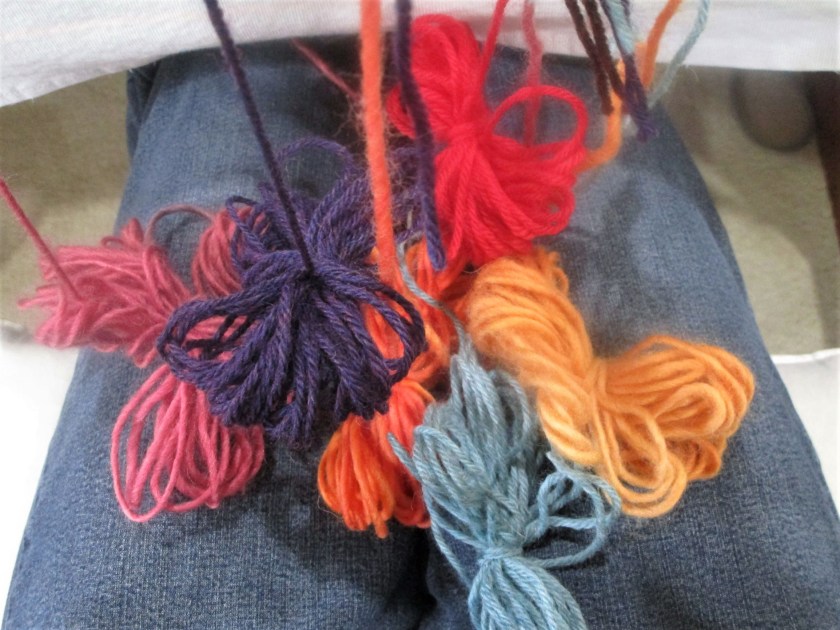
Not the usual place one finds butterflies. These little twisted pieces of yarn are called butterflies, wound up in pursuit of knitting multiple colors at once. I am attempting to make a colorful vest for my daughter. Here is what I have so far:

This is the start for the back of the vest. The concept is to create a riot of color while keeping the front very plain. Back interest is a tactic that I use frequently in my knitting designs. Sometimes I use a dramatic over-sized cable, sometimes a fancy lace panel. I like to make a good impression both entering and leaving the room.

In the picture above you can see a chart that I made for this project. The actual concept, however, isn’t mine. I have to give credit to Irishman Kieren Foley, the creative force behind knit/lab.

https://www.kieranfoley.com/index.html

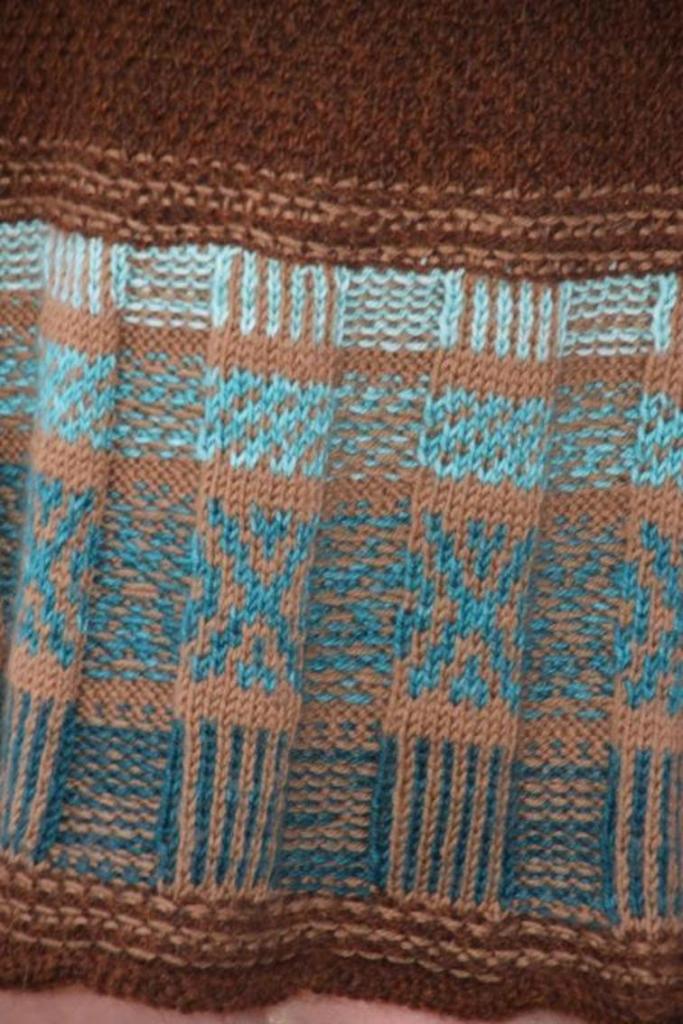
I have been a fan for years. The first project I made inspired by his work was a skirt. I incorporated one of his fair isle designs into the hem area. Completing this project really helped me to gain confidence as a knitwear designer.

The next project I made was men’s scarf. I actually made two of them – one for my dad and one for my husband. The pattern, available for free on Ravelry, is called Fair Isle Rapids. Here it is on the knit/lab site.

https://www.kieranfoley.com/knit_lab_fair_isle_rapids.html

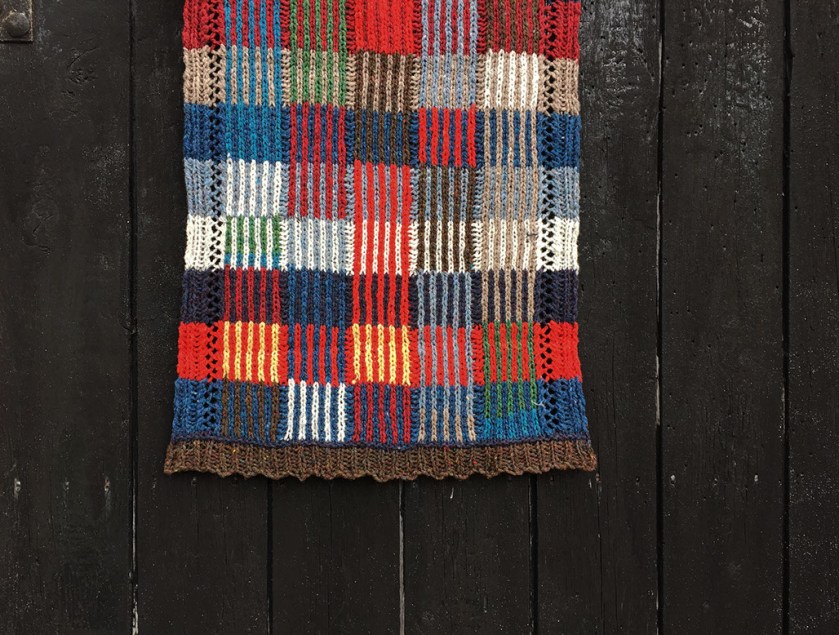
The design I am aspiring to follow for daughter’s vest is called Weaver’s Square. Here is how it looks on the Knit/Lab site.

My version omits the lace trim and adds another vertical band of color, so that I can achieve the width I need.

Foley’s website offers detailed charts of his beautiful designs in the form of pdf files, for a very reasonable price. If you like color work, I encourage you to visit knit/lab.

Posted in quilting

Gateway Arch: Nine Views

A culmination of six months spent thinking about and working on it, here is the Gateway Arch quilt. I finishing sewing on the binding while watching the Super Bowl (Yay KC Chiefs!) I feel an odd combination of elation, satisfaction and relief. The finished object is largely what I had envisioned.

IMAGE OF UPPER RIGHT PANEL

The colors are wonderful. The curving shapes are a good representation of the real arch. I’m happy with the embroidery.

MIDDLE RIGHT BLOCK REPRESENTING CITY BUILDINGS

The construction flaws bother me a little more that I had expected them to, especially the waviness of the right border. How did that happen?

LOWER RIGHT BLOCK SHOWING ONE TRIANGULAR BASE AND RIVER

The arch shapes were made from hand-painted fabric cut apart into shapes that mirrored the arch’s steel panels and then fused to a solid background. This piece was then cut into the sixteen square background block on the left edge and appliqued on the right edge before being top-stitched in matching thread. Shading was painted on with acrylic paints after the block was finished.

THREE BLOCKS OF CENTER PANEL

I had a lot of fun with free motion quilting. I chose patterns to emulate aspects of the landscape or city-scape. I did a lot of experimenting with thread colors, either matching or contrasting with the background colors as the spirit moved me. Eventually I hand painted some thread to get the colors I needed. The idea for the fireworks came from my memory of a July 4th trip when my family stopped in St. Louis for dinner.

UPPER AND MIDDLE LEFT BLOCKS

This project was a real stretch from the perspective of skills required. Thanks go to Bluprint.com for all the quilting tutorials I accessed. I learned a lot about painting on fabric, matching points, sewing curved shapes and putting the whole thing together. I also learned about the limitations of my current tools and studio space.

LOWER LEFT BLOCK: THE WHOLE ARCH, RIVER AND SKY

What’s next? I have a few ideas. But first I’ll be taking a short break from quilting to focus on painting, knitting and teaching.

Posted in colorwork, hand embroidery

Application of Painted Thread

Last week I wrote about painting heavy weight DMC thread with fabric paint. Just now, I finished embroidering my quilt with the thread. Before I do a “reveal” of the finished quilt (it isn’t quite sewn together yet) I want to show how I used the thread.

Essentially, I created little scenes that tell a story of looking up at the Gateway Arch.

The moon and the stars.
Falling Star
Jet airplane and flock of birds over downtown
Fireworks over the Mississippi river on July 4th.

I had no real difficulty embroidering with the threads. They do not appear to be bleeding color at all. I wish I could say the same for the quilt fabric, some of the paint rubbed off on my quilting gloves.

The important thing right now is that the End Is In Sight! A little assembly and sewing on the binding and it will be done.

Posted in colorwork, painting, quilting

Painting Thread

So far I have found myself frequently frustrated while shopping in my local craft store for decorative topstitch thread. My local craft store, which is a Hobby Lobby ( I have a love-hate relationship with H-L,) has a limited selection of quilting threads, none of which are what I am wanting for my current project. And the threads that are available are not particularly affordable.

I have nothing to lose in experimenting with painting my own thread. (Not be confused with thread painting, a hand embroidery craft in which stitches are worked densely to create a painterly landscape of thread on fabric.) I have everything I need.

1. A 50 gram spool of 100% cotton DMC thread no. 10 in an off-white color. 2 Assorted jars of Jacquard Dye-Na-Flo fabric paint. 3. water proof freezer paper. 4. latex gloves.

After coiling several yards of thread and tying them together with string, I let the thread soak in the paint for about ten minutes. Wearing latex gloves I lifted the coil from the paint, squeezed out the excess and laid the threads on paper. Drying took several hours. The next day I pressed the dried thread with a hot iron, under a pressing cloth, for about 30 seconds. This was my attempt to fix the color. Because Jacquard Dye-Na-Flo is an acrylic paint, it is essentially color-fast from the moment it dries. But if you want to use the paint on an item that will be washed, I would recommend letting it cure for at least a week before washing.

Here are my hand-painted threads wound on spools.

I love that the paint gave the thread a variegated effect. I’m not sure if this happened because I mixed paint colors together or because I had a cord tied around the coil. It certainly makes for a splashy look.

Airplane is in natural thread. Moon is stitched with painted thread.

So far I haven’t noticed any color bleed on my sample fabric. Tomorrow I will start using it on my quilt. I’m excited to see how that goes.

Posted in weaving

Weaving Workshop: Lesson 3

DESIGN AND WEAVE A TAPESTRY

LEARNING OBJECTIVE: Students will learn the basic process for designing and making a woven fiber object. Students will practice transferring their designs to scrim, tying knots, and using a tapestry needle to weave various patterns.

VOCABULARY: Tapestry, scrim, cross stitch, subject, background, transfer

MATERIALS AND TOOLS: Paper, pencil, crayons, markers, scissors, yarn, tapestry needle, rug canvas, masking tape. Optional: String-like objects such as ribbon, cord and fleece.

Step One: The design phase. Students will choose two yarns in favorite colors from the yarn bowl. Using a pencil and paper, they will draw a picture of an object or thing that has these colors in it. Place the scrim on top of the drawing to check that the subject of the drawing is within the margins of the scrim. Once students are comfortable with their drawings, they can color the subject using crayons.

Step Two: Transfer the design. Students will lay the scrim over the drawing, centering the design’s main subject. Masking tape can be used to keep the paper and scrim from sliding around. Using matching crayons or markers, students trace the outlines of the subjects’ shapes onto the scrim. Transfer each part of the shape. (see example)

Step Three: Weave the design. First, students will choose any additional yarn colors that will be needed to complete their designs. Starting with the center of the subject area, they will use yarn threaded onto a big-eyed tapestry needle to weave over each area. Students can weave in any direction that works for them – vertically, horizontally, diagonally, or a combination of all. The objective is to cover the entire surface. This example shows diagonal weaving in the black area and a wrapping technique with the blue yarn.

When the subject area is completely woven, the background can be covered in a contrasting color yarn. Alternatively, the background scrim can be left plain or colored using crayon or marker.

In Lesson 4 the class will finish weaving, add additional materials to complete image details and frame the completed weaving.