Posted in hand embroidery, recycling, sewing

Japanese Knot Bag

Having recently finished a wall quilt, I found myself with various pieces of fabrics left over. Instead of stuffing them into a box and shoving the box under a bed, I decided to cut the fabric into strips for the purpose of sewing them into a project bag.

Back two years ago, I became interested in the Japanese art of stitching, aka sashiko and boro stitching. There was a pattern for a knot bag in this book by the Shibaguyz.

I did a post about it on Jan 5, 2022.
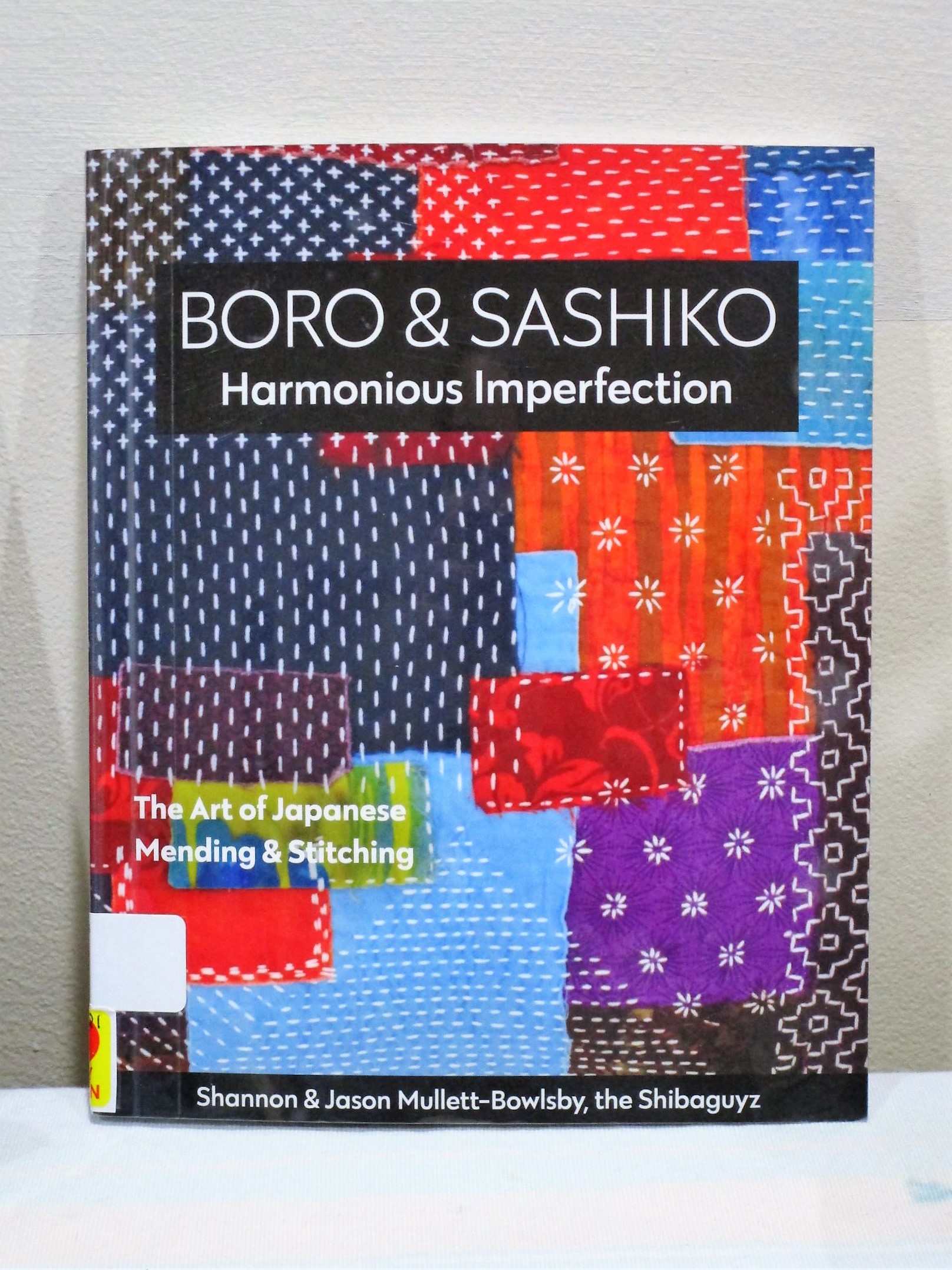
To make the bag, I would need fabrics for the base and lining, along with my strips of fabric. Fortunately, I had both. My daughter gave me some yardage of sturdy cotton flannel and my friend and co-worker Scott Perkins gave me a sample of raw silk.

Here is what I came up with using one quilt block made of a circle in a square. I then sewed strips of fabrics around it to cover all of the base and raw edges.
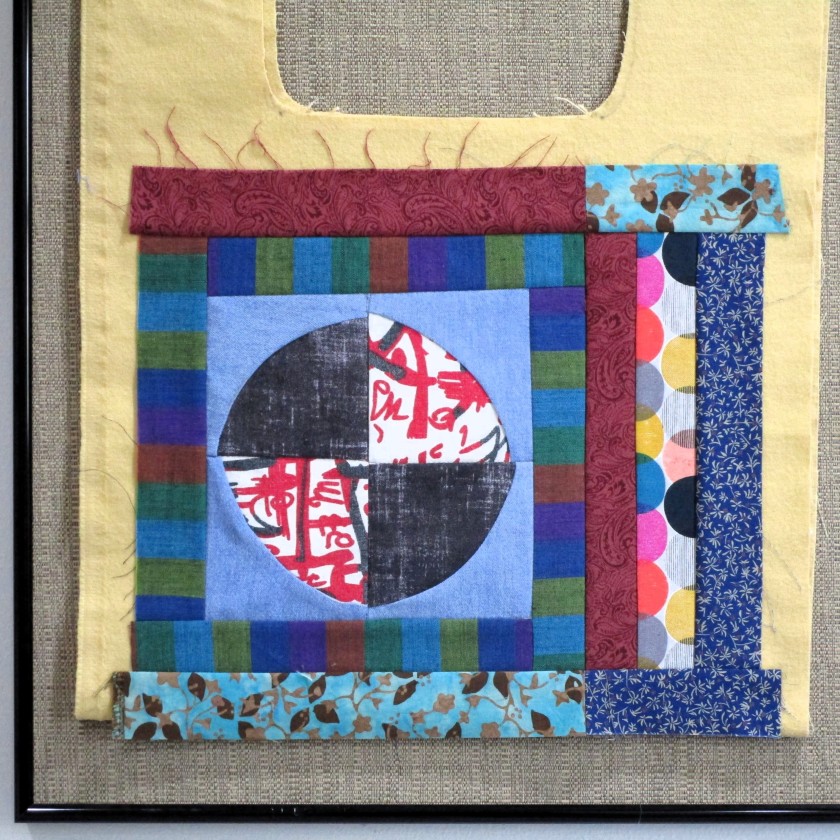
Side One
Side Two

Fabric selection included bits of three men’s shirts. (The dark red and dark green strips, and the blue chambray behind the first circle.) All three of these fabrics had been worked into the Shell Lake Story quilt. So, I am using scraps of scraps!

My next step was to sew up a lining using the same pattern as the base.
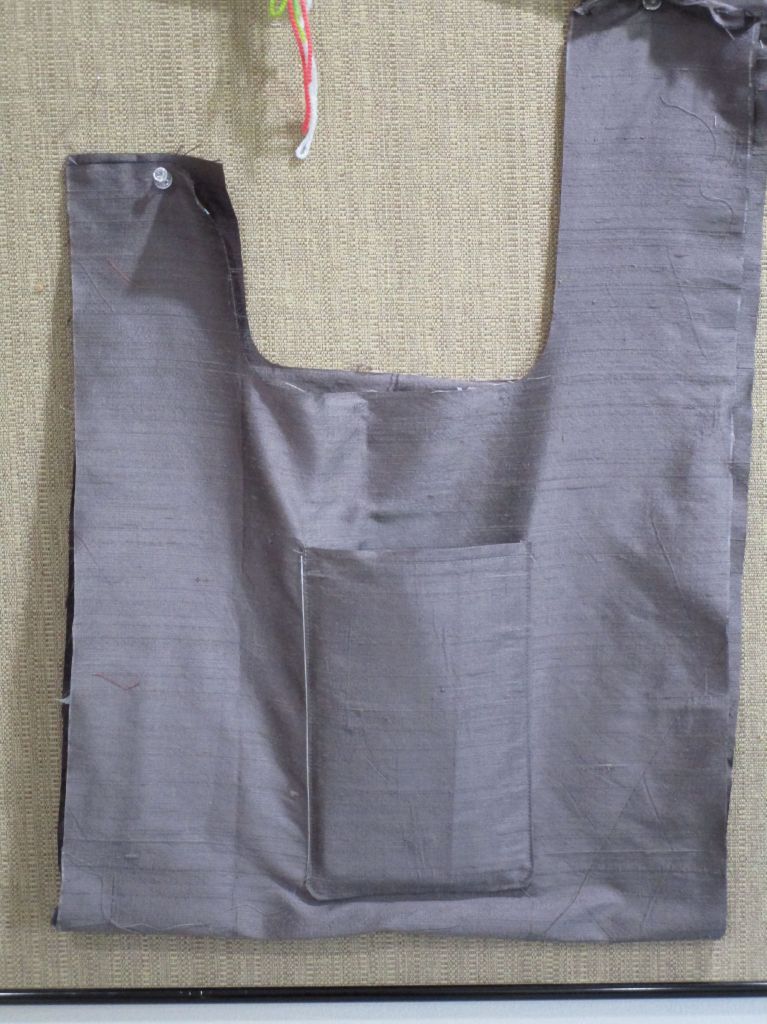
A cellphone pocket in the lining.

Adding the hand stitching took a few weeks. I marked all the stitch lines with a chalk pencil. Using white Sashiko thread I worked a running stitch in straight lines on the strips and circles around the circles.

And here is the front and back of the bag after all the top stitching is in place.

Finally, the seams of bag and lining are sewn up, the bag inserted into the lining with right sides facing and the U-shaped top edges are sewn together. This last step took me two tries, btw, so seam ripping happened.

Turning the bag to the outside, the only remaining steps were to close the strap side seams and top-stitch the opening.

To use the bag, the long handle is threaded through the short handle.

A quick look at the lining before it is turned to the inside. I love the look of the silk, and it is pretty easy to handle. Fraying was the only thing that gave me some trouble. The next time I sew with silk, I will zigzag the seam allowances

Here is the completed knot bag, filled with a knitting project.
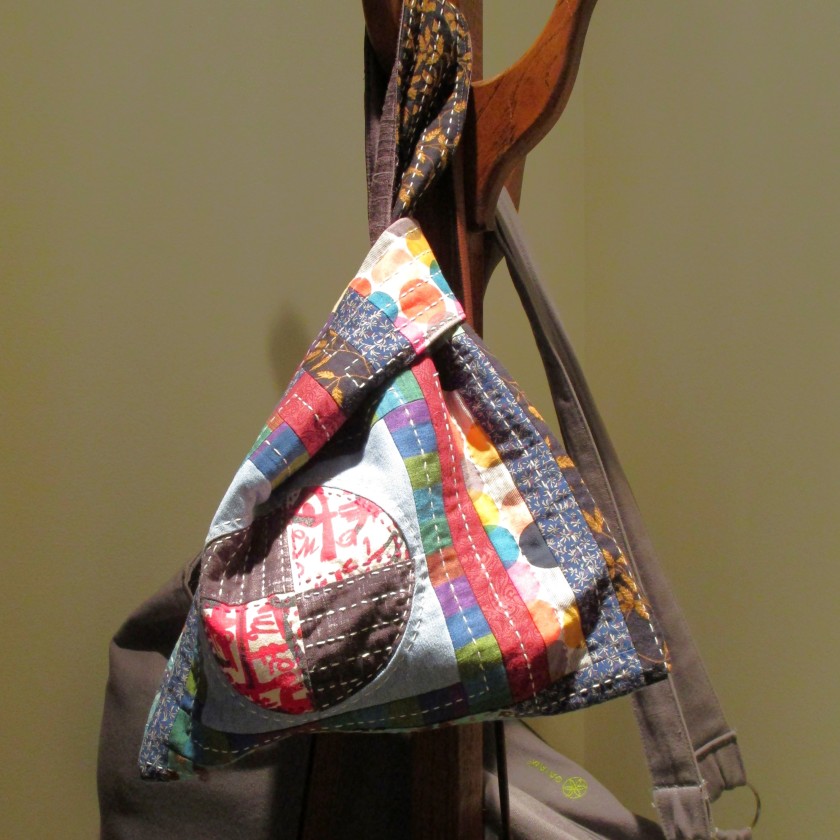
Front of bag as it hangs from a coat rack.

Back of bag.

This project was great fun (except for the seam ripping) and I would enjoy making more of these nifty bags. A larger size would be handy for bigger projects. And what a good way to use up scraps.

Posted in quilting, recycling

SAHRR 2024 Finish: Migration World

This is the week that Quilting Gail has designated for challenge participants to post pictures of their finished quilts. The Stay At Home Round Robin challenge is in its fourth year. It’s been a fun ride for me, and pure pleasure to see the work of other quilters as they add a border week by week.

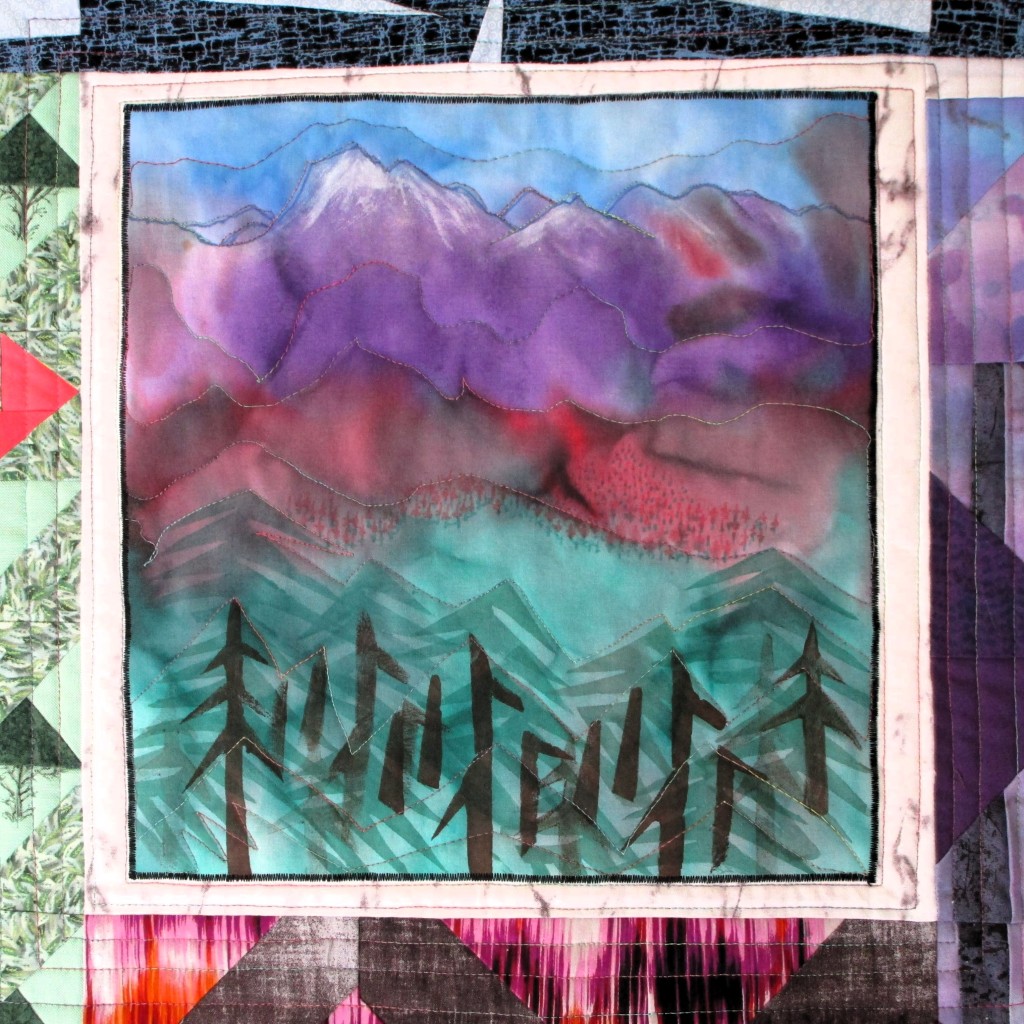
It started for me when I chose a center block from a group of experiments that I did almost five years ago. Back then I was teaching fiber arts to a group of home-schooled children. One week I had the students experiment with fabric paint on pieces of a cut-up sheet. The panel I used in my SAHRR came from the example I made, to show the students some of the possibilities of fabric paint.

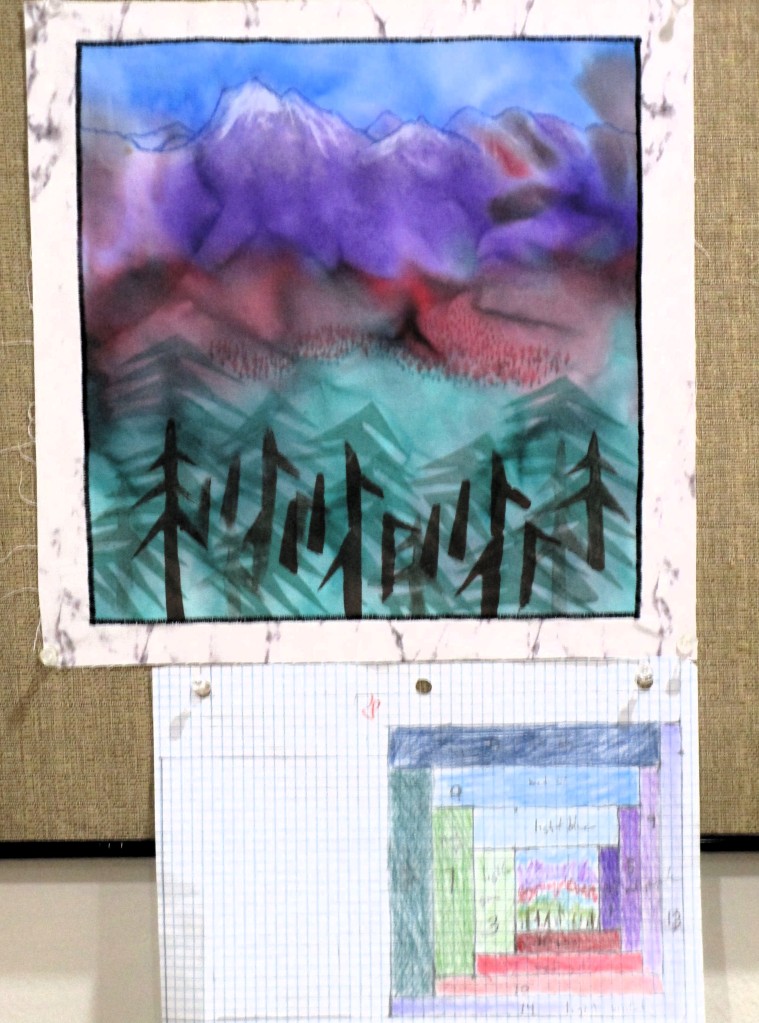
Four colors of paint were applied in bands horizontally across the fabric and allowed to bleed together. When the panel dried, it looked like a mountain scene to me. I enhanced the image with opaque white paint, paint pens and stencils of pine trees.

The painted panel set the color palette for my SAHRR.

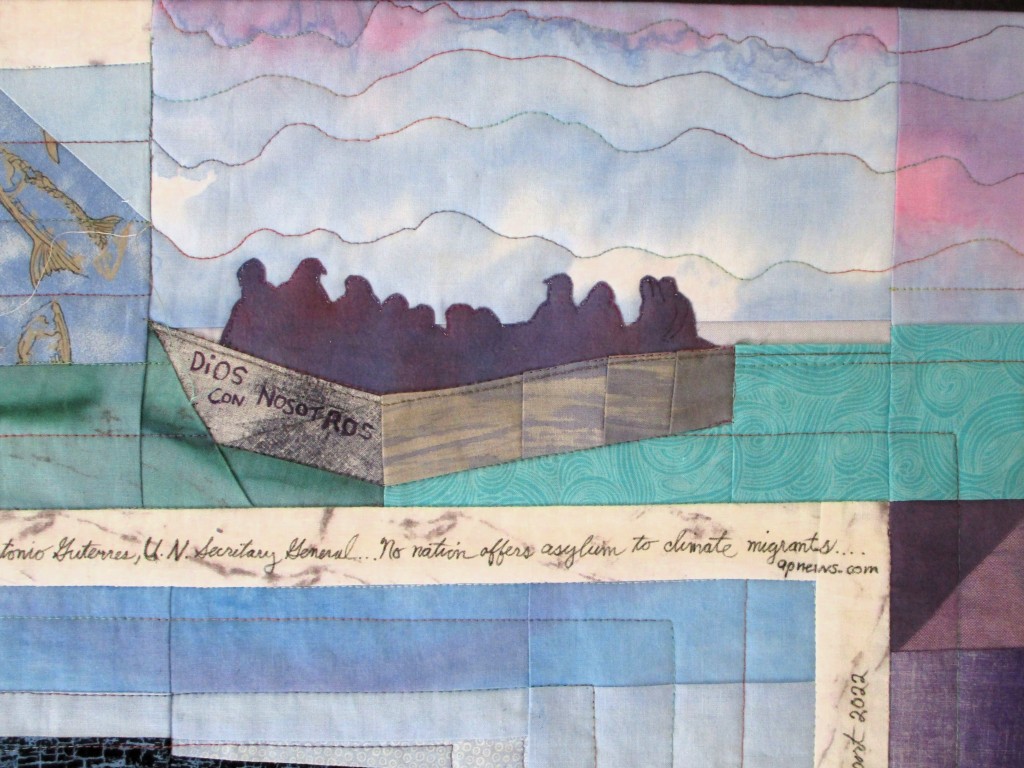
That choice led me on a path which resulted in a quilt about migration. For some time, I had been toying with designing and sewing paper pieced butterfly blocks. Could I make a quilt about the monarch annual migration to Mexico? The time I spent researching this migration led me to think about the wider issues of habitat loss and climate change. Now I had a broader story to tell with my quilt.

The weekly challenges offered by SAHRR quilters helped me to build some structure around my ideas. For that I am grateful.

Here are some close-ups of a few details I added with applique and micron pens.

And here is my finished quilt:

Just a word about the materials used: I was determined to buy nothing for this project, making it entirely with stuff that I already owned. I mentioned the cut-up sheet. In addition, I recycled pieces of clothing such as dresses and men’s shirts. The main fabric, which was used as sashing, was also divided up and painted various colors to carry it into most of the borders. Ultimately, I did have to buy a few quarter yards of black patterned fabric and the quilt’s batting.

Thank you to organizer Quilting Gail and her fellow designers who put together this year’s SAHRR challenge. You can find their work here:

And to see the finished quilts, follow this link.

https://fresh.inlinkz.com/party/7eab5849658e4307bf5cfcff8e69c998

Posted in quilting, recycling

SAHRR 2024 begins this week

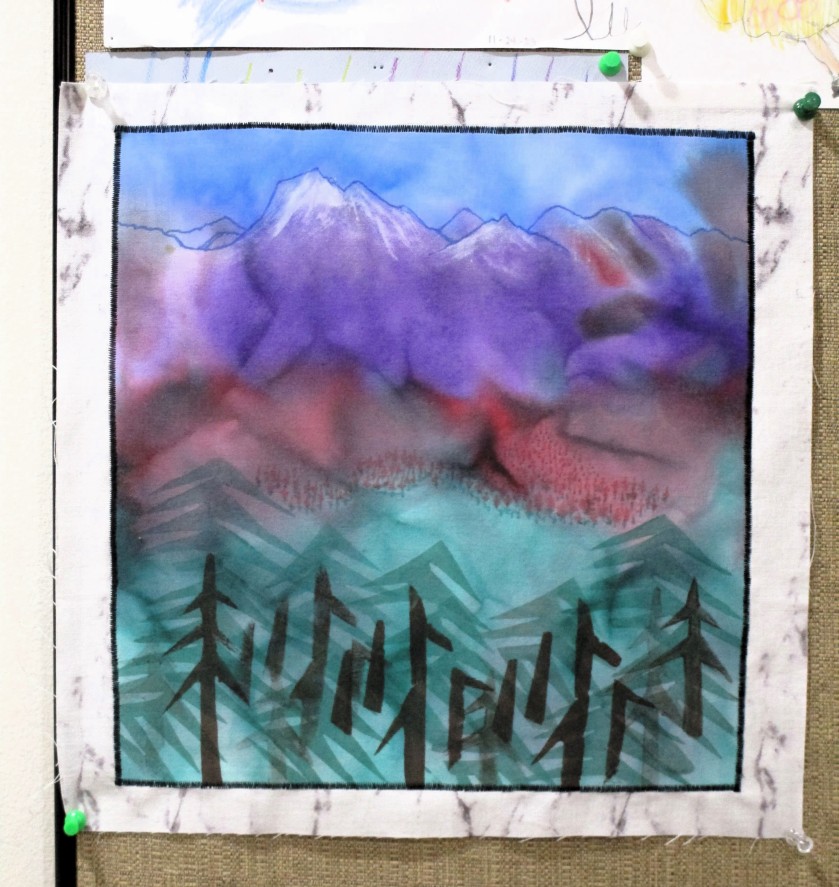
Last week I posted a number of choices for my center block in the annual Stay At Home Round Robin quilting challenge. Readers of this blog will not be terribly surprised to hear that I chose the mountain painting on fabric.

Now I am forced to consider the short-comings of my choice. First of all, it wasn’t square, having a slightly portrait layout. I sliced off the top and bottom to the limit that I was willing to sacrifice the image. It was still out of square.

My solution was to applique it to a 12 1/2 background. By choosing to applique instead of piece, I avoided seam allowance, retaining more of the painting. With a center block finishing at 12 in., I have lots of options for sizes of the rounds to come.

The second shortcoming became clear when I observed that the painting was mostly one value – it’s medium value nearly throughout. There are some darks, but no real lights. I’ll have to find a way to bring in some light, perhaps with embroidery.

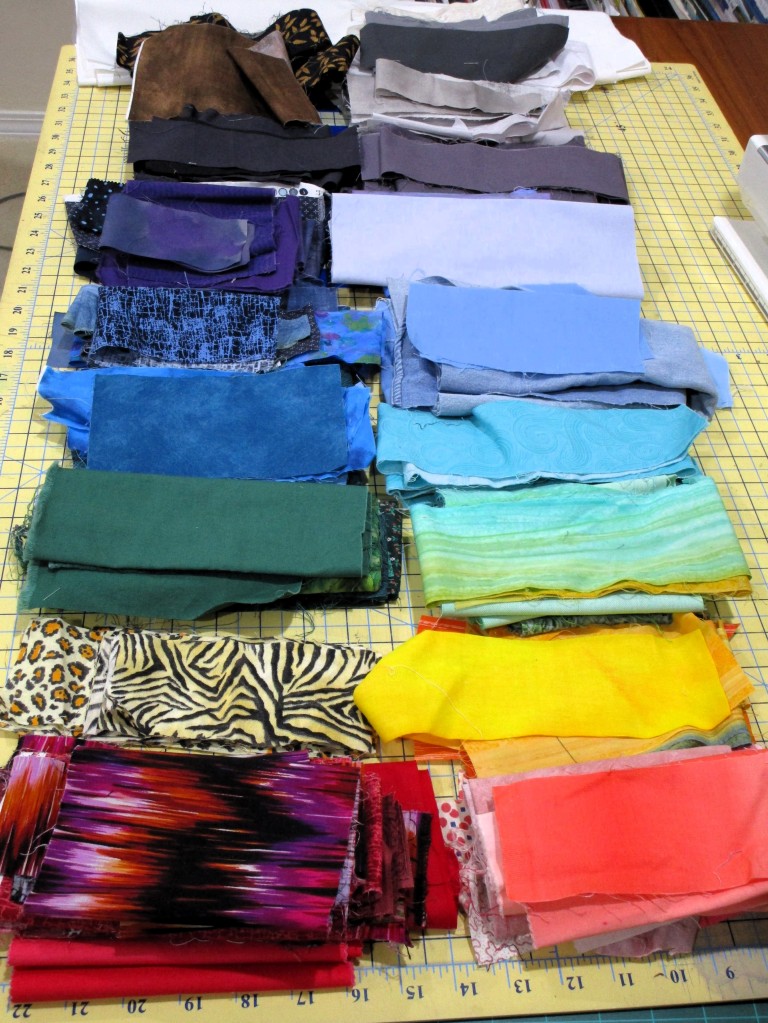
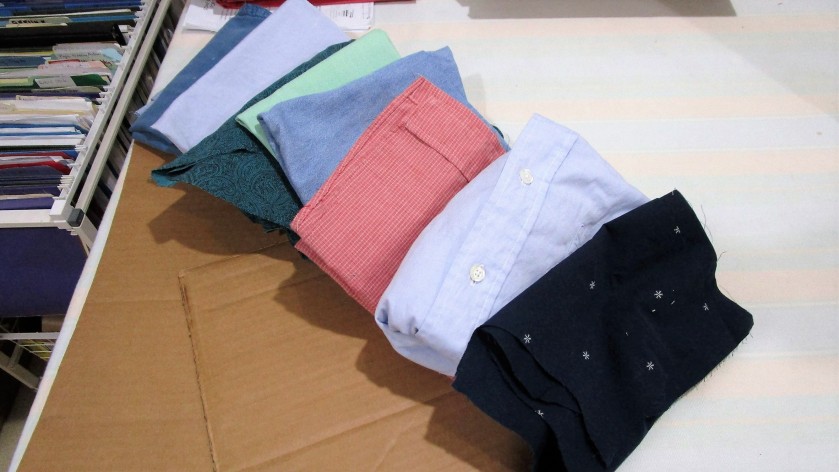
Now I am confronted with a number of design decisions. I have resolved to make the entire thing out of scraps, if I can manage it. Coming up with the palette was easy. It will be an analogous one, featuring a range of colors that exist in the painting. Purple, blue, teal and cool greens will predominate, with a generous dash of reds as accent. Here are the eligible scraps, organized by color and value.

With any luck, I can avoid buying more fabric, outside of the backing.

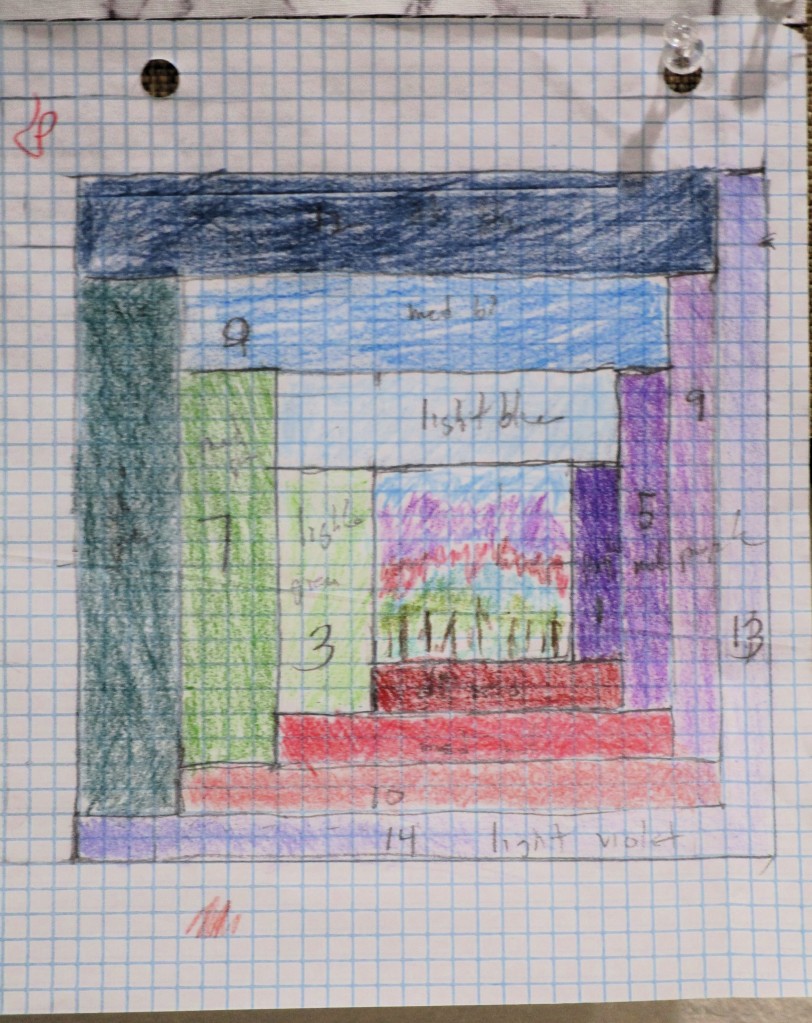
The final design decisions that I can make prior to getting the first clue concern size and layout. I spent hours thumbing through books and looking online before I made my choices. Ultimately, I settled on a square, with an expected size of 45 inches, more or less. My plan is to add the rounds in log cabin fashion, keeping each round within a strict color range. To see how it would work I made a mock-up using colored pencil on graph paper.

I’m old school. No computerized design program assistance in my studio.

To see all the challenge participants’ center blocks, click Here.

Posted in recycling, sewing

Friday Finish: Sewing

While tidying my workspace last week, I noticed all the shirt pieces I had left over from making the Howard Wabi-Sabi quilt. Since I had used only the backs, the leftovers included sleeves, fronts and collars. It occurred to me that there is a potential fiber object buried inside each one of them.

Naturally, I turned to U-Tube, to see what others have made from discarded men’s shirts. Not surprisingly, there were many, many projects. I wanted to make an apron, but I also spotted a cute little girl’s dress.

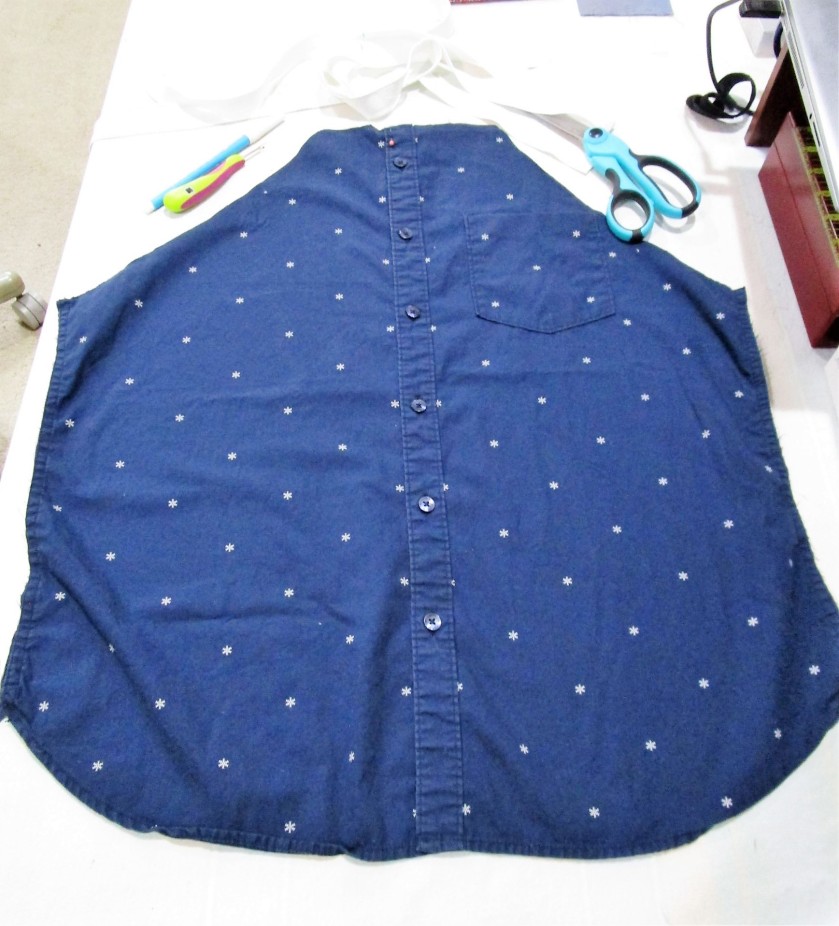
That idea I will save for another day. For today I am focusing on this dark navy all cotton shirt front.

I also happened to have a whole spool of 1-inch white twill tape which will work very well for the neck strap and the ties.

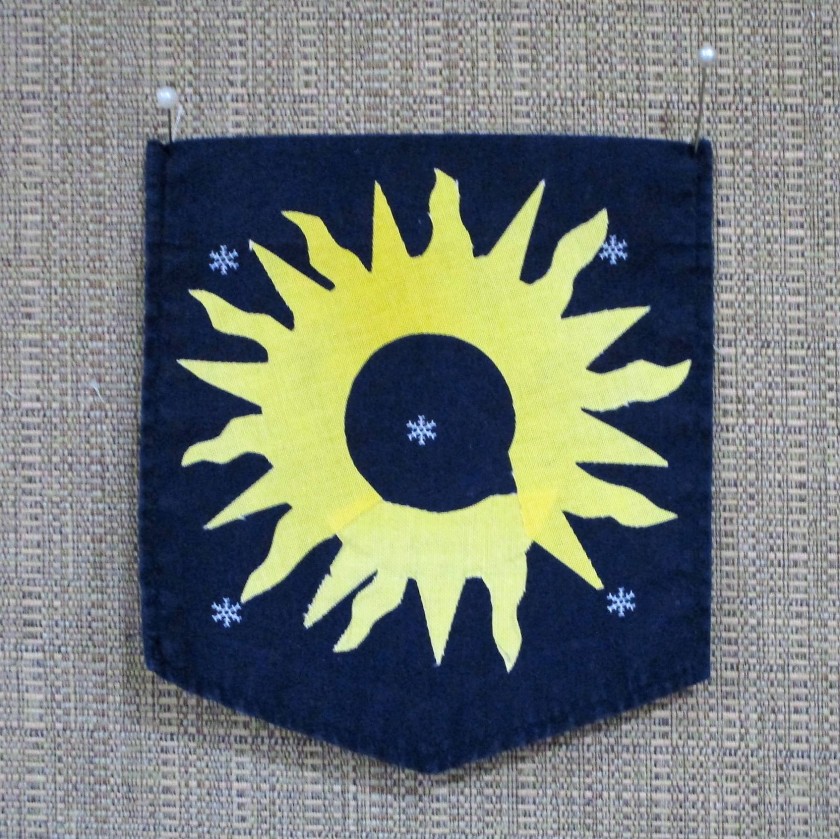
First I removed the breast pocket. This will be jazzed up a bit to add some fun color to my apron. Since the shirt fabric featured a little star motif, (okay, it’s really a snowflake, but go with me on this one) I decided to make a sun using yellow fabric and fusible interfacing. In fact, I happened to have saved some suitable yellow fabric that already had fusing attached to its back. I cut this into the shape of a corona and fused it to the pocket.

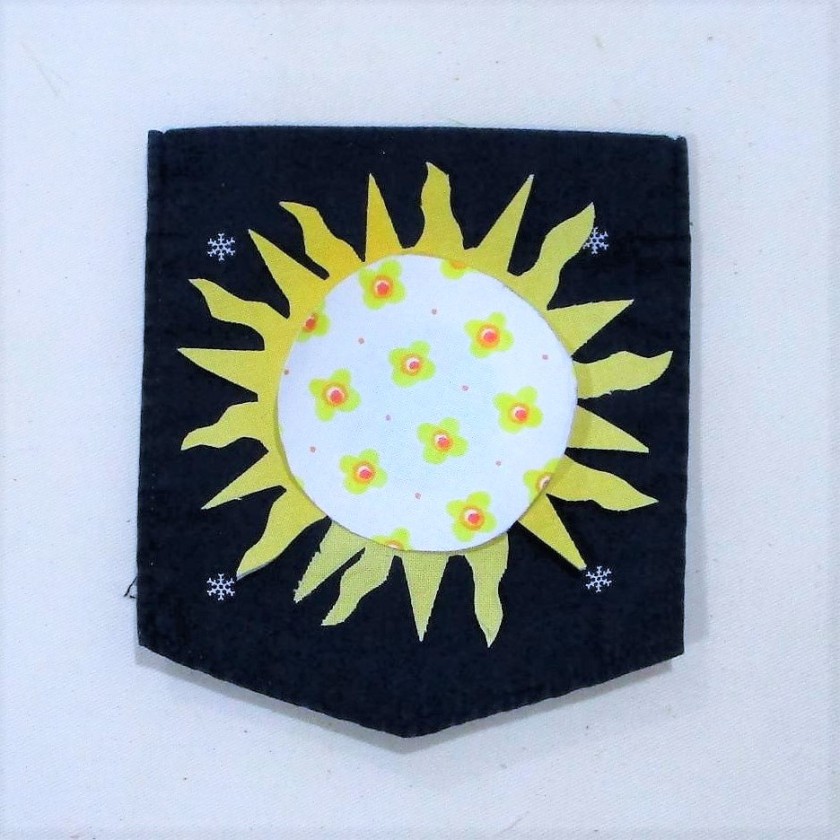
Next I traced a circle onto white printed fabric, pressed fusing to its back, cut out the circle and pressed it over the yellow corona.

Sun Shine!

Getting back to the shirt, I trimmed the upper edge into the shape of an apron front and sewed the button opening shut. Next, I sewed a piece of the twill tape to the neck edge and folded it over the raw edge, This made for a sturdy facing. With the rest of the twill tape, I found its center, measured down each leg to reserve a big enough neck loop and marked where to start sewing the side edges. These were sewed down in the same manner as the neck facing.

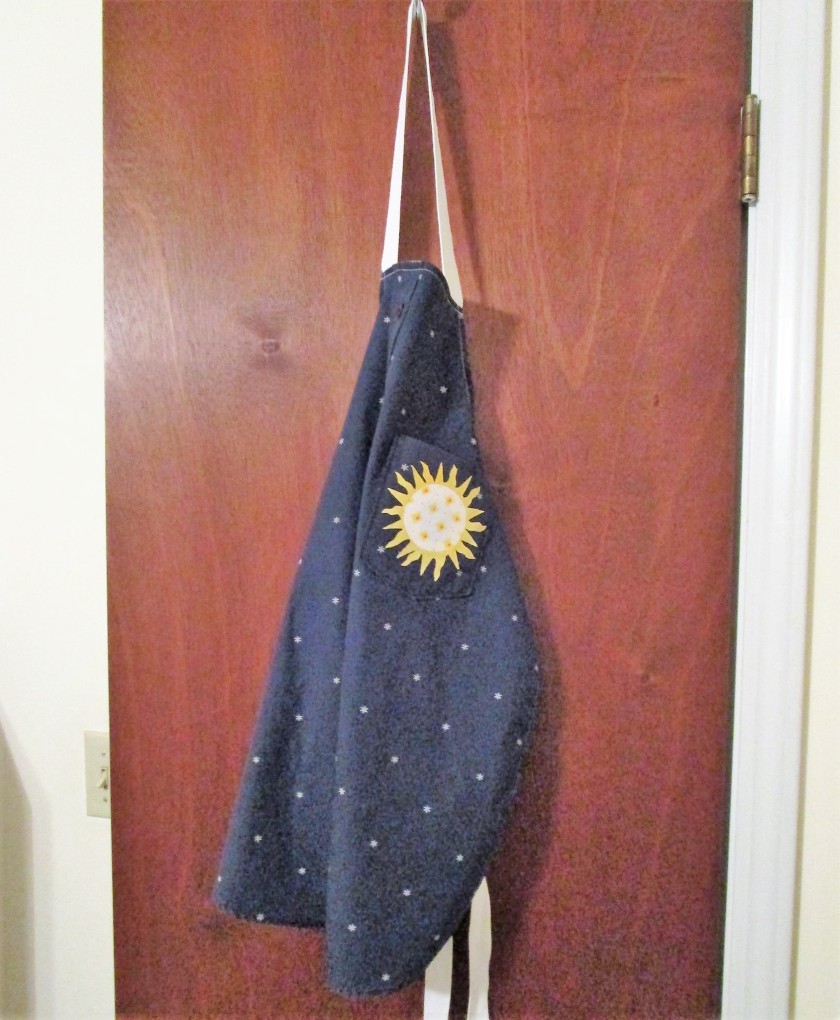
After zig-zag stitching the apron string ends, I re-attached the pocket, and was done!

POOR QUALITY LIGHT ON THIS PHOTO – SORRY

The apron fits me just fine, but it will work also on shorter persons.

This fun project cost me a few dollars and only an hour of time. With several more cut-up shirts hanging around, I can easily spend a little more time and a few more dollars to make unique, personalized gifts for the artists and cooks in my life.

Posted in quilting, recycling

SAHRR Quilt Challenge 4: Water

Pieceful Wendy chose the pattern for round four, and it’s one I had never heard of before now: Signature blocks. This type of block is often used to provide spaces for people to write stuff on your quilt. They are very popular for special occasion quilts like weddings, baby showers, graduations and so on.

Wendy created her Signature blocks by cutting into a square on the diagonal.

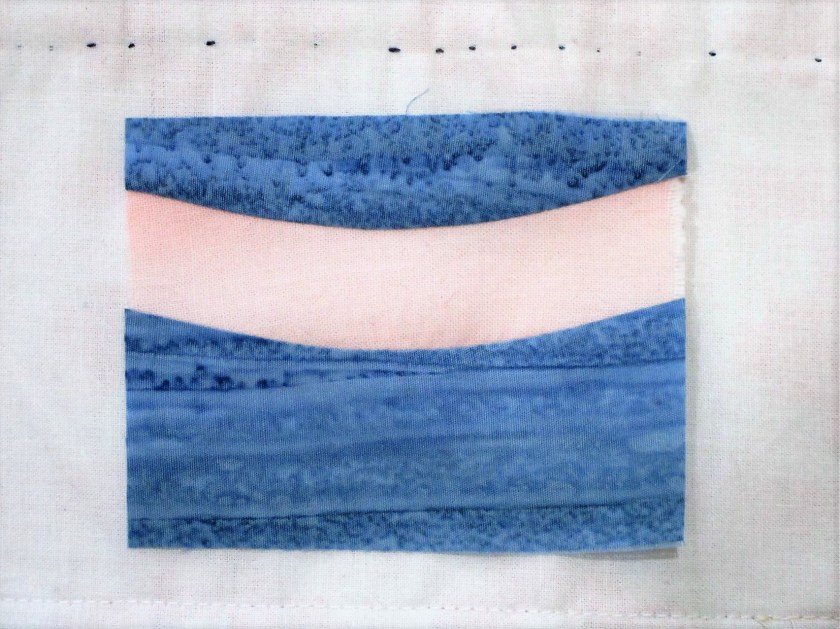
That design will not work with in Water section of my quilt, where I plan to add the signature squares. Water, especially lakes, are filled with waves. So I came up with a wavy style block by free-form slicing into a square piece of fabric, where I inserted a pale peach curve.

Prototype signature block with a curve.

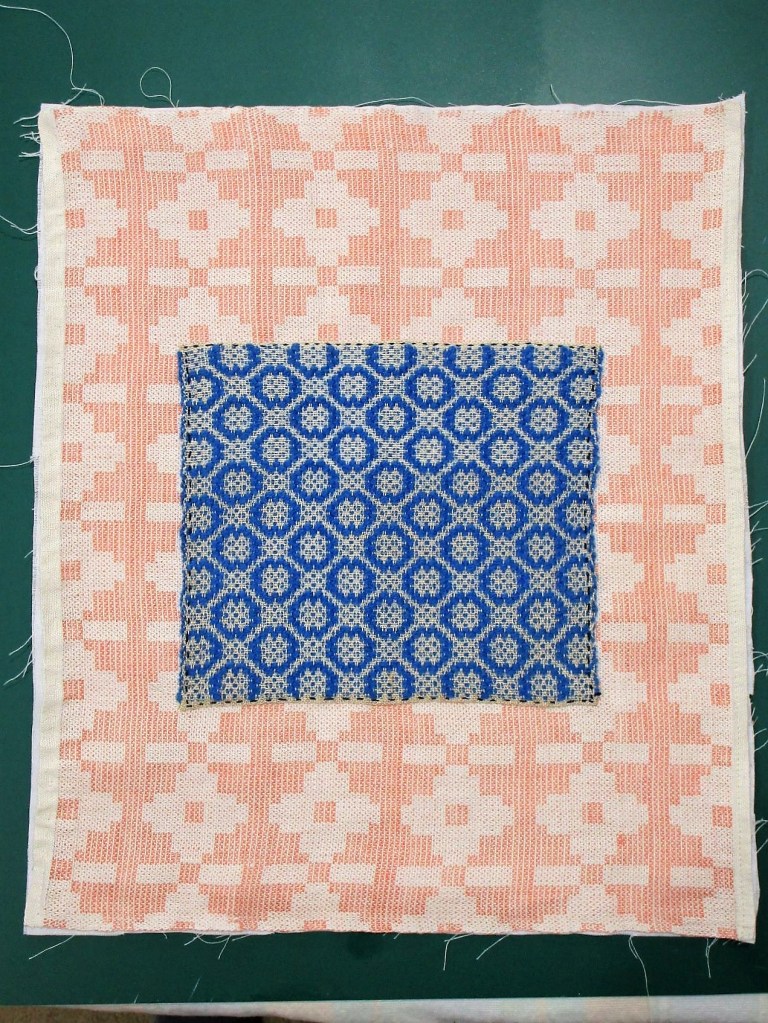
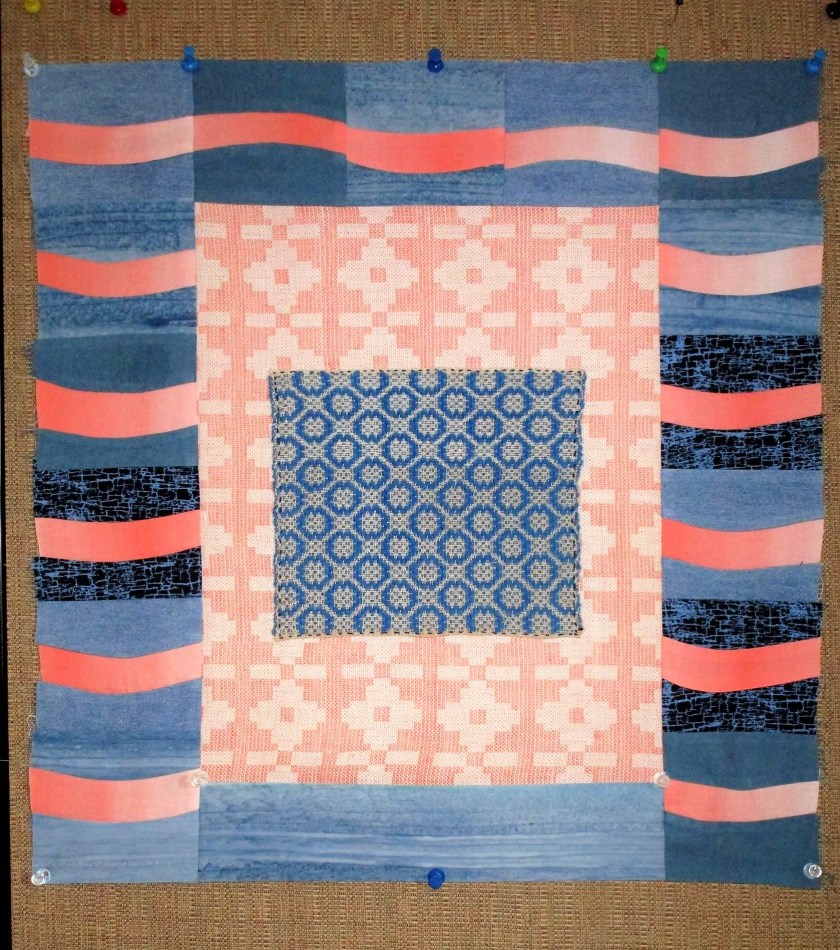
Here is the centerpiece of my water block where I will attach the signature squares. It is made of Margaret Howard’s weaving swatches. I hand-stitched a small blue one on top of a pastel peach brocade.

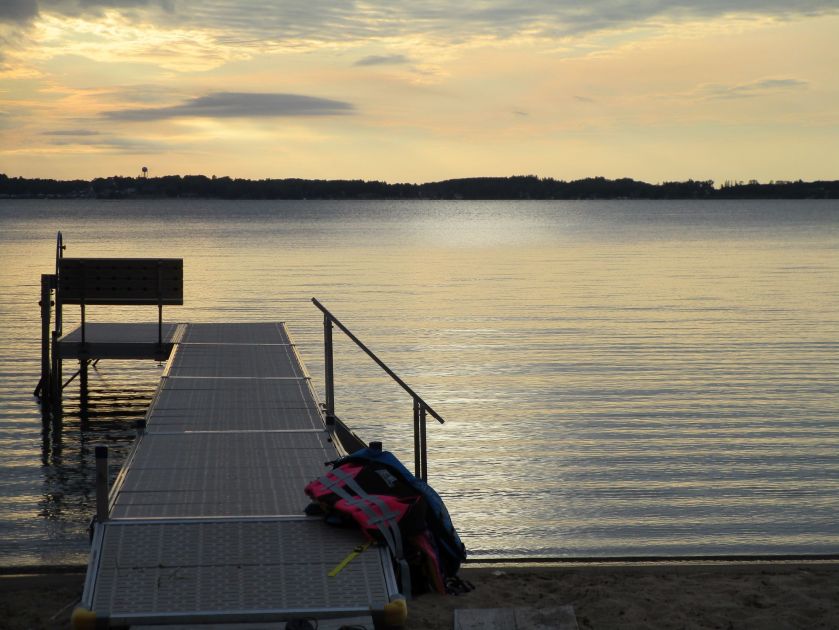
This says “lake” to me.

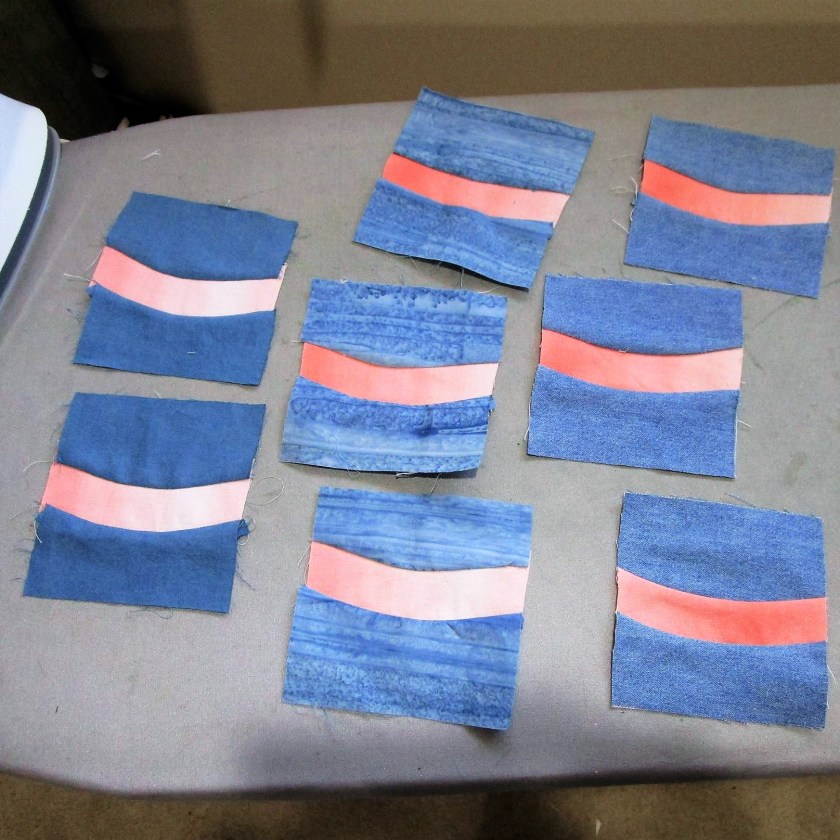
Next I made a bunch of curved signature squares. Here’s the first group.

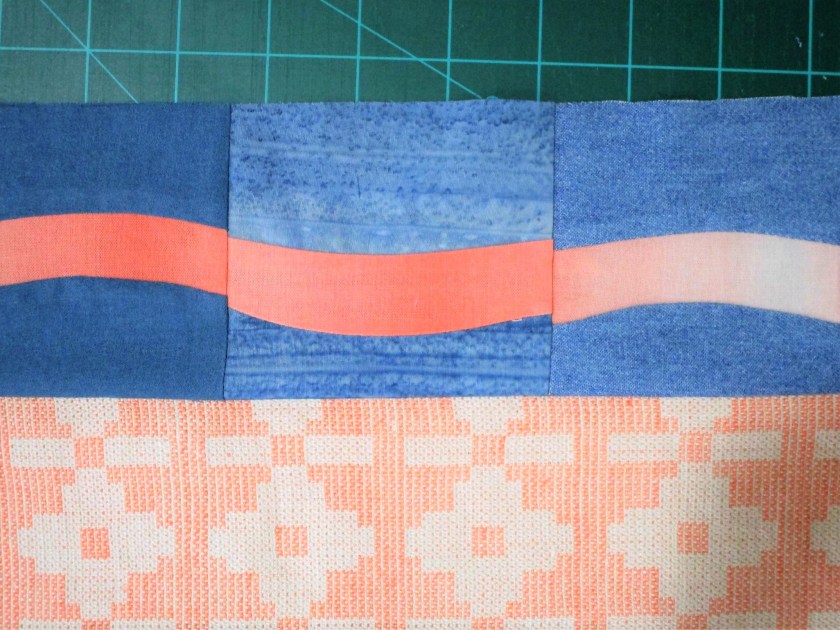
I started at the top of my block with a strip of three of these little darlings.

I’m thinking that the curve will provide a good place for a line of sashiko stitches to echoes its shape.

Next I made two strips to add on either side of the center block. Before I attached them, I added a plain blue strip at the bottom to anchor the design.

FINISHED WATER BLOCK

I’m happy with the resulting block. It’s about 18 inches square right now. After I square up the edges it will probably become a little smaller.

To see the other Stay At Home Round Robin participants’ quilts, follow the link.

https://fresh.inlinkz.com/party/26f3167a028d45689c82a40df41c3a40