Posted in quilting

SAHRR 2025 – yes, I’m participating

After telling myself that I had too many projects going at the same time I had decided that adding SAHRR to the mix would not be a good idea. Then I changed my mind. What’s this all about, you may ask?

After my mother had a stroke, I assisted my sisters in cleaning out my mother’s crafting room and disposing of the contents. One project bag contained some intriguing fabric panels depicting Japanese geishas. I took these home.

There are four in all. She also had various bits of Japanese quilting fabric, including cotton fat quarters and some lengths of yellow silk.

I became enamored with the idea of making a Japanese-style quilt, to the point that I bought a few books to learn how.

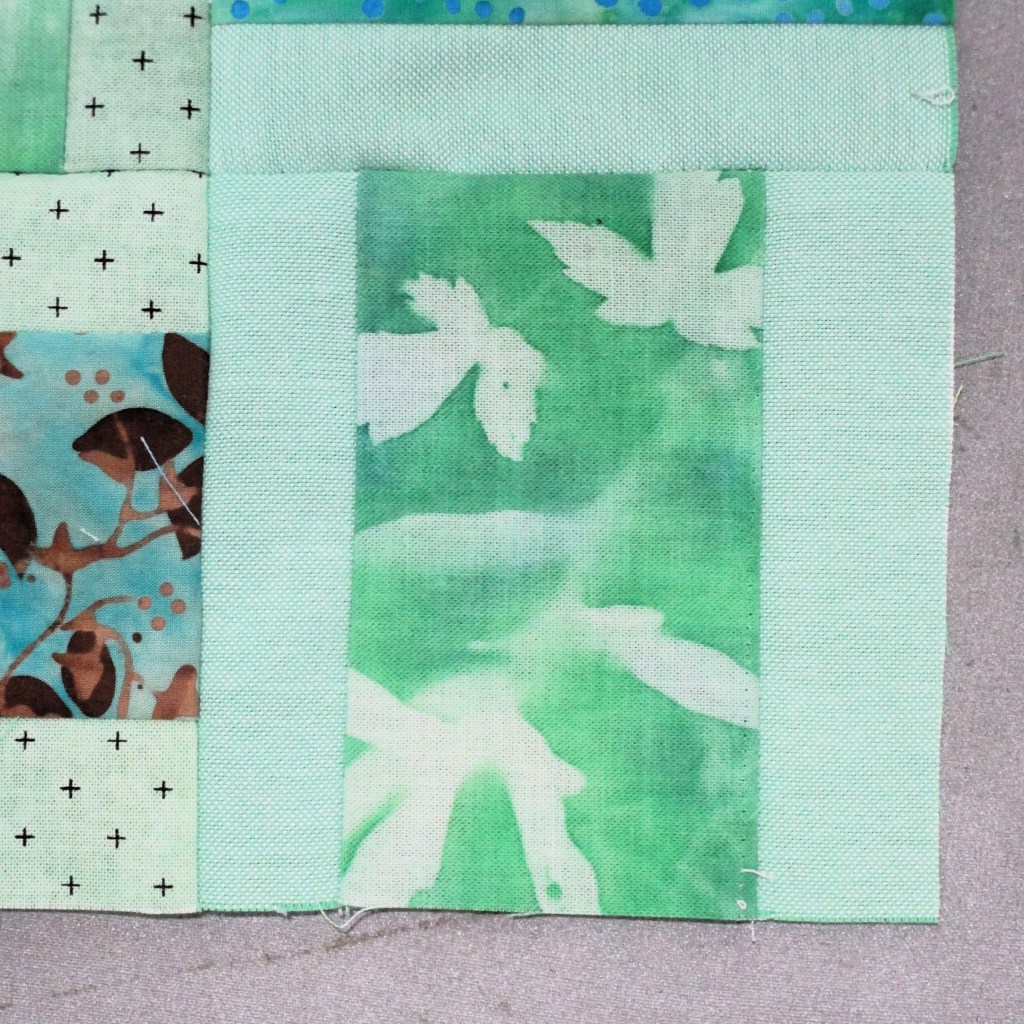
So, getting back to SAHRR. I decided that my center block could be one panel.
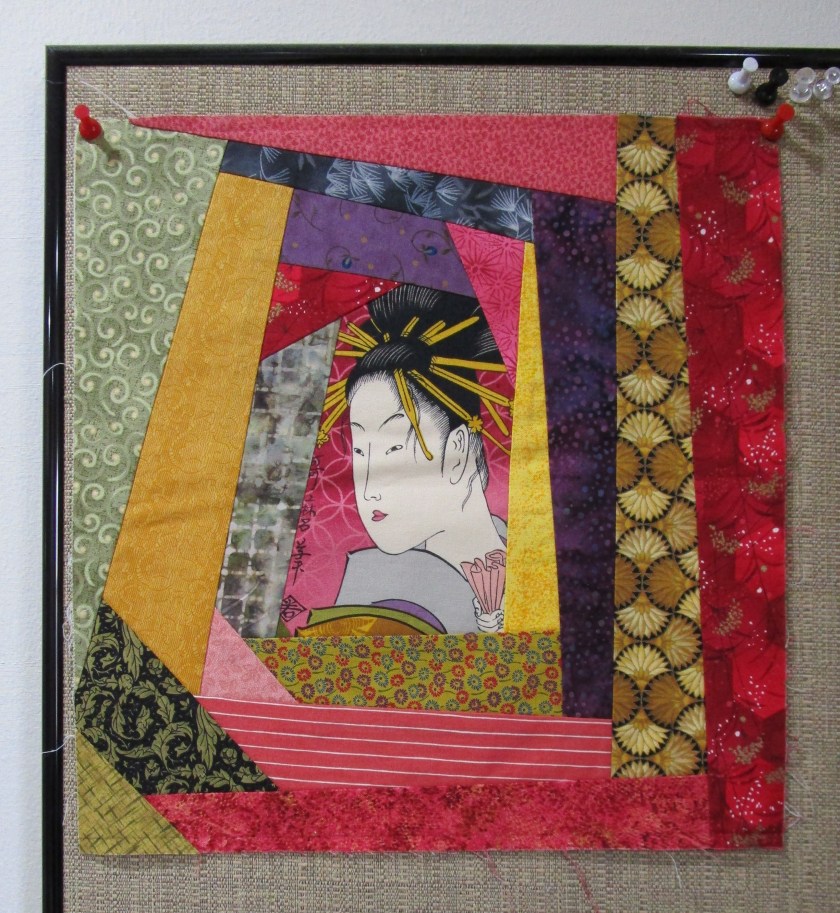
I worked on it a little to get its dimension down to 11 and 1/2 inches. My plan is to make a row-style quilt that will be suitable for turning into a kimono-style robe. I’ll match up each week’s clue to one or more block patterns from this book.
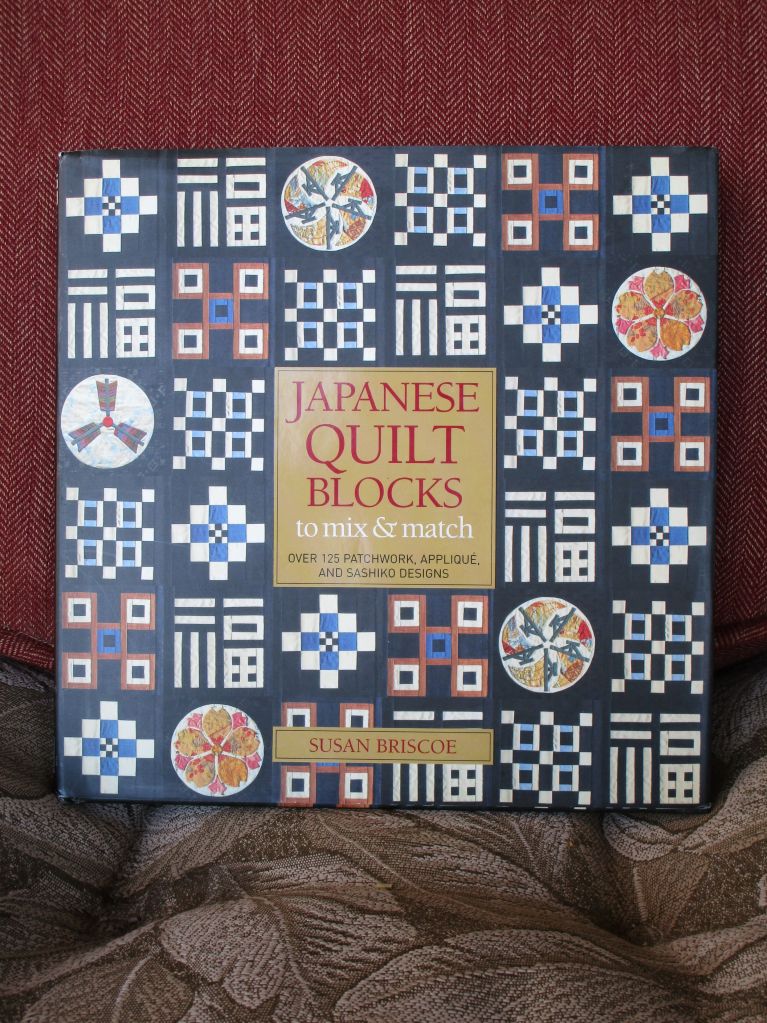
All the blocks are designed to finish out at 9 inches. This plan could be a good work-out for my problem solving skills.

And when I am finished, I will have something made with my mother’s fabric selections, to remind me of how much she loved to sew.

To see the SAHRR 2025 participants’ center blocks, click here.

Posted in painting, quilting

Wednesday WIP: Scrappy quilt update

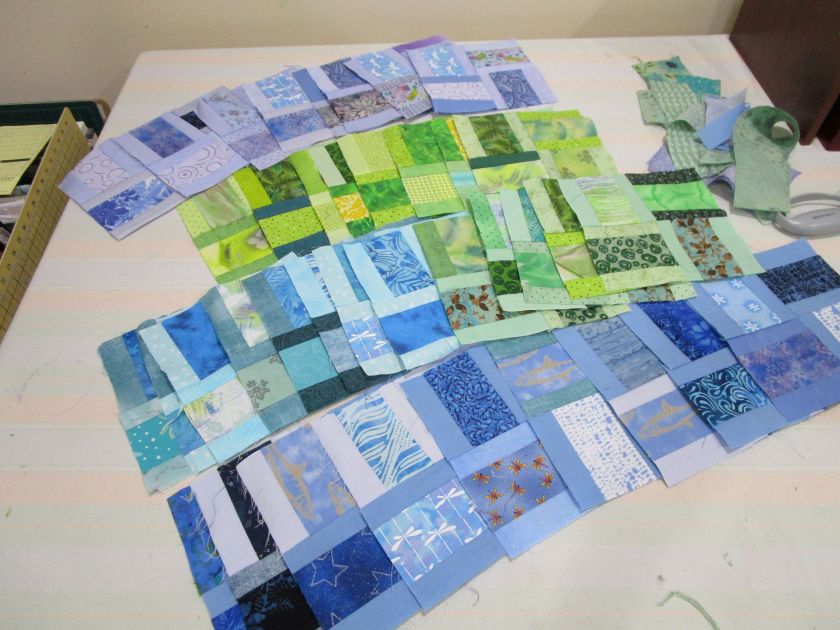
I feel like I have been assembling four square blocks all summer long. I have sewn five sets of eight blocks, each set confined to one color in my analogous palette.

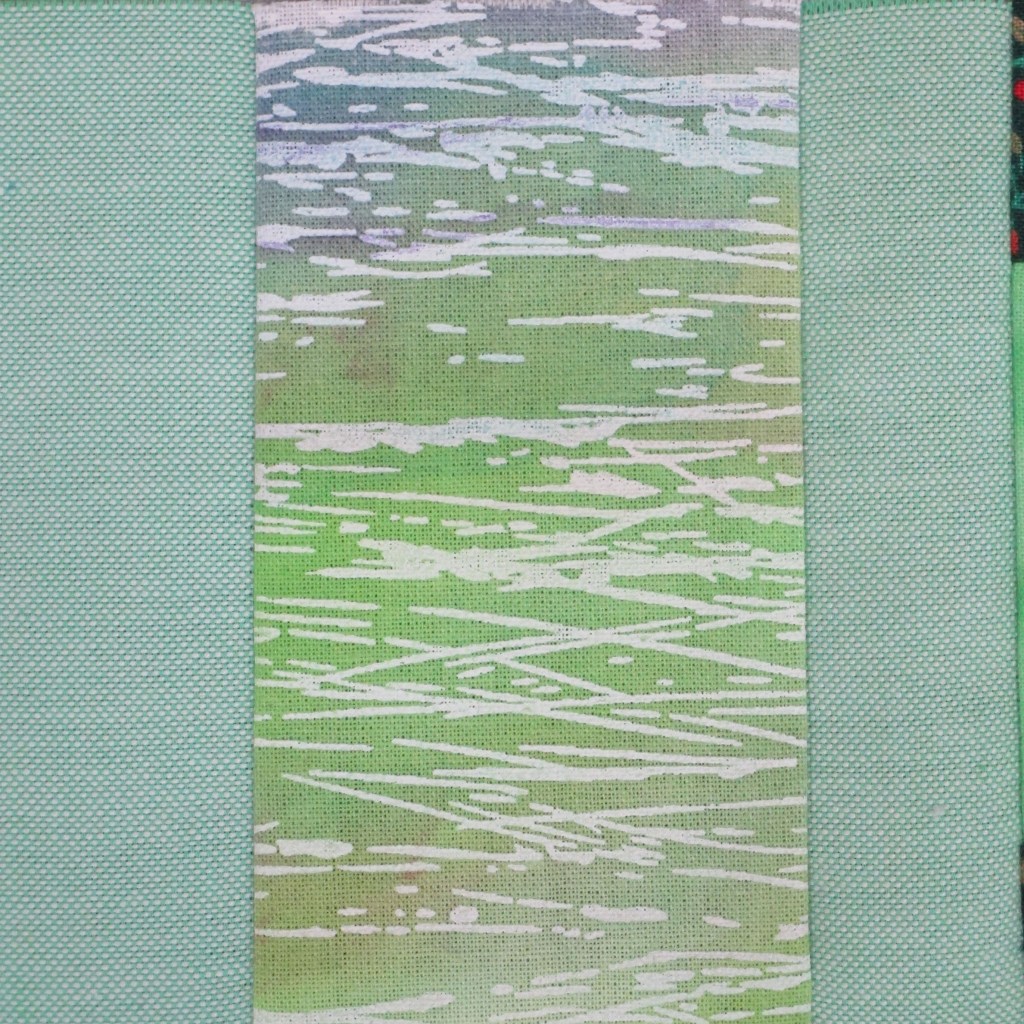
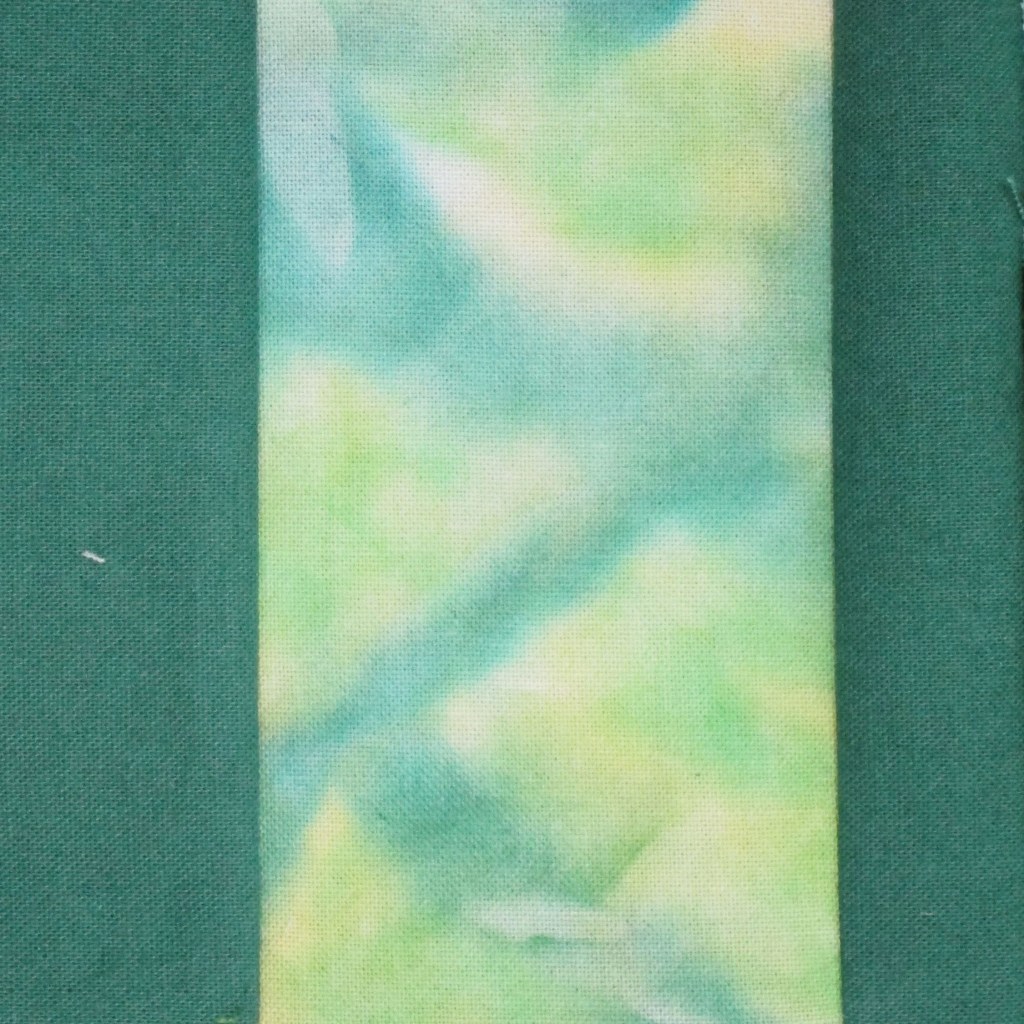
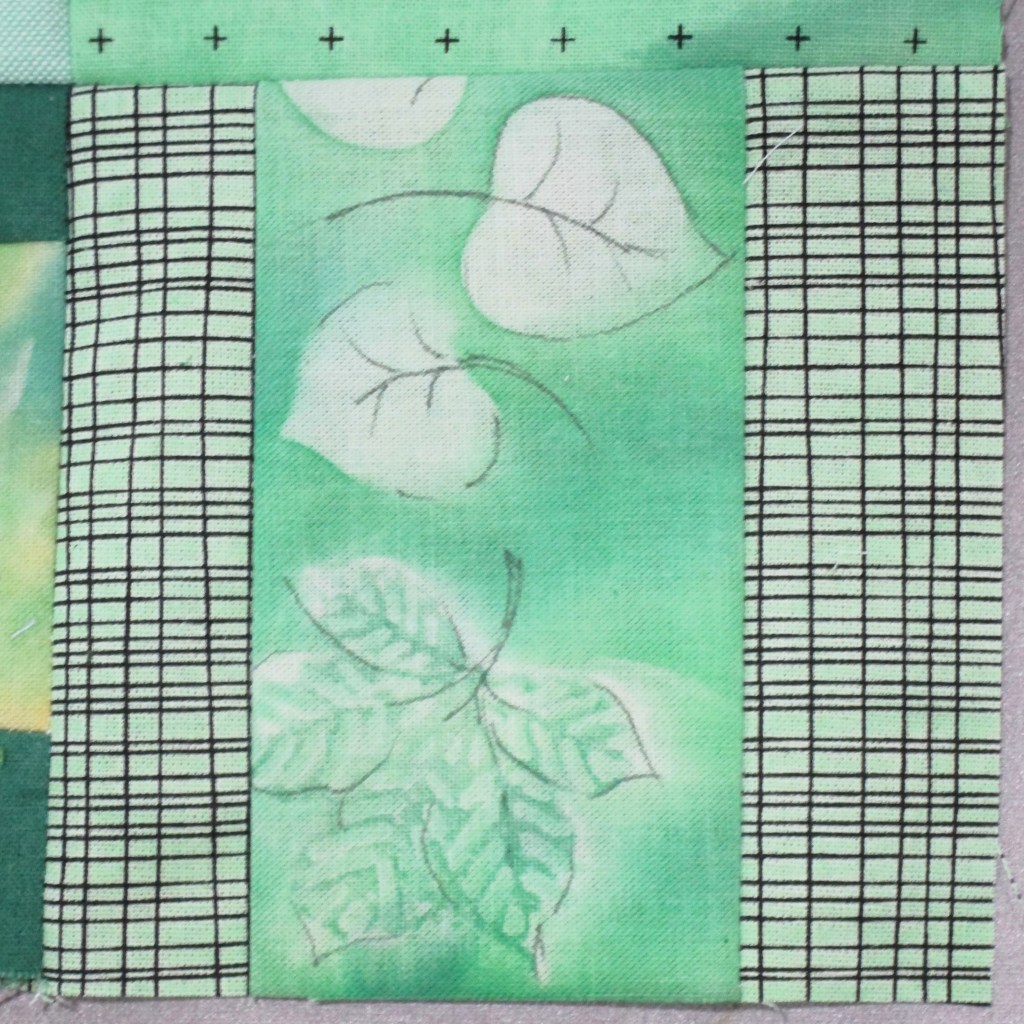
Finally, I am nearing the end of the block-building phase. There were two glitches that lengthened the time spent building blocks. Firstly, I ran out of scraps and couldn’t find the colors I needed at Hobby Lobby. This led me to adding color to my white or pale fabrics by painting them with Jacquard Dye-na-flow paint. I painted the featured 4 x 2 and 1/2 strips AND the 1 and 1/4 border strips to get the effects I was seeking. It was kind of fun, in a time-consuming sort of way.

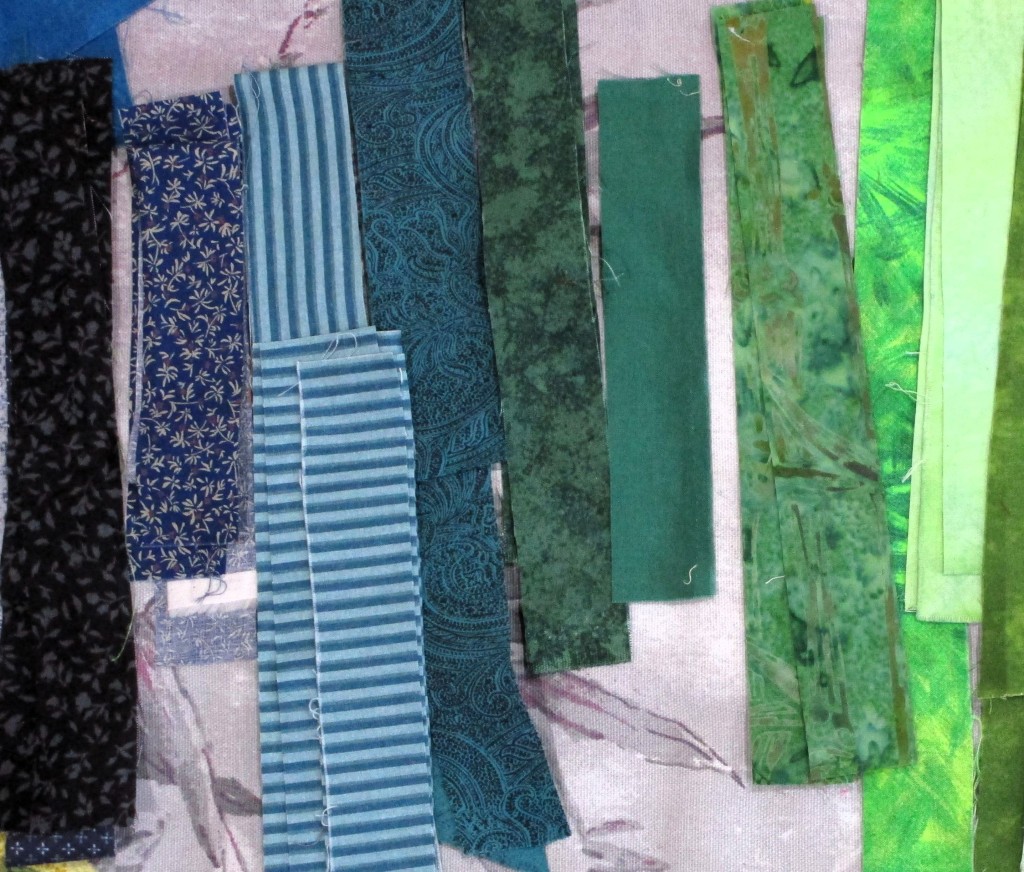
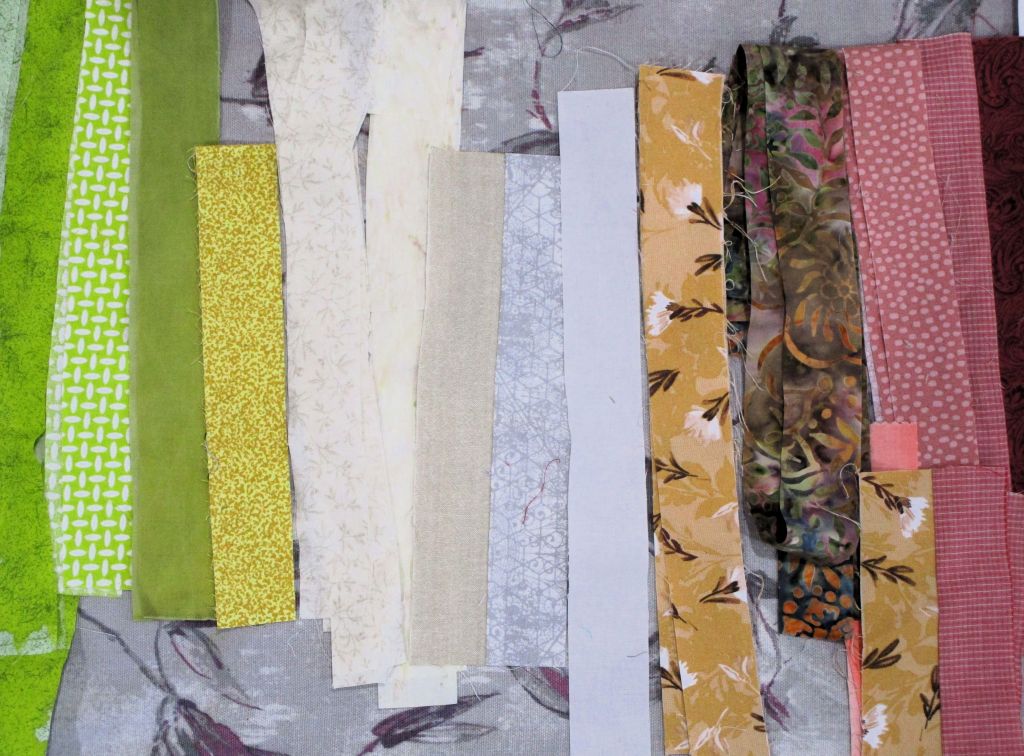
Here is a sampling of some painted strips/blocks in green hues.

I ended up needing painted fabric in blue-violet, teal AND yellow green.

The second issue arose when laid out my blocks. I took an intense dislike to any block that had dark borders. To fix this, I cut apart many blocks and replaced the dark strips with light colored fabrics (mostly were created with paint on white fabric.)

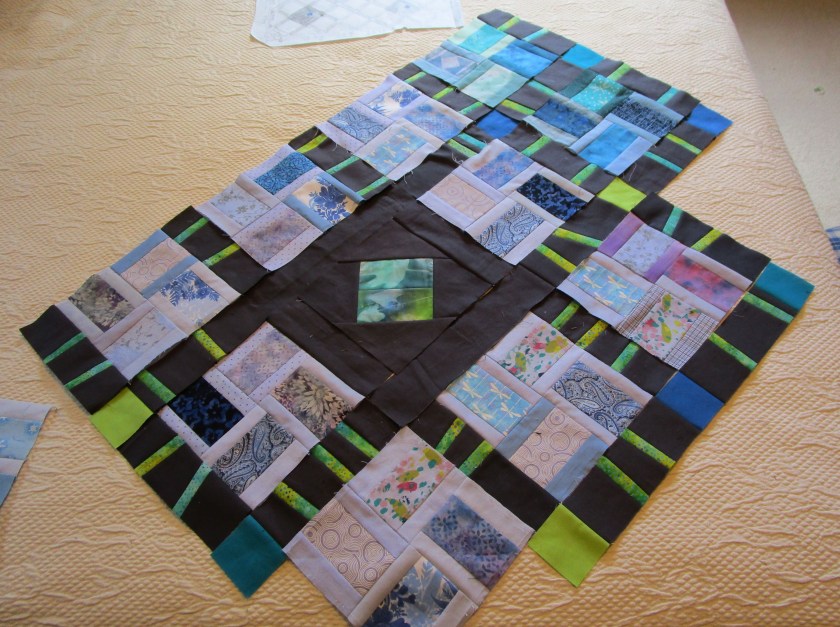
I now have enough blocks to form the five regions of my quilt. I have sewn a center block for each region using black fabric and hand-painted feature fabrics. To create some breathing room between my blocks, I made sashing with black fabric. Believing the black fabric was too boring, I cut the sashing randomly and inserted “sticks” of multi-hued batik fabric. Here is a the “blue-violet” region laid out and ready to sew.

I’m excited to start assembling the quilt, but a little nervous that the pieces won’t fit together properly.

Posted in quilting

Fabric Strips Saga: Chapter Three

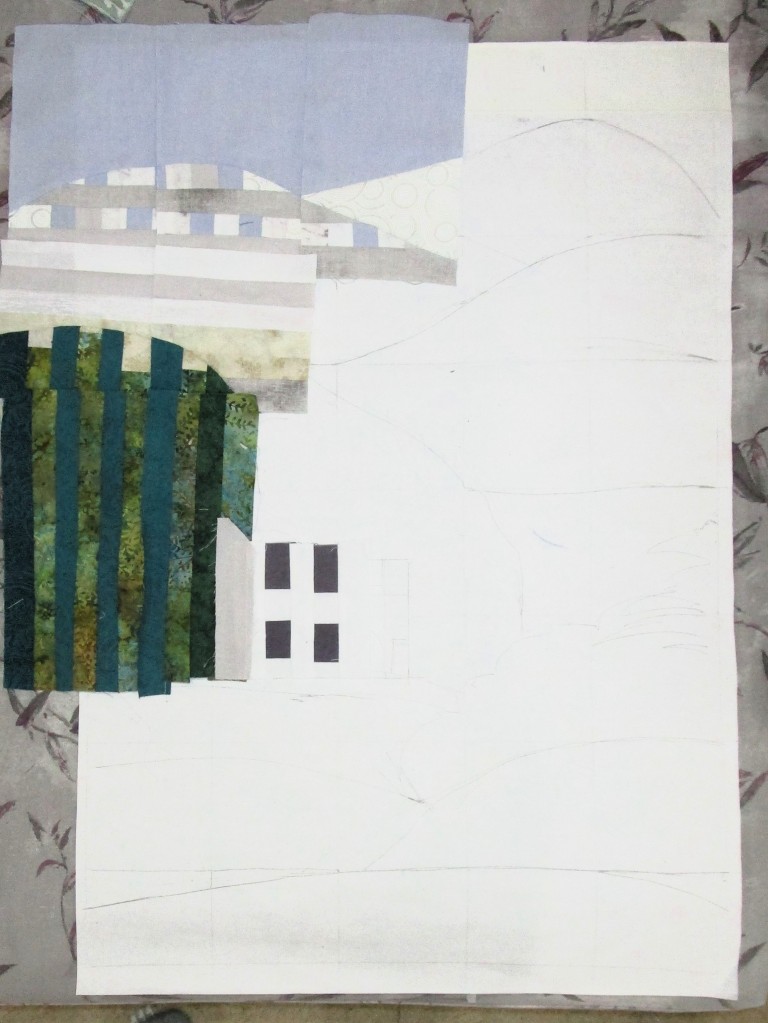
My obsession with strips continues. First, let me share an image of the pieced abstract landscape that I have been working on most recently.

The work at this stage looks about as I expected, although I feel kind of let down by it. I’m also stumped as to how I will proceed with the surface embellishments and quilting. As I ponder, I have laid it aside.

Leftover strips are hanging out, and they keep drawing my attention. I started noodling around with them, cutting and sewing together. Since I had used the 1- and 1/4-inch-wide strips for the landscape art quilt, I wondered what else I could do with this size. Pulling out some 2 and 1/2 inch scraps, I start sewing strips together, again.

Well geez, first I need a little bit of structure to this game. How about a palette? I decide to try analogous colors. Pulling out my color wheel, I spun it around to show that teal blue color in the center, surrounded by its four closest relatives.

Now I am really in my comfort zone. My stash contains many scraps in this range, leftovers from some favorite projects.

If I sew two thin strips on either side of a 2 1/2 inch precut, then cut that piece down to four inches, I get a nice-looking square block. I decided to stick to monochromatic fabrics for each. Here are some examples.

Combining four of these gives me a seven and 1/2 inch square.

What if I sew four of these together?

Hm. To me it looks too busy while also looking kind of boring. I can do better.

How about inserting some sashing? I have a longing to try dark background fabric with this palette.

Now we’re talking. But to get more negative space into the picture, I could put the blocks on point and space them out with a background block.

Ah, the drama it beginning to happen. I sit down with graph paper and plot out a lap sized quilt using this on-point configuration.

This could be wonderful. Perhaps I can create focal points in the dark blocks by inserting some bits of hand-painted fabric. Something like this leaf, which is left over from my very first quilt.

Gosh I feel better. Going from a vague notion to a planned design is so satisfying. Even though I had no intention of sewing up another lap quilt, I’m ready to go. The trick will be to buy as little fabric as possible and still get the look I want. I’m up for that challenge as well.

Posted in quilting

In Progress: Pieced Landscape Art Quilt

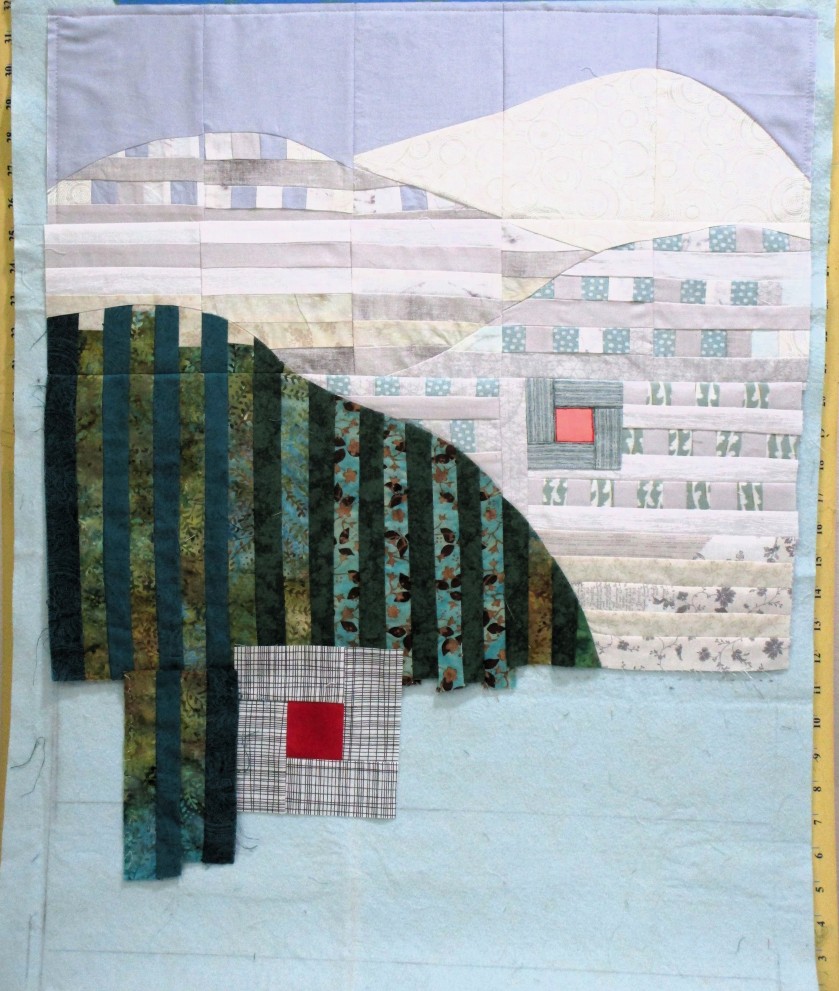
Today I’m catching up on the abstract landscape quilt that I started in mid-May:

Obsessed by Strips

I would say nothing has changed, but I would be lying. During the planning phase, I started to think about Japanese quilts – most likely because I recently purchased two books on modern Japanese quilting by Susan Briscoe. She is a textile artist who worked in Japan for many years as an English teacher. In her book, Japanese Quilt Blocks to mix and match, she features 125 patchwork, applique and sashiko blocks in a modern style that is inspired by tradition. Textiles recycled from kimonos and other garments give the blocks an Asian look.

Consequently, I decided that my original plan was not abstract enough. I discarded the house block already constructed and made one using the Japanese block called Sunken Hearth.

In fact, I made two hearth blocks – one in bold colors for the middle ground and one in faded pastels for the background. This second block is located half-way up the mountain in the foggy part of the landscape.

I redrew the upper right corner of the design from clouds into a mountain. You could think of it as Mt. Fuji. The fabric is a white-on-white print of spirals, suggestive of clouds to me.

As of today, I am about 2 thirds finished with the piecing phase. I have completed four rows out of seven.

By the way, I have a new favorite tool:

This flexible flat-bottomed shape is a technical drawing tool that belongs to Bill. He got it back in his college days for a class. Using this tool, I can match up a long curve which crosses over two different blocks. I Love it.

One more Japanese touch will be added to the lower right corner. In the reference photograph, there is a group of red-twigged shrubs behind a stone wall. I plan to use the Pieced Ogi, aka Folding Fan, to abstract this feature.

Are you making something from your scraps? Do share.

Posted in quilting

Obsessed with Strips

Since completing the Japanese Knot bag (which turned out quite well, IMHO,) I keep thinking about the potential of making art by sewing strips of fabric together. Casting around for some inspiration, I thought about making another abstracted landscape art quilt. Last year’s landscape quilt was inspired by a visit to the Badlands at Roosevelt National Park. My technique of choice for that piece was layered applique. It interests me to try another landscape but this time piece it with blocks made of fabric strips.

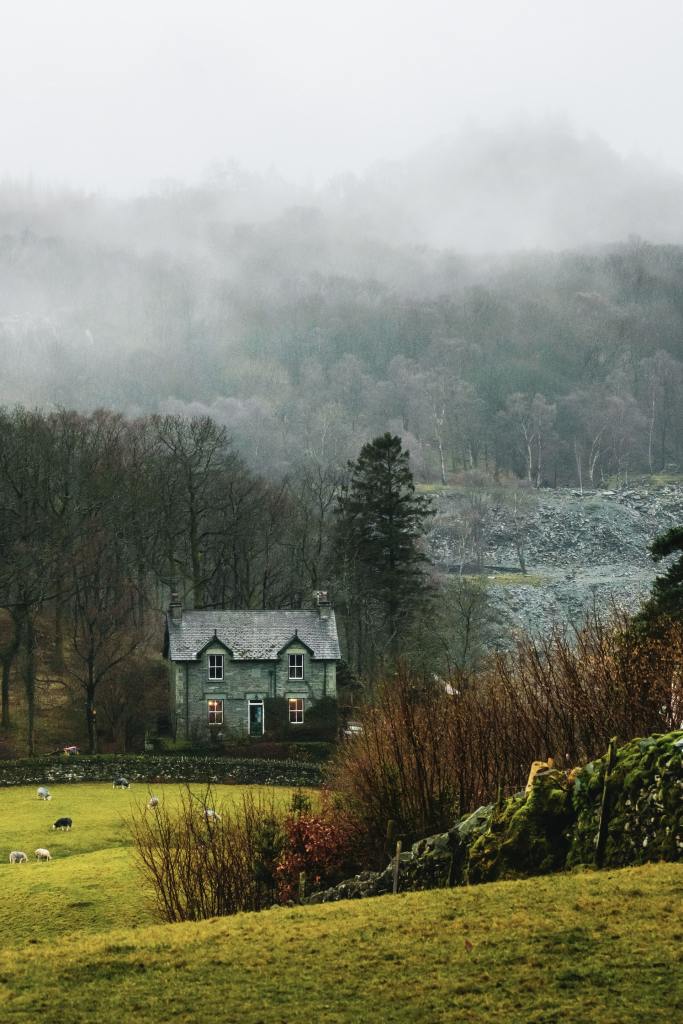
In searching suitable references, I returned to this evocative photograph by James Kemp which I had found on Unsplash a few years ago.

james-kemp-bXFEiuZtk64-unsplash

I love the contrast of pale foggy high places, with a midground of dark trees and a foreground of warm grasses and red twigs. If I can simplify the big shapes and translate the photo’s colors to fabric scraps, it could work.

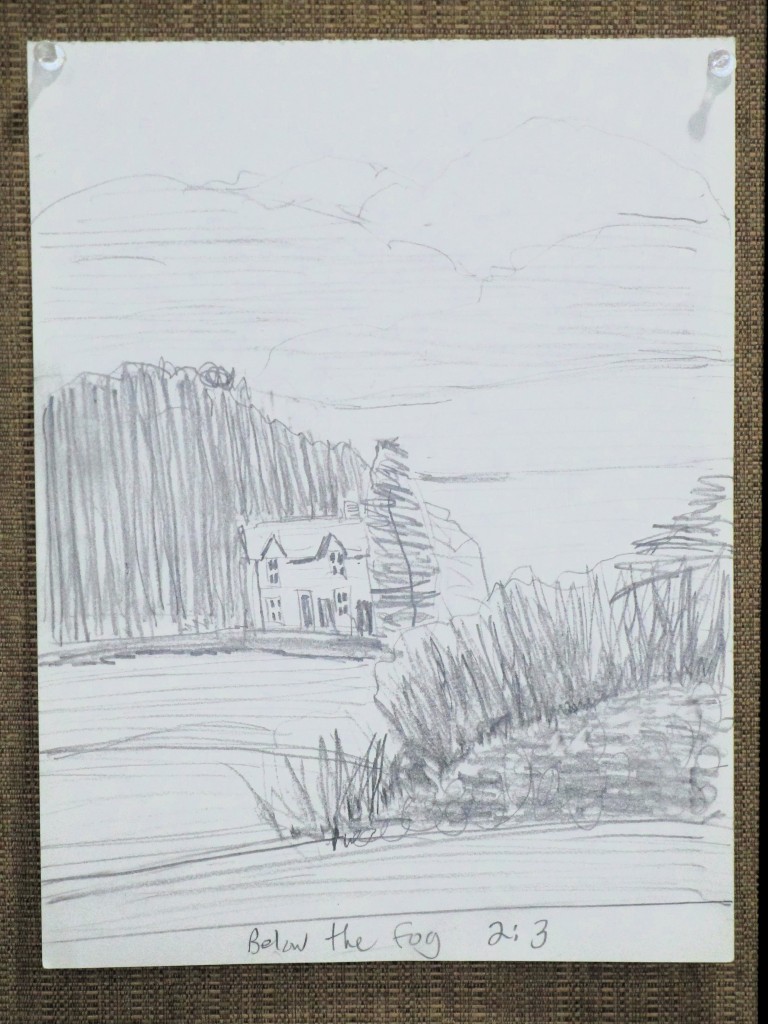
Next I did a quick, scribbly value sketch.

I transferred the major lines to a giant Post-It note, which happened to be full-size for this project. I next drew in a grid of 4 x 4 squares. Using 4 inch blocks, I will need to make 35 blocks.

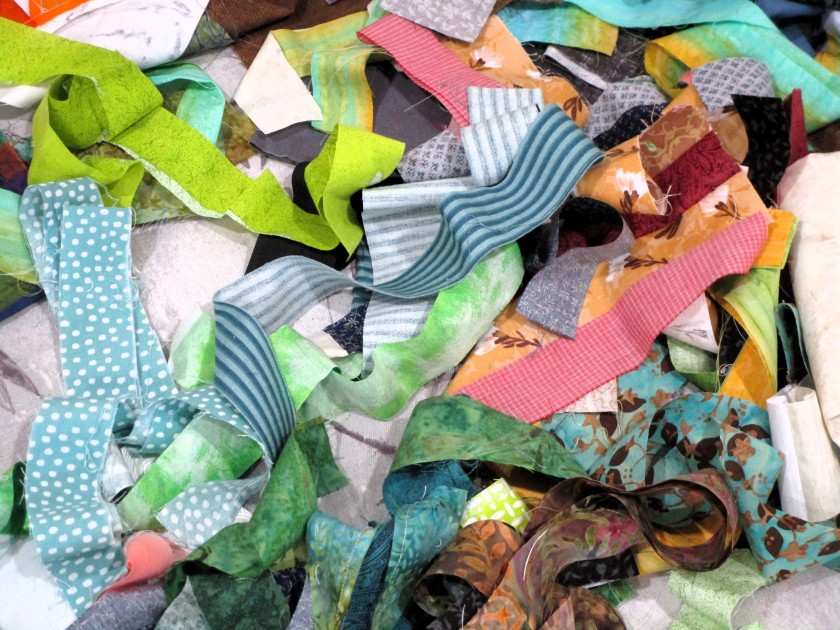
I started cutting my strips and sorting them by color.

Using the image as my guide, I built sets of six strips, arranged them along the grid and cut them down into squares.

The whole project started to spin out of control. Weirdly enough, instead of getting frustrated, I was drawn into working with more effort and thought.

Two days later, things looked something like this.

No, look away Nothing to see here!

Ah, more like this.

Sad little blocks. Believe me, it does look better IRL than in this photo.

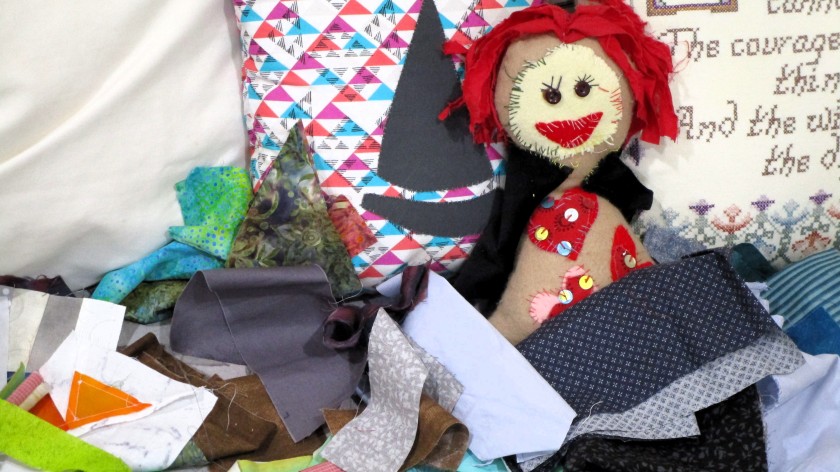
I predict that if it keeps raining, and I can’t go outside and play, I’ll continue to cut, strip and sew on this project.