Posted in knitting

Wool, Silk and Glass

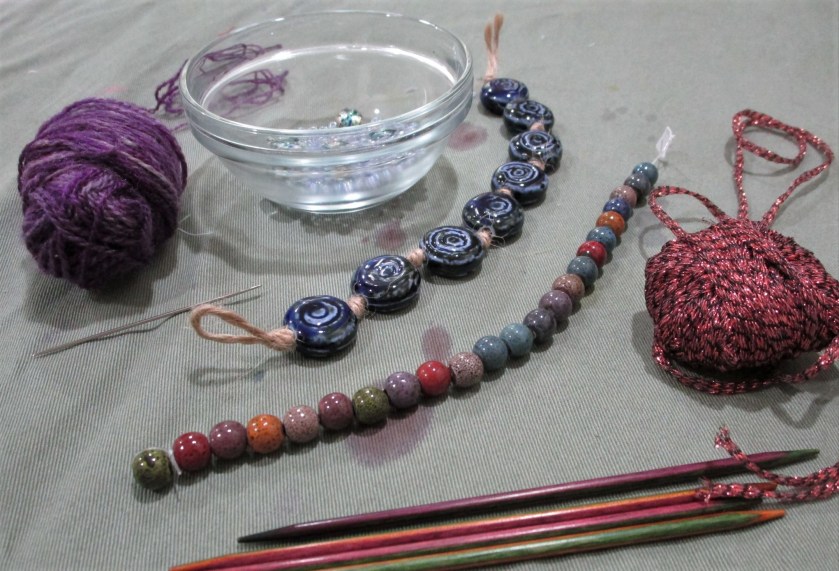
Today’s fiber project combines yarn with glass beads to make a fun, easy and beautiful necklace. I like this because I can make the whole thing in an afternoon. Also, I’m always on the look-out for unusual accessories to jazz up my standard daily look of jeans and t-shirts. You see in the photograph the makings of two necklaces. I chose the purple variegated yarn and the iridescent beads in the glass dish. The yarn is a lace-weight blend of merino wool and silk called Stream from Willow yarns. The pattern, by Carol Metzger, is called Scallop-Edge Beaded Necklace. I’ll have a go at making up a design for the ribbon yarn and ceramic beads on another day.

Cast-on and first row completed.
Notice that all the beads were strung on the yarn before starting to knit.
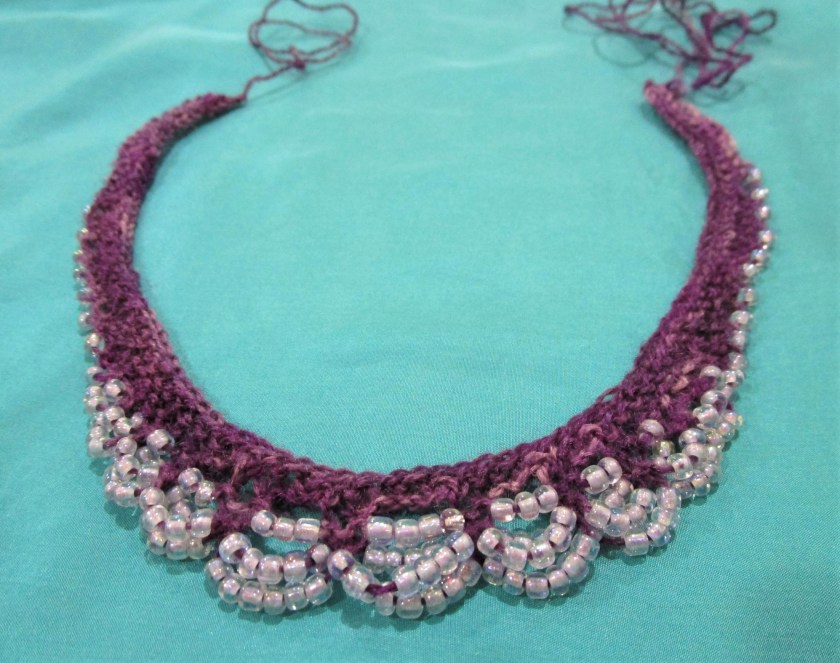
Necklace bound off but without the jewelry fittings

After weaving in the yarn ends, I used all-purpose thread to sew a jump ring to one end and an alligator clasp to the other. Here I am modeling the finished work. Photography courtesy husband Bill.

It’s so light and delicate. I can hardly tell that it’s there.

No special skills were needed to make this necklace. I recommend that you use a floss loop to thread the beads, or buy a special bead needle from a craft store. Carol’s pattern can be found on Ravelry at https://www.ravelry.com/patterns/library/scallop-edge-beaded-necklace.

Posted in knitting

Mowing around the Luna Moth

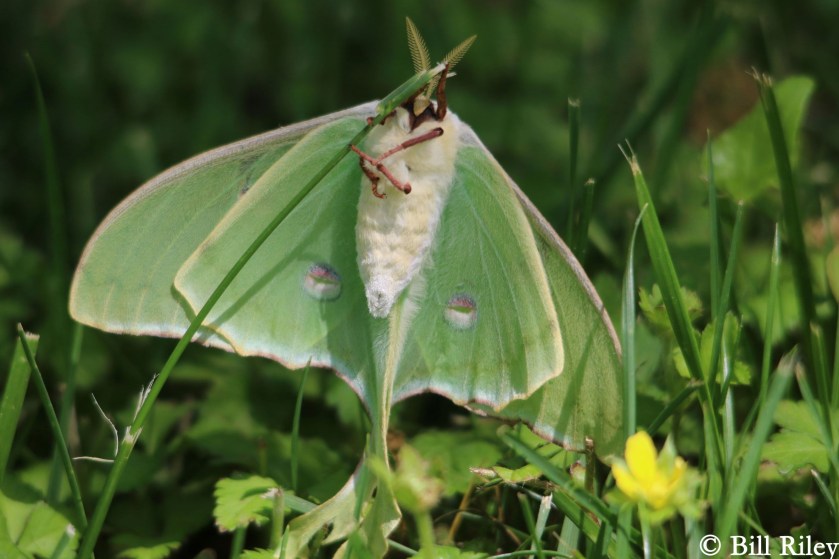
The green expanse of our back yard is not the monoculture of grass species typically found in American suburbs. Due to the presence of several mature trees, the grass will not grow thickly. Instead, we have what I call an English lawn. Today it is dark green, dotted with the yellow, lilac and white blooms of English violets, false strawberry, dandelions, oxalis, white clover and tiny bluets. It still requires weekly mowing. But one of the virtues of this diverse ecosystem is the abundance of wildlife. Today I noticed a luna moth clinging to a leaf of fescue. I stopped the mower and went to get Bill, so he could take her picture. The moth held perfectly still. In fact, she simply would not be budged. I carefully rolled the mower around her. After spending nine months as a pupa beneath the soil, this magnificent creature has but seven to ten days to complete her life cycle. If she is lucky, she will attract a mate tonight. They will dally together for a few hours, then she will be off to lay her eggs in a nearby tree top.

I was struck by the strong resemblance of the moth to this little dress I am knitting for the grandbaby. At the end of the first skein I am nearly finished with the skirt.

Ruffle and all but a few rows of the skirt section complete.

I have named the project Luna Lou Dress and plan to embroider a moth on the bodice. I will keep you posted on my progress.

Posted in knitting

Knitting Baby Clothes

The past two days have been cold and wet – perfect weather for curling up with a bit of knitting. My daughter let me know that the baby has outgrown most of her outfits which I knit last year. And she is crawling now. Here is the baby, seven months old, wearing the cotton overalls that I made in a 12 month size.

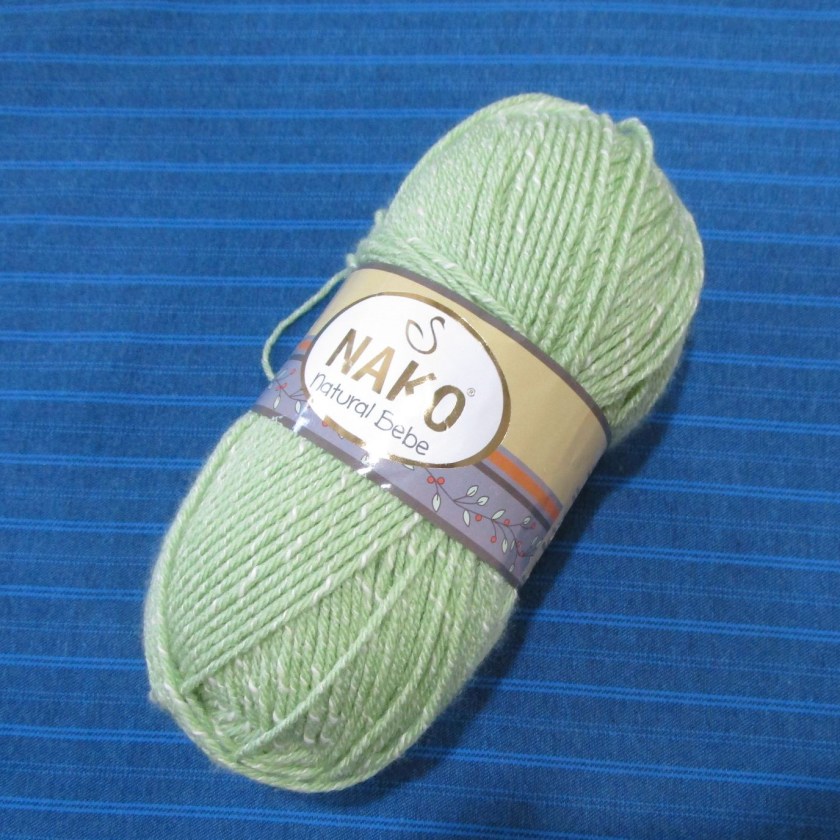
I picked up a similar yarn last summer, in an acrylic blend.

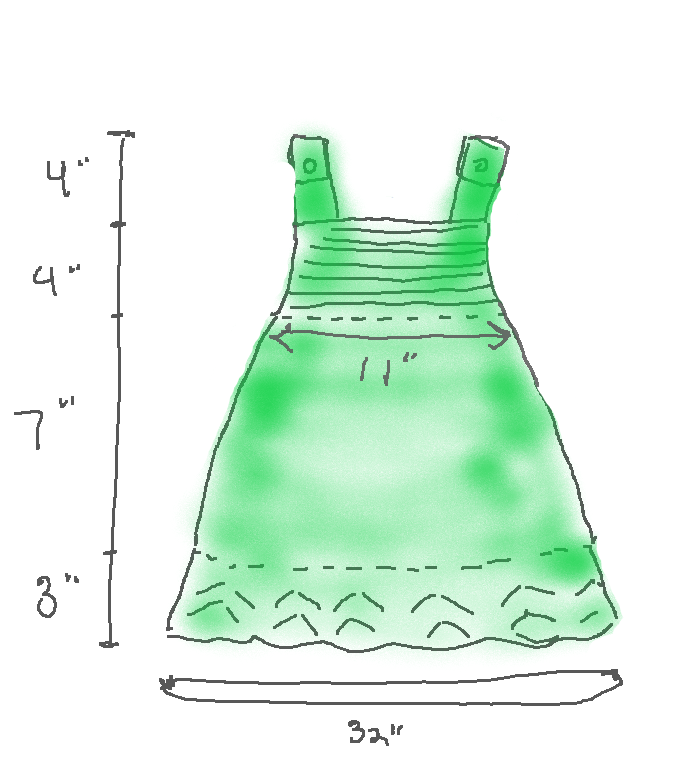
Designing baby clothes is really quite simple. All you need is an idea, some measurements, a swatch, and a schematic drawing. Everything else is math. While I don’t have my granddaughter’s measurements, I can use the standard baby size chart developed by the Craft Yarn Council. You can find it here: https://www.craftyarncouncil.com/standards/baby-size-chart.

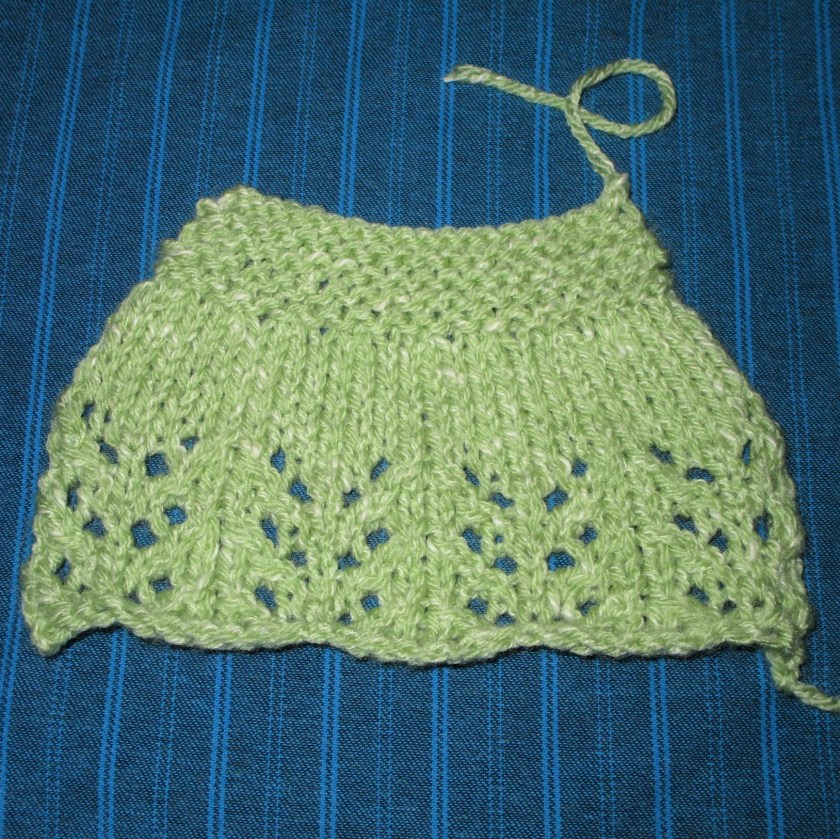
Here are my drawing and swatch:

The lower edge will be a lace ruffle. The skirt will be in stockinette stitch and the bodice in garter stitch. I have decided to use the same style of buttoned straps as I did on the orange overalls. My swatch gauge for the lace section is 4 and 1/2 stitch per inch. I want the skirt to measure at least 32″ around. The lace pattern is a seven stitch repeat. So I will cast on 154 stitches. This works out to 22 pattern repeats and about 34″ diameter. After about three inches, I will switch to stockinette stitch. My gauge for this stitch is 4 and 3/4 stitch per inch, which will bring the diameter back to 32″ After knitting for seven more inches, I will reduce by K2tog every other stitch, eliminating about 40 stitches. This brings the diameter down to 24 inches for the bodice. Once I am there, I will figure out the armhole shaping.

Here is the dress so far. Ruffle almost complete.

Since rain is forecast for the rest of this week, I should make fast progress on this cute little dress in the next couple of days.

Posted in colorwork, crochet, knitting

Colorblock with a twist

Easter and garden events in the past two days have kept me away from my Daily Fiber blog, but my fiber stash has not been idle. I have checked out a few tutorials on some techniques that I have been wanting to try. The first is Tunisian crochet. If you haven’t heard of Tunisian, it is a sort of cross between knitting and crocheting. The hook looks like a crochet hook but with a straight smooth handle, on which the loops are collected up during the forward pass. On the return pass, you crochet them back off the hook. Since each stitch is worked twice, it makes a nice, thick fabric.

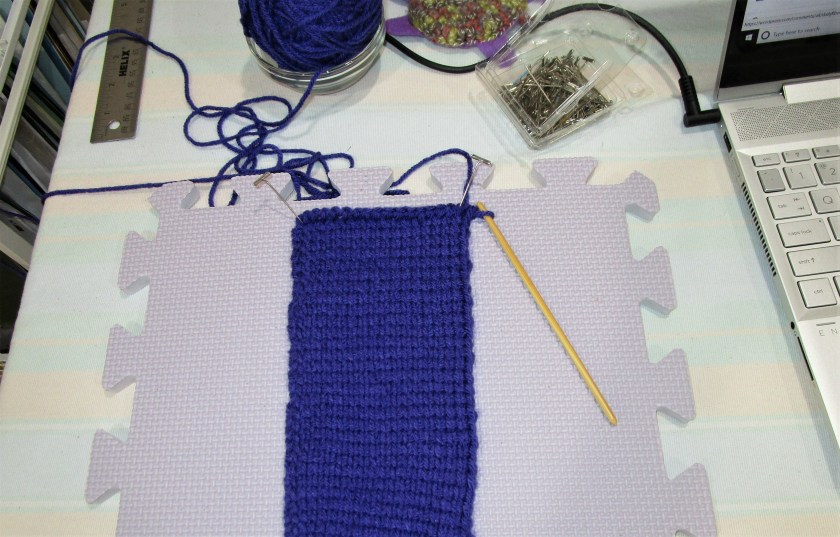
Tunisian Simple Stitch.

To be honest, this technique did not capture my imagination. The swatch is just, well, meh. Perhaps it could be used to make a warm pair of slippers. Moving on – the tutorial I watched yesterday is about various colorwork knitting techniques, including fancy stripes, duplicate stitch, inlay stitch (called Roositud in Estonia) and two-color cables. This last technique is the one I am swatching right now.

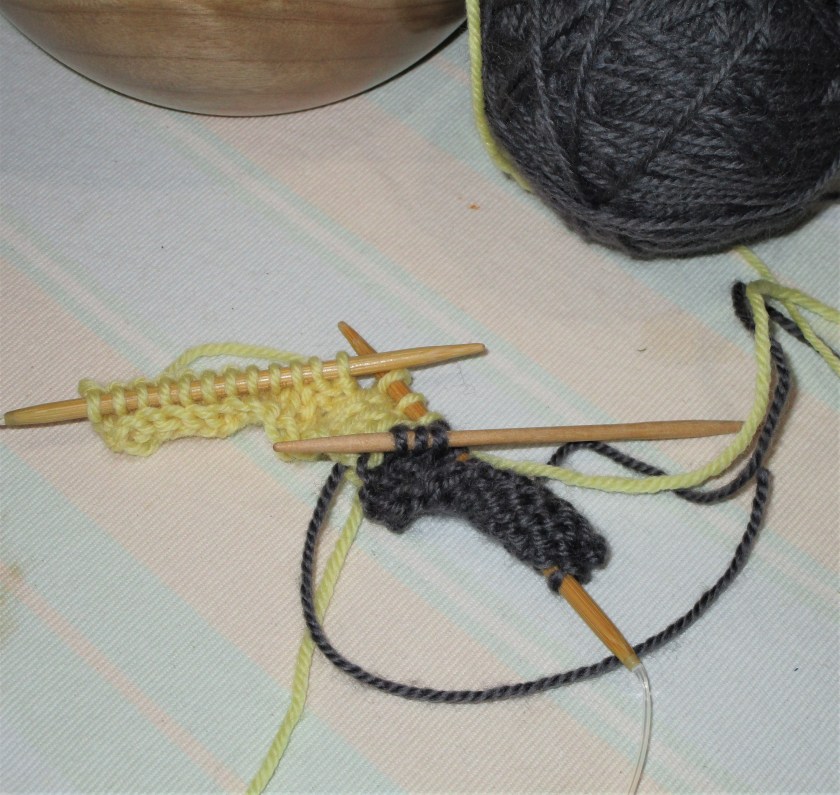
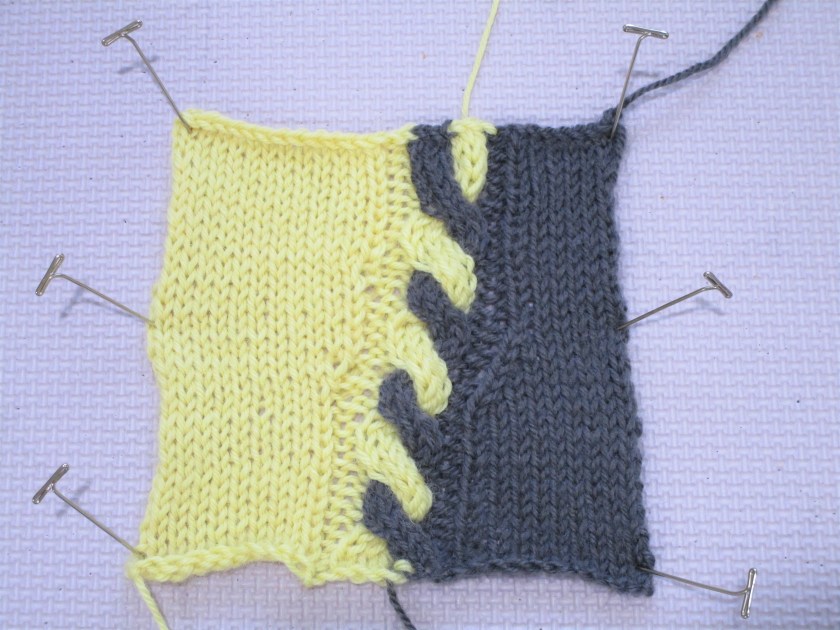
I’m using the two-color cable technique as a join between two different colors of yarn. In other words, I made a swatch that was two colors, side by side, joined in intarsia technique. I started by casting on fifteen stitches of grey and the same of yellow. Here is the wrong side of the swatch, just as I begin the first cable.

This is a six-stitch cable, bordered by two purls stitches on each side.

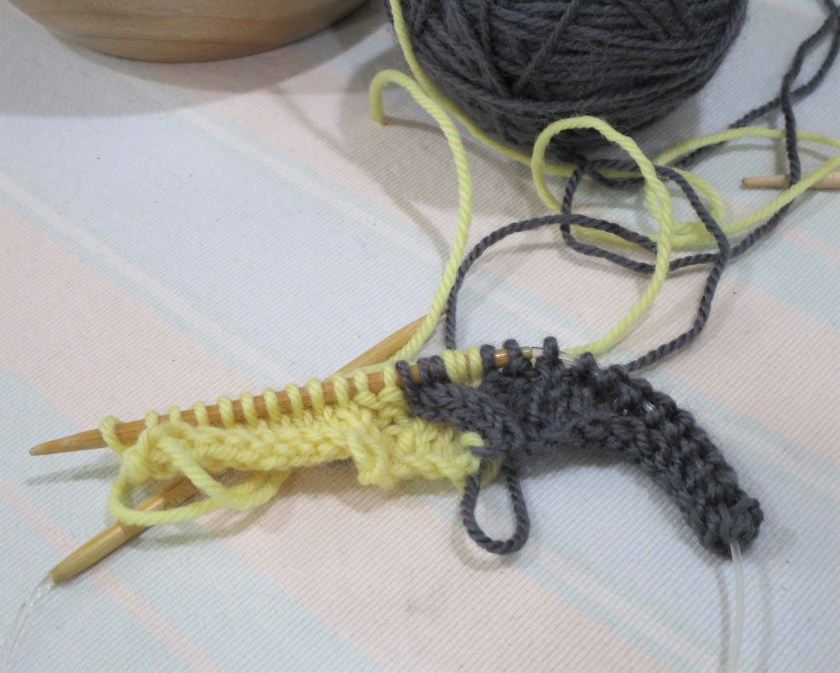
Here is my progress for the first two cables:

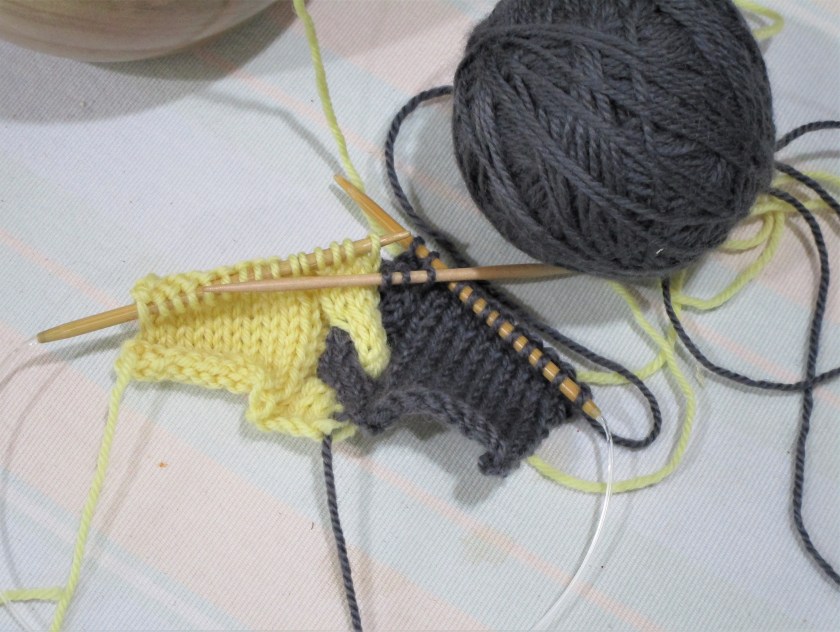
At this point, I was totally getting the technique and decided to make it a little more interesting. I decided to “travel” the cable from its central position. I did this by knitting two grey stitches together and making one yellow stitch. I repeated this two more times. Here is a view of the swatch back, showing how the two yarns are locked together. To do this, you bring the working yarn of the second color up from underneath the first color working yarn.

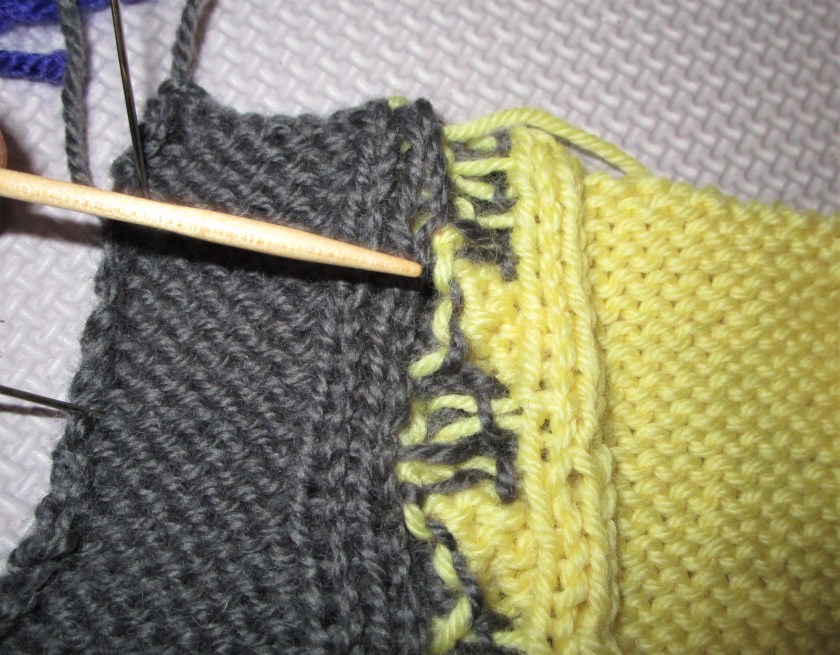
And here is my two-color cable swatch after wet blocking.

This was an easy knit. I can think of fun applications for two-color cables, such as children’s sweaters and team color scarves. Can you spot the slight lean in my cable? It’s going to the right, so I guess that makes this a conservative stitch.

Happy knitting!

Posted in colorwork, knitting

Project Unearthed

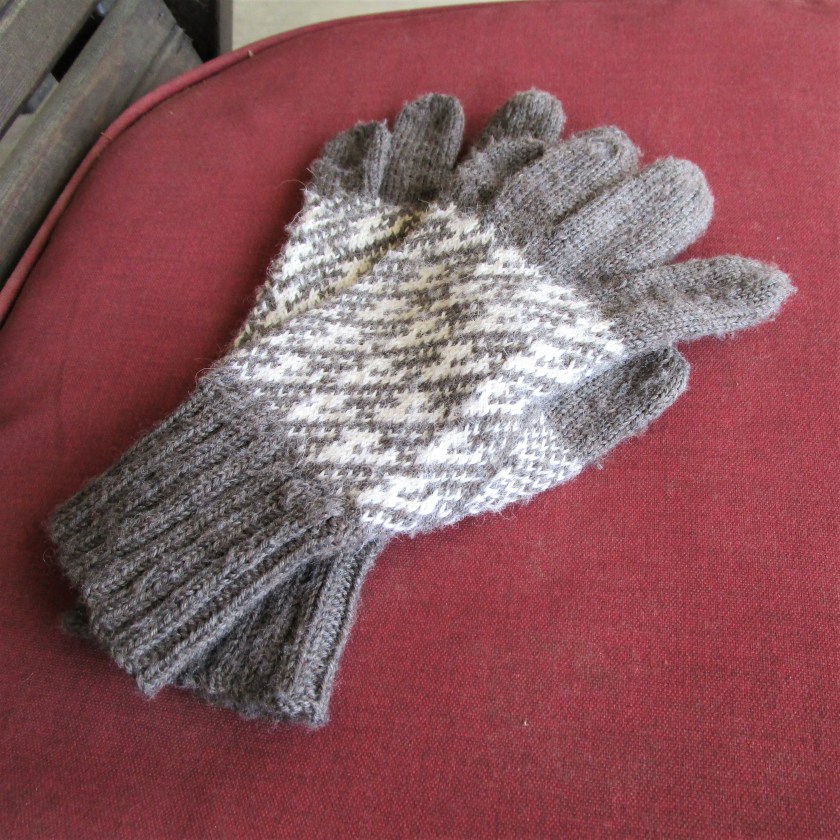
Yesterday, as I was tidying up my studio, I came across a project bag. In it were four small balls of sock yarn and this inspiration photograph:


Technically, this project is half finished. I knit my first pair of gloves last winter, using an eight stitch square stranded knitting pattern that I had designed. They turned out great and I wore them frequently during the cold months that followed.

Grey is merino wool and nylon, white is alpaca

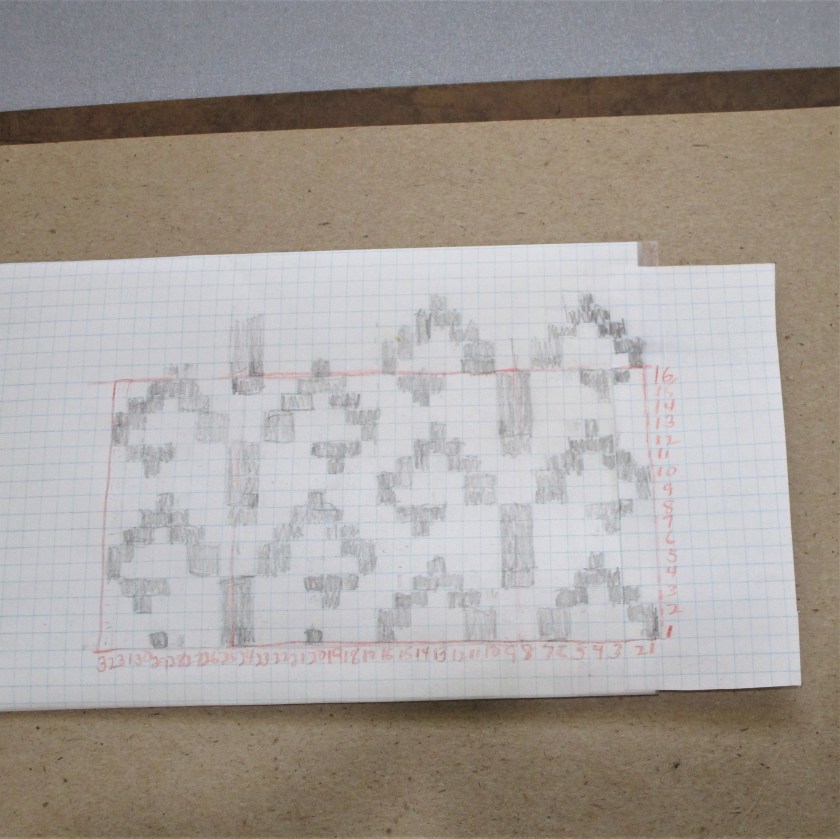
But I had intended to make patterned mitts to wear over the gloves, as a fashion statement and to give some extra warmth when needed. Today I will start this project. I don’t want to copy the inspiration photo slavishly, rather, I’d like to make something unique.  It will be a bit tricky, because 1: The design must be about 8 inches around because that is the diameter of my hand, 2. The mitts are knit in the round, and 3. I don’t know the gauge yet. I will need to determine the gauge before I finalize the design. Here is the chart that I drew:

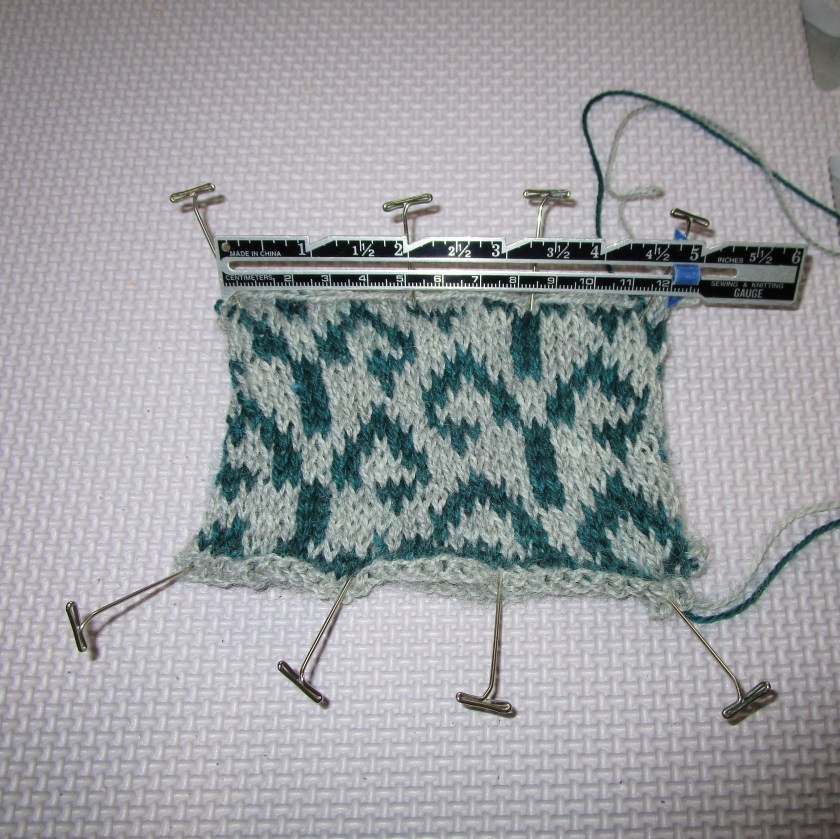
This design suggests palm trees to me. Notice that the pattern stitch repeat and the pattern row repeat are both multiples of eight. My plan is to cast on 64 stitches, assuming that I will get a gauge of 8 stitches per inch. At least that is what I usually get with sock yarn and stranded knitting. So here is my 64 stitch swatch fresh off the needles:

Hm, it seems a little bit big.

It knit up pretty well. I kinda like the design. Here is the swatch blocked:

If you have sharp eyes, you will notice that the blocked piece is 4 and 1/2 inches across, making it 9 inches around. Too big! While I could try to get gauge with smaller needles, I’m not sold on this design for the mitts. The scale is too large.
I’ll go back to the drawing board and try again. Thankfully, the cold weather is over for the next eight months.