Posted in hand embroidery, quilting

Mojo Mini Quilts

This project is inspired after viewing a class by Suzie Williams, on BluPrint.com. The gist of the lesson is to improvise a mini quilt which illustrates one of various design principles. These quilts are sized to be framed as wall art. I chose to base my design on the concept of Rhythm. Here is my sketch (just a few swooping lines, really minimal) and my chosen fabrics.

I had recently purchased the black printed fabric, which is just a scrap in the picture. I like the idea of repeating bars of the circle shapes on a background of orange.

The design is cut up, so that it can be pinned to the fabric and fabric cut out. I am using a gray background fabric. Each element is appliqued to the background, using glue as baste. I had never basted fabric with white glue before, but it seems to work just fine. Here is the design at the beginning of the layout stage.

Truly fun little cogs in multi colors.

After a few adjustments to the design, and more than one re-cut of the shapes, I finally have all the pieces in place, glued down, pin basted and ready for sewing.

Hmm, what color thread will I use?

I started by zig-zagging along the raw edges, to minimize fraying. Next I stitched some swoops of machine quilting in black and orange. Finally, I finished up with hand embroidery. It was fun choosing floss and stitches to accentuate the circles.

Here is the finished mini quilt, ready for framing or binding.

Detail of hand embroidery

What a fun project, even if it did take most of the day to complete! The Mojo Mini quilt class can be found here: https://www.mybluprint.com/playlist/11422/20696

Posted in hand embroidery

Sparking Creativity with Embroidery

While studying embroidery in books and on-line classes, I learned about a method for practicing stitches by working on printed fabric. The concept is to use the design found in the print as a template for your design, then embroider it with your choice of stitch and thread. This is well illustrated by the designs found in damask napkins. These are often woven with clearly delineated fruits or flowers.

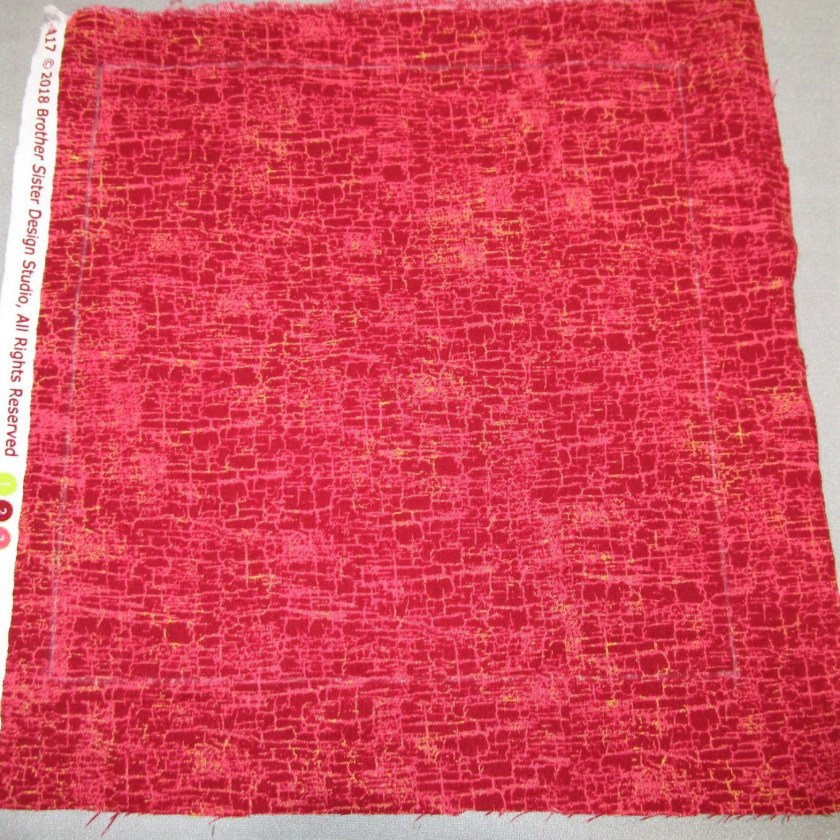
That’s not what I chose to do. I started with some quilting fabrics that had more abstract, textural designs. Here they are:

Settling on the third one, I started to analyze it. Hm. The terra cotta color reminded me of clay, and the geometric print suggested faceted jewels to me. I came up with the concept of jewels in the clay.

Have you ever had the misfortune of losing a beloved piece of jewelry? One minute the necklace was securely fastened around your neck. The next time you checked, it was gone. This has happened to me more than once. The most notable incident was while visiting Paris, where I lost a necklace the very day I was given it. But that’s a tale for another day.

Have you ever had the great fortune of Finding a piece of jewelry? You’ve just locked your car in the parking lot at Lowe’s , glanced down, and there at your feet is a silver bracelet in perfect condition.

This little fiber object will look as if someone dumped her jewelry box into the red dirt. I started out by making some gemstones in colors of amethyst, topaz, ruby, emerald and turquoise. Using the faceted squares on the fabric, I stitched outlines in split stitch and then worked satin stitch over top. The centers of the jewels were made with French knots and sequins.

Turquoise finished. Showing the split stitch base for the amethyst. I simply sew along the lines of the pattern.

And here are all the jewels. I added some diamond looking stones made with more sequins and connected the jewels with a silver “chainstitch” chain. The chain follows the lines of the print, which give it a crumpled look.

Found Jewels in the Clay

It took me two days to finish the embroidery. I like the dimensional quality of the work. One feels as if she could just reach down and pick it this lovely lost treasure.

Posted in drawing, hand embroidery, painting, sewing

Welcome to Summer, Farewell to Gloria

It’s my desire to note each season as it arrives with a fiber project that celebrates the specialness of the season. When I learned of the passing of Gloria Vanderbilt, I decided to include a small tribute to her in today’s celebration of summer.

I remember Gloria Vanderbilt best from her television adverts, promoting her line of jeans. She promised to make jeans designed to fit women’s curves. That promise was fulfilled – those jeans did fit us! She branded her product by signing her name on the hip pocket. Soon, all the designers were catering to women’s shape and placing their logos on the pockets.

So, thank you, Gloria. You made us feel good about our bodies, at a time in our lives when we needed a boost to our self image.

Today’s fiber object shows a woman contemplating the sun while lying on a beach. In tribute to Ms. Vanderbilt, my lady is dressed in a pair of cut-off jeans. Here is the sketch I made with the design’s basic elements.

I toyed with the idea of inserting the Gloria Vanderbilt logo somewhere in the design, but ultimately decided not to. Here is the finished object.

Hello Summer, Goodbye Gloria

I’m happy with all the elements of this piece. First of all, my ability to draw is getting better. It only took me two tries to sketch this slightly stylized female body. I am also getting better control of the fabric paint while using the wash technique. And finally, both my hand and machine embroidery are improved.

Posted in colorwork, drawing, hand embroidery, sewing

Inspired by O’Keefe

My fiber efforts have been rather uninspired over the last two days, so no new posts. Then I picked up this book written by Georgia O’Keefe. It is an autobiography told in her own words and in beautifully reproduced images of her paintings. It got my creative thoughts moving again.

While she spent most of her life living in and painting the American Southwest, in the early stages of her career O’Keefe was best known for her large-scale paintings of flowers. Here is what she has to say about these works:

Nobody sees a flower – really – it is so small – we haven’t time – and to see takes time, like to have a friend takes time. If I could paint the flower exactly as I see it no one would see what I see because I would paint it small like the flower is small. So I said to myself – I’ll paint what I see – what the flower is to me but I’ll paint is big and they will be surprised into taking time to look at it.

Exhibition catalog, An American Place, 1939

So I decided to create a fiber flower, because I want to look closely at a flower. I chose to make a Moonflower, partly because of its star-like shape, and partly because I don’t see them growing around here. When I lived in Texas, I grew some moonflowers. It was way too hot to enjoy the garden during the day. Instead I sat outside at dusk, when I could watch the moonflowers swirl open.

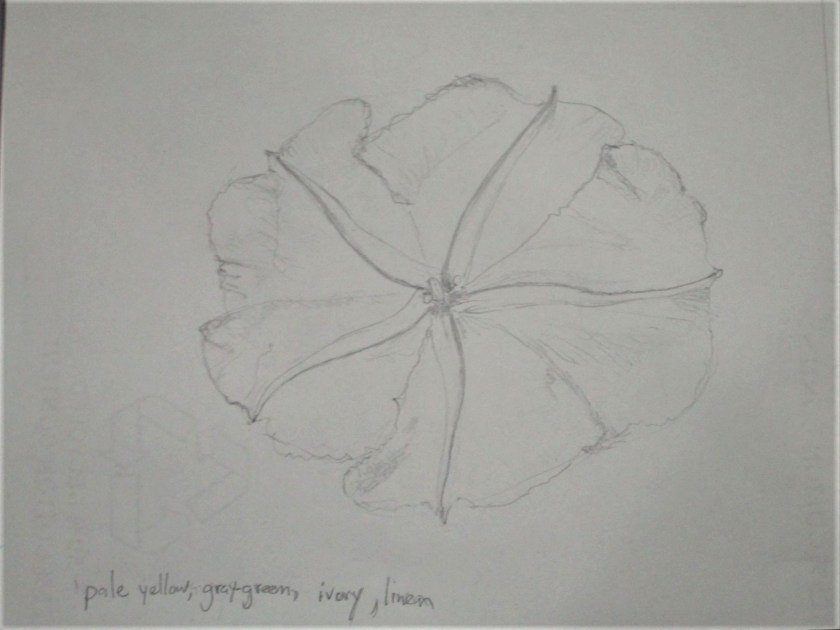
Here is a pencil sketch I made of my moonflower:

I plan to use white poplin for the flower, with fabric paint on the shaded areas and embroidery on the bright areas. Here are some green fabrics I have chosen for the background and the flower shape I will cut from the white poplin.

The next steps are to piece together and sew the background.

Background with paper template showing flower placement

Tomorrow I paint.

Posted in colorwork, hand embroidery, sewing

Haiku illustrated

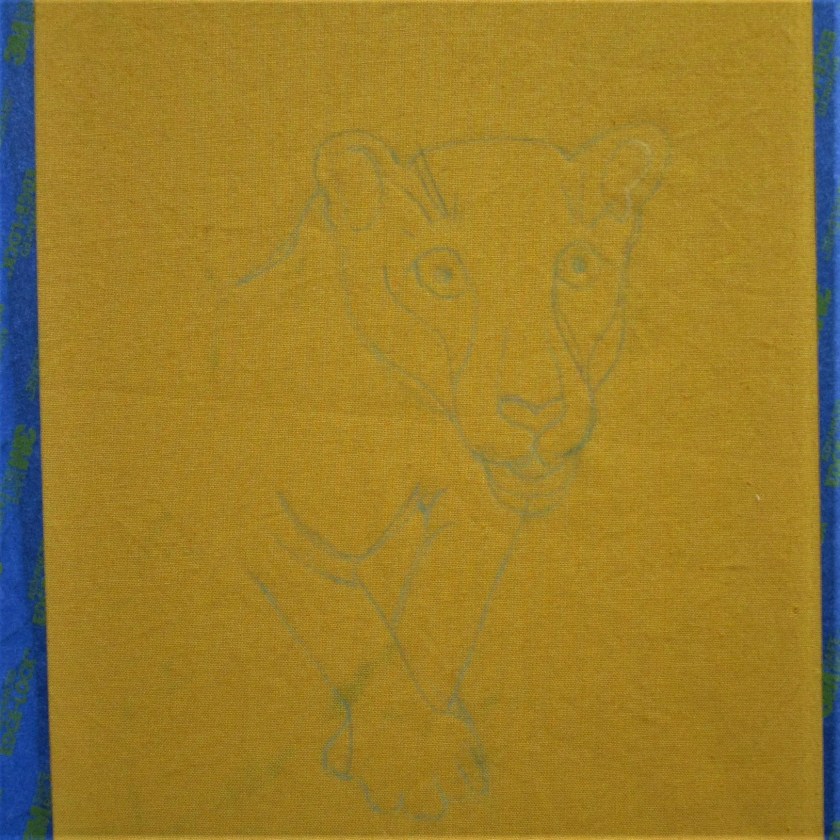
So here is what has happened since you last checked in with the haiku project. I have transferred the image of the jaguar to fabric.

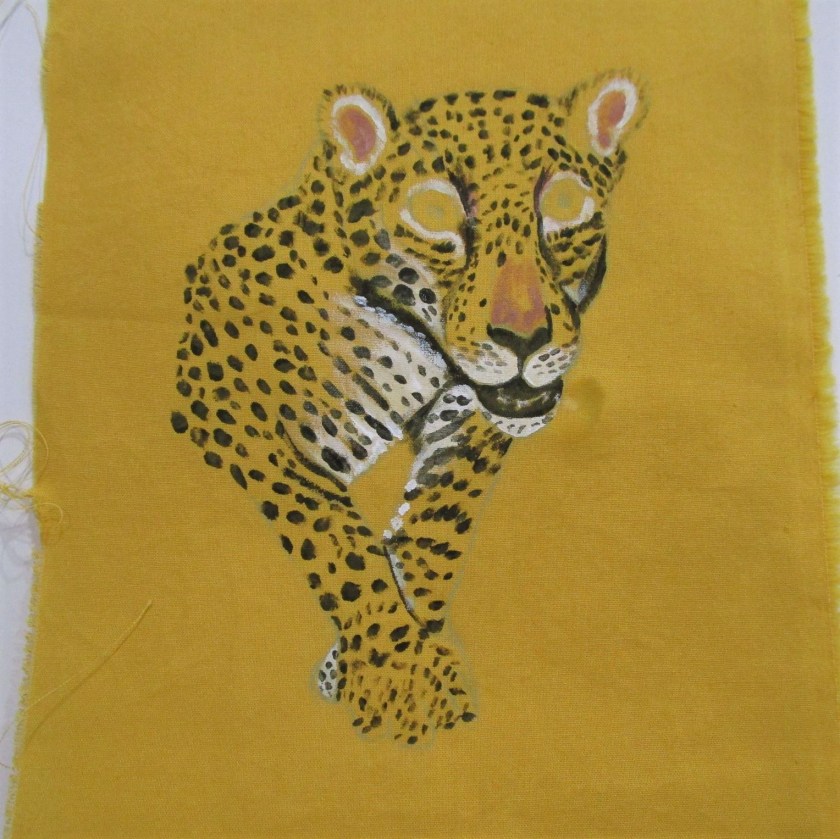
Using Jacquard Textile paint, I added the features and spots to this beast.

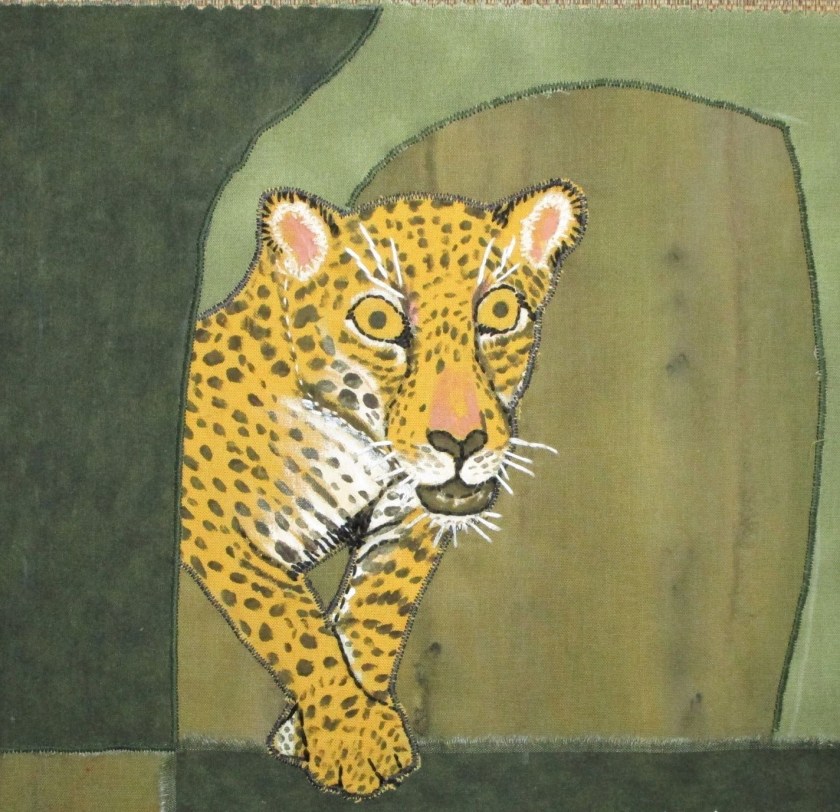
Next I hand embroidered the details, including eyes, ears, mouth, paws and whiskers.

Here are the fabrics I chose, in the general layout I wanted.

The next step was to embroider the haiku onto the dark green rectangle. It was important to me to replicate Henry’s handwriting as well as I could. I enlarged the original on the printer. Using chalked paper, I traced over the letters to mark them on the fabric. Then I embroidered the letters in white floss.

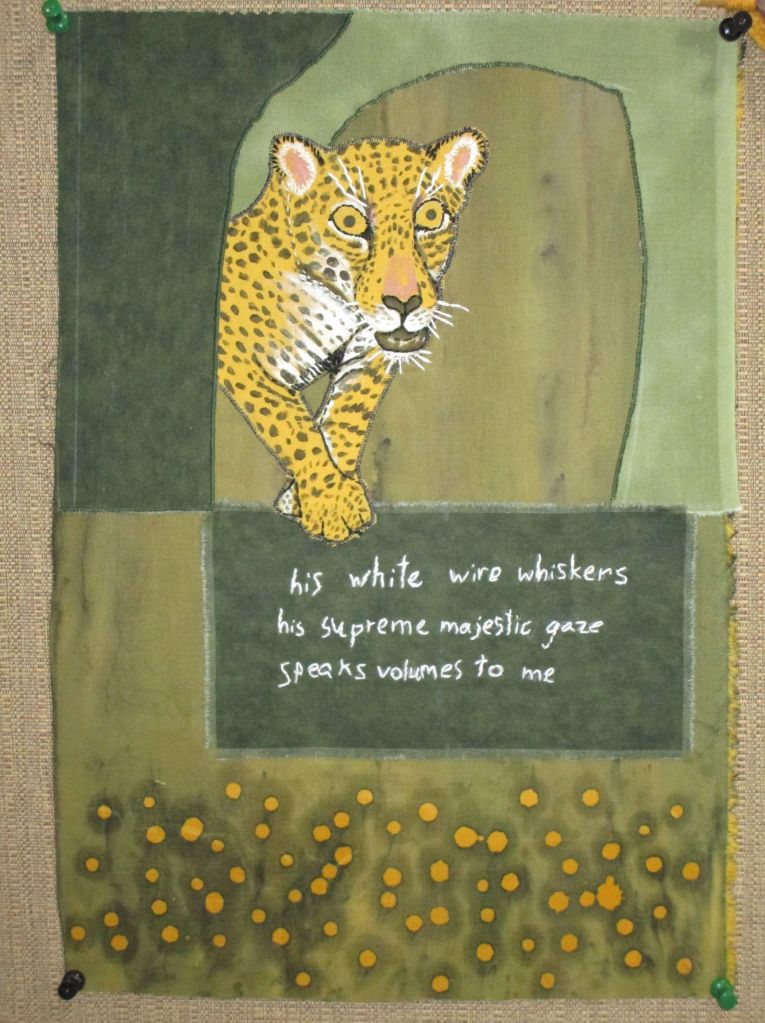
Finally I appliqued all of the pieces to the background fabric, machine-stitched around the raw edges, and embroidered the last few white whiskers on the cat. Here is the piece in its current state:

Henry’s Haiku

And here is a final close-up of the jaguar.

My original goal for this piece was to illustrate Henry’s poem, and to practice embroidering hand writing onto fabric. At the outset, I never expected to paint the fabric so much. But I’m glad I did it. I learned more about how to apply paint to fabric. And I ended up with a colorful and meaningful piece of fabric art.