One of six children, I was raised by a busy mom, who instilled in me a love of fabric. Though I learned to sew and knit at a young age, it was the arrival of my first grandchild that pushed me into action. A long-time knitter, I am now ready to explore all things fiber.
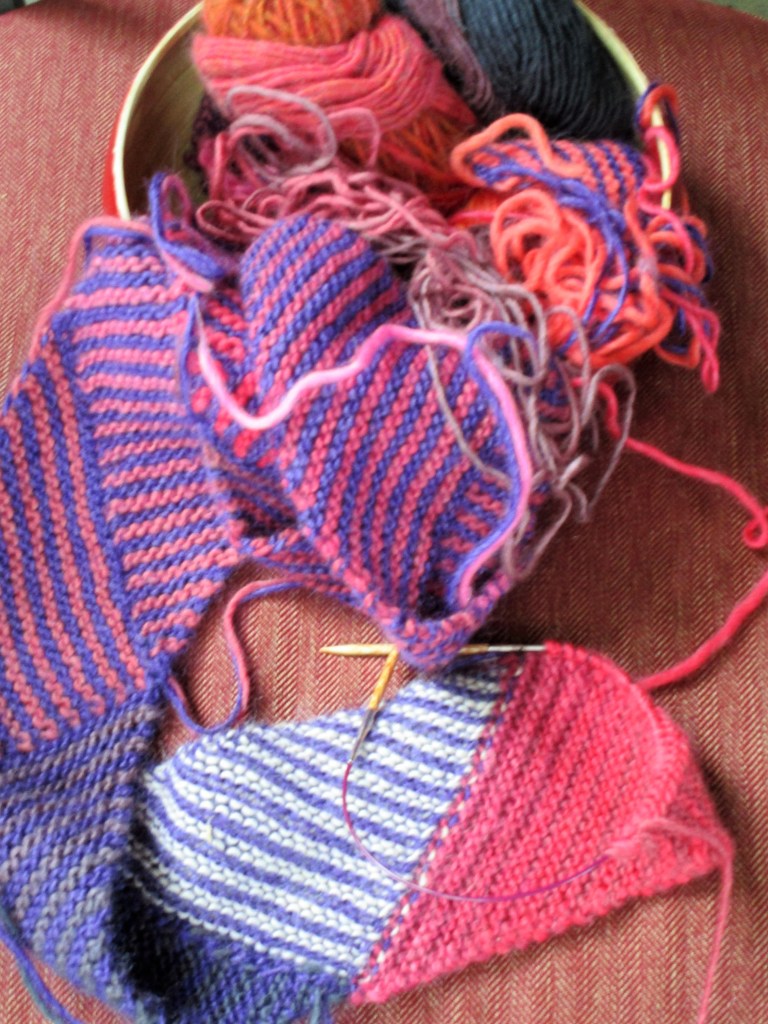
A few months ago, I wrote about my plan to assign unused yarns in my stash to potential knitting projects. Among those plastic bags hanging in the yarn closet were some UFOs (unfinished objects) including this one.
It had started life as a vest project, which involved knitting garter ridge triangles in strips, then sewing the strips together, adding shoulder seams, etc.
To make a long story short, I discarded that plan, partly because I really didn’t have enough yarn and didn’t want to buy more. Plan B involved making the strips longer and sewing them end-to-end to make a scarf.
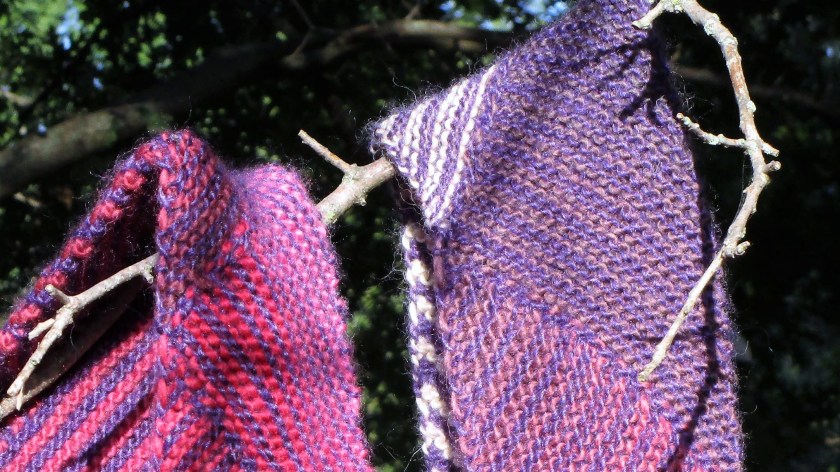
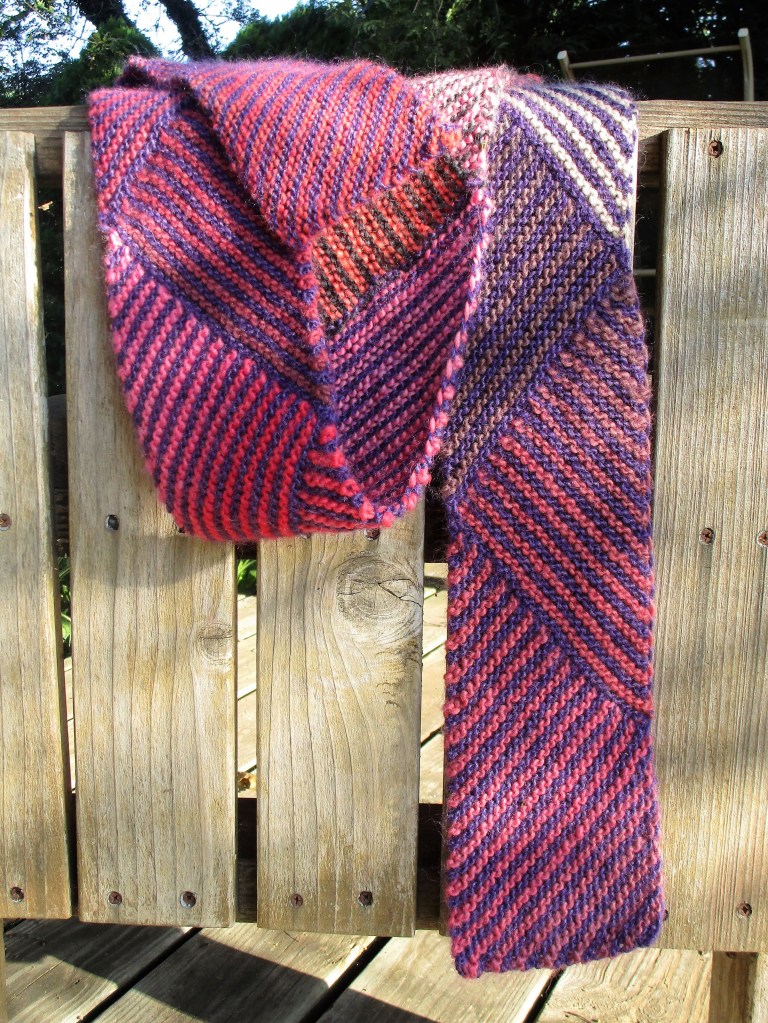
This scarf is today’s Friday Finish
I enjoyed working on this project. It was basic straight knitting and made a good mindless project. It’s easy to pick up stitches along the triangle’s edge – one stitch per garter ridge. And the color play is gratifying to watch.
The final project is about 54″ long and 5″ wide. There is almost no yarn leftover.
Presto! Another Stashbuster crosses the finish line!
More accurately, this is Watercolor Week. Our local art association is opening its annual art show and sale on Friday. In conjunction with this event, the association invited the judge, teaching artist Jan Brieschke, to give a three-day class.
Jan is teaching me and 10 other students how to compose and paint in the abstract style using watercolor and ink. Her work in this form of mixed media is stunning.
The first two days have been great fun. Jan is soft-spoken and low key. Her lessons on how to get an abstract composition started are inspired by four modernist painters:
We haven’t got to the Pollock yet (dripping and throwing paint at paper will be pretty darn exciting for a bunch of conservative Oklahomans!) Today I’m posting my work resulting from the first two days of class.
We started with Mondrian and geometric abstracts. Jan’s method was to have each student to suggest a shape. We then had to incorporate those suggestions into our initial drawings. Here is my work after drawing, inking the lines and painting washes.
To finish, we were asked to stipple our paintings using black Micron pens. I limited my stipples to the red circles, as you can see in this slightly wonky photograph.
The next technique involved the organic shape of a leaf. We started by making directional lines on our papers. Then we traced the leaf many times, overlapping the shapes in the direct of the lines. Color was added to the spaces made by the lines crossing. I chose to use warm colors on the leaf shapes, keeping the background in mixed shades of green.
Tomorrow I hope to finish by drawing more lines and some texture in black ink.
Our technique this morning involved soaking a string in one or two colors of paint, laying the wet string on a paper, covering the paper with another piece, and then pulling the string out while rotating it. I pulled two strings through mine, one twisted one straight. This is how it looks after the paper dried and I added a few twisty lines in a pale color of paint.
After studying the result for a while, I decided that I will crop it down, maybe like this.
Tomorrow is the last day of class. Hopefully I will finish my leaf and string paintings. And who knows what other crazy things Jan will show us using paint and ink.
At one point, I was interested in working with yarn that has a very long color transition. One summer, when Knitpicks has its yarn on sale, I picked up this skein of Stroll. The colorway is called Beach House – hard to resist! But when I started to knit it, I noticed that it was very thin and quite light. I put it back in the yarn closet while I had a good think about what it could become.
Flash forward to this year and the Summer of the Stash Bust. Way in the back of the fingering weight yarn cubbyhole, I came across the skein on the left. It is 100% alpaca lace weight in a warm white color. It is languishing, because I found it impossible to work with yarns that light. As I made my loops, they had the predilection to float right off of my needles. I grabbed this featherweight and decided to knit the alpaca and the Beach House Stroll held together as one strand.
Finding a garment that I can make using only the 450 yards of fingering weight is tricky. It should become a shawl, but I have way too many of those. So I came up with a pattern for a tiny, short-sleeved lace cardigan by Susanne Sommer.
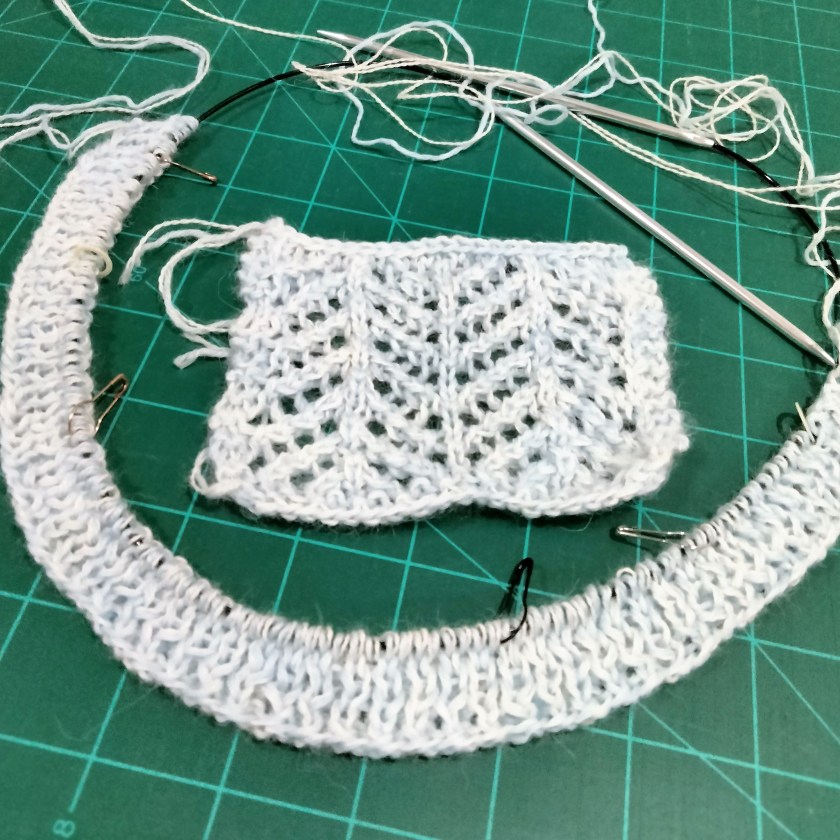
Here is my swatch and my cast-on. The pattern is worked top down.
Based on the swatch, I am thinking that I will have to add a few additional repeats of the lace to get the cardigan to fit. SO, a game of yarn chicken is afoot. (sigh.)
Gosh, this was a fun and easy project, once I got the hang of the 3-color slip stitch pattern. The yarns were great (Cascade Elysian) and blocked out beautifully. If only I had a five-year-old to test the fit and pose for the photo shoot.
A quick solution for a head mannequin: Grab an oatmeal box and draw a face on it. At least this solves for the photo shoot. Checking the fit will require plopping the piece on a real live child.
View from the side. I stuffed in a small ball of yarn to fill out the crown.
Looking at the back, you observe my slight alteration to the pattern: I noticed in the pattern’s photographs that the neck increases resulted in a slight flare.
To accentuate this feature, I switched from 1 by 1 ribbing to seed stitch just in this section. This will allow the back of the neck to fit easily over a collar.
Or, the flare could be tucked inside coat, to keep winter winds away from tender skin.
If you like the pattern, here is a link to Gretchen Tracey’s website.
She offers the balaclava in a baby size as well as dozens of other cute head coverings for kids. This pattern was free. I hope you’ll give her designs a try.
Today’s sketch may also be categorized as the 100 Day Project. I am again working with photographs by husband Bill. Having recently enjoyed spending time with loons while on the lake in Wisconsin, I gained more appreciation for the beauty of these birds. This photograph is a classic loon pose: neck held in a graceful S-curve, head and bill slightly raised. But what I’m interested in for this exercise is the graphic quality of those black and white feathers. I zoomed in on Bill’s picture to examine the feathers more closely.
I started my sketch by drawing strong lines to separate what I see as four quadrants of an abstract view. Using a micron fine tip pen, I drew in the white markings, making shapes with a lot of variety – just like I see them. Then I used a Stabilo permanent marker to fill in around all of the white dots.
I originally wanted to do this art piece in black and white only. But the solid-looking color of the neck suggested an opportunity to try out a water soluable graphite pencil. So, I did and used it again on the lower body.
In the end, I felt compelled to add a little bit of color, in the form of red ink and blue watercolor paint for the water and sky.
I took some liberties with a few red dots. They create some focal points, and echo the bird’s red eye, which remains unseen in my sketch.
My abstract loon was drawn on smooth paper in a 9 x 9 sketchbook.




 Daily Fiber